Traveling to the islands with a two- or three-year-old rewrites almost every assumption a household brings from a mainland vacation. The five- to six-hour West Coast leg, the two- to three-hour time change, and Hawaii’s ban on many mainland sunscreens all reshape the packing list, the flight choice, and the daily rhythm on the ground.
The good news for relocating families or first-time visitors: several beaches on Oahu, Maui, Kauai, and the Big Island are almost purpose-built for toddlers, with reef-sheltered water, waist-deep shelves, and shade options within walking distance of the sand. The harder news is that flight timing, car-seat logistics, and lodging choices punish improvisation. A two-hour scheduling error on Day 1 can wipe out the first two days of the trip.
This research pulls together data from the U.S. Census, the Hawaii Department of Health, the Bureau of Labor Statistics, and major rental car and airline operators to describe what families experience — beach by beach, flight by flight, and hour by hour.
How Hawaii with toddlers actually differs from an adult trip
Three structural facts shape every family itinerary. First, the flight from a West Coast gateway runs 5 hours 15 minutes to 6 hours 30 minutes each way, longer than most toddlers have ever been strapped into a seat.
Second, Hawaii runs on HST year-round with no daylight saving, so the winter time gap from the East Coast reaches 5 hours. Third, the sun is closer to overhead than at any latitude in the continental U.S., which raises UV index readings above 11 for much of the year.
The Census QuickFacts for Hawaii shows about 1.44 million residents across the main islands, most on Oahu. That density affects the practical toddler question: how far from a pediatric urgent-care clinic will the family be at any given hour? Oahu offers the shortest response times, followed by Maui and the Big Island, with Kauai the most rural.
The Hawaii Department of Health also flags several environmental risks that matter more for small children than for adults — leptospirosis in fresh water, jellyfish stings after a full moon plus 8 to 10 days on south shores, and reef cuts on lava rock. Toddlers reach the water first and think about it last, so parents plan around these hazards rather than reacting to them.
The calm-water beach map, island by island
Not every “beach” in Hawaii is toddler-appropriate. Many of the postcard shots — Waimea Bay in winter, Makena Beach’s shorebreak, Hanakapiai on Kauai — are dangerous even for strong adult swimmers. The list below focuses on beaches where the swimming zone is protected by reef, breakwater, or bathymetry, and where the sand entry is genuinely gentle.
| Island | Top toddler beach | Wave shelter | Facilities |
|---|---|---|---|
| Oahu | Ko Olina Lagoon 4 | Man-made rock breakwater | Restrooms, showers, lifeguards nearby |
| Maui | Kapalua Bay | Twin rock headlands | Restrooms, outdoor showers |
| Kauai | Baby Beach Poipu | Reef 40 feet offshore | Street parking, no facilities |
| Big Island | Kahaluu Beach Park | Reef ring at bay mouth | Restrooms, snorkel rentals, lifeguard |
| Maui #2 | Baby Beach Lahaina | Reef seawall | Limited street parking, no restrooms |
| Oahu #2 | Waikiki (Kuhio Beach) | Concrete groin walls | Full amenities, high crowds |
Oahu — Ko Olina and the leeward coast
The four man-made lagoons at Ko Olina, roughly 17 miles west of Honolulu’s HNL airport, function as controlled swimming pools with ocean water. Each lagoon is fringed by a rock breakwater, so wave action inside rarely exceeds ankle-height, and the sandy bottom slopes gently to about waist depth for adults. Lagoon 1 (Kohola) is the largest, Lagoon 4 (Ulua) is quieter and shadier.
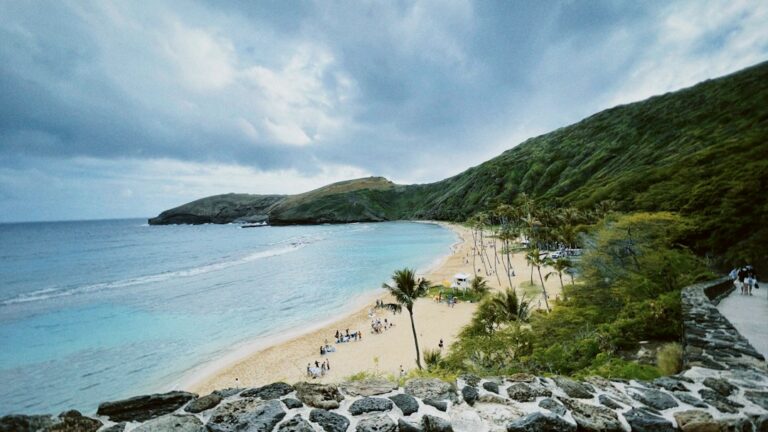
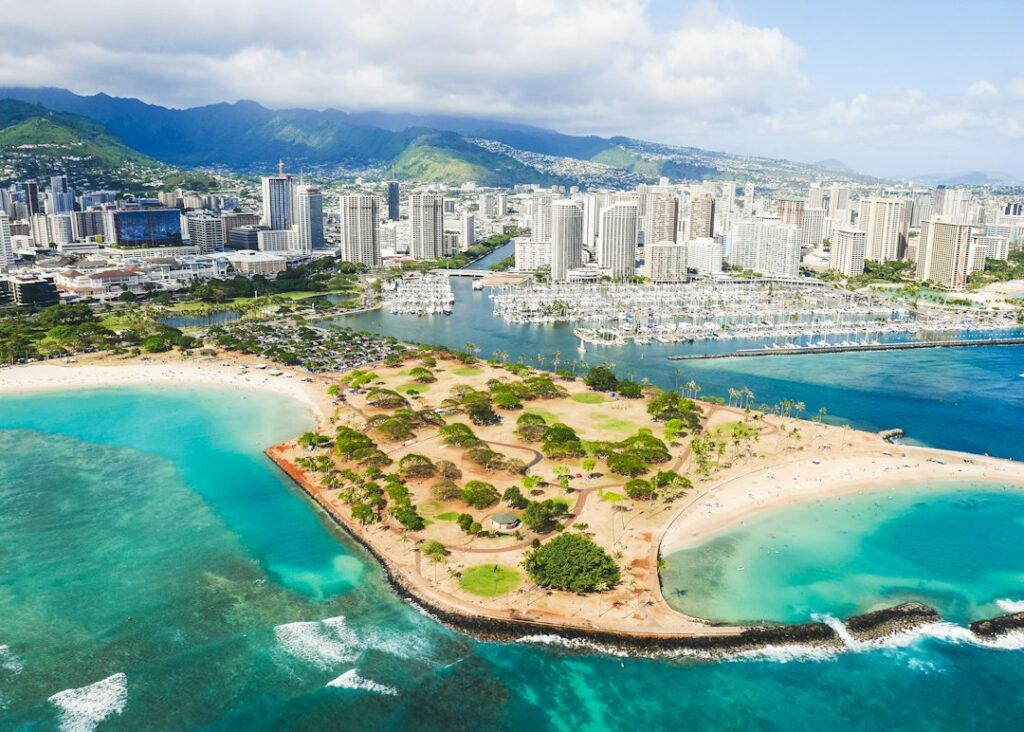
Waikiki Beach in front of the Duke Kahanamoku statue, sheltered by an offshore breakwater, is another calm option, but trade winds and cruise-ship wake make it less reliable than Ko Olina. For a snorkel-first alternative that older toddlers can wade into, families sometimes book Hanauma Bay through the 48-hour booking window and $25 entry system.
Parking at Ko Olina is metered at $10 per day for non-resort guests, with 200 public stalls that fill by 10:00 a.m. on weekends. Families day-tripping from Waikiki should leave by 8:15 a.m. to secure a spot at Lagoon 4, plus a picnic table under the palms.
Maui — Kapalua Bay and Baby Beach Lahaina
Kapalua Bay on West Maui sits between two low headlands that block the dominant northeast trade swell for most of the year. The sand shelf runs about 30 feet out before the reef starts. Full details on tides and reef entry timing are covered in the Kapalua Bay coral entry timing analysis.
Baby Beach Lahaina, a narrow strip north of Front Street, is protected by a reef seawall about 100 feet offshore that creates a wading pond at low and mid tide. It has no restrooms, no lifeguard, and thin shade, so families typically pair it with a morning stop before returning to their lodging for lunch and nap.
Kauai — Baby Beach Poipu
Baby Beach Poipu on Kauai’s south shore is sheltered by a shallow reef about 40 feet offshore, producing a knee-deep pool at most tides. Poipu also enjoys the driest weather on the island — about 30 inches of rain a year against 80+ inches on the north shore. Families targeting December through March generally choose south-shore lodging to escape the wet season.
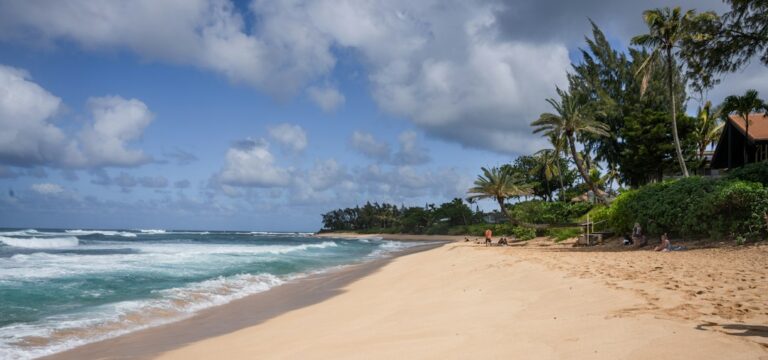
The tradeoff on the north shore is real. Winter swells routinely close beaches like Tunnels, where the surf cutoff and reef currents demand adult judgment, described in the Tunnels Reef winter surf and currents analysis. Families planning a Kauai trip in the wet months should also plan indoor and covered activities to avoid weather-driven stir-crazy afternoons in a cramped condo.
Poipu also hosts a colony of Hawaiian monk seals that regularly haul out on Baby Beach and adjacent Poipu Beach Park. State law requires humans to stay 50 feet from a resting seal, and volunteer NOAA stewards mark boundaries with cones. Toddlers who wander toward the seals need adult intervention — a running two-year-old is a federal violation waiting to happen.
Big Island — Kahaluu and Mauna Kea Beach
Kahaluu Beach Park on the Kona coast has a reef ring at the bay mouth that flattens waves inside to almost nothing. It is also a green sea turtle feeding ground; the county posts educational signage and volunteer stewards during peak hours. Water depth inside the bay rarely exceeds 4 feet, which suits toddler waders while parents keep older siblings in snorkel gear closer to the reef line.
Mauna Kea Beach at Kauna’oa Bay, on the northwest coast, offers a wide crescent of white sand with gentle year-round swimmable conditions except during rare south swells. Public parking is limited to 40 stalls per day, so families arrive before 9:30 a.m. The broader ranking of black-sand, green-sand, and family beaches is covered in the ranked Big Island beaches guide.
Red-eye vs daytime flights across the West Coast leg
The single biggest lever a family pulls is the outbound flight time. From LAX, SFO, SEA, or PDX, the westbound leg to HNL runs about 5 hours 30 minutes, and the return eastbound leg runs 4 hours 45 minutes to 5 hours 15 minutes with the jet stream. Neither leg is short. But the departure hour reshapes the first 48 hours of the trip.
A daytime departure — 8:00 a.m. Pacific arriving around 11:00 a.m. Hawaii time — lets a toddler nap on the plane during their normal nap window and lands the family with half a day of light left. The tradeoff is a very early wake-up on Day 1, often 4:30 or 5:00 a.m., which many toddlers refuse to sleep through even in a hotel.
A red-eye is the opposite bet. Most toddlers will not sleep straight through five hours in a plane seat, so parents arrive at 5:30 a.m. Hawaii time with a wide-awake, over-tired child and a rental car counter that opens at 6:00. For return flights, the red-eye becomes more workable because the child has been active all day.
Jet lag itself resolves faster in toddlers than adults — most children reset to Hawaii time within 48 hours. The dominant symptom is a 4:30 a.m. wake-up on nights 1 through 3, which cascades into a strong afternoon nap that lands on the beach schedule almost by accident.
| Departure pattern | Sample route | Arrival local time | Best for |
|---|---|---|---|
| Early morning outbound | LAX 8:00 a.m. → HNL 11:00 a.m. | 11:00 a.m. HST | Toddlers under 3 with reliable morning naps |
| Mid-morning outbound | SFO 9:30 a.m. → OGG 12:15 p.m. | 12:15 p.m. HST | Older toddlers, families skipping the nap |
| Afternoon outbound | SEA 12:00 p.m. → LIH 3:00 p.m. | 3:00 p.m. HST | Late check-in with dinner and bed |
| Overnight return | KOA 8:45 p.m. → LAX 5:30 a.m. | 5:30 a.m. Pacific | Return day after full afternoon at the beach |
| Daytime return | OGG 10:00 a.m. → SFO 6:30 p.m. | 6:30 p.m. Pacific | Toddler bedtime routine intact same night |
Return-day planning at Maui’s Kahului airport gets its own layer of logistics — timing the rental car return, the gas fill, and the shuttle. The specific sequencing is broken down in the Kahului red-eye rental return strategy. Cross-island itineraries add another layer of connection windows to plan around.
Fare pressure on the westbound leg follows predictable seasonal patterns. The Hawaii fare-drop windows analysis shows the September and early-May troughs delivering round-trip prices as low as $298 from West Coast gateways, roughly half the June-through-August peak.
Car seat logistics with the major rental agencies
Federal aviation rules allow — but do not require — a child under age 2 to fly as a lap infant. Once the family lands, the state of Hawaii requires a rear-facing or forward-facing seat for every child under 4, and a booster through age 9 (with height and weight exceptions). The FAA-approved seat that comes on the plane is legally usable in the rental car.
The three practical options are: bring the seat from home; rent from the car agency; or use a local baby-gear rental company that delivers to the hotel or airport. Each has cost and hassle tradeoffs.
| Option | Typical cost | Hassle level | Best fit |
|---|---|---|---|
| Bring seat from home (checked free) | $0 | Bulky at both airports | Families with a familiar seat and a stroller frame |
| Bring seat (gate check with bag) | $0 | Higher damage risk | Short trips, one adult per child |
| Rental car agency add-on | $13–$16 per day, $65 cap | Low — grab at counter | 7-day or shorter trips |
| Local baby-gear rental (delivery) | $45–$75 per week | None — delivered | Trips of 8+ days, multiple gear items |
| Purchase a cheap seat locally | $79–$120 at Target Honolulu | Storage or donation at end | Long stays or relocation trips |
Major agencies — Enterprise, Alamo, National, Hertz, Avis, Budget — all offer child seat rentals in Hawaii for roughly $13 to $16 per day with a weekly cap near $65. Reserving the seat online is safer than counter walk-up; the agencies do not always guarantee availability of the exact style requested, and swap-outs on arrival with a jet-lagged toddler are the definition of a poor start.
Local companies such as BabyQuip and Paradise Baby Company deliver seats along with cribs, high chairs, strollers, and beach gear directly to the condo or resort. The all-in weekly rate for a car seat plus a full-size crib plus a jogging stroller runs about $145 to $190. Delivery is free on Oahu and Maui within the main resort corridors and $25 to $40 on the Big Island and Kauai.
Condo-with-kitchen vs hotel — the early-bedtime math
The lodging decision for a toddler trip usually comes down to one question: where is the second adult at 7:30 p.m. after the child is asleep? In a hotel room, the answer is often “on the bathroom floor with a laptop.” In a one-bedroom condo, the answer is “in the living room with the door closed.”
That structural difference explains why families with children under 4 lean condo. The kitchen also matters. Grocery prices on the islands are 45% to 65% higher than the U.S. mainland average per the BLS Honolulu Consumer Price Index, but cooking two of three daily meals still beats resort dining for a family of four.
| Lodging type | 7-night sample cost | Kitchen | Adult evening space |
|---|---|---|---|
| Waikiki mid-range hotel | $1,890 ($270/night) | Mini-fridge only | Bathroom or lanai |
| Ko Olina resort hotel | $3,150 ($450/night) | Mini-fridge, coffee maker | Larger room, still one space |
| Ko Olina 1-BR condo | $2,660 ($380/night) | Full kitchen, dishwasher | Separate living room |
| Kihei 1-BR condo (Maui) | $1,925 ($275/night) | Full kitchen, washer/dryer | Separate living room, lanai |
| Poipu 2-BR condo (Kauai) | $2,730 ($390/night) | Full kitchen, dishwasher | Two separate spaces |
Add in-unit laundry and the math tips further. A three-hour beach day generates two full loads of sandy clothes, towels, and rash guards. A hotel launderette costs $6 to $9 per load; a condo washer runs on the resort’s flat utility charge. Detailed island-by-island grocery pricing is in the Hawaii grocery prices comparison by island.
Resort fees are the other line item to check. Many Waikiki and Ko Olina properties charge $35 to $55 per night on top of the room rate for pool, gym, and Wi-Fi access — amenities a condo typically bundles in the base price or through an HOA dues pass-through.
Stroller-friendly attractions and daily loops
Not every Hawaii attraction accommodates a stroller. Any beach with lava-rock entry, most waterfall trails, and the coastal path at South Point are impassable with wheels. But a solid list of paved, gentle-grade destinations exists on every island, and a good daily loop pairs one active morning stop with one indoor or shaded afternoon anchor.
On Oahu, the Honolulu Zoo, Waikiki Aquarium, Bishop Museum, and the paved beach walkway from Fort DeRussy through Kuhio Beach all handle standard strollers. The Ala Moana Center’s air-conditioned corridors give parents a nap-friendly walk during the hot 1:00-to-3:00 p.m. window. Diamond Head’s crater trail is not stroller-friendly, but the paved lookout at Puu Ualakaa State Park is.
On Maui, the Maui Ocean Center at Maalaea, the Kepaniwai Heritage Gardens, and the paved Wailea coastal boardwalk all work with wheels. The 30-mile Road to Hana does not — the switchbacks and roadside pull-outs make it a poor toddler day even if the driver has caffeine on standby.
Kauai’s stroller anchors include the Kilauea Point Wildlife Refuge, the paved section of the Kapaa coastal path, and the National Tropical Botanical Garden’s Allerton visitor center at Poipu. The Big Island’s most reliable options are the Hilo Farmers Market, Hawaii Volcanoes National Park’s paved crater rim segment near the visitor center, and Punaluu Black Sand Beach’s boardwalk.
Nap windows and the tropical afternoon
Hawaii sits between 18° and 22° N latitude. From April through September, solar noon peaks near overhead and afternoon temperatures on the leeward coasts routinely reach 87–90°F with UV index readings of 11 to 12. That combination is punishing for toddlers whose thermoregulation is not yet adult-grade.
Families who protect the 12:00-to-3:00 p.m. window with a condo lunch and a room-darkened nap consistently report longer trips without meltdowns than families who try to power through. The pattern most parents settle into looks like: beach 7:30 to 10:30 a.m., early lunch back at the condo, nap 12:00 to 2:30 p.m., pool or shaded park 3:30 to 5:30 p.m., dinner 5:45 p.m., bed 7:00 to 7:30 p.m.
The Hawaii time change actually helps westbound. A toddler who normally naps at 1:00 p.m. Pacific will naturally want to nap at 11:00 a.m. Hawaii time for the first two or three days, which lines up with the peak-UV window parents want to avoid anyway. Rebound wake-ups at 4:30 a.m. HST are the price paid; blackout curtains and a white-noise machine help.
Seasonal choice matters here too. The shoulder months of April, May, September, and early October deliver the mildest afternoon temperatures — 82°F highs versus 88°F in August — plus lower flight rates and thinner crowds at the calm-water beaches.
The toddler packing card
A packing list for a toddler beach trip differs from the adult version in three ways: more skin protection, more redundant clothing, and more feeding logistics for a child who eats every two hours. The list below assumes a 7-night trip in a condo with a washing machine.
Skin protection deserves its own note. Hawaii’s Act 104, effective January 1, 2021, bans over-the-counter sale of sunscreens containing oxybenzone or octinoxate. The full ingredient rules and enforcement details are covered in the Hawaii reef-safe sunscreen Act 104 explainer. Families should buy compliant SPF 50+ mineral formulas before the trip or on arrival at ABC Stores.
| Category | Item | Quantity per toddler |
|---|---|---|
| Sun | Reef-safe mineral SPF 50+ (zinc oxide) | 2 tubes (6 oz total) |
| Sun | Long-sleeve UPF 50+ rash guard | 3 |
| Sun | Wide-brim sun hat with chin strap | 2 |
| Sun | UV-block swim bottoms | 3 |
| Water | Reusable insulated water bottle | 1 (min 12 oz) |
| Feet | Toddler water shoes with heel strap | 1 pair |
| Feet | Regular sandals | 1 pair |
| Sleep | Portable blackout curtain (suction cup) | 1 |
| Sleep | White-noise machine (USB powered) | 1 |
| Sleep | Familiar lovey or blanket | 1–2 |
| Beach | Pop-up sun tent (SPF 50+) | 1 per family |
| Health | Children’s Tylenol, Benadryl, bandages | Small kit |
Water shoes solve a specific problem that catches families off guard: the entry rocks at Kapalua, Kahaluu, and Baby Beach Poipu can be sharp, and toddler feet do not tolerate lava rock. Selection guidance is in the Hawaii water shoes and lava-rock entry guide. For older toddlers ready to try a mask, adults should hold the child in ankle-deep water on the calmest days.
A realistic weekly budget for a family of four
Total costs vary sharply by island, season, and lodging type. The table below shows a mid-range 7-night trip for two adults and two toddlers, flying from LAX in shoulder season (May or September), staying in a one-bedroom condo, and eating two meals a day at the condo plus one out.
| Line item | Oahu (Ko Olina) | Maui (Kihei) | Kauai (Poipu) |
|---|---|---|---|
| Round-trip flights (2 adults + 1 seat) | $1,425 | $1,485 | $1,560 |
| 1-BR condo, 7 nights | $2,660 | $1,925 | $2,730 |
| Rental car with 2 car seats | $525 | $560 | $610 |
| Groceries (7 days) | $385 | $410 | $425 |
| Restaurants (7 dinners out) | $630 | $665 | $595 |
| Gas + parking | $85 | $105 | $95 |
| Activities (aquarium, luau, etc.) | $340 | $395 | $285 |
| Total | $6,050 | $5,545 | $6,300 |
The Kauai total runs higher on flights and lodging but the daily activities budget is smaller — the island has fewer paid attractions. Big Island totals typically land between Maui and Oahu, with lower lodging offset by longer drives and higher fuel costs. Current gasoline pricing tracked by the EIA weekly petroleum report puts Hawaii regular around $4.85 to $5.10 per gallon versus a national average near $3.20.
Electricity costs — relevant only if the trip stretches to a longer stay or relocation scouting — average about 42 cents per kWh statewide per the EIA Hawaii state electricity data, roughly triple the U.S. average. That figure matters for families evaluating whether a longer condo stay pencils out against a resort with utilities included.
Frequently asked questions
What age is easiest for a first Hawaii trip with a toddler?
Most family research points to ages 3 to 4 as the sweet spot: children can walk sand and shallow water independently, tolerate a 5-hour flight, and hold nap timing. Under age 2 is manageable with a condo and disciplined schedule; the 15-to-24-month window is often the hardest because mobility exceeds risk awareness.
Do airlines charge for a toddler using a car seat on board?
A child under age 2 can fly as a lap infant free on domestic itineraries, but families using an FAA-approved car seat must buy a separate ticket. From age 2 up, every passenger buys a seat regardless. Most airlines allow one car seat and one stroller checked free per child, even if the child is a lap infant.
Is a red-eye ever the right call with a toddler?
Rarely on the outbound; often on the return. Outbound red-eyes deliver a wired, sleep-deprived child at 5:30 a.m. HST with no room ready. Return red-eyes from KOA or OGG let the family use the full last afternoon at the beach and land in the Pacific time zone at breakfast, ready for a real bed by lunchtime.
Which island has the best pediatric urgent care access?
Oahu has the shortest ambulance and urgent-care response times, followed by Maui’s Wailuku corridor and the Big Island’s Kona and Hilo hospitals. Kauai has one full hospital, Wilcox Medical Center in Lihue, plus urgent care in Kapaa. Families with medically complex children generally choose Oahu or a resort within 20 minutes of Wailuku or Kona.
Can toddlers snorkel at the calm-water beaches?
Not really — snorkel masks are hard for a two- or three-year-old to seal, and face-in-water breathing is developmental. Older toddlers age 4+ can use a small mask in ankle-deep water at Kahaluu or Kapalua with an adult directly holding them. Full-face snorkel masks are not recommended for young children due to CO2 buildup concerns.
How dangerous are Hawaii’s waterfalls for small children?
Freshwater pools carry leptospirosis risk from wild pig and rat urine, and rocks are slick with algae. The Department of Health documents cases annually, and the exposure risk is explained in the leptospirosis waterfall trails guide. Most family research recommends skipping waterfall swims with toddlers entirely — the beach delivers similar wow-factor without the pathogen exposure.
Do rental car agencies actually have the car seats they promise?
Most of the time yes, but availability tightens on peak weekends and during major events like the Ironman World Championship in October. Booking the seat online with a confirmation number is safer than counter walk-up. Families with any doubt about availability should default to a local baby-gear rental company that guarantees delivery to the lodging.
What is one item most families forget to pack?
A portable blackout solution — either a suction-cup blackout curtain or heavy-duty painter’s tape with garbage bags. Hawaii sunrise runs 5:45 to 6:30 a.m. year-round with no daylight saving shift, and many condos have thin curtains sized for adult sleepers. Toddlers wake at first light, which erodes the afternoon nap and cascades into evening meltdowns.
How do families handle the time change on the return flight home?
The three-hour eastbound jump lands most West Coast families back at bedtime local, which usually goes smoothly. East Coast families face a five-hour jump and often build in a buffer day. Booking a daytime return with a mid-afternoon arrival on the mainland, followed by a normal bedtime, resets the schedule within about 72 hours.