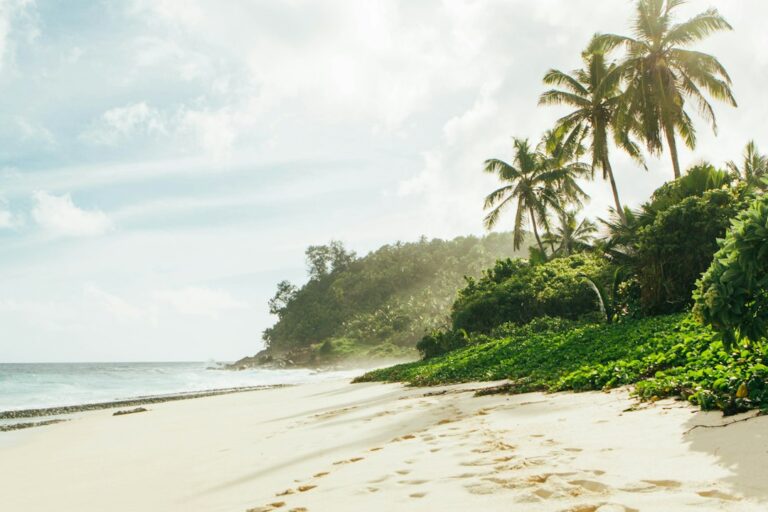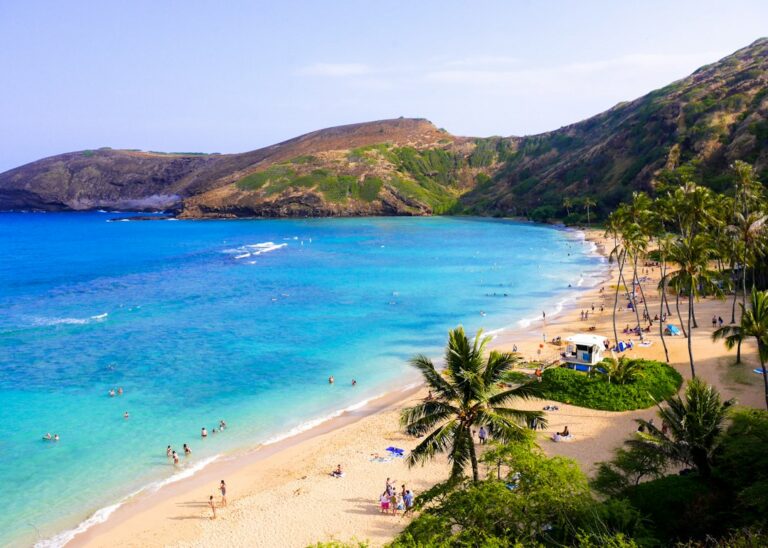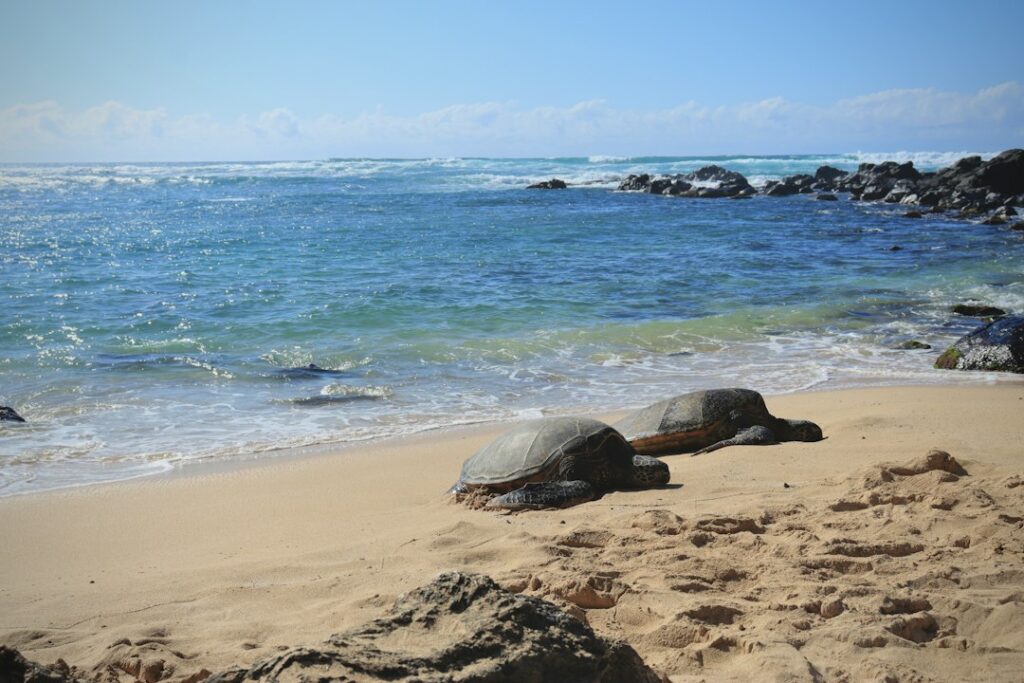
Punaluu Beach Park sits on the southern flank of Hawai’i Island in the Ka’u district, roughly 30 miles southwest of Hawai’i Volcanoes National Park and about 65 miles southeast of Kailua-Kona on Highway 11. The jet-black shoreline draws two very different visitor streams: geology travelers chasing the color contrast, and wildlife watchers hoping to see green sea turtles (honu) hauled out on the warm basalt sand.
Both groups arrive with the same question and often the wrong answer: how close is close enough. Hawaiʻi rules and federal Endangered Species Act protections require distance, not proximity, and the sharp basalt rubble underfoot is not the soft shoreline it looks like from the parking lot.
This guide covers the practical distance thresholds, the reason reef entry is discouraged, the overhead coconut palm hazard, and how to time a stop so the beach fits cleanly between a Volcano-side morning and a Kona-side sunset on the Belt Road.
Where Punaluu sits on the Belt Road
The Hawai’i Belt Road (state route HI-11) wraps the southern arc of the island between Hilo and Kailua-Kona, running through Volcano Village, Pahala, Naʻalehu, and Ocean View before climbing toward Captain Cook. Punaluu Beach Park lies about 5 miles northeast of Naʻalehu and is signed from the highway with a short paved access road down to the county lot.
Drivers coming from the east typically arrive within 40 to 55 minutes of leaving Kilauea’s summit area, depending on Pahala traffic. Westbound drivers heading toward Kona should budget 90 to 110 minutes for the remaining leg to Kailua-Kona, which passes through South Point turnoffs, macadamia country, and the long lava plains near Ocean View.
Because Punaluu falls almost exactly halfway between the volcano and the resort coast, it functions as the natural leg-stretch, restroom, and lunch stop on a single-day Belt Road traverse. Travelers pairing it with the Papakolea green sand hike or truck shuttle should note that Papakolea’s Kaʻalualu access sits another 20 miles south near South Point.
| From | Distance | Drive time | Fuel stops en route |
|---|---|---|---|
| Hawaiʻi Volcanoes NP entrance | 30 mi | 45 min | Volcano, Pahala |
| Hilo Airport | 60 mi | 75 min | Kea’au, Volcano |
| Kailua-Kona | 65 mi | 95 min | Naʻalehu, Ocean View |
| Kona International Airport | 72 mi | 105 min | Naʻalehu, Ocean View |
| South Point turnoff | 13 mi | 20 min | Naʻalehu |
The Belt Road here is two lanes with sporadic passing zones, and Hawai’i DOT road conditions are worth checking through the Hawai’i Department of Transportation before departure, especially during heavy Kona-side rain events or after seismic activity near the summit.
Why the sand is black
Punaluu’s sand is not the ash-fine black of Waiʻanapanapa on Maui or the freshly quenched grit of newly formed flows. It is basaltic sand of varying coarseness, with pebble and cobble zones near the water and finer grains higher on the berm. The color comes from rapid cooling of lava as it hit the sea centuries ago, shattering into dark fragments.
The grains are heavier than coral sand, retain heat aggressively in direct sun, and can reach surface temperatures north of 130°F on cloudless afternoons. This heat is one reason honu haul out here — the warm substrate helps regulate body temperature and may aid immune function after long feeding sessions.
Unlike the Kona coast, where white sand beaches often front protected bays, Punaluu is exposed to south-facing swell and delivers surf that breaks close to shore across basalt shelves. Casual comparisons with the ranked Big Island beach guide help set expectations: Punaluu is a viewing beach, not a swimming beach.
The 15 to 25 foot rule for basking honu
Green sea turtles (Chelonia mydas) are protected under both Hawaiʻi Administrative Rules and federal law. The state rule most often cited at Punaluu is HAR 13-124, which restricts harassment of protected indigenous wildlife and is enforced by the Department of Land and Natural Resources. NOAA Fisheries layers on federal Endangered Species Act protection for the species, including its Central North Pacific distinct population segment.
Signage at the beach and NOAA outreach materials converge on a minimum viewing distance of roughly 10 feet in water and 15 to 25 feet on land, with 25 feet treated as the safer default when a turtle is hauled out and resting. Some interpretive volunteers use the 3-car-length rule of thumb as an easy visual: about 20 to 25 feet.
HAR 13-124 in plain language
The Hawaiʻi rule prohibits pursuing, harassing, touching, or causing any change in behavior of indigenous wildlife. Practically, that means a turtle should not turn its head toward you, retract flippers, or lift itself from its resting posture in response to your presence. If it does, you are too close and must back off in slow steps until behavior normalizes.
NOAA ESA federal overlay
Under the Endangered Species Act, “take” includes harassment that meaningfully disrupts feeding, breeding, or sheltering. Civil penalties can reach $25,000 or more per violation, and criminal penalties are possible for willful takes. Rangers and volunteer honu watchers at Punaluu can and do document incidents, and Hawaiʻi Island Police can be called for repeat harassment.
Real enforcement and fines
Enforcement is uneven but not absent. DOCARE officers with the state issue citations at Punaluu periodically, and news coverage through outlets such as Hawaii News Now and the Honolulu Star-Advertiser has documented tourist fines in the four-figure range for touching or riding turtles at Hawaiian beaches. Assume that any close approach is being watched by someone with a phone camera.
| Situation | Minimum distance | Rule source | Typical penalty range |
|---|---|---|---|
| Honu basking on sand | 15–25 ft | HAR 13-124 + ESA | $500–$25,000 |
| Honu swimming or surfacing | 10 ft | NOAA guideline | $500–$25,000 |
| Monk seal on beach | 50 ft | MMPA + HAR 13-124 | Up to $50,000 |
| Nesting turtle at night | Do not approach | ESA “take” clause | Up to $50,000 |
| Hatchlings emerging | Do not approach | ESA “take” clause | Up to $50,000 |
Reading honu behavior
A resting turtle should look boring. Head down or slightly tucked, flippers relaxed against the sand, eyes half-closed, no obvious muscle tension. If breathing quickens, the head rises to scan, or a flipper repositions to face you, the animal is now aware and stressed. This is the moment to step back, not the moment to take one more photo.
Honu at Punaluu range from juveniles around 60 to 100 pounds to adults over 300 pounds. Adults may bask for hours, sometimes returning to the same section of beach day after day. Volunteer stewards from local nonprofits often rope off basking turtles with sand-colored cones and yellow tape — those cones mark the minimum boundary, not a photo line.
Occasional sightings of hawksbill turtles (honu ʻea) also occur, and hawksbills are far rarer and more strictly protected. Any turtle with a pointed beak-like face, overlapping shell scutes, and yellow-tan carapace pattern warrants extra caution and space.
Why the reef is off-limits here
Punaluu is not a snorkel beach in any conventional sense. The nearshore floor is broken basalt with pockets of sand, sharp-edged rubble, and cobble that shifts under wave energy. Cuts from basalt heal slowly and are prone to infection in warm salt water. Sea urchin (wana) spines lodge in the same rubble, and stepping on one can end a vacation quickly.
Water clarity is poor compared with the leeward Kona coast. South-facing swell drives sand and organic matter into suspension, and freshwater seeps from the Punaluu ponds and springs behind the beach lower visibility further. For clear-water turtle viewing, consider Kona-side alternatives referenced in the Keauhou and Kailua Pier manta ray comparison or Maui’s Ulua Reef cleaning cove.
Even strong swimmers should treat Punaluu as a surface-viewing beach. Currents wrap around the basalt point on the north end, and rip currents can pull toward open ocean during larger south swells. Hawai’i Fire Department has no permanent lifeguard tower at this park.
Sunscreen chemistry matters
If any water entry does happen, mineral-only sunscreen is required by state law under Act 104. The oxybenzone and octinoxate ban applies statewide, and Ka’u shorelines are among the most-cited stretches when advocates argue for stronger enforcement. Zinc oxide and titanium dioxide non-nano formulations remain compliant.
Coconut palm hazards overhead
Punaluu’s parking lot, picnic pavilions, and berm zone sit under a dense line of coconut palms. Mature Cocos nucifera at this beach reach heights of 40 to 70 feet, and mature nuts weigh 3 to 6 pounds each. A falling coconut from that height carries enough force to cause serious head injury or death; there are documented fatalities from coconut strikes in Pacific tropical regions.
Hawaiʻi County Parks periodically trims nut clusters at high-use beach parks, but visitors should not assume every tree overhead has been de-nutted. Local guidance is simple: do not park a rental car directly under a heavy nut cluster, and do not spread a picnic blanket directly beneath fruiting palms.
Look up before you sit down. The best picnic tables are those with clear sky above them or those shaded by non-fruiting trees such as heliotrope or milo. County contact information for park maintenance is available through Hawaiʻi County.
| Overhead risk | Height range | Object weight | Mitigation |
|---|---|---|---|
| Coconut palm nuts | 40–70 ft | 3–6 lb | Move 15+ ft from trunk |
| Dead palm fronds | 40–70 ft | 10–25 lb | Avoid brown-frond trees |
| Ironwood branches | 30–50 ft | Variable | Watch during trade wind gusts |
| Kiawe thorns underfoot | Ground | N/A | Closed-toe walking shoes |
Timing the stop between Kilauea and Kailua-Kona
The most common one-day itinerary pairs Hawaiʻi Volcanoes National Park with a Kona-side sunset. Punaluu works best as the midpoint transition — a place to switch from crater viewing shoes to beach flip-flops, refuel the driver, and stretch before the long Ocean View plateau leg.
Eastbound to Volcano
Visitors starting from Kailua-Kona and driving south should aim to leave by 7:30 to 8:30 a.m. to reach Punaluu around 9:00 to 10:00 a.m. Morning light on the black sand is flat but honu are often already hauled out from overnight or early-morning foraging. Plan 45 to 75 minutes at the beach, then continue northeast toward Volcano for a mid-afternoon arrival.
Westbound to Kailua-Kona
Coming from Volcano, plan a late-morning Kilauea walk followed by a 12:30 to 1:30 p.m. Punaluu arrival. Afternoon trade winds pick up between 2:00 and 4:00 p.m., which can make the picnic experience windier but often deepens turtle basking activity as the sand holds heat. Continuing west, sunset over the Kona coast falls between 5:45 p.m. (December) and 7:15 p.m. (June).
| Belt Road segment | Miles | Typical time | Best stop |
|---|---|---|---|
| Kilauea summit → Pahala | 22 | 30 min | Pahala fuel |
| Pahala → Punaluu turnoff | 8 | 12 min | Beach park |
| Punaluu → Naʻalehu | 5 | 10 min | Bakery lunch |
| Naʻalehu → Ocean View | 19 | 25 min | Last fuel |
| Ocean View → Captain Cook | 29 | 40 min | Coffee farm |
| Captain Cook → Kailua-Kona | 13 | 20 min | Waterfront |
Drivers extending the westbound leg with a Kona coffee farm tour should book the last afternoon slot no later than 3:30 p.m., which requires leaving Punaluu by roughly 1:45 p.m. Traffic on the descent into Kailua-Kona thickens after 4:00 p.m., especially on Fridays.
Facilities, parking, and amenities
Punaluu Beach Park is managed by Hawaiʻi County and includes a paved parking lot, restrooms with cold outdoor rinse showers, covered picnic pavilions, and grass lawn areas set back from the sand. Parking is free and typically fills between 10:30 a.m. and 2:00 p.m. on peak days. Tour buses use a separate turnout on the access road.
Restroom conditions vary; the beach sees heavy tour bus turnover, and midafternoon plumbing issues are not uncommon. There is no on-site food concession, though a shave ice truck occasionally parks at the entrance. The nearest reliable food is in Naʻalehu, 5 miles south, or Pahala, 8 miles north.
Cell service is spotty. Verizon and AT&T both drop to 1 to 2 bars in the parking lot, and streaming is unreliable. Download offline maps before leaving Volcano or Kona. For emergencies, 911 works even without a signal on most modern phones.
Costs to plan around
Access to the beach itself is free, but a Ka’u day still adds up. Rental car fuel across the 130-mile round trip runs 5 to 7 gallons; Hawaiʻi Island retail gasoline prices tracked by the U.S. Energy Information Administration generally sit $0.80 to $1.20 above the national average. A Naʻalehu Bakery malasada lunch for two typically runs $18 to $25. Kona-side dinner ranges from $60 to $140 for two.
- Parking: free at county lot
- Restrooms: free, no attendant
- Rinse showers: cold water only
- Pavilion reservations: available via Hawaiʻi County Parks
- Lifeguard: none stationed
What to bring and what to leave
The beach rewards a small, focused kit and punishes over-packers who plan to swim. Because reef entry is discouraged and turtle approach is bounded, the essentials are more about sun protection, foot protection, and hydration than snorkel gear.
- Closed-toe walking shoes or sturdy sandals with heel straps
- Mineral sunscreen (zinc or titanium, non-nano)
- Wide-brim hat and UV-blocking sunglasses
- 1 liter of water per person minimum
- Reusable microfiber towel that shakes clean of black sand
- Zoom lens or phone with 3x optical zoom for turtles
- Trash bag for pack-out
Leave at home or in the car: floaties, snorkel masks intended for reef use, drones (prohibited near wildlife under both HAR and FAA rules within national wildlife refuges and often locally restricted), speakers playing amplified music, and any rocks or sand you might be tempted to bring back. Removing sand from Hawaiʻi beaches is discouraged by state agencies and violates park rules at multiple sites.
The black sand at Punaluu is a finite geological feature. Even a cup taken home by each visitor would materially reduce the beach within a generation.
Cultural context and respect
Punaluu means “spring dived for” in Hawaiian, referring to freshwater springs that emerge below the tide line offshore. Ancient Hawaiians dove with gourds to collect the fresher water rising from the seabed. The site holds cultural significance well beyond its geology, and the surrounding Ka’u district is one of the more Native Hawaiian communities on the island.
Local families still fish here, gather limu, and hold events at the pavilions. Visitors should give right of way to local users, keep voice volume low around resting turtles, and avoid climbing on the heiau ruins visible at the north end of the beach. Photography of local ceremonies without permission is inappropriate.
Ka’u’s cultural landscape connects to broader shoreline governance discussed in the SMA setback and DLNR shoreline certification process, which shapes how close new development can approach beaches like this one.
Endangered species significance
Hawaiian green sea turtles were listed as threatened under the federal ESA in 1978 and were the subject of a 2016 status review that maintained protection for the Central North Pacific population. Population recovery has been measurable but uneven, and beach-level etiquette contributes directly to reproductive success. The Hawaiʻi Department of Health tracks water quality data that also affects hatchling survival.
Weather, swell, and seasonal patterns
Ka’u’s southern exposure means Punaluu catches south swells during the Southern Hemisphere winter (May through September), when wave faces can reach 6 to 10 feet. During Hawai’i winter (November through March), north-swell energy wraps around less directly and conditions on the sand are often calmer, though rainfall increases.
Air temperatures at sea level in Ka’u run 76°F to 84°F year-round, with humidity between 65 and 85 percent. Water temperatures range from 74°F in February to 80°F in September. Trade winds from the northeast average 10 to 20 mph and typically strengthen after 11:00 a.m.
| Month | Avg high (°F) | Rain (in) | Water temp (°F) | Swell direction |
|---|---|---|---|---|
| January | 78 | 4.2 | 75 | NNW wrap |
| April | 80 | 2.1 | 76 | Mixed |
| July | 84 | 1.4 | 79 | South |
| October | 82 | 2.8 | 80 | Mixed |
| December | 78 | 4.6 | 76 | NNW wrap |
Volcanic vog (volcanic smog) from Kilauea drifts southwest during Kona wind episodes and can settle at Punaluu, occasionally hazing views and irritating sensitive lungs. Vog advisories are issued through Honolulu Civil Beat reporting and state health channels.
How Punaluu compares with other black sand beaches
Punaluu is the most-visited black sand beach on the Big Island, but it is not the only one, and it has trade-offs against alternatives.
| Beach | Island | Access | Turtles | Swim |
|---|---|---|---|---|
| Punaluu | Big Island | Paved lot, 1 min walk | Frequent basking | Not recommended |
| Pololu Valley | Big Island | 0.6 mi hike down | Rare | Dangerous currents |
| Kehena | Big Island | Cliff scramble | Occasional | Advanced only |
| Waiʻanapanapa | Maui | Reservation required | Rare | Rough shore break |
| Kaimu (new) | Big Island | Walk across lava | None | No entry |
For travelers extending the Maui side of the trip, the Piilani Highway return loop passes Waiʻanapanapa, though that beach requires advance reservation. On Kauaʻi, no comparable black sand beach exists at scale, and honu viewing shifts to sites like Poipu.
Practical safety checklist
- Check surf forecast before leaving Volcano or Kona
- Fuel up in Naʻalehu or Pahala; no gas at the beach
- Do not park under fruiting coconut palms
- Maintain 15 to 25 feet from any basking honu
- Do not touch the sand rope-off zones
- Wear closed-toe shoes to cross the basalt berm
- Skip snorkel gear; the reef is not visitor-safe here
- Apply mineral sunscreen only
- Pack out all trash including cigarette butts
- Return to Belt Road with daylight to spare
Related Hawaiʻi planning topics
Households considering a longer Big Island stay or a full relocation often bundle a Punaluu day with cost research for the leeward coast, covered in the Kailua-Kona cost of living breakdown. Ka’u itself remains one of the more affordable districts on the island, though services are thinner and the drive to a major grocery store can exceed 45 minutes each way.
Statewide demographic and housing baselines from the U.S. Census QuickFacts page for Hawai’i help contextualize how Ka’u compares to state medians. The district population sits below 10,000 residents across a very large geographic area.
Frequently asked questions
Is Punaluu Beach open to the public year-round?
Yes, Punaluu Beach Park is a Hawaiʻi County public park open daily from sunrise to sunset with no entrance fee. Parking is first-come, first-served, and pavilions can be reserved for events through Hawaiʻi County Parks and Recreation. Storm closures are rare but possible during large south swells or heavy rain, so a quick call to county parks the morning of a visit is worthwhile.
How close can visitors legally get to a basking honu?
Hawaiʻi guidance and NOAA outreach recommend a minimum of 15 to 25 feet from basking green sea turtles on land, and 10 feet in water. HAR 13-124 prohibits any behavior that causes the animal to change its resting posture. If the turtle lifts its head, moves flippers defensively, or breathes rapidly, back away immediately in slow steps until behavior normalizes.
Can visitors swim or snorkel at Punaluu?
Swimming is legal but strongly discouraged. The nearshore floor is jagged basalt with poor visibility, no lifeguard station is present, and south-facing swells produce hazardous shore break during summer months. Wana urchins and sharp rock cuts are common injuries reported at Ka’u District parks. Serious snorkelers should drive north to Kealakekua Bay or Two Step in South Kona instead.
What is the biggest safety risk that most visitors overlook?
Falling coconuts from the 40 to 70 foot palms lining the parking lot and picnic area cause more documented injuries than turtle encounters. A mature coconut weighing 3 to 6 pounds falling from that height can cause skull fracture or worse. Never park a rental vehicle directly under a fruiting palm, and choose picnic tables with clear sky above them whenever possible.
How long should visitors plan to stay at Punaluu?
Most travelers spend 45 to 90 minutes at Punaluu, which is enough time to walk the beach, observe any basking turtles from a respectful distance, use restrooms, and eat a packed lunch. Photography enthusiasts and wildlife watchers may stretch to two hours. Longer stops are possible but rarely necessary given the limited swim value and the length of the Belt Road drive still ahead.
Are drones allowed over the beach?
Drone flights are strongly discouraged and effectively prohibited within 100 feet of protected wildlife under NOAA guidance, which covers basking honu at Punaluu. Even outside those zones, FAA rules restrict operation over crowds and require line-of-sight compliance. Rangers and volunteer stewards may confront drone operators, and citations have been issued at other Hawaiʻi beach parks for wildlife disturbance from drones.
Is there cell service and can rideshare be called from the beach?
Cell service ranges from 0 to 2 bars depending on carrier and weather, and streaming is unreliable. Uber and Lyft do not operate in the Ka’u district in practical terms; drivers rarely accept trips this far from Kona or Hilo. Travelers arriving without a rental car must arrange a tour van or private driver in advance. Download offline maps before the drive.
Can visitors take black sand home as a souvenir?
Removing sand, rocks, or coral from Hawaiʻi beaches is discouraged by state and county agencies and prohibited at many specific sites. Punaluu’s black sand is a finite geological feature that does not replenish quickly since the source lava flows are dormant. Buying sand-themed souvenirs from Naʻalehu or Kailua-Kona shops supports local businesses while leaving the beach intact for future travelers.