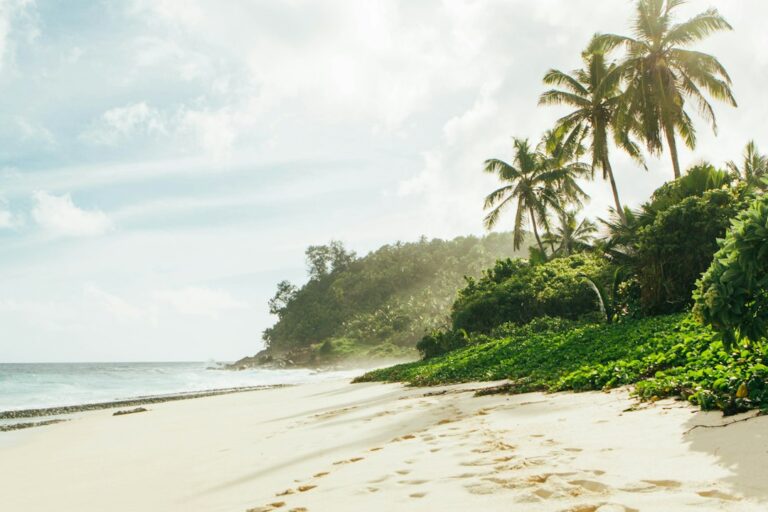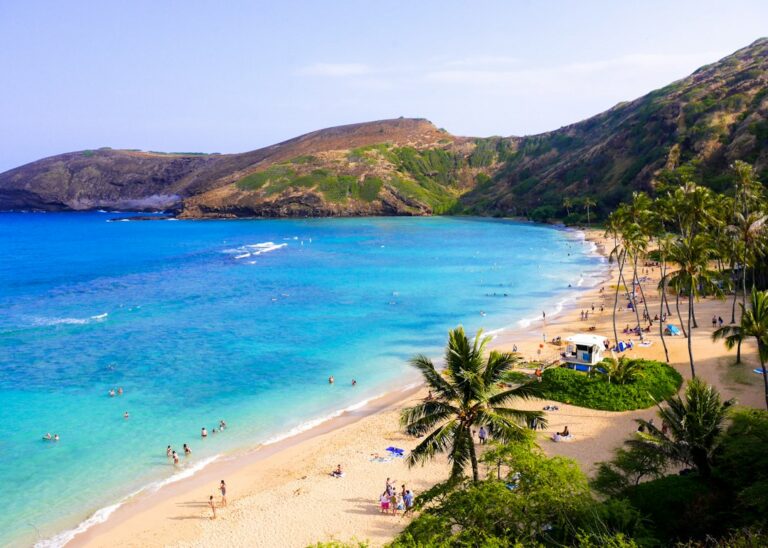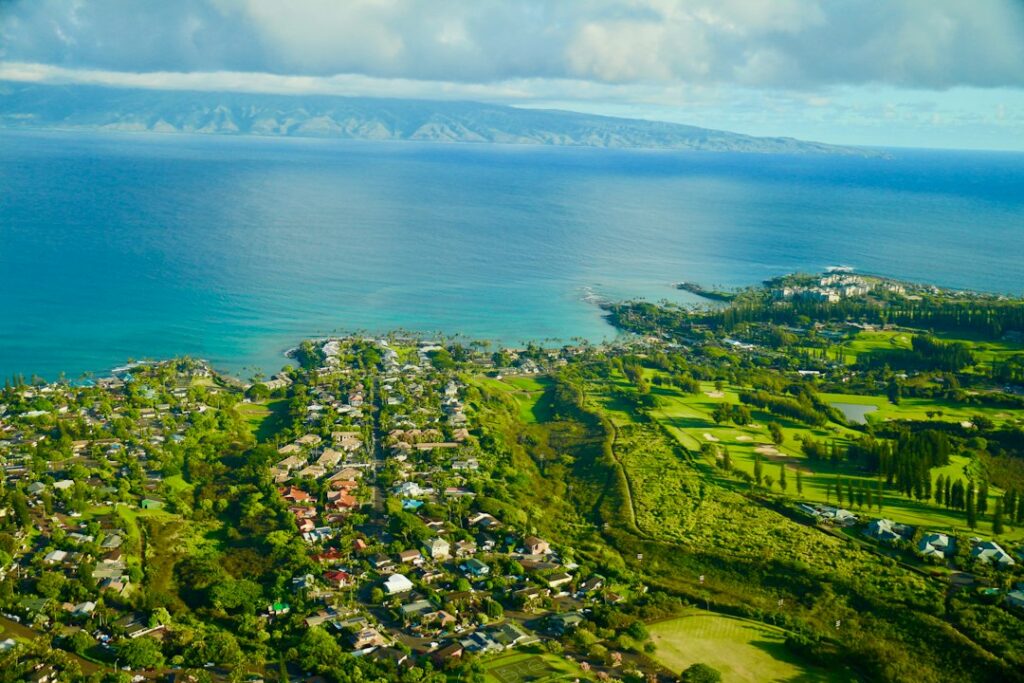
Kapalua Bay sits at the northern edge of West Maui’s resort strip, roughly 10 miles up the coast from Lahaina and about 40 minutes from Kahului airport by rental car. The crescent runs about 1,500 feet from headland to headland, protected on both sides by lava-rock points that flatten wind chop and keep the inner water unusually calm through most mornings.
The bay’s snorkel value comes from a fringing reef that hugs the north point in shallow water. Casual swimmers can float over live coral without a boat, a kayak, or a paid tour. Entry is a walk-in from soft sand, exit is the same, and the productive coral sits inside 10 feet of depth for most of the reef’s usable length.
What follows is a research-driven walkthrough for a household planning a snorkel morning at Kapalua: where to enter, how to time the swim before the trades pick up, where to park when the two small lots fill, which fish and turtles reliably show up on the reef, and how Hawaii’s Act 104 sunscreen ban shapes what a visitor may legally apply before wading in.
Why Kapalua Bay Rewards Walk-In Snorkelers
Kapalua sits inside a double-headland pocket that blocks the prevailing northeast trade winds far better than most West Maui beaches. Namalu Bay wraps the north point, Hawea Point pushes west, and the combined geometry keeps surface chop low during the trade season that dominates roughly April through October.
The bay is one of the few Maui reefs where a swimmer can float directly over living coral within 40 feet of dry sand. Compare that to Ulua Reef in Wailea, where reef structure sits farther offshore and demands a longer surface swim before the fish life becomes dense.
Water clarity at Kapalua commonly runs 30 to 60 feet of horizontal visibility during a clean summer morning, dropping to 10 or 15 feet after a south swell stirs sand or after heavy runoff from a winter storm. The reef itself is fringing, meaning it grows attached to the shoreline platform rather than rising from a deep offshore base.
The bay is also protected as a Marine Life Conservation District under Hawaii state rules, which prohibits spearfishing, gathering, and most take of marine life inside the posted boundaries. Enforcement is uneven, but the rule matters — reef fish density here noticeably exceeds unprotected beaches a few miles south, and green sea turtles use the bay as a resting cove.
What “fringing reef” means for a swimmer
A fringing reef grows out from the shore itself. There is no lagoon, no deep channel to cross, and the coral heads begin as shallow as 2 feet of water within a body length of the sand line. That geometry is friendlier for beginners than a barrier or patch reef, where the swim out can spook a nervous newcomer.
The trade-off is fragility. Fin kicks that would be harmless over sand can shatter coral heads at 3 feet of depth, and the bay’s north corner in particular has visible scarring from foot contact. Float, do not stand, once past the sand runway.
The North Corner Sand Entry
The correct entry is the far right (north) end of the crescent when facing the water. A narrow sand runway extends from the beach into shallow water for roughly 30 to 50 feet before coral heads begin. Walk in until knee-deep, put fins on while floating, then swim rather than wade the moment coral appears below.
The south end of the bay is a wider, sandier bathing area. It looks inviting but delivers a mostly barren swim — sand bottom, sparse coral, few fish. Snorkelers who start there often report the reef as a disappointment because they never crossed to the north corner where the structure actually lives.
Step-by-step entry sequence
- Approach the beach from the paved path beside the Merriman’s restaurant building.
- Walk north along the sand toward the low lava point.
- Enter the water on the sand runway, not on rock or coral.
- Float, then don fins in waist-deep water to avoid coral contact.
- Turn right (north) and follow the reef edge in 5 to 10 feet of depth.
- Return by the same route; do not exit onto the point’s rocks.
The reef edge runs roughly 300 to 400 feet along the north headland before dropping into deeper, less productive water. Most snorkelers cover the productive stretch in 30 to 50 minutes at a slow drift pace, which is enough to see the bay’s headline species without pushing endurance limits.
The Fringe Coral Layout and Where the Reef Sits
The bay’s reef is best pictured as a shallow shelf hugging the north point, with living coral concentrated on the outer edge of that shelf. Depths range from about 2 feet at the shoreline to 20 feet where the reef drops off. Most fish sightings happen in the 6-to-12-foot band along the outer edge.
Coral cover is a mix of lobe coral (Porites lobata), cauliflower coral (Pocillopora meandrina), and finger coral, with rice coral scattered on vertical faces. The 2015 and 2019 marine heatwaves bleached significant sections, and recovery has been partial — some heads show pale patches or algal overgrowth, while others have regained full color.
| Zone | Distance from sand | Depth | What a swimmer sees |
|---|---|---|---|
| Sand runway | 0–40 ft | 1–4 ft | Empty sand, sea cucumbers |
| Inner reef shelf | 40–120 ft | 4–8 ft | Tang schools, wrasses |
| Outer reef edge | 120–300 ft | 8–15 ft | Parrotfish, turtles, butterflyfish |
| Drop-off | 300+ ft | 15–25 ft | Larger jacks, occasional eagle rays |
| South bathing zone | Any distance | 2–20 ft | Sand bottom, minimal reef |
The state Division of Aquatic Resources and periodic Hawaii Department of Health water-quality reports have both flagged the West Maui shoreline for elevated turbidity after heavy rains, which reduces visibility for a day or two. A rainy overnight forecast is a reason to delay the snorkel by 24 hours.
Coral etiquette that matters
- Never stand on coral, even bleached or dead-looking heads.
- Keep fins horizontal and behind the body, not dropping downward.
- Give turtles at least 10 feet of clearance in the water.
- Do not chase or corner fish against reef walls.
- Skip gloves — they signal grabbing, which is prohibited.
Morning Glass-Off Timing and Trade Wind Cadence
West Maui trade winds follow a predictable daily rhythm during summer. Overnight land breezes flatten the surface, dawn arrives glassy, and the northeast trades typically build between 10 a.m. and noon. By early afternoon the outer bay carries whitecaps and the surface visibility from above deteriorates sharply.
The functional snorkel window at Kapalua is therefore roughly 7 a.m. to 10 a.m. Arrive by 7:30, be in the water by 8, and finish before the wind curls around Hawea Point. This same pattern shapes swim planning at many West Maui reefs, and it is discussed in more depth in the site’s broader Lahaina snorkeling roundup.
| Time window | Typical wind | Surface state | Snorkel rating |
|---|---|---|---|
| 6:30–8:00 a.m. | 0–5 mph | Glass to ripple | Excellent |
| 8:00–10:00 a.m. | 5–10 mph | Small ripple | Excellent |
| 10:00 a.m.–12 p.m. | 10–15 mph | Light chop | Good |
| 12–3:00 p.m. | 15–20 mph | Chop, whitecaps outside | Fair |
| 3:00–6:00 p.m. | 15–22 mph | Sustained chop | Poor |
Winter (November through March) inverts some of this pattern. Trades slacken, but north and northwest swells wrap around Molokai and can send unexpected surge into the bay’s north corner. Days with a National Weather Service high-surf advisory for west-facing shores are days to skip the reef swim entirely.
How to check conditions the night before
- Pull the marine forecast for Pailolo Channel from weather.gov.
- Look for wind below 15 mph and no small-craft advisory.
- Check the buoy at Pauwela Point for swell height and period.
- Confirm no flash-flood watch for West Maui uplands.
- Set alarms early enough to be parked by 7:30 a.m.
Water temperature at Kapalua ranges from about 75°F in February to 82°F in September. That upper end feels warm, but 75°F under a 10-mph breeze after a long snorkel gets cold faster than expected, and a rash guard or thin neoprene top pays for itself on a February morning.
Parking Reality — DT Fleming vs Kapalua Beach Lot
Kapalua Bay has a small dedicated public parking lot on Lower Honoapiilani Road with roughly 40 marked stalls. It is the closest option to the sand and the most convenient by a wide margin. It also fills, often before 8:30 a.m. on a summer weekend and by 9 a.m. on almost any weekday during peak season.
DT Fleming Beach Park sits about a mile north on Honoapiilani Highway and offers a larger county lot with restrooms, showers, and no time limit. From DT Fleming, snorkelers can drive back down to the Kapalua area or, more practically, take the free Kapalua Resort shuttle if it is running.
| Lot | Approx. stalls | Walk to Kapalua sand | Fill time (summer) | Cost |
|---|---|---|---|---|
| Kapalua Beach public lot | ~40 | 2–3 min | ~8:15 a.m. | Free |
| Napili roadside pull-offs | varies | 10–15 min | Rarely full | Free |
| DT Fleming Beach lot | ~120 | 25 min walk / 5 min drive | ~10 a.m. | Free |
| Ritz-Carlton valet | Guest priority | 10 min | Guests only | $20+ |
| Merriman’s validation | Small deck | 1 min | Diner priority | Purchase required |
The 40-stall Kapalua Bay lot is signed as public, but the surrounding roadside is heavily posted no-parking, and Maui Police do enforce with tow trucks during summer months. Do not park on the shoulder of Lower Honoapiilani Road; the fine plus tow release commonly runs $200 or more.
What the DT Fleming walk actually looks like
The pedestrian route from DT Fleming to Kapalua Bay is about 1.1 miles along a coastal path and hotel walkways. It takes 20 to 25 minutes at a normal pace, most of it shaded by ironwood trees. It is a reasonable Plan B, especially if the payoff is an unhurried snorkel window and a guaranteed spot for the vehicle.
Fish Species Divers Regularly Encounter
Kapalua’s reef supports the standard cast of Hawaiian shallow-water species, plus a few less-common visitors along the outer edge. The Marine Life Conservation District status keeps grazer populations high, which visibly affects algae cover on the reef flats.
Snorkelers should carry a laminated fish card or download an offline reference before the swim. The site’s broader Hawaii snorkeling guide covers the identification basics for the most common families. Knowing what to look for is half the enjoyment.
| Species | Hawaiian name | Sighting frequency | Typical depth |
|---|---|---|---|
| Yellow tang | Lau’ipala | Almost guaranteed | 3–15 ft |
| Manini (convict tang) | Manini | Very common, schools | 2–10 ft |
| Bullethead parrotfish | Uhu | Common | 6–20 ft |
| Saddle wrasse | Hinalea lauwili | Constant | 3–15 ft |
| Moorish idol | Kihikihi | Frequent | 5–20 ft |
| Green sea turtle | Honu | ~60% of mornings | 4–20 ft |
| Raccoon butterflyfish | Kikakapu | Common in pairs | 5–15 ft |
| Bluefin trevally | Omilu | Occasional | 10–25 ft |
| Whitemouth moray | Puhi-oniho | Occasional in crevices | 5–20 ft |
Yellow tang
Bright lemon yellow, about 6 inches long, and effectively the reef’s mascot. Groups of 5 to 15 graze algae off coral heads and rocks. They are approachable but not aggressive and tolerate a slow float above them without spooking. Populations across Hawaiian reefs have rebounded since the aquarium trade collar was tightened in 2020.
Parrotfish
Larger, blue-green individuals patrol the outer reef edge. Listen for a distinctive crunching sound underwater — that is parrotfish teeth biting coral for algae, an audible confirmation the species is present. A single adult parrotfish can produce hundreds of pounds of sand a year through this feeding process.
Green sea turtles
Honu use Kapalua Bay as a rest and grazing area. Sightings run roughly 60% of mornings by informal counts posted on snorkel forums, higher in summer and lower during heavy winter surf. Turtles are federally protected under the Endangered Species Act and by Hawaii state statute; the working rule is 10 feet minimum distance and no touching, ever.
Green Sea Turtles and Legal Distance Rules
Honu are the animal most visitors hope to see. They are also the animal most visitors accidentally harass. Hawaii state law and NOAA guidance both call for at least 10 feet of separation in the water and 20 feet on land, with no chasing, cornering, or blocking a turtle’s path to the surface for a breath.
Penalties for harassment under the federal Endangered Species Act can reach $25,000 per incident, and state citations under Hawaii Revised Statutes chapter 195D carry their own fines. Enforcement is periodic but real; volunteer monitors on Oahu and Maui do report violations to DLNR and NOAA.
The correct behavior when a turtle approaches on its own is to freeze, breathe normally through the snorkel, and let the animal choose the distance. Turtles at Kapalua often surface within a few feet of a still swimmer, then continue grazing without concern. Advancing on a turtle is what triggers the violation.
Turtle etiquette at Kapalua mirrors the guidance at other well-known basking and cleaning sites in the state, including the black-sand cove covered in the site’s Punalu’u basking guide. The distance rules are identical whether the turtle is in water or on sand.
Reef-Safe Sunscreen Under Act 104
Hawaii’s Act 104, passed in 2018 and effective January 1, 2021, bans the sale and distribution of sunscreens containing oxybenzone or octinoxate anywhere in the state. Maui County followed with a stricter local ordinance in 2022 that requires non-nano mineral sunscreens (zinc oxide or titanium dioxide) at all Maui County beaches.
The practical effect for a visitor at Kapalua is that any drugstore chemical sunscreen bought on the mainland is likely non-compliant on this beach. Enforcement at the sand is limited, but the point is ecological rather than punitive: oxybenzone concentrations as low as 62 parts per trillion have been shown in laboratory studies to damage coral larvae.
| Ingredient | Status in Hawaii | Status in Maui County |
|---|---|---|
| Oxybenzone | Banned | Banned |
| Octinoxate | Banned | Banned |
| Avobenzone | Allowed | Restricted at county beaches |
| Octocrylene | Allowed | Restricted at county beaches |
| Non-nano zinc oxide | Allowed | Allowed |
| Non-nano titanium dioxide | Allowed | Allowed |
Look for products labeled non-nano zinc oxide with particle size above 100 nanometers. Popular compliant brands include Stream2Sea, Little Hands Hawaii, Kokua Sun Care, and Raw Elements. Expect to pay $18 to $32 for a compliant 3-ounce tube, which is roughly double what a mainland chemical formula costs.
The full statute language, penalty structure, and county-level differences are laid out in the site’s dedicated Act 104 breakdown. Rash guards and long-sleeved swim shirts remain the single most effective sun protection and reduce the need for repeated application altogether.
Application timing that matters
- Apply mineral sunscreen 15 to 20 minutes before entering water.
- Reapply after every 60 to 80 minutes in the water.
- Cover ears, tops of feet, back of neck, and hands.
- Do not spray on the sand; overspray drifts into the water.
- Use rash guards or long sleeves to cut chemical load in half.
Mask, Fin, and Snorkel Rental Locations in Lahaina
The August 2023 wildfire destroyed much of historic Lahaina town, including a number of long-standing dive and snorkel shops on Front Street. Ongoing recovery has been reported extensively by Honolulu Civil Beat and the Star-Advertiser. Rental supply has partially relocated to the Kaanapali and Napili corridor north of the burn zone.
For a Kapalua morning, the closest active rentals are typically in Napili, Kahana, or Honokowai — a 5-to-12-minute drive from the bay. Prices as of 2026 run $9 to $15 per day for a mask-and-snorkel set, and $18 to $30 per day for a full mask-fin-snorkel package. Weekly rates are usually 3 to 4 times daily.
| Shop location | Drive to Kapalua | Daily mask + snorkel | Weekly package |
|---|---|---|---|
| Napili strip mall | ~5 min | $12 | $40 |
| Honokowai marketplace | ~10 min | $10 | $35 |
| Kaanapali resort concierge | ~12 min | $15 | $50 |
| Kahului airport-area shop | ~45 min | $9 | $28 |
| Costco Kahului (buy) | ~45 min | $35 purchase | N/A |
Rent or buy?
For a stay of 5 days or more with multiple planned snorkel outings, purchase usually wins on cost. A basic mask-snorkel set from Costco, Longs Drugs, or a Kahului sports retailer runs $28 to $45 and eliminates the daily pickup and return. Fins add $25 to $40. A three-week rental of a full set can easily exceed the purchase price of new equipment.
Rentals win for travelers with tight luggage or single-day plans. Prescription-lens rental masks are also available at most shops for a $5 to $10 premium and eliminate the problem of blurred underwater vision for anyone who wears glasses.
Safety, Currents, and When to Skip the Swim
Kapalua Bay is generally safer than most West Maui snorkel sites, but complacency is the main hazard. Drownings on Maui reef swims cluster around unfamiliar swimmers who overestimate their fitness or misread wind and swell. State health surveillance data published through the Hawaii Department of Health shows drowning remains a leading cause of visitor death, and snorkeling is over-represented among the incidents.
The bay’s specific hazards are a narrow current that runs along the outside of the north point during larger north swells, and surge that can push a swimmer into shallow coral if a big set arrives while they are near the drop-off. Neither is dangerous in normal summer conditions, but both matter on high-surf days.
When to cancel the snorkel
- High-surf advisory posted for west or north shores of Maui.
- Trade winds forecast above 20 mph for morning hours.
- Brown-water advisory posted after heavy rain.
- Snorkeler with cardiac history and no in-water experience.
- Any visible whitewater breaking on the north point.
Compare the north point exposure at Kapalua to the reef safety notes for other high-traffic west-facing swims like Tunnels Reef on Kauai. The pattern is consistent across the islands: fringing reefs that are calm all summer flip fast when a north swell arrives.
Snorkel dry-drowning and the “silent” event
Recent reporting by Hawaii News Now has covered a wave of research into full-face snorkel masks and unexplained snorkeler deaths, where rebreathing exhaled CO₂ inside a poorly ventilated mask appears to trigger unconsciousness in the water. The safest choice for a first-time or infrequent snorkeler is a traditional mask-and-J-tube setup, not a full-face design.
Getting There and Making a Morning of It
Kapalua is roughly 32 miles from Kahului airport by way of Honoapiilani Highway (Route 30). Google Maps commonly quotes 45 minutes but expect closer to 60 during morning commute traffic between Maalaea and Lahaina. State transportation planning for the Lahaina bypass is tracked by the Hawaii Department of Transportation.
An efficient morning: leave Kahului at 6 a.m., park by 7:15, gear up by 7:30, snorkel 7:45 to 9:15, rinse and change by 9:30. That schedule leaves plenty of time for a mid-morning coffee stop covered in the Maui coffee roundup and an early-lunch shave ice from the Ululani Shave Ice guide.
What to pack the night before
- Compliant non-nano zinc sunscreen and rash guard.
- Mask, snorkel, and fins (rented or owned).
- Two liters of water per person.
- Reef shoes for the rocky access at low tide.
- Dry bag for phone and keys during the swim.
- Towel and a spare set of dry clothes.
- Snacks — the resort restaurants open at 11 a.m.
How Kapalua Compares to Other Maui Snorkel Options
Kapalua is not the only walk-in reef on Maui, and the honest answer to “is it the best?” depends on skill level, wind direction on the day, and what species matter most. The bay’s strengths are calm water, easy entry, and reliable turtle sightings. Its weakness is that the reef is small — 30 minutes covers most of the productive area.
| Site | Entry difficulty | Reef size | Turtle likelihood | Wind protection |
|---|---|---|---|---|
| Kapalua Bay | Easy sand | Small | High | Excellent |
| Napili Bay | Easy sand | Very small | Very high | Excellent |
| Honolua Bay | Rocky, moderate | Large | Moderate | Good (summer) |
| Ulua Beach | Easy sand | Medium | High | Fair |
| Black Rock (Kaanapali) | Easy sand | Small vertical | Moderate | Fair |
| Ahihi-Kinau | Rocky, hard | Large | Moderate | Good |
Honolua Bay, about 2 miles north of Kapalua, offers a much larger reef but demands a rocky entry across sharp lava and is closed to snorkeling roughly half of every winter due to surf. Napili, immediately south, is smaller than Kapalua but has an even higher turtle count and comparable calm water.
A three-day snorkel plan for a West Maui trip might reasonably visit Kapalua on day one, Napili on day two, and Honolua on day three if summer swell allows. The site’s Lahaina snorkeling guide lays out that broader sequence in detail.
Frequently asked questions
Is Kapalua Bay free to visit?
Yes. The beach itself is public under Hawaii shoreline access law, and the small parking lot on Lower Honoapiilani Road is free of charge, though limited to about 40 stalls. There is no entry fee, no reservation requirement, and no lifeguard stationed at the bay. Bring cash only for optional rentals, food, or a resort-lot parking upgrade.
What is the best time of year to snorkel Kapalua Bay?
May through September delivers the most consistent conditions: warm water around 79 to 82°F, calm morning surface, and minimal north swell. Winter months from November through March bring larger north swells that can disrupt the bay two or three days a week. Summer visibility commonly runs 40 to 60 feet, versus 20 to 40 feet in winter.
Do I need to book a tour to snorkel Kapalua Bay?
No. Kapalua is a walk-in reef swim. Guided snorkel tours are available and cost roughly $80 to $150 per person, but they are unnecessary for the bay itself. Independent snorkelers with basic swimming ability, a mask, fins, and reef-safe sunscreen can access the full productive reef without any guide, boat, or paid instruction.
Are there sharks at Kapalua Bay?
Reef whitetip and blacktip sharks live throughout Hawaiian waters and occasionally pass through the bay, most often at dawn or dusk. Attacks on snorkelers at Kapalua are effectively unheard of. Statewide, shark incidents average roughly 8 to 10 per year across all Hawaiian shores, and the majority involve surfers rather than snorkelers in shallow reef water.
Can I touch the sea turtles at Kapalua Bay?
No, never. Green sea turtles are federally protected under the Endangered Species Act, and Hawaii state law bans touching, chasing, or feeding them. Maintain at least 10 feet of distance in water and 20 feet on sand. Fines for harassment can reach $25,000 at the federal level and additional penalties apply under Hawaii Revised Statutes chapter 195D.
Where can I rent snorkel gear near Kapalua?
The closest active rental shops are in Napili, Honokowai, and Kaanapali, roughly 5 to 12 minutes south by car. Daily mask-and-snorkel sets run $9 to $15, and weekly rentals of a full mask-fin-snorkel package cost $35 to $50. For stays of five days or more, buying gear at Costco Kahului is usually more economical than renting.
What sunscreen can I legally use at Kapalua Bay?
Under Hawaii Act 104 and stricter Maui County rules, only non-nano mineral sunscreens using zinc oxide or titanium dioxide are recommended at Maui County beaches. Chemical filters including oxybenzone, octinoxate, avobenzone, and octocrylene are restricted. Compliant brands sold locally include Stream2Sea, Little Hands Hawaii, and Kokua Sun Care, priced from about $18 to $32 for a 3-ounce tube.
How long should I plan to spend at Kapalua Bay?
Budget about 2.5 to 3 hours from parking to leaving. That covers 20 minutes of setup, a 45-to-60-minute snorkel across the productive reef, rinse and change time at the outdoor shower, and a short beach break. Arriving by 7:30 a.m. and leaving by 10:30 a.m. avoids the parking crush, the trade winds, and the afternoon UV peak.