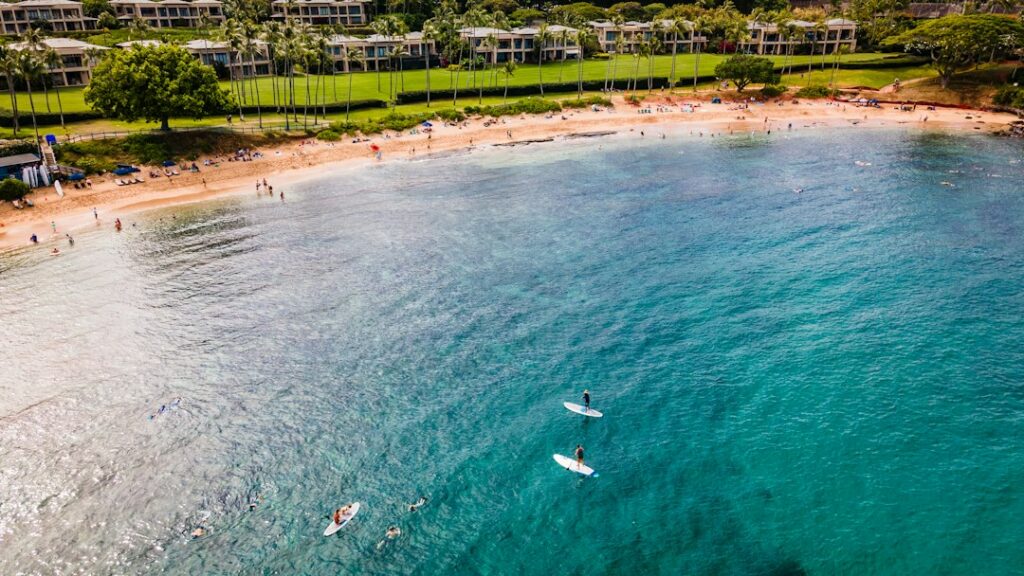
Puu Kekaa — the lava headland travelers know as Black Rock — sits at the northern hinge of Kaanapali Beach, roughly 3 miles up the coast from Lahaina town and about 30 miles west of Kahului airport. The site pulls two very different crowds each afternoon: reef snorkelers hunting green sea turtles along the shaded north wall, and sunset watchers gathering on the sand for the Sheraton’s nightly cliff dive rite that runs from about 4pm through sunset.
For mainland households scouting Maui as a relocation base, Black Rock is one of the easiest reef-and-culture combinations to reach. The Sheraton validates public parking with a minimum spend at its restaurants or shops, the sand entry is unusually forgiving compared to rocky Maui coves, and the reef itself functions as a working cleaning station where cleaner wrasses tend to honu at predictable depths of 8 to 20 feet.
This research guide breaks down the parking validation math, the safe entry point on the north side of the sand, the turtle cleaning behavior visible along the reef wall, the historical weight behind the sunset ceremony, and two packing cards — one for the rental car and one for a snorkel day pack — so a household visiting from the mainland can plan the afternoon end-to-end.
Puu Kekaa: Cultural Weight and the Cliff Dive Ceremony
Black Rock is not just a snorkel site. Native Hawaiian tradition holds Puu Kekaa as a leina a ka uhane — a “leaping place of souls” — where spirits of the recently deceased departed the physical world for the ancestral realm. That belief shapes how kupuna, cultural practitioners, and hotel staff frame the sunset ceremony that has run on the sand below the promontory since the 1960s.
The rite reenacts a 1790s feat attributed to Kahekili II, Maui’s last independent ruling chief, who is said to have proved his courage by leaping from Puu Kekaa in full view of his warriors. The Sheraton, which opened on the site in 1963, began staging a nightly torch-lighting and cliff dive shortly after as a tribute to that history. The ceremony has continued for more than 60 years with only brief pauses.
What the 4pm-to-Sunset Rite Looks Like Now
The pageant unfolds in two phases. Beachfront pre-events — lei-making, hula performances, and pu (conch) blowing — typically begin between 4pm and 5pm depending on season and the sunset table. The torch-lighting procession up Puu Kekaa follows in the final 10 to 15 minutes before official sunset, and the diver leaps as the sun touches the horizon.
A cliff diver — often a Sheraton employee trained on the specific 35-foot ledge — carries a lit torch across the rock face, lights a sequence of tiki torches, and finishes with a leap into the water below Puu Kekaa. The dive itself lasts under a minute. Timing follows the sunset table rather than the clock, so the exact start moves by roughly two hours across the calendar year.
Sunset on Maui varies through the year: about 5:52pm in mid-December, 6:35pm in mid-March, 7:15pm in mid-June, and 6:35pm in mid-September. That puts the leap in a window of roughly 5:35pm to 7:15pm depending on the month, with pre-event pageantry starting an hour or more earlier. Snorkelers should be out of the water and off the reef corner well before then.
Locating Black Rock on the Kaanapali Coast
Kaanapali is the resort strip on West Maui between Lahaina and Kapalua. Puu Kekaa divides Kaanapali Beach into two lobes: the longer south stretch fronting the Marriott, Westin, Whalers Village, and Hyatt, and the shorter Kaanapali Kai section running north of the rock toward the Sheraton’s frontage and the residential end of the strip. Most snorkelers stage from the Sheraton side because the entry sand sits within 40 yards of the reef.
Beach Walk Approach From the South
Guests staying farther south often prefer to walk the beach path rather than fight for parking. The paved Kaanapali beach walk runs about 3 miles between Hanakaoo Beach Park and Kahekili Beach at the north end. From Whalers Village to Black Rock is a flat 0.6-mile walk on hardpack sand plus paved sections. Fifteen minutes at an easy pace gets a swimmer with fins and a mesh bag to the entry point.
Households comparing the whole snorkel corridor may want to also read the airport-end write-up on Kahekili Beach on the airport end of Kaanapali, which sits about 0.8 mile north of Puu Kekaa and offers a very different, coral-forward reef. The two spots are commonly paired on the same afternoon.
Sheraton Public Parking and Validation Logistics
The Sheraton Maui operates a public parking lot at 2605 Kaanapali Parkway. It is one of only two easy public-lot options for the north half of Kaanapali; the other is the Kahekili Beach Park lot up the coast. The Sheraton lot holds roughly 100 stalls dedicated to non-guest use, and it fills fastest between 2pm and 5pm on weekends when snorkelers stack up with sunset-ceremony arrivals.
Validation Threshold and Vendors
The resort validates the flat public-parking fee for visitors who spend a minimum at on-property food and beverage outlets — commonly the Cliff Dive Grill, the pool bar, or the beachfront restaurant. Validation policies at Kaanapali resorts shift seasonally, so the current numbers should be confirmed at the concierge on arrival. As a rough range, non-validated day-parking on the Kaanapali strip runs $20 to $45, and a validated visit brings that down to $0 to $15.
The Cliff Dive Grill in particular is a common stop for snorkelers who want to earn validation and stay on-site through the ceremony. A shared appetizer plate plus a drink for two adults generally clears the validation threshold with room to spare, and the patio angle also offers a side profile of the torch procession.
Overflow Options When the Lot Fills
| Lot | Approx. stalls | Distance to Black Rock | Rate (2026 range) |
|---|---|---|---|
| Sheraton public lot | ~100 | 3-minute walk | $20-$45 unvalidated |
| Kahekili Beach Park | ~80 free | 0.8-mile beach walk | Free |
| Whalers Village garage | ~500 | 0.6-mile beach walk | $8-$25 validated |
| Hanakaoo Beach Park | ~40 free | 1.5-mile beach walk | Free |
| Kapalua overflow | Varies | 4-mile drive back | Free at some lots |
Kahekili Beach Park is the strongest free backup. The lot is small but turns over steadily, and the sand walk south to Black Rock takes about 20 minutes with gear. Whalers Village is a paid garage but its restaurant and shop validations often outperform the Sheraton’s for non-guests who want a longer meal window.
The Safe Sand Entry Point
Black Rock has a reputation for being safer than other Maui reef spots because the entry does not require walking over sharp lava. A sand chute cuts through the reef immediately north of the promontory, giving swimmers a clear path from dry sand into 3 to 6 feet of water without touching coral. That chute — locally called the “keyhole” — is the single most important location fact for first-time snorkelers here.
Locating the North-Side Sand Chute
Standing on the beach looking at Puu Kekaa, walk about 30 yards to the right (north) of the rock’s tallest visible point. Look for a corridor of pale, empty sand extending straight into the water — no dark reef mottling breaks it. That is the entry. Walk in until the water is thigh-deep, sit down, don fins, and swim out along the reef wall to the left toward the rock’s north face.
Reef Wall Route to the Cleaning Station
Once in the water, most snorkelers hug the north wall of Puu Kekaa moving south-southwest, keeping the rock about 15 to 25 feet off the left shoulder. The wall drops from about 8 feet at the shoreline to 30 feet at the tip. The cleaning-station alcove sits roughly two-thirds of the way toward the point, where the wall bends inward. Time from entry to the alcove is 4 to 6 minutes at an easy fin pace.
What Happens if the Sand Chute Is Crowded
On busy sunset-ceremony evenings the chute can back up. A secondary entry sits about 60 yards farther north where the sand extends unbroken into water clear of the coral shelf. It is a slightly longer swim to reach the cleaning station — roughly 8 minutes — but the trade-off is a calmer entry with less kicked-up sand around the swimmer.
The North-Side Turtle Cleaning Station
Puu Kekaa’s north wall functions as a natural cleaning station for Hawaiian green sea turtles, known locally as honu. Honu arrive on their own schedule to hover motionless over exposed coral heads while endemic cleaner wrasses and surgeonfish nibble algae, dead skin, and parasites from their shells and flippers. The activity is most reliable in the morning between 8am and 11am and in the late afternoon between 3pm and 5pm.
Adult green sea turtles at Black Rock typically measure 3 to 4 feet across the carapace and can weigh 200 to 350 pounds. They are protected under the federal Endangered Species Act and Hawaii state marine wildlife rules. Approach distances matter: state and NOAA guidance asks snorkelers to keep at least 10 feet away and to avoid positioning themselves between a turtle and its exit route to open water.
Cleaner Fish Behavior Snorkelers Actually See
The dominant cleaners at Puu Kekaa are Hawaiian cleaner wrasses (Labroides phthirophagus), an endemic species. They perform a distinctive vertical bobbing dance to signal availability, and larger fish and turtles pause above the coral head to accept service. Watching the interaction from 12 to 15 feet away without kicking sand into the alcove is the closest thing to guaranteed turtle time on West Maui.
Turtle Etiquette Households Should Rehearse
- Maintain a 10-foot buffer at all times, per NOAA and DLNR guidance.
- Never touch a honu; touching is a federal offense with fines starting at $500.
- Do not chase a swimming turtle; drift and let the animal pass.
- Avoid flash photography; strobes disorient turtles in dim reef light.
- Give surfacing turtles a clear vertical channel to the air.
- Never feed marine wildlife; feeding disrupts natural cleaning behavior.
Compared with the shallow lagoon at Maluaka’s Turtle Town on the south shore, Black Rock’s cleaning station is deeper and more current-exposed, but sightings are just as reliable. Households cataloging Maui turtle spots often add the ladder cove at Ulua Reef in Wailea and the kayak-friendly cove at Makena Landing to build a full south-Maui contrast set.
Time-of-Day Strategy: The 4pm Water Window
The single most effective plan for a household visiting Black Rock is to enter the water no later than 3:30pm, snorkel the north wall and cleaning alcove for 60 to 75 minutes, and exit before the cliff dive ceremony begins. That window aligns snorkelers with the late-afternoon turtle service peak, gives the sun enough angle to light the reef wall, and clears the water before divers begin their torch procession above the alcove.
Dusk Snorkel Constraints
Snorkeling within 30 minutes of sunset carries specific risks that mainland visitors often underestimate. Light drops fast in the tropics, glare on the surface hides swimmers from paddlers, and predatory fish — including small reef sharks — become more active at dusk. Reef corners like Puu Kekaa also see a wind shift between 5pm and 6pm on many trade-wind days, kicking up chop that can reduce visibility from 50 feet to 20 feet within minutes.
Sunset Ceremony Viewing Locations
| Viewing spot | Vantage | Crowd density | Trade-off |
|---|---|---|---|
| Sand directly below Puu Kekaa | Straight-up angle | Heavy after 5pm | Best photos, no seat |
| Sheraton Cliff Dive Grill patio | Side profile | Reservation only | Seated, food/drink |
| Beach walk 60 yards north | Silhouette angle | Light | Farther from action |
| Water off north wall | From below | Cleared by staff | Not permitted after 5pm |
| Whalers Village boardwalk | Distant profile | Moderate | Combined with dinner |
Households planning a whole afternoon at Kaanapali sometimes pair the Black Rock snorkel with a whale-watch after sunset from a Lahaina harbor departure. The peak of the North Pacific humpback migration is documented in the Kaanapali humpback migration guide, which covers the January to March window when whales are visible from the same stretch of beach.
Water Conditions, Visibility, and Seasonal Swells
West Maui sits in the lee of the West Maui Mountains, which knock down the trade winds and make Kaanapali one of the calmer snorkeling coasts on the island for much of the year. Summer south swells and winter north swells still influence the water at Puu Kekaa, but the effect at Black Rock’s north face is muted by its position on the northwest corner of the leeward zone.
Monthly Water Temperature and Visibility
| Month | Water temp (°F) | Typical visibility (ft) | Dominant swell |
|---|---|---|---|
| January | 75 | 40-60 | North |
| February | 74 | 35-55 | North |
| March | 74 | 40-60 | North |
| April | 75 | 50-70 | Transitional |
| May | 76 | 50-70 | Light south |
| June | 78 | 50-80 | South |
| July | 79 | 50-80 | South |
| August | 80 | 50-70 | South |
| September | 80 | 50-70 | Transitional |
| October | 79 | 45-65 | Early north |
| November | 77 | 40-60 | North |
| December | 76 | 35-55 | North |
The two lowest-visibility windows tend to be late February and mid-December, when back-to-back north swells push whitewater into the reef zone. Households planning around ocean-safety and health advisories can check current conditions at the Hawaii Department of Health portal, which posts brown-water and bacterial notices that occasionally close West Maui beaches after heavy rain.
Air Quality and Vog Considerations
Volcanic gases from Kilauea on the Big Island are the main air-quality wildcard for West Maui. Vog reaches Maui roughly 20 to 40 days per year depending on trade-wind patterns, and it reduces underwater visibility slightly by dimming ambient light. The state’s air-quality monitoring network publishes daily readings that households can check the morning of a planned snorkel.
Rental Car Packing Card
Kahului Airport is the primary rental hub for Maui. From the airport lot to the Sheraton at Kaanapali is about 32 miles via Highway 380 and Highway 30, a drive of 55 to 75 minutes depending on Lahaina traffic. Fuel and vehicle logistics matter because West Maui has limited gas stations after Lahaina, so the round-trip fuel plan should account for a Lahaina fill-up on the way out or back.
Vehicle Kit for a Kaanapali Snorkel Day
- Full tank leaving Kahului; plan a Lahaina top-up if renting a compact SUV.
- Two 32-oz insulated water bottles per adult, frozen overnight.
- Beach towels rated for salt water rather than hotel-branded terry.
- Cooler with ice for post-snorkel food; rental cars often lack shade.
- Sun-shade windshield reflector; interiors reach 140°F in Lahaina lots.
- Physical driver’s license for validation at some vendors.
- Cash for beach-park parking machines that reject foreign chip cards.
- Reef-safe sunscreen sealed in a zip bag against melt.
- Trash bag for wet gear on the return drive.
Fuel pricing on Maui typically runs $0.60 to $1.10 higher per gallon than the U.S. mainland average, and prices are tracked in the EIA weekly retail gasoline report which breaks out the Pacific region. Households mapping a longer Hawaii road-trip fuel plan can also compare Oahu’s leeward stops in the Waianae Farrington Highway fuel-point sequence guide.
Rental Car Cost Snapshot
| Vehicle class | Peak week rate | Shoulder week rate | Est. fuel per Kaanapali day |
|---|---|---|---|
| Compact sedan | $85-$115/day | $55-$75/day | $8-$12 |
| Mid-size SUV | $110-$160/day | $75-$100/day | $14-$20 |
| Full-size SUV | $140-$210/day | $95-$135/day | $18-$28 |
| Convertible | $130-$220/day | $90-$150/day | $10-$16 |
| Minivan (family) | $120-$180/day | $85-$120/day | $14-$22 |
Snorkel Gear Packing Card
Rental gear on Maui is easy to find but not always sized correctly, and shop mask selection is heaviest in generic adult sizes. Households traveling with children, small-face adults, or prescription needs should pack from home. A properly fitted mask that seals under a light suck-test on land is worth more at the reef than any equipment feature.
Personal Gear Checklist
- Silicone-skirt mask fitted at home; test seal with a breath check.
- Dry-top snorkel with purge valve for chop off the north point.
- Open-heel fins with 3mm neoprene booties for the sand-chute entry.
- Rash guard rated UPF 50 for sun protection during long swims.
- Reef-safe sunscreen using non-nano zinc oxide, per Hawaii law.
- Mesh gear bag for wet fins and mask on the beach walk out.
- Wrist-worn dive watch or waterproof phone case for time tracking.
- Whistle and inflatable safety sausage for open-water swims past the point.
- Anti-fog drops or baby-shampoo pretreatment for the mask lens.
Reef-Safe Sunscreen Law
Hawaii’s Act 104 banned the sale of sunscreens containing oxybenzone and octinoxate statewide beginning January 1, 2021, and Maui County added octocrylene and avobenzone to its restricted list under a separate 2022 ordinance. Snorkelers arriving with mainland-formula sunscreen should replace it with a non-nano zinc oxide product before the first swim. Local pharmacies and grocery stores in Lahaina and Kahului stock compliant options.
Rental Alternatives
| Rental source | Full-set daily rate | Full-set weekly rate | Notes |
|---|---|---|---|
| Beach hut kiosks | $18-$25 | $85-$120 | Limited sizes; walk-up |
| Snorkel shops (Lahaina) | $12-$18 | $55-$85 | Better fit selection |
| Resort activity desk | $25-$40 | $140-$220 | Convenience premium |
| Big-box store purchase | N/A | $40-$90 (own it) | Cheapest for 5+ days |
| Prescription mask (mail) | N/A | $70-$150 (own it) | Order two weeks ahead |
Health, Safety, and Reef Etiquette
Kaanapali’s calmer surface can lull mainland visitors into skipping precautions that Maui lifeguards see cause the majority of ocean-safety incidents. The West Maui coast averages 30 to 40 ocean-related rescues per month during peak season, and reef-corner sites like Black Rock account for a disproportionate share because currents wrap around the point on ebbing tides.
Reading the Puu Kekaa Current
Water on the north side of Puu Kekaa moves in a predictable pattern most days. The dominant flow runs south-to-north along the reef wall, meaning a snorkeler swimming out from the sand chute drifts naturally toward the tip. Returning against that current takes noticeably more effort. Snorkelers who feel themselves pulled around the point should exit north to Kahekili Beach rather than fight the current back to the entry chute.
What to Do If a Cliff Dive Is About to Start
The Sheraton posts a beach attendant near the base of the rock 30 to 45 minutes before the ceremony, and staff clear the water beneath the ledge starting 15 to 20 minutes ahead. Snorkelers in the alcove will hear a whistle; the response is to swim slowly back toward the sand chute along the reef wall rather than surfacing at the tip.
General Ocean Safety at Kaanapali
- Always snorkel with a buddy who can visually confirm surface breathing.
- Enter no later than 90 minutes before sunset in fall and winter.
- Check the county’s brown-water advisory list on the state health portal.
- Do not stand on coral; even dead-looking coral hosts living tissue.
- Wear fluorescent-colored fins or a bright rash guard for boat visibility.
- Cell service works along the entire beach; save 911 in advance.
Comparable turtle-and-current safety guidance for other Hawaiian shorelines is covered in the Hookipa Point turtle etiquette article for windward Maui and the Punaluu Black Sand basking distance guide for the Big Island. Households building a broader West Maui snorkel plan may also want the wider Lahaina snorkeling overview that catalogs additional cove options between Kaanapali and Olowalu.
Practical Planning for a Relocating Household
Mainland households scouting West Maui as a base often pair a Black Rock afternoon with property-look drives up Honoapiilani Highway between Kaanapali and Kapalua. Traffic and parking at Kaanapali are informative test cases for what daily life would feel like in the resort strip. Roads and coastal parking policy are administered by the Hawaii Department of Transportation and county agencies, whose current guidance sits at the HIDOT portal.
Cost-of-Living Signals a Snorkel Day Reveals
A Kaanapali snorkel afternoon exposes several living-cost realities that show up on official statistics. Honolulu-area consumer prices — used as the state benchmark by the Bureau of Labor Statistics — run 20 to 30 percent above the national urban average in recent readings from the Honolulu CPI release. Restaurant meals in Lahaina, parking on the resort strip, and rental gear premiums track that gap almost exactly.
Household Utility Preview
Electricity on Maui is expensive and worth checking before any relocation commitment. Residential rates averaged about 43 to 48 cents per kilowatt-hour in recent reporting — roughly three times the U.S. average — according to the Hawaii state electricity profile. A household running one central AC unit at Kaanapali sea level would see summer bills of $350 to $600 per month at those rates.
Frequently asked questions
Is snorkeling at Black Rock free for non-hotel guests?
Yes. Beach access below the high-water mark is public in Hawaii, and Puu Kekaa’s north-side entry sand is unrestricted. The Sheraton’s beach frontage cannot be closed to public snorkelers. What is not free is parking; the Sheraton public lot charges a flat rate that can be reduced or waived through validation at on-property food and shop vendors on the same visit.
What time does the cliff dive ceremony start each night?
The rite is timed to sunset rather than a fixed clock hour, and the torch procession begins 10 to 15 minutes before the sun drops below the horizon. That puts the ceremony window between roughly 5:35pm in mid-December and 7:15pm in mid-June. The Sheraton’s front desk posts the exact start time each morning based on the sunset table.
How likely are snorkelers to see a sea turtle at the cleaning station?
Sightings are highly reliable but not guaranteed. Data from Maui dive and snorkel operators suggests that midweek afternoon visits between 3pm and 5pm produce turtle sightings on roughly 75 to 85 percent of trips. Cleaning behavior — turtles hovering motionless while wrasses tend them — occurs on about 40 to 55 percent of sightings, and it is most reliable in calm, clear water.
Is the Sheraton parking validation worth it for a short snorkel?
For a two-hour snorkel with two adults, yes. A shared appetizer or two drinks at Cliff Dive Grill typically costs less than the unvalidated parking rate while adding food to the plan. For solo snorkelers on a shorter visit, walking in from Whalers Village or Kahekili Beach Park can be cheaper overall once meal costs are factored against a $20 to $45 parking fee.
Can households snorkel Black Rock with young children?
The sand-chute entry works well for children who can already comfortably use a mask and snorkel in a pool. Water at the entry sits at 3 to 6 feet deep, and the reef alcove reaches 15 to 25 feet. Parents should keep children on the shallow side of the reef wall, avoid the point on afternoons with a north swell, and exit well before the sunset ceremony crowds arrive.
What is the closest safe alternative if Black Rock is too crowded?
Kahekili Beach Park, 0.8 mile north along the beach, has free parking, a lifeguard tower, and comparable coral-and-turtle habitat with a very different reef structure. The airport-end Kaanapali write-up describes that spot in detail. Farther south, the coves off Olowalu offer shallower, family-friendlier water, though visibility drops after any significant rain in the West Maui Mountains.
Do snorkelers need to worry about jellyfish or Portuguese man o’ war?
Box jellyfish arrive on Maui’s leeward beaches on a monthly cycle, typically 8 to 10 days after each full moon, and warnings appear on state health advisories when swarms are present. Portuguese man o’ war can appear year-round on any windward-influenced day. Kaanapali sees fewer stings than south-shore Wailea beaches, but snorkelers should still scan the sand at the entry chute before wading in.
Is the Kaanapali coast a realistic snorkel base for a relocating household?
For households prioritizing reef access, yes — Kaanapali offers 3 miles of walkable beach with two turtle-rich reefs at Puu Kekaa and Kahekili. Costs are the trade-off. Rents, utilities, and groceries on West Maui run 20 to 35 percent above Honolulu averages in most quarters, which itself sits well above the mainland baseline.