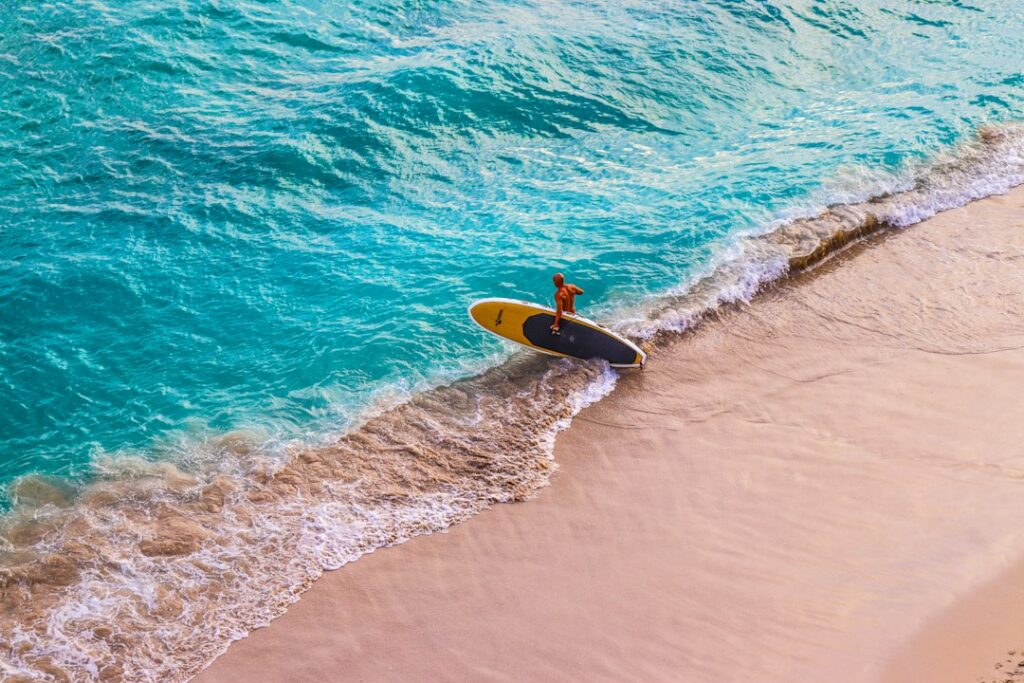
Hookipa Beach Park sits about nine miles east of Kahului on Maui’s north shore, roughly a 20-minute drive up Hana Highway (State Route 36) from the airport. The half-mile crescent of sand and pahoehoe rock has two personalities. Mornings and midday belong to windsurfers, kiteboarders, and photographers watching the ocean throw waves at the reef pass.
In the last two hours before sunset the beach shifts. Green sea turtles – honu in Hawaiian – haul themselves out of the water onto the sand at the east cove to rest, warm their shells, and sleep. Some afternoons the count reaches 30 to 40 individual turtles spread along a 200-yard stretch of shoreline.
The ritual has drawn enough attention that the Hawaii Department of Land and Natural Resources stations trained volunteers on the sand most afternoons with rope, signs, and quiet reminders about the federal 10-foot buffer. This piece covers what to expect, where to stand, why the point itself is closed to swimming, and what gear pays off from the lookout above the parking lot.
Why Hookipa Became a Green Sea Turtle Haul-Out Site
Green sea turtles were listed as threatened under the U.S. Endangered Species Act in 1978, when the Hawaii population had been reduced to a few hundred nesting females at French Frigate Shoals. Decades of protection reversed the trend. The Hawaii stock now numbers in the tens of thousands, and honu behavior has shifted meaningfully with the rebound.
Basking on land – hauling out to rest above the tide line – is a behavior almost unique to the Hawaiian population of Chelonia mydas. Scientists still debate the driver. Leading theories include thermoregulation after warm-water swims, predator avoidance from tiger sharks working the offshore reef, and simple digestion after grazing on the algae mats along the north shore ledges.
Hookipa checks the boxes turtles need. The east cove holds a gently sloping sand shelf that lets a 200-pound animal drag itself above the surf line without much effort. Offshore reef ledges hold turf algae the honu graze on. Trade wind chop keeps the water well-oxygenated, and it stays cooler than south-shore lagoons – useful when a turtle needs to shed body heat.
Size and age of the animals
Adult Hawaiian green sea turtles typically weigh between 150 and 350 pounds and measure 3 to 4 feet along the carapace. Most take 25 to 35 years to reach reproductive maturity, and individuals can live 60 to 70 years in the wild. The animals hauling out at Hookipa are almost entirely adults or large juveniles – hatchlings and small juveniles remain pelagic for their first several years.
The Late-Afternoon Haul-Out Ritual
The first turtle usually arrives between 3:00 and 4:00 p.m., though on winter days with earlier sunsets the arrival can slide forward to 2:30. By 5:00 p.m. the count is usually at its peak. Individual turtles rest on the sand for 5 to 8 hours, and some stay overnight, sliding back into the surf near dawn on the outgoing tide.
The animals do not arrive as a group. Watchers see them appear one or two at a time in the shorebreak, get pushed forward by a wave, then use front flippers to pull themselves above the wet zone. Each turtle picks its own patch, and observation records kept by local wildlife reporters and the Hawaii Wildlife Fund show the same individuals often return to the same spots across weeks.
The east cove where haul-outs concentrate is not the same beach where the surf schools set up. It is the quieter pocket beyond the point, closer to the base of the seaside cliff. From the parking lot, the honu beach sits to the east, past a short walk down a sand track marked with wildlife closure signage.
DLNR Volunteer Rope-Off Boundaries
The Hawaii DLNR Division of Aquatic Resources trains volunteers through the Hawaii Wildlife Fund and the Hawaii Marine Animal Response network. On Hookipa’s busier afternoons, one or two of these volunteers walk the beach with rolled orange caution tape, wooden stakes, and laminated signage that reads NOAA distance guidelines in English, Japanese, and Spanish for visitor accessibility.
The rope goes up as each turtle settles in. Volunteers typically stake a semicircle 10 to 12 feet around the animal on the landward side, leaving the surf side open so the honu can retreat when it decides to leave. A single laminated card sits in the sand explaining the closure. On busy weekend afternoons the volunteer team stakes 15 to 25 separate perimeters.
Volunteers cannot legally arrest anyone. Their authority is educational and observational. They radio the state’s DOCARE conservation enforcement office when a violation is serious, and DOCARE officers have jurisdiction to issue citations under Hawaii Revised Statutes Chapter 195D and federal Endangered Species Act provisions. Coverage on the Honolulu Star-Advertiser tracks major enforcement actions each year.
What violates the rope-off
The rules inside the rope perimeter are simple and strictly enforced by both volunteers and any DOCARE officers on scene.
- Do not cross the rope line for any reason, including a photo.
- Do not touch, feed, ride, or attempt to move any resting turtle.
- Do not use flash photography within 30 feet of the animal.
- Do not let dogs approach; the beach requires leashes at all times.
- Do not pour water on turtles, even if they look dry from the sun.
- Do not use loud voices, whistles, or clapping to prompt a reaction.
The 10-Foot NOAA Distance Rule
The National Oceanic and Atmospheric Administration NOAA Fisheries Pacific Islands Regional Office publishes voluntary viewing guidelines for Hawaiian marine wildlife. Green sea turtles get a 10-foot minimum viewing distance on land and in the water. Hawaiian monk seals get 50 feet. Spinner dolphins get 50 yards. Each species reflects a different behavioral threshold researchers documented over years of population studies.
The 10-foot rule is a floor, not a ceiling. Wildlife biologists at Hawaii Marine Animal Response recommend giving basking turtles closer to 20 feet whenever possible. The extra buffer prevents flight responses that expose the animal to sun, dehydration, and predator risk during a rest cycle it needs to complete before another foraging swim.
Federal penalties for harassment – including approach that causes a behavioral change – run up to $50,000 in civil fines under the Endangered Species Act. State fines under Hawaii Revised Statutes 195D-4 can add another $5,000 to $15,000. Criminal harassment carries potential jail time up to one year. Investigations published on Honolulu Civil Beat have documented the enforcement pattern.
In practice, DOCARE officers use the fine ladder mostly for touching, riding, or attempting to move turtles. Standing 8 feet away for a phone photo usually earns a verbal warning from a volunteer. Standing 3 feet away with a flash triggers the radio call. Visitors should treat 10 feet as the absolute minimum and aim for 15 to 20 feet whenever the beach layout allows.
Why the Point Is Windsurf-Only Water
The rocky headland at the west end of Hookipa Beach, called Hookipa Point, marks the boundary between the swimmable east cove and the surf zone. The point itself sits above a reef pass where trade wind swell wraps around and stacks into breakers running 6 to 15 feet on average winter days, with rare double-overhead sets during major north swells.
The state maintains no lifeguard tower at the point, and Maui County beach advisories warn against any recreational swimming at the west end of Hookipa. Currents pull hard offshore between wave sets. The reef at the point is shallow and sharp, and beginners who slip in from the rocks have been rescued and evacuated in past seasons after being pinned in the impact zone.
What the point does host, in high volume, is elite windsurfing and kiteboarding. Hookipa is the home of the Aloha Classic wave-sailing championship each October and November. Wind speeds through the north shore trade wind channel typically run 15 to 25 knots on afternoons from April through October, with 30-knot gusts common. The Hawaii tourism authority lists Hookipa as an advanced-only surf zone.
Zones to learn before descending to the sand
- East cove sand: turtle haul-out area, walking OK, no swimming during high surf.
- Middle beach: surf school and beginner longboard zone, mixed use.
- The point and reef: expert windsurf, kiteboard, and shortboard only.
- Cliff base rocks: no access, unstable footing, rogue wave exposure.
- Parking lot lookout: family-safe viewing, best telephoto vantage on the beach.
The Lookout Above the Parking Lot
Hookipa’s most useful feature for turtle watchers is not the sand at all. It is the paved pullout above the main parking lot, roughly 40 to 50 feet above sea level. The lookout runs about 200 yards along the highway shoulder and gives an unobstructed view down onto the east cove sand where the honu concentrate each afternoon.
From this height, a spotter with binoculars can count 30 or more resting turtles without setting foot on the beach. The angle also frames the windsurfers riding the point break behind them, which makes the lookout the most photographed spot in the park. Long-lens photographers with 300mm or 400mm glass shoot the entire ritual from the guardrail without breaking any distance rules.
The pullout has room for about 25 cars along its length, with additional street parking on the makai shoulder. On calm-wind afternoons, the lookout fills between 4:00 and 5:30 p.m. Rental cars often circle waiting for a spot on peak weekends. Arriving by 3:30 p.m. usually secures a parking place before the crowd builds through golden hour.
The trail down from the lookout
A short sand-and-dirt trail drops from the lookout to the east cove, about a 100-foot walk with 40 feet of elevation loss. The trail is unpaved, sometimes muddy after rain, and unlit after dark. It is not wheelchair-accessible, though the lookout itself has curb cuts and a paved shoulder that accommodates strollers, wheelchairs, and folding beach chairs comfortably.
Packing Binoculars and Telephoto Gear
Because the 10-foot rule limits how close photographers can get, Hookipa rewards patient shooters with the right glass. The optimal setup differs based on whether the visitor is watching from the lookout above or from the sand below, and whether the goal is documentation or portfolio-grade images.
Binoculars
Compact 8×42 or 10×42 binoculars cover both viewpoints well. The 8×42 gives a wider field of view for tracking a turtle sliding through shorebreak. The 10×42 gets closer to individual features – eye rings, algae growth on the shell – and is preferred for identifying returning individuals against photo archives kept by the Hawaii Wildlife Fund volunteer team.
Anything above 10x magnification gets shaky handheld in wind, and afternoon trades at Hookipa run steady above 15 knots most days. A monopod stabilizes larger optics. Waterproof coating is worth the extra $60 to $120 because ocean spray reaches the parking lot on big-surf days when north swells push mist several hundred feet inland.
Telephoto lenses
From the lookout, a 200mm lens frames a single turtle at a comfortable size on a full-frame body. A 300mm or 400mm lens fills the frame with head and shell detail. Wildlife specialists on the north shore commonly use the Canon RF 100-500mm or the Sony 200-600mm zoom for the flexibility to also catch windsurfers riding waves in the background.
From the sand, working outside the 10-foot rope perimeter, a 70-200mm lens is usually enough to isolate one animal without cropping in post. Prime portrait lenses like an 85mm or 135mm work for wider environmental shots that include the dark sand, wave curl, and one honu together in the same composition.
| Gear | Purpose | Approx. cost |
|---|---|---|
| Nikon Monarch M5 10×42 binoculars | Handheld turtle spotting | $280 |
| Vortex Diamondback HD 8×42 | Budget alternative | $200 |
| Sony FE 200-600mm G lens | Long-reach wildlife photo | $2,000 |
| Canon RF 100-500mm L | Compact zoom wildlife | $2,900 |
| Peak Design travel tripod | Lookout stabilization | $600 |
| Waterproof camera bag cover | Trade wind spray protection | $45 |
Timing the Visit by Season and Wind
Hookipa’s turtle haul-out happens year-round, but conditions on the beach change dramatically by month. Summer trade winds are stronger and more reliable. Winter brings the biggest north swells and lighter winds. The turtles do not particularly care about surf size, though volunteer coverage is lighter in the shoulder months of March and November.
| Month | Typical wind (knots) | Wave height (feet) | Turtle count |
|---|---|---|---|
| January | 10-18 | 8-15 | 25-40 |
| April | 15-22 | 4-8 | 20-35 |
| July | 18-25 | 3-6 | 25-40 |
| October | 15-22 | 4-10 | 30-45 |
Sunset times drive the sweet spot for arrival. In late June, sunset falls near 7:15 p.m. and the haul-out peaks around 5:30 to 6:30 p.m. In late December, sunset is around 5:55 p.m. and peak count arrives closer to 4:30 to 5:15 p.m. Arriving 90 minutes before sunset typically catches the fullest beach for both counting and photography.
How Hookipa’s timing compares with other Maui turtle sites
Hookipa is a haul-out site: turtles come out of the water to rest. That behavior contrasts with cleaning-station snorkeling at south-shore coves like Ulua Reef in Wailea, where honu float in place while yellow tang scrape their shells. A visitor spending a week on Maui can layer both experiences into one itinerary without conflict.
The closest structural comparison in the state is the Big Island’s Punaluu Black Sand basking area in Kau. Both sites host adult turtles resting on the sand behind a volunteer rope, both enforce the same 10-foot NOAA standard, and both draw large late-afternoon crowds needing careful etiquette from arriving rental car drivers.
Etiquette Rules Beyond the Rope
The rope perimeter handles most of the enforceable rules. What it does not cover is the surrounding behavior that keeps the beach functional for turtles, volunteers, surfers, and other watchers. These are the practical courtesies that regulars and volunteers ask of visitors during any busy afternoon at the park.
- Speak in quiet voices near the haul-out zone; sudden loud noises trigger flight.
- Keep beach chairs, coolers, and umbrellas 30 feet or more from resting turtles.
- Never park on the highway grass shoulder; DOCARE ticketing runs weekly.
- Skip drones – the entire beach is a marine wildlife closure area.
- Take out any trash, including microtrash like bottle caps and cigarette filters.
- Do not stack rocks or move sand near haul-out spots or nesting divots.
- Yield the lookout guardrail to photographers with long lenses on tripods.
The broader Maui etiquette guide catches many of the mistakes that show up at Hookipa – illegal shortcuts to viewpoints, misplaced Instagram enthusiasm, and disregard for signed closures. Hookipa concentrates all of those tension points into a small parking lot on a state highway with fast-moving traffic and limited sight lines for pedestrian visitors crossing back to their vehicles.
Drone rules
The Hawaii DLNR closes airspace over marine mammal and sea turtle habitat to unmanned aircraft. Hookipa Beach Park sits fully inside this closure zone. Federal Aviation Administration regulations at 14 CFR Part 107 also require drone operators to yield to any recreational aircraft, including the tour helicopters that overfly Maui’s north shore during afternoon sightseeing loops.
Enforcement is not theoretical. DOCARE officers monitor the parking lot on weekends. A single drone launch near a resting turtle can trigger a state harassment citation with fines from $500 to $15,000 per animal disturbed. The safer alternative is a long lens from the ground-level lookout, which produces cleaner images without the wildlife stress or legal risk.
What to Do After the Turtle Watch
The haul-out ends the day’s beach viewing. Sunset from the lookout runs 5 to 10 minutes of vivid light, then the reef pass turns dark. Most visitors head back toward central Maui or up Hana Highway for dinner. The parking lot clears within 30 minutes of last light most weekday evenings.
Paia town sits about 3 miles west of Hookipa. The stretch has beach-town cafes, poke shops, and a couple of the surfboard rental shops that also stock reef-safe sunscreen. Coffee stops along the return road include Maui Coffee Roasters and other spots covered in the best Maui coffee guide, most of which stay open until 5:00 or 6:00 p.m.
Post-beach shave ice is a Maui tradition. Ululani’s has a Paia-adjacent location a short drive from Hookipa, and lines usually clear by 6:30 p.m. on weekdays. Kids finishing a turtle count often trade the guardrail for a large lilikoi with snow cap and macadamia nut ice cream in a paper cup.
For an alternate afternoon that pairs with a Hookipa sunset, the Iao Valley Needle State Monument works as a rain-day fallback about 25 minutes west. Iao Valley is often 10 to 15 degrees cooler than the coast and can be visited in an hour before heading north to catch the honu haul-out during the same afternoon.
How Hookipa Fits Into a Broader Maui Wildlife Itinerary
Visitors making a wildlife-heavy Maui trip often stack Hookipa with two or three other coastal spots. The trick is separating haul-out sites (land rest) from cleaning stations (in-water rest) from active foraging reefs. Each behavior needs different equipment, different distance rules, and different timing to catch during a single vacation week.
| Site | Behavior | Best time | Gear |
|---|---|---|---|
| Hookipa Point | Land haul-out | 3-6 p.m. | Binoculars, telephoto |
| Ulua Reef Wailea | Cleaning station | 10 a.m.-2 p.m. | Snorkel, mask |
| Makena Landing | Cleaning + foraging | 7-11 a.m. | Kayak, snorkel |
| Kahekili Beach | Foraging on reef | Morning slack tide | Snorkel, reef gloves |
| Kapalua Bay | Passing reef swim | Early morning | Snorkel, mask |
Snorkelers wanting active in-water encounters should look at Kahekili on the Kaanapali end or Kapalua Bay’s fringing reef. Both host honu grazing on turf algae in shallow water and both work best in the early morning before the trade winds pick up around 10:30 a.m. and roughen the surface.
Kayakers wanting a hands-on turtle experience can put in at Makena Landing Cove and paddle a mile south to Turtle Town, an in-water cleaning station along the reef. The paddle distance is manageable for beginners but timing matters – south winds fill in by 11 a.m. and can make the return leg significantly harder for less experienced paddlers.
The Bigger Picture: Sea Turtle Conservation on Maui
The Hookipa haul-out is a conservation success story with pressure points. The Hawaiian green sea turtle population increased roughly 5 percent per year for several decades after the 1978 listing. In April 2023 NOAA proposed a distinct population segment status for Central North Pacific greens that could support delisting within the next decade if trends hold steady.
Even a recovering population is fragile at high-visitation sites. Boat strikes, entanglement in nearshore fishing gear, and habitat pressure from coastal development continue to injure animals seen at Hookipa. The Hawaii Wildlife Fund runs an active necropsy program on stranded turtles collected across the north shore, and volunteer patrols log injuries and identifiers weekly for the state stranding database.
Long-term residents concerned about coastal access sometimes push back against tourism-driven wildlife rules. The DLNR’s approach at Hookipa balances state-mandated protection under Hawaii Revised Statutes with the reality that windsurfers, fishermen, and local families use the beach daily. Homeowners tracking Bill 9 vacation-rental changes often become reliable turtle-watch supporters over time.
How to volunteer
Both the Hawaii Wildlife Fund and the Hawaii Marine Animal Response network accept volunteers on Maui. Training runs 4 to 6 hours and covers marine mammal law, sea turtle identification, radio protocol, and rope-off procedure. Committed volunteers typically work a 3-hour weekly shift and provide their own transportation to Hookipa. Retired residents make up a significant share of the current volunteer roster.
Getting There, Parking, and Practical Logistics
Hookipa Beach Park sits at mile marker 8.9 on Hana Highway, about 9.5 miles east of Kahului Airport. Drive time from the airport runs 18 to 25 minutes without traffic. From Lahaina the drive is closer to 60 minutes each way, and traffic through central Maui adds 15 to 20 minutes during afternoon commute hours between 4:00 and 6:00 p.m.
The park has two entrance driveways. The main lower entrance drops into the beach parking lot, which holds about 60 cars and fills first on peak afternoons. The upper lookout pullout runs along the mauka shoulder above the beach. Both areas are free of charge – no state park fee applies at Hookipa, unlike many other Maui coastal sites.
| Origin | Distance | Drive time | Traffic risk |
|---|---|---|---|
| Kahului Airport | 9.5 miles | 18-25 min | Low |
| Wailea | 25 miles | 45-55 min | Medium |
| Kaanapali | 35 miles | 60-75 min | High |
| Hana town | 44 miles | 2.5-3 hrs | Variable |
| Paia town | 3 miles | 6-10 min | Low |
The park has clean flush restrooms near the pavilion, cold-water outdoor showers, and picnic tables under a covered concrete shelter. There is no lifeguard tower at the east cove, though a seasonal tower sometimes staffs the middle beach during summer months. Cell service through the park is strong on Verizon and T-Mobile networks. Sunset is drone-restricted, so plan for photos before dusk.
Rental car considerations
Standard sedans handle Hookipa fine. The parking lot is paved. The upper lookout is paved. The only unpaved section is the sand track down to the east cove beach. Rental car counters at Kahului Airport (Enterprise, Hertz, Turo hosts) generally rent under $75 to $110 per day for a compact vehicle during shoulder-season windows.
Frequently asked questions
What time do the sea turtles arrive at Hookipa Beach Park?
First arrivals usually appear between 2:30 and 4:00 p.m. depending on the season. Peak counts of 20 to 40 individual turtles happen between 4:30 and 6:00 p.m. In winter with earlier sunset the ritual shifts earlier by about an hour. Arriving 90 minutes before sunset typically catches the fullest beach for viewing.
Can visitors swim at Hookipa Beach Park?
Swimming is not recommended anywhere at Hookipa. The east cove has strong shorebreak and no lifeguard tower. The point and reef pass on the west end host expert windsurfing over sharp coral, with waves running 6 to 15 feet on typical winter days. Currents pull hard offshore between sets. Swimmers should use Baldwin Beach about 2 miles west instead.
How close can photographers get to the turtles?
The federal NOAA guideline for green sea turtles is 10 feet minimum on land or in the water. Hawaii Wildlife Fund biologists recommend 15 to 20 feet to avoid triggering a flight response. Volunteers rope off a 10-to-12-foot semicircle around each resting animal. Standing 8 feet away for a phone photo typically earns a warning; standing 3 feet away can trigger fines.
Is there an entrance fee for Hookipa Beach Park?
Hookipa Beach Park is free of charge for all visitors. It is a Maui County park along Hana Highway, not a state park subject to the tourist entry fee that applies at Waianapanapa or Iao Valley. Parking is free in both the lower beach lot and the upper lookout pullout. Both fill by 4:00 p.m. on peak-season afternoons, so early arrival matters.
What binoculars work best for Hookipa turtle watching?
Compact 8×42 or 10×42 binoculars balance magnification, field of view, and hand stability in the north shore trade winds. The Nikon Monarch M5 at around $280 or Vortex Diamondback at around $200 are common choices among returning visitors. Waterproof coating matters because ocean spray reaches the lookout on big-surf days. Magnifications above 10x require a monopod for stability.
Are drones allowed at Hookipa for aerial turtle photos?
No. The Hawaii DLNR closes airspace over marine mammal and sea turtle habitat to unmanned aircraft. Hookipa sits fully inside this closure zone. State harassment citations run $500 to $15,000 per animal disturbed, and federal penalties under the Endangered Species Act can reach $50,000. A 400mm telephoto lens from the lookout replaces any aerial angle safely and legally.
How does Hookipa compare to Punaluu Black Sand for turtles?
Both are haul-out sites where adult green sea turtles rest on sand behind a volunteer rope-off. Punaluu’s sand is black lava, offering higher photo contrast against the honu shell color. Hookipa has more consistent count numbers year-round and easier access from a major airport. Punaluu sits on the Big Island’s south coast; Hookipa is on Maui’s north shore with different weather patterns.