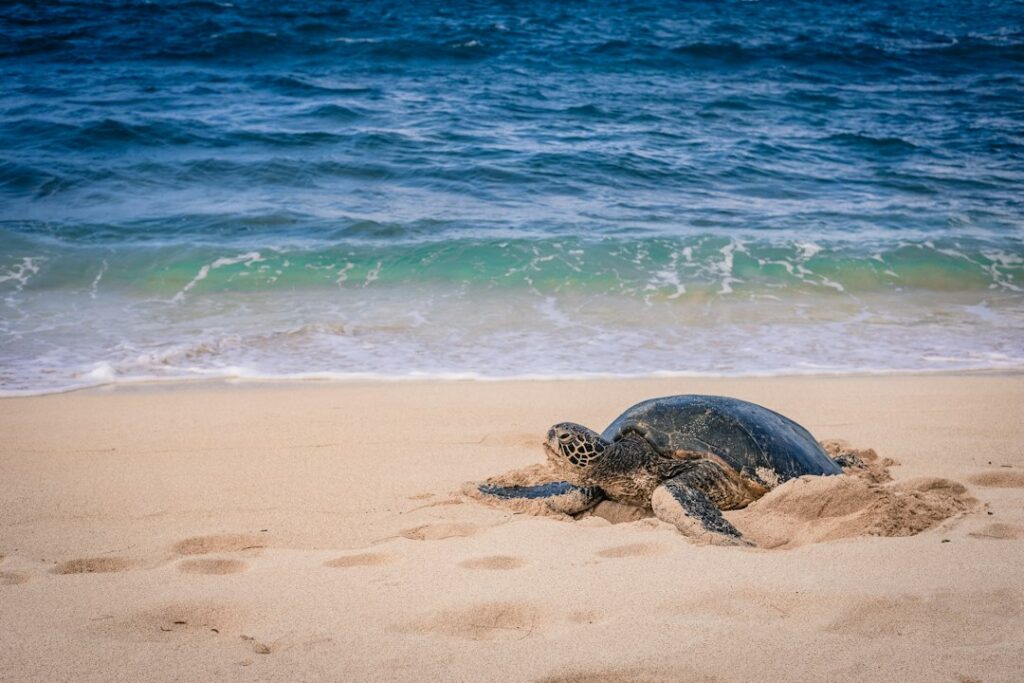
Two protected marine animals account for most wildlife citations issued to visitors in Hawaii, and neither one requires bad intent to trigger a violation. The Hawaiian green sea turtle, or honu, hauls out on public beaches in broad daylight, often within arm’s reach of people already standing there. The Hawaiian monk seal does the same, sometimes on the busiest sand on the island.
The rules differ sharply between the two species. Federal guidance asks people to stay 10 feet from a honu. The published distance for a monk seal is 50 yards, and 150 feet when a mother and pup are together. Those figures are not decorative — enforcement officers treat them as the working threshold for what counts as harassment.
What follows covers where each animal reliably appears by season, what the distances actually require, the penalty ranges under federal and Hawaii law, why roped perimeters materialize on beaches overnight, and how to photograph both species without ending a vacation in a citation.
Two species, two separate legal frameworks
The green sea turtle’s Central North Pacific population is listed as threatened under the federal Endangered Species Act. The Hawaiian monk seal is listed as endangered, and because it is a marine mammal it carries a second layer of protection under the Marine Mammal Protection Act. Two statutes, two sets of maximum penalties, and two very different buffer distances.
State law adds a third layer. Hawaii Revised Statutes chapter 195D independently protects both animals, which means a single incident on a Hawaii beach can draw federal charges, a state administrative fine, or both. County park rules and state park regulations can stack on top of that.
Why the honu buffer is small and the seal buffer is large
Green sea turtles in Hawaii do something turtles almost nowhere else do: they haul out on beaches during the day simply to rest and thermoregulate. Because basking happens on narrow, crowded public sand, a 50-yard rule would be unenforceable at Laniakea or Ho’okipa. The 10-foot figure is a practical minimum that still prevents touching and crowding.
Monk seals are a different proposition. Roughly 1,600 animals remain in total, with about 300 living in the main Hawaiian Islands. Adults reach 400 to 600 pounds and about seven feet in length. A startled seal can bite, and a disturbed mother can abandon a pup, so the buffer is far larger.
The legal distances, written out
The table below collects the distances that matter most on a Hawaii beach or reef. Where a figure comes from agency viewing guidance rather than a codified number, that is noted — guidance still establishes what an officer considers reasonable conduct, and it is routinely cited in enforcement decisions.
| Animal or situation | Minimum distance | Basis |
|---|---|---|
| Green sea turtle (honu), water or sand | 10 feet (3 meters) | NOAA viewing guidance |
| Nesting turtle or marked nest | Stay outside rope, typically 20–30 feet | Site-specific closure |
| Hawaiian monk seal, resting adult | 50 yards (150 feet) | NOAA viewing guidance |
| Monk seal mother with pup | 150 feet minimum; perimeters often 300 feet | NOAA; volunteer cordon |
| Humpback whale | 100 yards (300 feet) | Federal approach regulation |
| Spinner dolphin, nearshore waters | 50 yards (150 feet) | Federal rule, effective October 2021 |
| Drone over marine mammals | 1,000 feet altitude | NOAA guidance plus FAA rules |
Distance is measured from the animal, not from the rope, and it applies in the water as well as on land. A snorkeler who hovers three feet above a resting turtle is closer than a photographer kneeling 12 feet away on the sand, and the snorkeler is the one at risk.
What counts as harassment
Federal law does not require contact. Harassment includes any act that has the potential to disturb an animal by disrupting natural behavior — feeding, resting, breeding, breathing, or sheltering. If a turtle lifts its head, flinches, or moves toward the water because of a person’s approach, the behavioral change itself is the evidence.
- Touching, riding, or attempting to move any turtle or seal
- Feeding either species, including tossing food into the water
- Blocking a turtle’s path between the sand and the surf
- Circling or chasing an animal while snorkeling or on a board
- Using flash photography on a basking or sleeping animal
- Letting a dog off-leash near a haul-out site
- Crossing a roped or signed perimeter for any reason
Penalty ranges: what a citation actually costs
Statutory maximums and real-world outcomes are far apart. The numbers below are the ceilings written into law; most first-time incidents involving a tourist who backed off when asked end in a verbal warning or a fine in the low hundreds. Repeat conduct, video evidence, and physical contact move cases toward the upper end fast.
| Statute | Civil maximum | Criminal maximum | Common real outcome |
|---|---|---|---|
| Endangered Species Act | $25,000 per violation | $50,000 and 1 year | Warning or $250–$1,500 fine |
| Marine Mammal Protection Act | $10,000 per violation | $20,000 and 1 year | Warning or $500–$2,500 fine |
| Hawaii HRS 195D, first offense | Up to $5,000 | Misdemeanor exposure | Administrative fine $250–$1,000 |
| Hawaii HRS 195D, second offense | Up to $10,000 | Misdemeanor exposure | Fine plus restitution |
| Hawaii HRS 195D, third offense | Up to $15,000 | Misdemeanor exposure | Escalated fine |
| State or county park rule violation | $100–$500 | Petty misdemeanor | Citation on the spot |
Federal civil penalty maximums are adjusted for inflation on a recurring schedule, so the figures published in a given year can run higher than the original statutory text. Anyone facing an actual citation should read the notice itself rather than relying on a summary.
Why enforcement has gotten stricter
Bystander video changed the calculus. Cases that once ended with a shrug now circulate widely before an officer ever arrives, and Hawaii newsrooms including the Honolulu Star-Advertiser and Hawaii News Now report individual incidents by name. Several recent prosecutions began as social media clips.
Volunteer networks have also professionalized. Trained responders log seal sightings, set perimeters, and document violations with timestamps and photographs. That record is what turns an ambiguous moment into a usable case file, a shift Honolulu Civil Beat has tracked across several years of coverage.
Where honu reliably appear, by island and season
Green sea turtles are present in Hawaii waters year-round, so “season” mostly describes when conditions make them easy to see rather than when they exist. Calm mornings, low swell, and afternoon basking cycles matter more than the calendar at most sites.
| Site | Island | Best window | Typical animals | Parking |
|---|---|---|---|---|
| Laniakea Beach | Oahu, North Shore | Year-round; peak 11 a.m.–4 p.m. | 2–8 basking | Roadside shoulder, no lot |
| Ho’okipa Beach Park | Maui, North Shore | Year-round; after 3 p.m. | 15–40 basking | Paved overlook, ~40 stalls |
| Punaluu Black Sand | Hawaii Island, Kau | Year-round; mid-afternoon | 1–6 basking | Free lot, ~60 stalls |
| Kahaluu Bay | Hawaii Island, Kona | Year-round; 7–10 a.m. | 5–15 in water | Free lot, fills by 9 a.m. |
| Maluaka (Turtle Town) | Maui, Makena | April–October calm | 3–10 in water | Free lot, ~50 stalls |
| Poipu Beach Park | Kauai, south shore | Year-round; seals common | 1–4 turtles, 1–2 seals | Free lot plus street |
Laniakea Beach, Oahu
Laniakea sits about 61 minutes and 39 miles from Waikiki along Kamehameha Highway. It is the single most reliable basking beach on Oahu, and the most chaotic. There is no parking lot — vehicles pull onto a dirt shoulder across a two-lane highway, and pedestrians cross mid-block.
Volunteers rope a perimeter around each basking turtle using stakes and yellow line, usually within minutes of haul-out. The rope typically sits 10 to 15 feet from the animal. The traffic and shoulder-parking situation here is exactly the sort of thing covered in what surprises mainland drivers about Hawaii roads.
Punaluu Black Sand Beach, Hawaii Island
Punaluu sits on Highway 11 between Naalehu and Pahala, roughly 27 miles southwest of Hawaii Volcanoes National Park. Turtles haul out onto dark basalt sand that runs noticeably warmer than white sand, which is part of why they choose it. Signs and low fencing mark the usual resting zone.
The etiquette question here trips up more visitors than anywhere else on the island, since the beach is small and the turtles sit close to the shoreline path — the specifics of basking distance etiquette at Punaluu are worth reading before arriving.
Kahaluu Bay, Kona
Kahaluu is a shallow, protected bay about five miles south of Kailua-Kona with an entry depth of roughly three to six feet. Turtles graze algae off the rocks within 30 feet of shore. Arrive by 8 a.m.; the lot is usually full by 9:30 a.m. in July and August.
Because the water is shallow and the turtles feed near the entry, this is the easiest place in the state to accidentally close inside 10 feet. Kahaluu appears alongside two deeper options in a rundown of Kona-side snorkeling at Kealakekua and Two Step.
Maui: Maluaka and the Wailea coast
Maluaka Beach at Makena, about nine miles south of Kihei, fronts a reef system that functions as a cleaning station — turtles hold position while reef fish remove algae from their shells. Morning visibility from April through October commonly runs 40 to 60 feet.
The site’s mechanics are covered in detail in a guide to the Makena cleaning station at Turtle Town. For land-based viewing without gear, the 1.5-mile Wailea coastal pathway between Grand Wailea and Polo Beach passes several small coves where turtles surface.
Kauai: Poipu and the south shore
Poipu Beach Park is the most consistent monk seal haul-out in the main islands, with sightings on a large share of days through the year. Turtles appear too, though usually in the water rather than on the sand. The park sits about 15 miles from Lihue Airport.
Seasonality matters more on Kauai than elsewhere because north shore surf shuts down snorkeling from roughly November through March while the south shore stays calm — a pattern laid out in a season-by-season ranking of Kauai snorkeling spots. Lodging trade-offs between the two coasts are covered in the Poipu versus Princeville comparison.
Monk seals: fewer animals, larger buffer, faster closures
A monk seal on a beach is a comparatively rare event, and the response to it is organized. Trained volunteers and agency staff arrive with stakes, rope, and printed signs, and they establish a perimeter that can consume a substantial section of beach for 24 to 48 hours.
The 50-yard figure applies to a single resting adult. That is 150 feet — roughly half a football field, and considerably farther than most people estimate. On a narrow beach, honoring it can mean leaving entirely rather than walking past.
Why roped areas appear overnight
Seals haul out on their own schedule, frequently at night or in the pre-dawn hours. Volunteers respond to sighting reports within a couple of hours, which is why a beach that was wide open at sunset can have 200 feet of sand cordoned off by 7 a.m. the next morning.
The signs are not advisory. Crossing a posted perimeter is treated as an approach violation regardless of how far the animal actually sits from the rope, and the rope’s position is itself the documented evidence of notice.
Pupping season and the 150-foot rule
Main-island pupping runs roughly March through August, with a concentration from April to June. Pups nurse for about five to seven weeks, during which a newborn grows from roughly 30 pounds to 150 to 200 pounds while the mother fasts and loses several hundred pounds of her own weight.
Nursing mothers are defensive and fast over short distances. The published minimum around a mother-pup pair is 150 feet, but practical perimeters at busy beaches often extend 300 feet or more and can close an entire beach section for the full nursing period.
| Phase | Months | Duration | Beach impact |
|---|---|---|---|
| Pupping season | March–August | ~6 months | Closures possible anytime |
| Peak births | April–June | ~10 weeks | Highest closure likelihood |
| Nursing period | Varies by birth | 5–7 weeks | 150–300 ft perimeter held |
| Post-weaning | Varies | 2–4 weeks | Pup alone; perimeter stays |
| Routine adult haul-out | Year-round | 4–48 hours | 50-yard buffer, smaller rope |
Turtle nesting season and what changes on the sand
The overwhelming majority of Hawaiian green sea turtle nesting — historically more than 90 percent — happens at French Frigate Shoals in the Northwestern Hawaiian Islands, hundreds of miles from any visitor beach. Main-island nesting is uncommon but has been documented with increasing frequency in recent years.
Where it does occur, nesting runs roughly from May through September. A female digs a chamber, deposits somewhere around 100 eggs, covers the nest, and returns to the water, typically at night. Incubation takes about 60 days, so hatchlings emerge from July into December.
A confirmed nest gets staked, signed, and monitored. Those perimeters stay up for two months or longer, and the restrictions extend to lights: white flashlights, camera flashes, and beachfront lighting all disorient hatchlings, which navigate toward the brightest horizon.
Hatchling emergence rules
- No white light on the beach after dark near a marked nest
- Never pick up or redirect a hatchling toward the water
- Keep a clear, unobstructed path from nest to surf
- Leave beach chairs and gear off the sand overnight
- Report any nest or crawl track to the marine wildlife hotline
Photographing honu and seals without a violation
Nearly every citation involving a camera comes from the same decision: closing distance instead of changing lenses. The fix is optical, and it is inexpensive. A 200mm lens at 50 yards frames a monk seal comparably to a 50mm lens at roughly 12 yards, which would be an outright violation.
Modern phones complicate this. A 3x telephoto on a flagship phone gives roughly 75mm equivalent, which is not enough reach at 150 feet for a filling composition. The honest answer is that a monk seal photographed legally with a phone will be small in frame — and that is the correct result.
| Gear | Legal shooting distance | Result | Typical cost |
|---|---|---|---|
| Phone, main camera (~24mm) | 10 ft turtle / 150 ft seal | Wide context shot | Owned |
| Phone, 5x telephoto (~120mm) | 150 ft seal | Small but identifiable | Owned |
| Mirrorless + 70–200mm | 150 ft seal | Strong frame-filling shot | $1,200–$2,400 |
| Rental 100–400mm, 3 days | 150 ft seal | Wildlife-quality result | $95–$170 |
| Underwater housing or action cam | 10 ft turtle | Reef-level composition | $280–$450 |
Drones, flash, and video
Drone operation near marine mammals is a recurring enforcement target. NOAA guidance sets 1,000 feet of altitude over marine mammals, and several Hawaii beaches and all state parks restrict launching outright. A drone hovering over a hauled-out seal is a straightforward harassment case with its own video evidence.
Flash is prohibited in practice on any resting animal. Set the camera to no-flash before reaching the beach rather than trusting automatic settings, which will fire in shade or at dusk — precisely when turtles are most likely to be basking.
Snorkel gear, boats, and guided encounters
Most in-water turtle encounters happen from shore, and the gear question is straightforward. Rental sets run about $9 to $15 per day or $30 to $45 for a week at dive shops in Kihei, Kona, and Poipu. Buying a decent mask and snorkel outright costs $35 to $70.
Fit matters more than price. A leaking mask makes people surface, reposition, and drift — and drifting is how snorkelers end up inside 10 feet of a turtle without noticing. A five-minute fit check at the shop prevents most accidental approaches.
Reef-safe sunscreen is a separate legal requirement
Hawaii banned the sale of sunscreens containing oxybenzone and octinoxate effective January 1, 2021, and some counties have gone further. Mineral formulations using non-nano zinc oxide are the standard substitute, typically $14 to $22 per tube. Rash guards eliminate the question for torso coverage entirely.
Guided boats and permitted operators
Commercial snorkel operators working in nearshore waters hold permits and carry staff trained on approach rules, which shifts the compliance burden off the passenger. Half-day catamaran trips generally run $130 to $190 per adult for four to five hours, including gear and food.
Operator selection is where quality varies most, and the differences are laid out in a comparison of Molokini crater operators and departure timing. Winter trips carry a second distance rule — humpbacks require 100 yards — which shapes the schedules described in February charter departure timing during humpback peak.
Trip logistics around wildlife viewing
Turtle and seal sites are spread across each island’s coastline, and nearly all of them require a vehicle. Ho’okipa sits about 10 miles east of Kahului; Laniakea is 39 miles from Waikiki; Punaluu is 56 miles from Kailua-Kona along Highway 11.
Rental rates swing hard by season and island, with the differences broken down by airport in a survey of Hawaii rental car prices by island and season. Fuel adds meaningfully to a wildlife circuit: Hawaii consistently posts among the highest retail gasoline prices of any state in federal weekly fuel price data.
Road conditions and closures on the coastal highways that access these beaches are published by the Hawaii Department of Transportation. Beach park hours, lot closures, and lifeguard coverage come from county sources — the City and County of Honolulu for Oahu and Hawaii County for the Big Island.
Beach alcohol rules intersect with wildlife sites
Several prime viewing beaches are state or county parks where alcohol is prohibited outright, and enforcement often happens in the same patrol that checks wildlife perimeters. The specifics differ by jurisdiction and are covered in a breakdown of Hawaii alcohol rules for waterfront and state park visitors.
What to do when an animal approaches you
The distance rules govern human approach, not animal movement. A turtle that surfaces two feet away while a snorkeler holds still has not created a violation. The obligation is to avoid pursuing, touching, or blocking — so the correct response is to stop finning and let the animal pass.
If a monk seal hauls out near a towel, the answer is to move, quietly and immediately, to 150 feet and then report the sighting. Packing up slowly at close range is itself the disturbance, and it is what officers end up documenting.
Reporting
- NOAA statewide marine wildlife hotline: 888-256-9840
- Report seal haul-outs, turtle nests, and any injured animal
- Note the time, exact beach, and approximate location on the sand
- Do not attempt rescue, feeding, or relocation under any circumstance
- Photograph from a legal distance if documenting a violation
Visitor-facing conduct guidance from the Hawaii Visitors and Convention Bureau reinforces the same distances, and the resident context behind the rules shows up plainly in state population data: roughly 1.4 million residents share these beaches with several million annual visitors.
Frequently asked questions
How close can you legally get to a sea turtle in Hawaii?
NOAA guidance sets 10 feet as the minimum distance from a honu, whether the animal is basking on sand or swimming. The same buffer applies underwater, where snorkelers most often violate it by drifting. Touching a turtle at any distance is a separate and more serious offense.
What is the fine for touching a monk seal?
Statutory maximums reach $25,000 civil under the Endangered Species Act and $50,000 plus one year in prison criminally, with parallel Marine Mammal Protection Act exposure. Hawaii state fines add up to $5,000 for a first offense. Actual first-time outcomes usually land between a warning and roughly $2,500.
Why is the monk seal distance 50 yards but the turtle distance only 10 feet?
Monk seals are endangered marine mammals numbering about 1,600 animals total, and disturbance can cause a mother to abandon a nursing pup. Green sea turtles are more numerous and routinely bask on crowded public beaches, where a 50-yard buffer would be impossible to maintain or enforce.
When is sea turtle nesting season in Hawaii?
Nesting generally runs May through September, with incubation lasting about 60 days, so hatchlings emerge from July into December. More than 90 percent of nesting historically occurs at French Frigate Shoals, far from visitor beaches, though main-island nests are documented with growing frequency.
Can you take photos of turtles and seals in Hawaii?
Yes, provided the photographer stays outside the required distance and uses no flash. Telephoto reach solves the framing problem legally — a 200mm lens at 150 feet produces a usable monk seal image. Drones must stay 1,000 feet above marine mammals and are banned in state parks.
Why do roped-off areas appear on Hawaii beaches overnight?
Monk seals haul out at night or before dawn, and trained volunteers respond within hours to stake a perimeter and post signs. A beach open at sunset can have 150 to 300 feet of sand cordoned by early morning, and those closures may hold for weeks during nursing.
Which beach is most reliable for seeing honu?
Ho’okipa Beach Park on Maui typically hosts the largest daily basking group, often 15 to 40 turtles after 3 p.m. Laniakea on Oahu is the most consistent single-turtle site. For in-water sightings, Kahaluu Bay in Kona delivers most mornings before 10 a.m.
Do the rules apply to residents differently than visitors?
No. Federal and state protections apply identically regardless of residency, and enforcement does not distinguish between a first-time visitor and a longtime resident. The only practical difference is familiarity — residents generally recognize a staked perimeter and the behavioral cues that signal an animal has been disturbed.