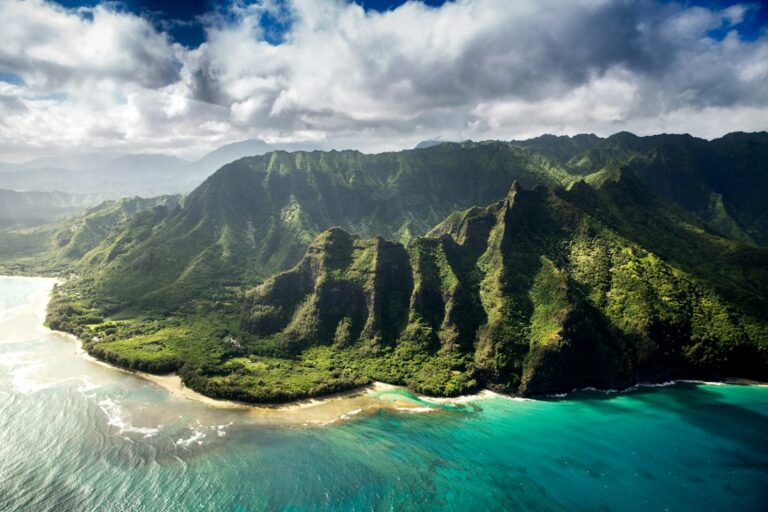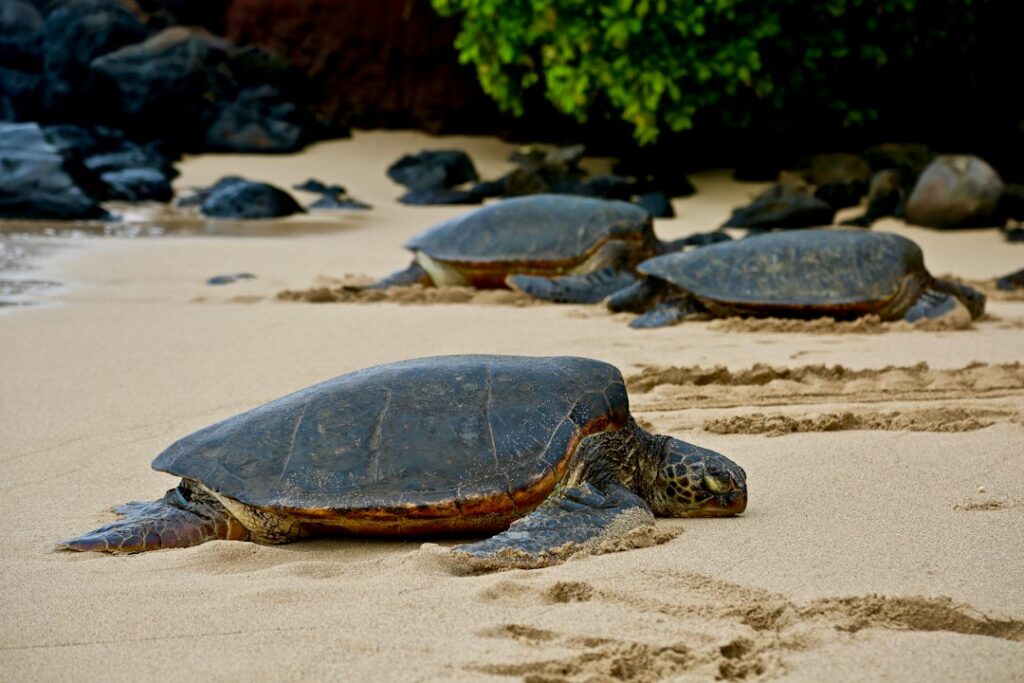
Ulua Beach sits mid-Wailea on Maui’s south shore, tucked between the Wailea Beach Marriott and the Grand Wailea Resort. Its offshore reef, shared with adjacent Mokapu Beach, ranks among the most reliable shore-snorkel sites on the island for one specific reason: a resident cleaning station where green sea turtles queue up while yellow tang and saddle wrasse pick algae from their shells.
The site rewards early risers. Between roughly 6:30 a.m. and 10 a.m., trade winds sit calm and the water goes glassy, exposing the reef contours in vivid detail. By 11 a.m., northeasterly gusts push whitecaps across the bay, cloud the visibility, and end the productive snorkel window for the day.
Access is unusually easy for a Wailea reef. A small public parking lot behind the Marriott provides free stalls to non-guests under Hawaii’s shoreline access laws, and a metal ladder bolted to the north point lets swimmers skip the sand entry entirely. Below is a full breakdown of parking timing, entry methods, gear logistics, and cleaning-station behavior.
The Ulua and Mokapu Reef at a Glance
Ulua Beach and Mokapu Beach are twin coves separated by a lava-rock point that juts about 180 feet into the bay. That point is the reef. Coral colonies extend roughly 300 feet from shore in a horseshoe formation, with depths ranging from 4 feet at the inside edge to 25 feet at the outer wall.
The reef sits within the Wailea-Makena section of Maui’s south shore, which averages 275 sunny days per year and receives just 10 inches of annual rainfall. That dry, leeward climate keeps runoff minimal and water clarity high — often 60 to 80 feet on calm mornings when no south swell is running.
According to Hawaii Department of Health beach monitoring data, Ulua consistently scores in the top tier of south Maui sites for water quality, with enterococcus counts below 35 CFU per 100 mL on more than 95% of sample days between 2020 and 2024.
Marine life density is high because the reef sits within an area designated for limited take. Common resident species include yellow tang, ornate butterflyfish, moorish idol, saddle wrasse, convict tang, whitemouth moray, and — most reliably — Hawaiian green sea turtles (honu).
The Marriott Public Parking Lot
Under Hawaii Revised Statutes §115, resorts fronting the ocean must provide public shoreline access with dedicated parking stalls. The Wailea Beach Marriott complies via a signed lot on the mauka side of Wailea Alanui Drive, marked “Public Beach Parking” near the resort’s south driveway.
The lot holds 32 stalls. Snorkelers arriving before 7:30 a.m. typically find open spots with no wait, while those arriving after 10 a.m. often circle for 15 to 20 minutes or park at the alternate Polo Beach lot 0.4 miles south and walk in via the coastal path.
Parking is free and untimed. The lot has no shade and only two portable restrooms. The walk from the stalls to the sand is 180 yards down a paved shoreline path that runs behind the Marriott pool deck. This is the same corridor discussed in the site’s overview of Wailea versus Kaanapali for family lodging.
| Arrival window | Weekday fill rate | Weekend fill rate | Expected wait |
|---|---|---|---|
| 6:30–7:30 a.m. | 10–20% | 25–40% | 0 minutes |
| 7:30–8:30 a.m. | 40–60% | 65–85% | 0–5 minutes |
| 8:30–9:30 a.m. | 75–90% | 95–100% | 10–20 minutes |
| 9:30–10:30 a.m. | 95–100% | 100% (turnover) | 15–25 minutes |
| After 11:00 a.m. | Turnover begins | Turnover begins | 5–15 minutes |
What the parking area does and does not include
The public path connects to outdoor rinse showers at the beach access, but the resort pool decks and towel service are reserved for registered guests. Non-guests should avoid the poolside lounges and resort restrooms, both of which are staffed and monitored.
- Two outdoor rinse showers at the sand entry point
- One drinking-water refill spigot on the shoreline path
- Portable toilets in the parking lot; no permanent restrooms
- No lifeguard on duty at Ulua or Mokapu Beach
- No trash cans past the parking lot — pack out all waste
- Overnight parking prohibited; enforcement runs 10 p.m. to 5 a.m.
Sand Entry Versus the Reef Ladder
Ulua offers two ways into the water: the sandy beach on the south side of the point, or a galvanized steel ladder anchored to the lava rock on the Mokapu side. Each entry suits a different swimmer profile and delivers a different first view of the reef.
The sand entry from Ulua Beach
The main entry is a gently sloping beach with fine white coral sand. Water depth at the shoreline reaches waist-high roughly 15 feet from the sand line, making it forgiving for children, first-timers, and swimmers with fins to don. The catch: to reach the reef, swimmers must kick 120 to 150 yards along the point before coral appears.
Morning shorebreak is usually under one foot, but a south swell during May through October can raise it to 2 or 3 feet at high tide. Rip currents are rare at Ulua itself but common at Mokapu when swell wraps around the point, so entering on the south side and exiting via the north ladder can leave swimmers fighting an unexpected pull.
The reef ladder on the north point
The ladder is bolted to the lava rock at the northern edge of the Ulua-Mokapu boundary, roughly 240 feet from the Ulua parking access. It drops swimmers directly into 8 feet of water above sand-and-coral bottom. From that entry point, the cleaning station lies just 40 yards south along the reef wall.
The ladder favors experienced snorkelers who arrive already wearing fins and mask, since the lava shelf offers no shallow standing area. In calm conditions it is the fastest route to the best coral. In choppy conditions, the same lack of shallow water makes reentry awkward if a swimmer becomes tired offshore.
| Attribute | Sand entry (Ulua) | Reef ladder (Mokapu side) |
|---|---|---|
| Distance from parking | 180 yards | 240 yards |
| Water depth at entry | 0–3 feet (gradual) | 8 feet (immediate) |
| Kick distance to reef | 120–150 yards | 40 yards to cleaning station |
| Best for | Kids, beginners, gear-up | Confident swimmers, fast access |
| Chop tolerance | Manageable at 12 mph wind | Difficult above 10 mph wind |
| Exit difficulty | Easy | Requires ladder rung timing |
The Green Sea Turtle Cleaning Station
The cleaning station is a specific coral head roughly 60 yards off the north point at a depth of 12 to 15 feet. Hawaiian green sea turtles — Chelonia mydas, called honu locally — arrive throughout the morning and hover motionless while reef fish pick algae, parasites, and dead skin from their shells and flippers.
Cleaning-station behavior is a mutualistic relationship documented across Hawaiian reefs. At Ulua, the resident cleaners are primarily yellow tang and saddle wrasse, occasionally joined by goldring surgeonfish. A single honu may hold the station for 8 to 15 minutes before rising to breathe.
Observing turtles without violating federal law
Hawaiian green sea turtles are protected under both the U.S. Endangered Species Act and Hawaii Revised Statutes §195D. NOAA guidance calls for a minimum viewing distance of 10 feet from any turtle in the water. Touching, chasing, or blocking a turtle’s path to the surface is a federal offense with fines up to $10,000.
At Ulua’s cleaning station, the practical rule is to float still on the surface at least three body-lengths back, keep fins from stirring sediment, and let turtles pass rather than positioning between them and open water. Groups often stack four or five snorkelers around a single honu, which drives turtles off station within minutes.
- Maintain a 10-foot minimum distance in the water
- Never touch, ride, or feed a honu — both are federal offenses
- Do not block a turtle’s path to the surface to breathe
- Stay flat on the surface; diving down disrupts cleaning behavior
- Turn off flash on any underwater camera
- Move on after 3–5 minutes so other snorkelers can view
When turtles are most active at the station
Cleaning-station activity peaks between 7:30 a.m. and 10:30 a.m., driven by both light penetration and the schedules of the cleaner fish. Turtle counts at the Ulua station have been documented at 4 to 9 individuals across a two-hour window on typical calm mornings, according to volunteer surveys logged with local reef groups.
Morning Glass-Off Timing
“Glass-off” refers to the period when surface winds drop to near zero and the water becomes mirror-smooth. On Maui’s south shore, this happens overnight and typically holds until mid-morning, when solar heating of the West Maui Mountains restarts the trade-wind convection cycle.
The Wailea coast sits in the lee of Haleakala. Predawn winds average 3 to 5 mph and often flatten to under 2 mph between 6:00 and 9:00 a.m. That calm produces the 60-to-80-foot visibility that makes Ulua worth the alarm-clock cost.
NOAA’s marine forecast station at Ma’alaea Bay, 12 miles north, is the best proxy for Wailea conditions. When Ma’alaea shows winds below 8 knots overnight, Ulua will hold glass conditions past 9:30 a.m. When Ma’alaea shows 15+ knots at dawn, the bay never fully calms and visibility stays under 40 feet all day.
| Time window | Typical wind (mph) | Visibility (feet) | Turtle sightings |
|---|---|---|---|
| 6:00–7:00 a.m. | 2–5 | 60–80 | Low; light still weak |
| 7:00–8:30 a.m. | 2–6 | 70–90 | Peak |
| 8:30–10:00 a.m. | 4–10 | 50–70 | Peak |
| 10:00–11:00 a.m. | 10–15 | 30–50 | Declining |
| 11:00 a.m.–1:00 p.m. | 15–22 | 15–30 | Rare; chop obscures |
| 1:00–5:00 p.m. | 18–25 | 10–25 | Very rare |
The 11 a.m. Trade-Wind Chop Cutoff
Hawaii’s northeasterly trade winds — the same pattern that keeps Honolulu ventilated and drives Oahu’s windward showers — sweep down the isthmus between Haleakala and the West Maui Mountains and hit Wailea’s coast on a strong diagonal. That funneling effect is why Wailea afternoons are windier than Kihei just five miles north.
By 11:00 a.m. the diurnal heating cycle is well underway. Winds ramp from a morning average of 6 mph to an afternoon average of 18 to 22 mph within about 90 minutes. Chop builds to 1.5 to 2 feet at the reef entry, and suspended sand cuts visibility roughly in half.
This wind pattern is the reason Wailea afternoons pivot toward pool-and-cocktail time. Snorkelers who plan for a 6:30 a.m. arrival and a 10:30 a.m. exit consistently see the reef at its best; those planning an 11:00 a.m. or noon session almost always report a disappointing outing.
Exceptions and reversals
Kona wind events — the reversal that brings southerly or southwesterly flow — happen roughly 15 to 20 days per year, mostly between October and April. During Kona days, Wailea can stay glassy all afternoon while Kihei and Kaanapali get pounded. Watch the local weather coverage for advisories on these reversals.
Summer south swell events (May–October) also change the calculus. A 3-foot south swell will churn the sand entry regardless of wind and can push heavy surge across the reef even during morning glass-off. The Hawaii DOT ocean-safety page links to the surf forecast that flags these events 48 hours in advance.
Gear Rental in Wailea Village
Wailea does not have a beach concession at Ulua itself. Snorkel gear must be rented or purchased in advance. The closest full-service rental shops sit in the Wailea Gateway Center and along South Kihei Road, three to six minutes’ drive from the parking lot.
Rental quality varies. The cheapest sets from tourist-strip shops in Kihei run $9 per day for basic silicone masks and rubber fins that leak and blister. Wailea Village Shops carries mid-range daily rentals with prescription mask options, and Snorkel Bob’s outlets rent optical-corrected masks by the week for divers who normally wear glasses.
| Shop | Location | Basic daily | Weekly premium | Prescription mask |
|---|---|---|---|---|
| Snorkel Bob’s Kihei | 2411 S. Kihei Rd | $9.00 | $44.00 | Yes, $54/week |
| Boss Frog’s Wailea | Wailea Gateway Ctr | $8.50 | $38.00 | Limited stock |
| Maui Dive Shop | 1455 S. Kihei Rd | $12.00 | $52.00 | Yes, $65/week |
| Costco Kahului | 540 Haleakala Hwy | Purchase $28–$65 | Purchase | Purchase adapter |
| Resort concierge | On-property | $25–$40 | $175–$250 | No |
Buying versus renting math
For stays of six days or longer, purchasing a mid-tier snorkel set from Costco Kahului at $45 to $65 beats renting on a per-day basis. Buyers can also leave the gear behind for the next visit or gift it locally. Renters avoid the packing bulk and always get the current season’s replaced silicone.
Fin sizing matters more than any other gear choice. Fins that are too small pop off in surge; fins too large cause instant blisters that end a week of snorkeling on day two. Every reputable Wailea-area shop will let renters test-fit before checkout.
Reef-Safe Sunscreen and Local Rules
Hawaii’s Act 104 bans the sale of sunscreens containing oxybenzone and octinoxate statewide, and Maui County’s stricter ordinance (Bill 135, effective October 2022) bans all non-mineral sunscreens from being applied on-island regardless of where purchased. Enforcement at Ulua is not aggressive, but citations have been issued for chemical sunscreen use on Maui beaches.
Reef-safe compliance means zinc oxide or titanium dioxide as the only active ingredients, both non-nano. The site’s guide to the Act 104 rules and enforcement details covers which brands actually comply versus which ones market themselves as reef-safe while still containing banned chemicals.
Rash guards and UPF 50 sun shirts eliminate the need for any sunscreen on the torso, which is the largest source of sunscreen washoff into the water. Zinc paste on the face and back of neck is the workable minimum kit.
Other rules snorkelers routinely miss
- Do not stand on coral; a snapped colony takes 25+ years to rebuild
- Do not feed fish; artificial feeding disrupts natural cleaning behavior
- Drone flights below 400 feet require FAA and county permission
- Collecting live shells, coral, or sand is illegal statewide
- Alcohol consumption on the beach is prohibited and enforced
Comparing Ulua to Other Wailea Snorkel Options
Wailea’s five-crescent coastline offers several snorkel sites within a 1.5-mile stretch. Each has a different profile in terms of parking, entry, marine life, and skill level. Ulua wins on turtle density; other beaches win on other axes.
| Beach | Distance from Ulua | Public parking | Turtle probability | Best for |
|---|---|---|---|---|
| Ulua/Mokapu | 0 miles | 32 stalls | Very high | Reef, honu, cleaning |
| Wailea Beach | 0.3 miles south | 60 stalls (Grand Wailea) | Low | Swimming, sand play |
| Polo Beach | 0.4 miles south | 28 stalls | Moderate | Sunset, less crowded |
| Palauea (White Rock) | 1.1 miles south | Street parking only | Moderate | Local feel, no facilities |
| Makena (Big Beach) | 2.6 miles south | 200+ stalls | Very low | Bodysurfing, wide sand |
For pure snorkel quality, Ulua is the ranked leader on Maui’s south shore. On the Big Island, several sites edge past it for coral density and pelagic sightings — the site’s ranked list of the best Big Island beaches for snorkeling covers those comparisons in detail.
Safety, Currents, and Emergency Access
Ulua lacks a lifeguard tower. The nearest guarded stations sit at Wailea Beach (1,200 feet south) and Kamaole III in Kihei (2.6 miles north). Response time for a 911 water-rescue call to the Maui Fire Department’s Kihei station averages 8 to 11 minutes to the Ulua parking lot.
The reef is generally low-risk in calm morning conditions. Currents around the Ulua-Mokapu point can push offshore during a strong outgoing tide combined with a south swell, but these events are visible from shore as breaking whitewater on the reef edge — an obvious “don’t swim today” signal.
Snorkelers should always enter with a buddy, tell someone the expected return time, and stay inside the horseshoe. Attempting to round the point to the outer wall is where most Ulua rescues originate; that outer edge is exposed to swell that funnels past the shelter of the bay.
Cell coverage and evacuation logistics
Both Verizon and AT&T report reliable LTE coverage at the Ulua parking lot and along the shore path. In-water coverage drops off past 200 yards offshore. Emergency evacuation from the sand requires either the Marriott service road (used for medical transport) or a stretcher carry down the 180-yard path to the parking lot.
What Relocating Households Should Know
For readers weighing a move to Maui rather than a two-week trip, Ulua is one of the reasons Wailea and south Maui command their premium rents. A household within a 15-minute drive of a top-tier reef treats snorkel gear the way mainland households treat bikes — grabbed for a Saturday morning, back home by lunch.
South Maui median home prices ran $1.42 million as of Q4 2025 per state DBEDT data, versus $1.05 million on the north shore. Households comparing options often look upcountry for cheaper land, which the site covers in its overview of relocating to Haiku above Paia, but that comes at the cost of a 45-minute drive to Wailea’s reefs.
Renters and buyers considering short-term rental income should read the site’s tracking of Maui’s Bill 9 TVR phase-out, which affects apartment-zoned units in south Maui specifically. Owners looking to exit the market should also review the site’s coverage of HARPTA withholding on non-resident sellers.
The relocator’s snorkel cadence
Residents who snorkel Ulua weekly report a consistent pattern: two 45-minute sessions per week from May through September, dropping to once every 10 days during winter when high surf on the north shore diverts attention to windward hikes. The Honolulu CPI series tracks the recreation-cost component that includes snorkel gear and reef-safe sunscreen.
Other Maui Considerations for the Same Trip
A morning at Ulua pairs efficiently with several other south Maui or upcountry activities. Snorkelers finishing at 10:30 a.m. still have the full day for a lunch, coffee stop, or drive to a second destination well before Kahului’s afternoon traffic peak.
- Coffee stop after snorkel: the site’s Maui coffee guide maps roasters in Kihei and upcountry
- Red-eye departure night: see the Kahului rental return strategy for the OGG return window
- Full snorkel day: pair Ulua morning with an afternoon boat trip once trade winds settle
- Rest day: swap snorkel for pool time and hit Ulua the following morning
Frequently Asked Questions
Is Ulua Beach parking really free for non-guests?
Yes. Hawaii law requires all shoreline resorts to provide free public parking for beach access. The Marriott’s designated public lot holds 32 stalls with no time limit and no fee. Non-guests must use the marked public path and outdoor rinse showers only, not the resort pool deck, poolside towels, or interior restrooms.
Can beginners handle the reef ladder entry?
The ladder drops swimmers directly into 8 feet of water with no shallow area to stand or adjust gear. Beginners should use the sand entry at Ulua instead, which slopes gradually and allows fins to be donned in waist-deep water. The ladder is best reserved for confident snorkelers who arrive with gear already on and want the fastest route to the cleaning station.
How reliable are turtle sightings at the cleaning station?
Between 7:30 and 10:30 a.m. on calm days, sightings are nearly guaranteed — volunteer surveys log four to nine individual honu across that window. Sightings drop sharply after 11 a.m. as chop reduces visibility and turtles disperse. Winter storms and summer south swells can shut down cleaning behavior entirely for two to five days at a stretch.
What is the earliest legal arrival time in the parking lot?
Overnight parking is prohibited between 10 p.m. and 5 a.m. From 5:00 a.m. onward, the lot is open. The shoreline path is walkable in the dark, though the reef itself is not snorkelable until roughly 6:15 a.m. when sunrise lights the water enough to see coral and fish clearly. Arriving at 6:00 a.m. secures a stall on any weekend.
Do children need special gear for Ulua Beach?
Children snorkeling Ulua benefit from a youth-sized silicone mask, short fins, and either a snorkel vest or a bright rash guard for visibility from shore. Full-face masks are not recommended for kids under 10 due to documented CO2 rebreathing risks. Every rental shop in Wailea and Kihei stocks kid sizing; resort concierges typically do not.
Is Ulua safe when a south swell is running?
A south swell above 2 feet at 14 seconds produces breaking surf across the reef entry, dangerous surge inside the horseshoe, and offshore-pulling rip currents at the Mokapu point. During advisories, snorkel plans should shift to windward Oahu spots like Hanauma Bay or wait 48 hours. Check the National Weather Service south-shore surf forecast before driving to the lot.
Can snorkelers use chemical sunscreen if they bought it on the mainland?
No. Maui County ordinance bans the on-island application of any non-mineral sunscreen regardless of where it was purchased. Only zinc oxide or titanium dioxide formulas qualify as mineral. Enforcement at Ulua is not routine, but citations have been issued at other Maui beaches, and the reef benefit of compliance is documented in coral-bleaching studies referenced by the Hawaii Department of Health.
How does Ulua compare to snorkeling on the Big Island?
Ulua has the most reliable turtle cleaning station on Maui, but the Big Island’s Kealakekua Bay and Two Step at Honaunau offer denser coral, deeper reef structure, and higher pelagic-fish counts. The site’s ranked overview of the best beaches on the Big Island covers those alternatives, including access requirements and permitting for Kealakekua.
Where can snorkelers rent gear closest to Ulua Beach?
Boss Frog’s at Wailea Gateway Center is 1.1 miles from the parking lot and offers basic daily rentals at $8.50. Snorkel Bob’s in Kihei sits 3.2 miles north on South Kihei Road with better mask quality, prescription options, and weekly rates around $44. Resort concierges rent gear at premium prices, typically $25 to $40 per day for basic sets.