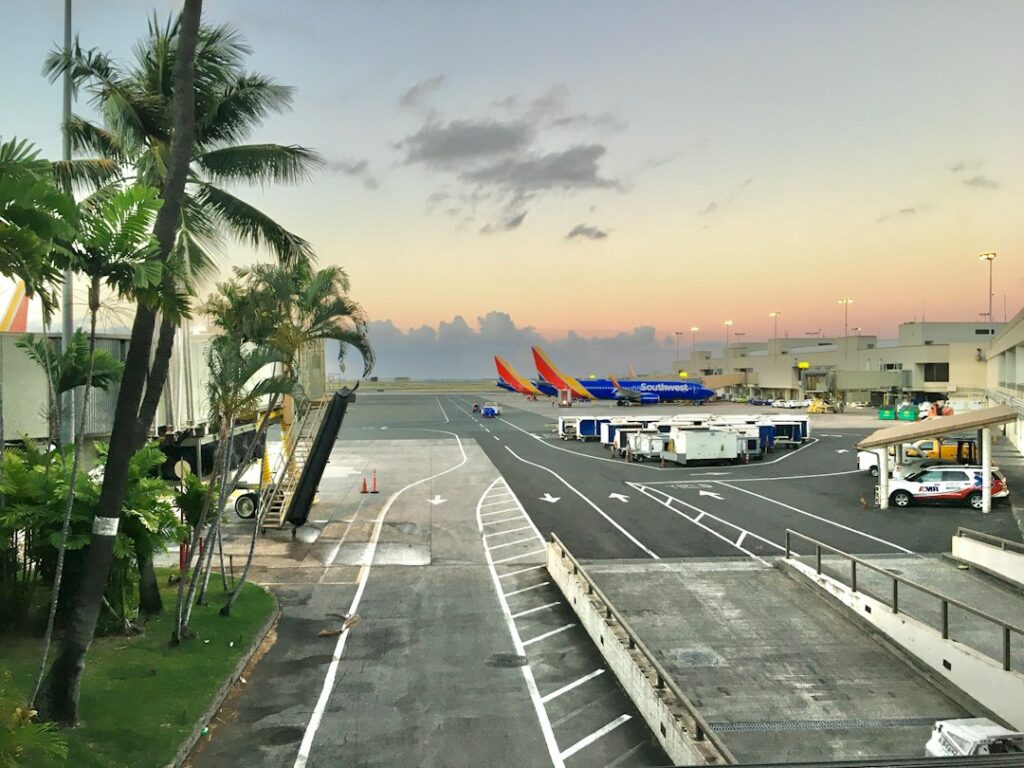
Daniel K. Inouye International Airport (HNL) sits about 9 miles west of Waikiki, between downtown Honolulu and Pearl Harbor. On a map that looks like an easy run. At 3pm on a weekday it often isn’t. The H-1 freeway between Middle Street and the airport viaduct carries much of Oahu’s commuter traffic, and the airport exits land in the middle of the island’s busiest westbound stretch.
This guide compares weekday drive times from three common starting points, Waikiki, Kapolei and Kailua, across the morning rush (6–9am), the afternoon rush (3–6pm) and the quieter evening window around 8:30pm. It also covers the interisland departure banks, arrival buffers, garage parking costs, the cell-phone waiting lot and the timing of a rental return at the consolidated rental car facility.
The figures below are typical ranges drawn from state transportation data, local traffic reporting and published airport rates. Construction, crashes and holiday weekends can change any of them quickly. Treat them as planning ranges, not guarantees.
The short answer: weekday 3pm vs 8:30pm
The headline comparison is simple. From Waikiki, the drive to HNL usually takes about 15–20 minutes at 8:30pm on a weekday. At 3pm the same trip typically takes 30–45 minutes, and on a bad Friday it can pass an hour. That is roughly double, sometimes triple, the evening time.
The main reason is direction. The afternoon commute on Oahu runs “ewa-bound” (westbound), out of town toward Pearl City, Waipahu and Kapolei. A traveler leaving Waikiki for the airport is driving the same way as tens of thousands of commuters heading home, and the airport exits sit inside that westbound stream.
By 8:30pm the commuter surge has cleared. H-1 westbound generally moves at or near the posted 55 mph past the airport, and Nimitz Highway’s signals cycle with little queuing. The remaining variable is construction: lane closures on H-1 are often scheduled overnight, usually starting after 8pm or 9pm.
| Origin to HNL | Distance | Weekday 3pm | Weekday 8:30pm | Difference |
|---|---|---|---|---|
| Waikiki (Kalakaua Ave) | ~9 miles | 30–45 min | 15–20 min | +15–25 min |
| Kapolei (Kapolei Pkwy) | ~17 miles | 25–35 min | 20–25 min | +5–10 min |
| Kailua (town center) | ~16 miles | 35–50 min | 22–28 min | +13–22 min |
Notice that Kapolei barely changes between 3pm and 8:30pm. Its trip to the airport is townbound (eastbound), the opposite direction of the afternoon commute. Kapolei’s problem window is the morning, covered below.
How Oahu’s commute shapes the airport drive
Oahu has a small number of freeways that carry most cross-island traffic. The Hawaii Department of Transportation manages H-1, H-2, H-3 and Nimitz Highway, and most residents live either west of the airport (Ewa, Kapolei, Mililani, Waipahu) or east of it (urban Honolulu, Windward Oahu). Jobs cluster downtown, in Kakaako and at Pearl Harbor.
That geography produces a tidal pattern. Mornings fill the eastbound lanes into town. Afternoons fill the westbound lanes out of town. The airport sits right at the hinge, so almost every trip to HNL rides with one wave or the other depending on the hour.
The two main routes
- H-1 Freeway: the direct route; exits 15 and 16 serve the airport depending on direction.
- Nimitz Highway (Route 92): a signalized surface road along the waterfront, from downtown to the airport.
- Ala Moana Boulevard: connects Waikiki to Nimitz without touching H-1.
- H-201 Moanalua Freeway: the inland bypass linking H-3 and Likelike traffic to H-1 near the airport.
H-1 is faster when it is moving. Nimitz is slower in free flow because of its traffic lights, but more predictable when H-1 jams. Local drivers often switch to Nimitz when H-1 westbound backs up past the Middle Street merge, which is where the freeway narrows and H-201 traffic joins.
The zipper lane and contraflow
Weekday mornings, HDOT runs the H-1 zipper lane, a movable-barrier lane for eastbound vehicles with two or more occupants. It typically operates from about 5:30am to 8:30am (later on some schedules) between Waipahu and the Keehi Interchange near the airport. A Kapolei household carrying two people can use it.
Afternoons, a westbound contraflow lane on H-1 often operates in the late afternoon between Kapolei and Waikele, which helps traffic beyond the airport but does little for the stretch between downtown and HNL. Schedules shift with construction, so drivers check HDOT’s notices before relying on either lane.
Drive times from Waikiki
Waikiki is the most common starting point for visitors and the most sensitive to time of day. The trip runs about 9 miles whether drivers take H-1 via McCully or Punahou, or the waterfront route along Ala Moana Boulevard and Nimitz Highway.
| Departure window (weekday) | Via H-1 | Via Ala Moana / Nimitz | Better choice |
|---|---|---|---|
| 5:00–6:00am | 15–18 min | 18–22 min | H-1 |
| 6:00–9:00am (AM rush) | 20–30 min | 22–32 min | H-1, usually |
| 9:00am–2:30pm (midday) | 18–25 min | 20–28 min | Either |
| 3:00–6:00pm (PM rush) | 30–50 min | 30–45 min | Nimitz when H-1 is red |
| 8:00–9:00pm | 15–20 min | 18–22 min | H-1 |
| After 10:00pm | 13–17 min | 16–20 min | H-1, watch closures |
Why the morning is easier from Waikiki
In the morning, a Waikiki-to-airport driver travels westbound while most commuters head east into town. Delays mainly come from surface streets around Waikiki and the on-ramps at Punahou or Kinau. The freeway itself usually flows in the westbound direction before 9am.
Why 3pm to 6pm is the hard window
Westbound congestion often builds by 2:30pm, earlier on Fridays and before three-day weekends. The worst stretch runs from around Liliha Street to the Middle Street merge. School pickup traffic adds to it from roughly 2pm to 3:30pm when classes are in session.
Nimitz does not escape the surge, since many commuters use it too. However, its delays tend to be spread across traffic lights rather than stacked in a stop-and-go freeway queue. When a crash blocks H-1, Nimitz is the standard fallback, and it fills within about 15 minutes of an incident.
For travelers without a car, the options between HNL and Waikiki include TheBus, shared shuttles and rideshare. All of them sit in the same afternoon traffic, so the time buffers below apply equally.
Drive times from Kapolei and the west side
Kapolei, about 17 miles west of HNL, has the opposite problem. Its airport trip runs east, with the morning commute. A 7am weekday drive from Kapolei to HNL can take 45–75 minutes, while the same trip at 3pm often takes 25–35 minutes.
Morning rush from Kapolei
Eastbound H-1 congestion typically starts west of the Kunia interchange before 5:30am and peaks between 6am and 7:30am. Merges at the H-2 junction near Waipahu and at the Waiawa interchange near Pearl City are the main choke points. Through traffic thins slightly after Aiea, but airport-bound drivers still face the queue for the Nimitz and airport exits.
A two-person car can save 10–25 minutes in the zipper lane. Solo drivers often leave before 5am or after 9am if the flight schedule allows. Departing at 9:15am rather than 7:15am typically cuts the drive from about an hour to roughly 30 minutes.
Afternoon and evening from Kapolei
In the afternoon, eastbound H-1 from Kapolei generally moves well. The westbound side is the jammed one. That makes Kapolei one of the easier places to reach the airport from at 3pm, though drivers should still allow for the airport’s own curbside congestion during the evening interisland bank.
| Kapolei to HNL (weekday) | Typical time | Worst-case time | Notes |
|---|---|---|---|
| 4:30–5:30am | 22–30 min | 40 min | Queue forms near Kunia |
| 6:00–9:00am | 45–75 min | 90+ min | Zipper lane helps HOV |
| 9:30am–2:30pm | 25–35 min | 50 min | Midday construction possible |
| 3:00–6:00pm | 25–35 min | 45 min | Counter-commute direction |
| 8:30pm | 20–25 min | 35 min | Overnight closures after 8pm |
West-side residents considering the region’s growth, including households adding rental units under the city’s ADU and ohana permit rules, often cite the commute as a trade-off. Census data puts Hawaii’s mean commute time in the high 20s of minutes, but Ewa and Kapolei commuters regularly exceed it.
Drive times from Kailua and Windward Oahu
Kailua sits on the Windward side, about 16 miles from HNL over the Koolau Range. Drivers choose among three crossings: the Pali Highway (Route 61), the Likelike Highway (Route 63) and the H-3 freeway. Each has its own timing pattern.
Choosing the crossing
- H-3 to H-201: usually fastest to the airport; lands at Halawa, near the terminals.
- Likelike to H-201: slightly shorter but slower in the morning townbound rush.
- Pali Highway to H-1: drops into downtown; useful only from south Kailua at off-peak hours.
H-3 tends to be the default for airport trips because it connects directly to the Halawa interchange, a short hop from the airport exits. Its tunnels can close briefly for maintenance or high winds, and fog or heavy rain on the Windward side can slow traffic noticeably.
Morning and afternoon from Kailua
Mornings, townbound traffic on the Pali and Likelike can add 20–30 minutes, pushing the airport trip to 45–60 minutes. H-3 typically holds up better, at 35–45 minutes. Afternoons, the main delay comes on the Leeward side, where H-201 and H-1 feed into the westbound commuter queue near the airport.
At 3pm a Kailua driver should plan on 35–50 minutes. At 8:30pm the trip typically takes 22–28 minutes via H-3. Windward residents tend to treat late-evening flights as the easy option and early-morning flights as a gamble on the Likelike and Pali.
Morning and evening interisland departure banks
HNL’s interisland flights do not depart evenly through the day. Hawaiian Airlines and Southwest schedule clusters, or “banks,” of departures to Kahului, Lihue, Kona and Hilo. Smaller carriers fly to Molokai and Lanai. These banks shape crowding at check-in, security and the curb.
| Bank | Approximate window | Typical TSA wait | Curb congestion |
|---|---|---|---|
| Early morning | 5:30–9:00am | 10–25 min | High, 6:00–7:30am |
| Midday | 10:00am–2:30pm | 5–15 min | Moderate |
| Late afternoon/evening | 3:30–7:30pm | 10–30 min | High, 4:00–6:00pm |
| Late evening | After 8:00pm | 5–10 min | Low on interisland side |
The morning bank serves business travelers and day-trippers heading to neighbor-island meetings and connections. The evening bank brings them home and also connects with mainland departures leaving after 9pm. Fares, bag fees and route frequency are covered in more detail in the guide to Hawaii interisland flights.
The 3pm overlap problem
The evening interisland bank collides with the afternoon road commute. A traveler booked on a 5pm flight to Kahului, leaving Waikiki at 3:30pm, faces peak westbound H-1 traffic and then a busy security checkpoint. That combination accounts for many missed interisland flights.
Flights to Molokai and Lanai, mostly on smaller carriers such as Mokulele, depart from the commuter terminal area with separate procedures. The Molokai Hoolehua flight guide covers check-in timing for those routes.
Recommended arrival buffers
Arrival buffers combine drive time, parking or rental return, check-in and security. Airlines publish minimum check-in cutoffs, and most interisland carriers close bag check about 30–45 minutes before departure. Mainland flights also require an agricultural inspection of checked and carry-on bags before security.
The agricultural inspection
Mainland-bound passengers pass a USDA agricultural screening before the TSA checkpoint. It checks for fresh fruit and plant material that could spread pests. The state’s own Hawaii Department of Agriculture plant quarantine branch handles inbound inspection. The outbound USDA line usually adds 5–15 minutes and can add more during evening mainland banks.
| Flight type | Arrive at terminal | Leave Waikiki at 3pm-rush | Leave Waikiki at 8:30pm |
|---|---|---|---|
| Interisland, carry-on only | 60 min before | 2 hr before | 1 hr 20 min before |
| Interisland, checked bags | 90 min before | 2 hr 30 min before | 1 hr 50 min before |
| Mainland U.S. | 2 hr before | 3 hr before | 2 hr 20 min before |
| International | 3 hr before | 4 hr before | 3 hr 20 min before |
The rush-hour column includes an extra 15–20 minutes of slack beyond typical drive times. Travelers returning a rental car should add another 20–30 minutes, as explained below.
Seasonal adjustments
- Late December through early January: add 30 minutes for holiday crowds.
- Mid-June through mid-August: summer family travel lengthens bag-drop lines.
- Thanksgiving week: Wednesday afternoon is among the year’s heaviest road periods.
- Major holiday weekends: Friday westbound traffic often builds before 2pm.
Late October is generally a shoulder period for airport crowds, though weekend events, such as those listed in the guide to Halloween in Hawaii, can push evening road traffic higher around Waikiki and downtown.
HNL parking: garage rates and alternatives
HNL parking is run by the state. Its two main structures are the International Parking Garage, across from Terminal 2 (overseas and interisland), and the Interisland Parking Garage serving Terminal 1. Rates are set by HDOT’s Airports Division and have risen in recent years, with the daily maximum reaching about $36 after the most recent increases.
| Parking option | Short-stay cost | Daily cost | 7-day cost |
|---|---|---|---|
| Terminal garages (approx.) | $1 first 30 min, then incremental | ~$36 max | ~$252 |
| Off-airport private lots with shuttle | Not offered | ~$16–$25 | ~$110–$175 |
| Cell-phone waiting lot | Free | Not permitted | Not permitted |
| Rideshare round trip from Waikiki (no parking) | ~$35–$60 each way | N/A | ~$70–$120 total |
The figures above are approximate and change with state rate actions. HDOT publishes current rates on its airports pages, and local outlets such as the Honolulu Star-Advertiser report rate increases when they take effect. Check the current schedule before any trip longer than a day.
Is there economy parking?
HNL does not operate a separate on-airport economy lot comparable to those at many mainland airports. The practical economy option is a private off-airport lot along the Nimitz and Ualena Street corridor, most of which run shuttles every 10–20 minutes. Their daily rates are typically 30–50% below the garage maximum.
Shuttle lots add time. Travelers should allow 20–30 minutes from lot arrival to terminal curb, more during the evening bank. For a three-night neighbor-island trip, the difference between a $36 garage day and a $20 private day is about $48.
Garage tips
- Note the level and row; both garages have similar-looking ramps.
- Payment is by card at exit lanes or pay stations; cash options are limited.
- Height clearance matters for lifted trucks and roof racks; check posted limits.
- Garages fill during holiday weeks; arrive early or book private parking ahead.
Visitors staying in Waikiki face separate parking costs at hotels and city structures. The guide to Waikiki public parking structures compares municipal rates with hotel valet charges, which often exceed $40 per night.
Cell-phone waiting lot rules
HNL operates a free cell-phone waiting lot for drivers picking up arriving passengers. It sits on airport property a few minutes’ drive from the terminal curbs, with signage from the airport access roads. The point is to keep drivers from circling the arrivals level or stopping at the curb before passengers are ready.
How the lot works
- Drivers must remain with the vehicle at all times.
- Unattended vehicles may be cited or towed.
- Waiting is for active pickups only, not long-term or overnight parking.
- Time limits are posted and enforced, especially at busy periods.
- Drivers move to the curb only after the passenger has bags and is outside.
Arrivals curbs at HNL are for active loading only. Airport police and traffic staff routinely move along vehicles that stop without a passenger present. For pickups after a long-haul flight, waiting in the lot until the passenger clears baggage claim typically saves 15–30 minutes of circling.
Evening pickup timing
Mainland arrivals cluster in the early afternoon and again in the evening. A mainland flight landing at 3:30pm means a driver leaving Waikiki around 3pm faces westbound rush traffic going out and then eastbound traffic back. An 8:30pm arrival is far easier in both directions, with round trips often under 45 minutes.
Rental-car return at the consolidated facility
HNL’s Consolidated Rent-A-Car Facility (ConRAC) opened in 2021 across from the terminals. It brings the major rental brands under one multi-level structure, replacing the scattered lots and shuttle buses that used to line the airport’s edges. Returns, pickups, fueling and washing all happen inside.
Most major brands are inside the facility. Some discount and peer-to-peer rental operators remain off-site and run their own shuttles. Rates and seasonal swings across islands are covered in the guide to Hawaii rental car prices.
Return process step by step
- Follow “Rental Car Return” signs from the airport access roads, not terminal signs.
- Enter the ramp and follow the lanes marked for the rental brand.
- An agent or handheld scanner checks fuel, mileage and damage.
- Collect belongings and a receipt, usually by email.
- Walk to the terminals via the pedestrian connection, or ride the airport shuttle to Terminal 1.
How much time to allow
Off-peak, the return itself takes about 10 minutes, plus 5–10 minutes walking to Terminal 2. During the evening bank, queues at the return lanes and the walk with luggage can stretch the process to 25–35 minutes. Travelers heading to Terminal 1 should add another 5–10 minutes for the connection.
Fueling adds time. Gas stations closest to the airport fill with rental returns from about 3pm onward, and station lines of 10 minutes are common. Hawaii’s gasoline prices consistently rank among the nation’s highest in EIA retail fuel data, often more than $1 per gallon above the U.S. average.
Fees on the receipt
Hawaii rentals carry several state and airport charges beyond the base rate. These include a daily rental motor vehicle surcharge, a customer facility charge that funds the ConRAC, and the general excise tax. The Hawaii Department of Taxation publishes current surcharge rates.
For neighbor-island comparison, the same red-eye return logic applies at Kahului. The guide to Kahului red-eye rental returns covers that airport’s layout, which differs in walking distances and after-hours procedures.
Rental-car return card: HNL weekday
From Waikiki at 3pm: drive 30–45 min, fuel 10–15 min, return 15–25 min, walk 5–10 min. Total about 60–95 min before reaching check-in.
From Waikiki at 8:30pm: drive 15–20 min, fuel 5–10 min, return 10 min, walk 5–10 min. Total about 35–50 min.
From Kapolei at 7am: drive 45–75 min, return 10–15 min, walk 5–10 min. Total about 60–100 min.
Keep: fuel receipt, return email, photos of fuel gauge and odometer, and the car’s exterior from four sides.
Planning a trip around the clock
Most of the timing advice comes down to three variables: direction of travel, flight bank and whether a car needs returning. The schedule a household chooses for its flight can matter as much as the route it drives.
Best departure times by origin
- Waikiki: morning or late-evening flights avoid the 3–6pm westbound jam.
- Kapolei and Ewa: afternoon and evening flights avoid the 6–9am eastbound jam.
- Kailua and Windward: late-evening flights are easiest; mornings depend on H-3 conditions.
- Anywhere: Friday afternoons before holidays are the worst window of the week.
Weekends
Weekend traffic follows a different pattern. Saturday mornings are usually light. Sunday afternoons can be heavy eastbound as beachgoers and North Shore day-trippers return to town between 3pm and 6pm. Waikiki-to-airport drives on weekends generally run 18–25 minutes at most hours.
Event days
Large events at Aloha Stadium’s redevelopment site, Ala Moana Center sales and downtown parades can add localized congestion. Visitors staying farther west, such as at the Aulani resort in Ko Olina, face Kapolei’s morning timing plus another 5 miles. Late-morning departures from Ko Olina tend to be the least stressful.
Rail as an alternative
Honolulu’s Skyline rail line has opened in stages from East Kapolei toward town. Its airport-area stations extend service closer to HNL as segments open. The City and County of Honolulu posts current station openings and schedules. For west-side travelers with light bags, rail can remove the drive-time variable entirely once service reaches the terminals.
Reporting from Civil Beat and Hawaii News Now tracks Skyline’s timeline and H-1 construction projects. Both are useful to check before scheduling a tight connection, since major lane closures are usually announced a week or more ahead.
What relocating households should expect
For new residents, airport trips become part of routine life. Neighbor-island visits, mainland trips for family events and business travel add up to many airport runs per year. The pattern that newcomers notice first is how strongly time of day governs the trip.
Households that move to Ewa or Kapolei for lower housing costs often schedule interisland flights for midday or afternoon. Those living in town or Waikiki favor morning departures. Windward households tend to time trips around H-3 conditions, especially in the winter rainy season from November through March.
Cost of living also shapes the choice between parking and rideshare. BLS consumer price data for urban Honolulu consistently shows transportation and housing costs above the national average. A household making eight to ten short trips a year may find off-airport lots or rideshare cheaper than repeated $36 garage days.
New residents also learn to keep an eye on local traffic apps around 2:30pm on weekdays. If H-1 westbound is already red near Liliha at that hour, Nimitz Highway is usually the better choice for anyone heading to the airport from town.
Frequently asked questions
How long is the drive from Waikiki to Honolulu airport at 3pm on a weekday?
Typically 30–45 minutes, and sometimes more than an hour on Fridays or before holidays. The trip runs westbound with the afternoon commute out of town. Leaving 2 hours before an interisland flight or 3 hours before a mainland flight gives reasonable slack during the 3–6pm window.
How long does the same drive take at 8:30pm?
Usually 15–20 minutes via H-1, since the commuter surge clears by around 7pm. The main risk at that hour is overnight construction, as HDOT often schedules lane closures starting after 8pm or 9pm. Checking HDOT lane closure notices before departure avoids most surprises.
Is Nimitz Highway faster than H-1 to the airport?
In free-flowing traffic, H-1 is faster because Nimitz has many traffic signals. During the afternoon westbound rush or after a crash on H-1, Nimitz is often equal or quicker and more predictable. Drivers starting in Waikiki reach it via Ala Moana Boulevard without touching the freeway.
How much does parking at the Honolulu airport garage cost per day?
The state-run terminal garages have charged a daily maximum of about $36 after recent rate increases, with short stays starting at about $1 for the first 30 minutes. Private off-airport lots with shuttles typically charge about $16–$25 per day. Rates change, so checking HDOT’s current schedule is advisable.
Can drivers leave the car in the cell-phone waiting lot?
No. The free cell-phone lot is only for drivers actively waiting to pick up arriving passengers, and drivers must stay with their vehicles. Unattended vehicles can be cited or towed, and posted time limits apply. Anyone needing to leave the car should use a garage or an off-airport lot instead.
How early should a rental car be returned before a flight at HNL?
Plan to reach the consolidated rental facility about 30 minutes before the target terminal arrival time, or 45 minutes during the 3–6pm rush and evening bank. That covers the return inspection, lane queues and the walk or shuttle to the terminal. Refueling nearby can add another 10–15 minutes.
When are the interisland departure banks at Honolulu airport?
Interisland departures cluster in an early-morning bank from about 5:30am to 9am and an afternoon-evening bank from about 3:30pm to 7:30pm. Security lines and curb congestion peak within those windows. Midday and late-evening flights generally have shorter lines and easier road conditions.
Is morning or afternoon worse for driving from Kapolei to the airport?
Morning is far worse. Eastbound H-1 from Kapolei often takes 45–75 minutes between 6am and 9am, versus 25–35 minutes at 3pm. Two-person vehicles can use the morning zipper lane to save 10–25 minutes, and solo drivers often shift flights to late morning or afternoon.