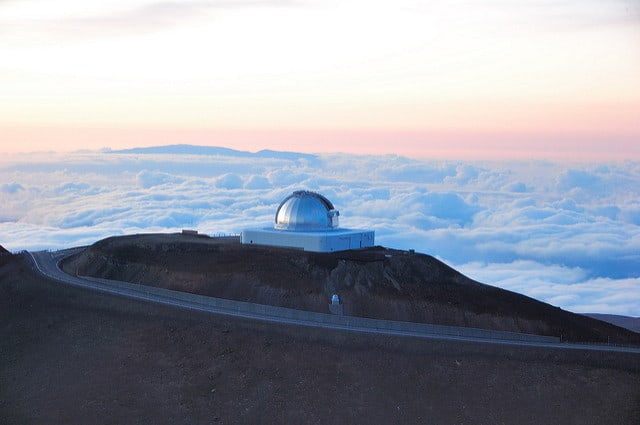
The summit of Mauna Kea (13,803 ft) sits above 40% of Earth’s atmosphere, in a thermal inversion layer that traps moisture below 9,000 feet — which is why the world’s most ambitious telescopes were built here and why the night sky from the summit ridge consistently rates as the darkest, clearest, and most stable observable from any populated landmass on the planet. For a regular traveler, you cannot easily get to the actual summit anymore (more on that below), but the Visitor Information Station at 9,200 feet, the access road’s lower switchbacks, and a handful of Saddle Road pullouts deliver Bortle 1 or Bortle 2 sky-quality views — practically speaking, what you’d need a private plane to find anywhere in California or Florida.
This guide covers: how Mauna Kea stargazing actually works in 2026 (post-tour-permit-changes), exactly where to go and when, what to bring, how to handle altitude, what you’ll see, and the best alternatives if Mauna Kea isn’t accessible during your visit.
What changed on Mauna Kea in 2024–2025
Mauna Kea management transferred from the University of Hawai’i to the Mauna Kea Stewardship and Oversight Authority (MKSOA) in 2023, and access policy has tightened progressively since. The three things travelers need to know:
- Commercial summit tours largely ended. The legacy operators who used to drive small vans to the summit for sunset and stargazing combined tours have either stopped or relocated their stargazing portion to lower elevations. A few operators still run summit access for the sunset portion only, then descend to the Visitor Information Station (VIS, 9,200 ft) for the actual stargazing.
- Independent summit access requires 4WD and is heavily discouraged. The road from VIS to the summit is unpaved, steep, frequently icy at altitude, and rental car contracts explicitly prohibit it. Going above VIS in a 2WD vehicle or any standard rental is both unsafe and a contract violation.
- The VIS Stargazing Program is the actual experience for 95% of visitors. Free, public, requires no reservation, runs nightly when weather permits. This is what most “Mauna Kea stargazing” trips actually mean in 2026, whether booked through a tour or DIY.
If you’re set on the summit specifically — for photography or to see the working observatories at sunset — book through one of the small number of remaining licensed operators (rates currently $250–$400/person) and confirm the day before, because operators cancel routinely for weather, road conditions, and capacity.
How the stargazing experience actually works
The Onizuka Center for International Astronomy Visitor Information Station (VIS) sits at 9,200 feet on the saddle between Mauna Kea and Mauna Loa, off Mauna Kea Access Road from Saddle Road (Daniel K. Inouye Highway / Route 200). On clear nights, volunteer astronomers set up portable telescopes outside the VIS from roughly 6:00 PM to 10:00 PM, give a brief sky orientation, and guide visitors through what’s overhead — typically the Milky Way core (April–September), specific deep-sky objects in season, planets when they’re up, and naked-eye highlights.
You do not need a reservation. You do not pay an entry fee. You drive yourself up Saddle Road from either Kona (about 50 miles, 75 minutes) or Hilo (about 35 miles, 55 minutes), turn onto Mauna Kea Access Road, and climb 6 miles of paved road to the VIS parking lot.
The program’s reliability has improved since 2023 but still depends on volunteer staffing — the VIS reduced hours during the management transition, and the public stargazing portion can be canceled on short notice for cloud cover, high winds, or staffing gaps. Check the official Mauna Kea Observatories website the morning of your trip and again in the late afternoon for any closure notices.
When to go: time of year
Mauna Kea has two practical seasons for stargazing:
April through October (best months)
This is the dry season at altitude. Cloud cover on the summit is lowest from June through September; the inversion layer holds firm; trade winds keep summit conditions calm. The Milky Way’s galactic core rises in the eastern sky after dark from April onward, climbs to its highest point near zenith in July, and sets in the west by mid-October — these months are when Milky Way photography from Mauna Kea is genuinely transformative. Late June through early August is the absolute peak; if you have flexibility, target the new moon weeks during these months.
Late summer (August–September) also overlaps the Perseid meteor shower (peak ~August 12–13), which from Mauna Kea routinely delivers 60+ visible meteors per hour during peak hours from a properly dark site. The Orionids (~Oct 21–22) close out the warm-season program.
November through March (challenging but rewarding)
Winter on Mauna Kea is genuinely cold and frequently snowy at altitude. The summit road can close for days. The VIS itself stays open more often than the summit road, but conditions can deteriorate fast. Cloud cover is more common, particularly in February.
What you get in winter is the winter constellations (Orion, Taurus, Gemini, Canis Major, Auriga), which dominate the December–March sky, plus the Geminid meteor shower (~Dec 13–14), which often outperforms the Perseids in raw meteor count. If you’re already on the Big Island in winter, the experience is worth attempting on a clear night — but build in flexibility, because closures happen.
Avoid full-moon weeks
A full moon turns even Mauna Kea’s sky into a washed-out medium gray. Deep-sky objects (galaxies, nebulae, faint star clusters) become invisible. Plan around the lunar calendar:
- 2026 new moons (best stargazing nights): Jan 18, Feb 17, Mar 18, Apr 17, May 16, Jun 14, Jul 14, Aug 12 (Perseid overlap), Sep 11, Oct 10, Nov 9, Dec 9.
- Aim for the 3 days before and 3 days after a new moon. If your trip dates can flex by even 4–5 days, shift to bracket the new moon.
When to go: time of night
Astronomical darkness (sky fully dark) begins about 90 minutes after sunset and ends about 90 minutes before sunrise. Optimal stargazing windows on the Big Island in 2026:
- Summer: roughly 9:30 PM–4:30 AM for full darkness. The VIS program typically wraps by 10 PM; for the deepest sky and Milky Way photography you’d need to stay later, which means staying in the VIS parking area (allowed) or driving back down (recommended for sleep + altitude reasons).
- Winter: roughly 7:00 PM–5:30 AM for full darkness. The VIS evening program covers a much larger fraction of the dark sky window.
The 7:00–9:00 PM window in summer is also when Saddle Road traffic is heaviest (visitors arriving). Showing up at the VIS at 5:30–6:00 PM means you get a parking spot, acclimate while there’s still light, and are settled when the telescopes come out.
Where exactly to go
Onizuka VIS (9,200 ft) — primary location
The Onizuka Visitor Information Station is where the public program happens. Address it via GPS as “Mauna Kea Visitor Center” or coordinates 19.7611°N, 155.4564°W. Parking is limited (~60 spots); on weekend nights in summer it can fill by sunset. The VIS building has restrooms, a small shop, and a small theater area used for the orientation talk.
Hale Pohaku turnout (8,800 ft) — overflow
If VIS parking is full, the Hale Pohaku turnout 0.4 miles below the VIS on the access road has space for 15–20 cars and an unobstructed sky. Walk back up to the VIS for the telescope portion.
Saddle Road pullouts (6,500–7,500 ft) — DIY backup
If the access road is closed or you don’t want to drive up, several pullouts along Saddle Road / Route 200 between mile markers 28 and 40 offer dark-sky stargazing from 6,500–7,500 ft. Sky quality is slightly degraded compared to the VIS but still Bortle 2 — better than 99% of inhabited places on Earth. Bring your own gear (or just lie back and look up).
Pu’u Kalepeamoa / Mauna Kea State Park (~6,500 ft)
The Mauna Kea State Recreation Area sits at 6,500 ft along Saddle Road, has restrooms, picnic tables, and excellent open horizons. Day-use ends at dusk but the parking area remains accessible.
Altitude and safety
The drive from Kona (sea level) to the VIS (9,200 ft) is 75 minutes. The drive from Hilo (sea level) to the VIS is 55 minutes. That ascent rate is too fast for many people, particularly those over 50, those with cardiovascular conditions, anyone who has been scuba diving in the previous 24 hours, and pregnant women.
Practical altitude protocol for the VIS:
- Stop at the VIS for 30 minutes before climbing further. Even if you’re only going to the VIS, this lets your body adjust before stepping out into thinner air.
- Do not drive above the VIS in a sedan or any 2WD vehicle. The summit road requires 4WD, low-range gearing, and experience with steep unpaved driving at altitude.
- Don’t go above the VIS if you’ve been at sea level all day and feel any altitude symptoms. Headache, nausea, fatigue, or light-headedness at 9,200 ft will be substantially worse at 13,800 ft.
- Children under 13 and pregnant women should not go above the VIS. Hawai’i state and MKSOA both recommend against it.
- Hydrate aggressively. Cold dry air at altitude dehydrates fast. Bring more water than you think you need.
For broader context on Hawaii’s natural environment risks — including vog conditions that can affect Big Island visibility — see our vog in Hawaii guide.
What to bring
The VIS is at 9,200 feet. Even in July, after-dark temperatures routinely drop to 35–45°F with windchill into the 20s. In winter, summit-area conditions reach 20°F with sub-zero windchill. Visitors who show up in shorts and a T-shirt — common — last about 15 minutes outside.
Essential layers:
- Warm pants (not shorts; not thin yoga pants)
- Long-sleeve base layer
- Insulated jacket (down or synthetic puffy)
- Hat, gloves, scarf — yes, all three
- Closed-toe shoes (no sandals)
- Headlamp or flashlight with red light mode (white light kills night vision and ruins the experience for everyone)
- 2+ liters of water per person
- Snacks (the VIS shop has limited inventory and closes at 9 PM)
- Motion sickness pills if you’re prone to it (the switchback drive bothers some people)
For photography: full-frame camera, fast wide-angle lens (24mm f/1.4 or 14mm f/2.8 ideal), sturdy tripod, intervalometer for star trails, fully-charged batteries (cold drains them fast), and lens warmer or hand warmers taped to lens barrel to prevent dew. The standard Milky Way exposure from the VIS: ISO 3200, f/2.8, 20-second exposure.
What you’ll see
From the VIS on a clear summer new-moon night, naked-eye observations include:
- The galactic core of the Milky Way — visible as a structured band of cloud and dust, with the Sagittarius/Scorpius bulge showing detail you can’t see anywhere with light pollution. This alone is what most visitors remember.
- Andromeda Galaxy (M31) — visible as a fuzzy oval, naked-eye, in fall.
- The Magellanic Clouds are NOT visible from Hawaii (they require southern hemisphere latitudes), despite occasional online claims otherwise.
- Planets in season: Saturn, Jupiter, Venus, and Mars are stunning in a telescope at this elevation when they’re up.
- Up to 7,000 stars on a moonless night — about 7× what you’d see in a suburban backyard.
Through the volunteer telescopes (typically 8–14 inch Dobsonians): planets at high magnification, star clusters (M13, the Pleiades), the Ring Nebula (M57), the Lagoon and Trifid nebulae in summer, the Orion Nebula in winter.
How to plan a Mauna Kea stargazing visit
If you’re staying in Kona
The Kona side adds 20 minutes vs. Hilo and a more challenging drive (Saddle Road climbs steadily from Kona). Plan a half-day commitment: leave Kona by 4:30 PM, dinner stop at Waimea or pack food, arrive VIS by 6:00 PM, stargaze until 9:30 PM, descend, back to Kona by 11:30 PM. Don’t try to do this and a Volcanoes National Park visit the same day — see our Hawaii volcano viewing guide for the realistic Big Island itinerary.
If you base in Kona, consider eating before the drive at one of our recommended Big Island restaurants. For background on living in or visiting the area, our Kona guide covers the broader town context.
If you’re staying in Hilo
Hilo is the better base for Mauna Kea — closer, shorter drive, and Saddle Road from the east is less winding. Leave Hilo by 5:00 PM, arrive by 6:00 PM, return by 11:00 PM. Restaurants in Hilo are limited late-night; eat before you go.
If you’re staying on another island
If Mauna Kea is the centerpiece of your trip, you need at least 2 nights on the Big Island to have a weather buffer (if your one planned night is clouded out, you have no backup). Inter-island flights to Kona or Hilo are 45 minutes and run frequently; our inter-island travel guide covers carrier options and pricing.
Alternatives if Mauna Kea isn’t workable
If road closures, weather, or schedule prevent a Mauna Kea trip, the Big Island still has excellent dark-sky stargazing at lower elevations. Hawaii Volcanoes National Park (around Volcano village, 4,000 ft) offers Bortle 2 sky on clear nights; Kohala coast resorts have surprisingly dark skies for resort areas. South Point Park (the southernmost point of the U.S.) has unobstructed horizon views in all directions and dark skies, accessible 24/7.
On other islands, the best stargazing locations are Haleakala Summit on Maui (closes at 10 PM in 2026; permit required for night access), Polihale State Park on Kauai (remote west-side beach), and Ka’ena Point on Oahu. None match Mauna Kea, but all are far better than what’s available in any mainland city.
For travelers planning around weather and seasonal conditions across the islands, see our best month to visit Hawaii overview and the island-by-island timing guide.
Common stargazing mistakes
Underestimating the cold. Showing up underdressed is the single most common visitor mistake. Even seasoned cold-weather travelers from places like Colorado or Minnesota describe Mauna Kea windchill at altitude as “shockingly bitter.”
Bringing white-light flashlights. Or worse, flash photography. Either ruins night vision for everyone within 50 feet — including the volunteers running the telescopes — and the experience is genuinely degraded for the entire group. Red light only.
Going on a full-moon night. The Milky Way is invisible. Deep-sky targets are washed out. You’ll see fewer stars than from a suburban backyard during a new moon.
Trying to drive above the VIS in a sedan. Rental car contracts are voided. Tow recovery from above 9,200 ft is expensive and slow. If you want the summit, take a permitted tour.
Not checking weather and closures. Cloud cover, snow, high winds, and management closures can shut the access road on short notice. Always check the official Mauna Kea Observatories status page the day of your visit.
Scuba diving the same day. Ascending to 9,200 ft within 24 hours of a dive can trigger decompression illness. Hawaii’s biggest dive operators all warn about this; many visitors learn the rule after dive #2 and abandon the same-day Mauna Kea plan.
Trying to do Mauna Kea, Volcanoes National Park, and a sunset spot all in one day. The Big Island is geographically large and visually slow — driving distances that look short on a map take twice as long as a mainland equivalent. Pick two of three at most for any single day.
Frequently asked questions
Is Mauna Kea stargazing free?
Yes. The VIS stargazing program is free, open to the public, runs nightly when weather and staffing permit, and requires no reservation. There is no entry fee for the access road or the visitor center.
Do I need a 4WD vehicle for Mauna Kea?
Not for the VIS (paved access road, any vehicle is fine). Yes for the summit (unpaved, steep, often icy). Standard rental car contracts prohibit driving above the VIS in any 2WD vehicle. If you want the summit, take a tour or rent a true 4WD vehicle specifically allowed for off-road use.
Can I drive up to the summit by myself?
Technically possible with a 4WD vehicle and substantial mountain-driving experience, but strongly discouraged. The road is genuinely dangerous at altitude in poor weather, summit conditions can deteriorate within an hour, and there is no cell service. Most travelers who plan a DIY summit attempt end up turning around at the VIS for safety. Use a permitted tour operator if the summit is the goal.
What time should I arrive at the VIS?
Aim to arrive 60–90 minutes before sunset. This gives you parking, daylight to acclimate, time to walk the short Pu’u Kalepeamoa trail behind the VIS for a sunset view, and a calm transition into darkness without rushing.
Is it cold even in summer?
Yes. After-dark temperatures at the VIS in July routinely drop to 40°F with significant windchill. Insulated jacket, hat, gloves, and warm pants are mandatory year-round.
Can kids go to the VIS?
Yes — VIS is fine for kids, though children may handle altitude poorly. Pack extra layers. Children under 13 should not go above the VIS to the summit. For more on family travel logistics in Hawaii, see our family guide.
How long is the drive from Kona / Hilo?
Kona to VIS: ~75 minutes via Saddle Road / Route 200. Hilo to VIS: ~55 minutes. Both routes are paved to the VIS. Add 15–20 minutes for after-dark return drives — the descent in low light demands slower driving.
Can I see the Milky Way?
From April through October on moonless nights, yes — and the view from the VIS is among the best naked-eye Milky Way views accessible to non-professional astronomers anywhere on Earth. November through March, the core is below the horizon at night; you’ll still see thousands of stars and bright winter constellations but not the structured galactic band.
Is Mauna Kea worth a special trip from Oahu or Maui?
If you have any interest in astronomy, yes — but only if you commit to at least 2 nights on the Big Island for weather flexibility. Single-night visits get clouded out roughly one in four times. For broader Big Island trip planning, see our things to do on the Big Island guide.
What about Haleakala on Maui — is that comparable?
Haleakala (10,023 ft) has darker skies than most places on Earth but doesn’t match Mauna Kea’s combination of altitude, atmospheric stability, and infrastructure. The Haleakala summit also closes at 10 PM in 2026 (without permit), which constrains stargazing windows significantly.