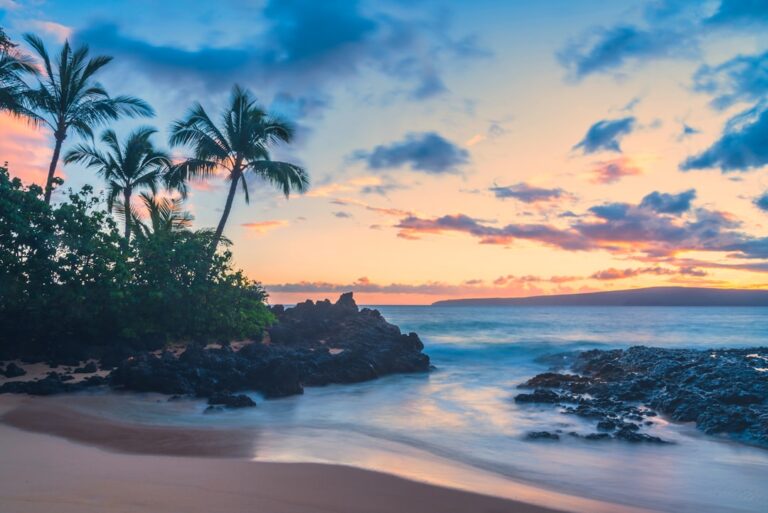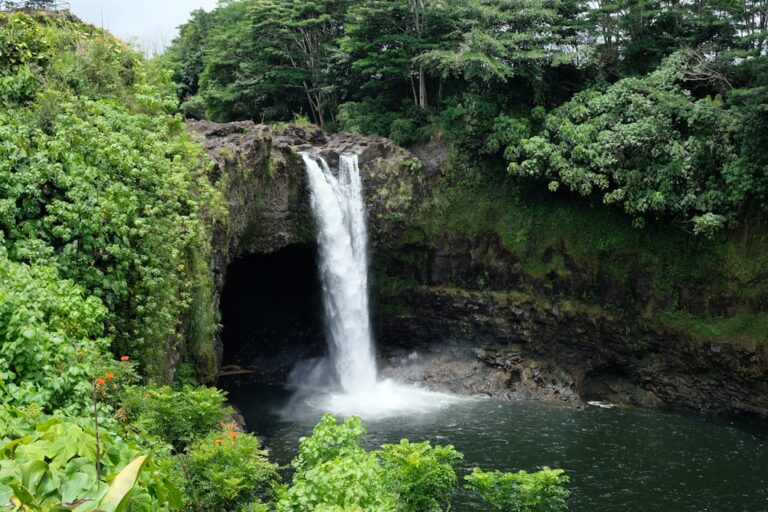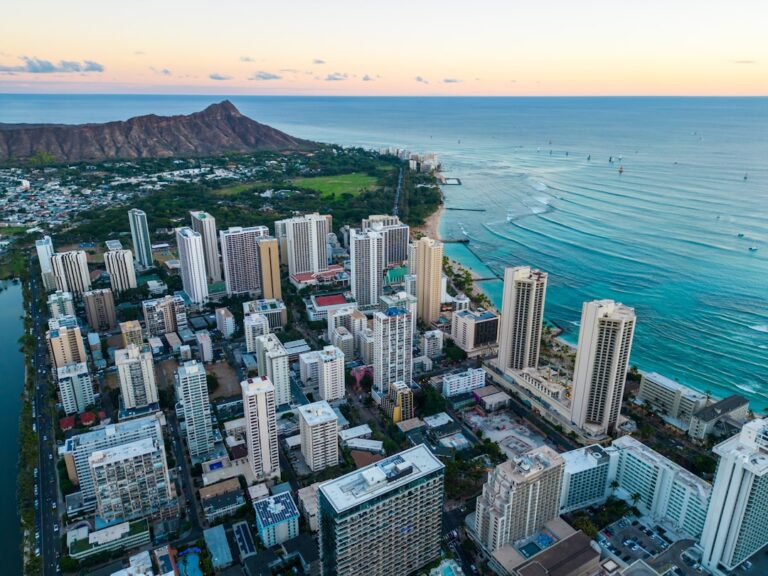
Hawaii isn’t one destination — it’s six inhabited islands, each with a slightly different climate, terrain, and tourist rhythm. “Best month to visit Hawaii” is the wrong question if you’ve already picked your island. Oahu, Maui, Big Island, and Kaua’i each have their own ideal months, plus their own busy weeks to avoid. Here’s the island-by-island breakdown.
For the general Hawaii calendar, start with our best month to visit Hawaii guide. For comparing island personalities, see best Hawaiian island to live on. This post focuses specifically on when to visit each island once you’ve decided where.
Best Time to Visit O’ahu
Best months overall: April, May, September, October.
O’ahu has Hawaii’s most stable year-round climate among the main islands, but Waikīkī is also Hawaii’s most consistently busy beach. Shoulder months deliver the best price-to-experience ratio.
- April–May: Excellent. Whales gone, summer crowds haven’t started, prices low. North-shore surf calming down (snorkel-friendly from mid-April).
- September: Hawaii’s quietest tourism month. Best value of the year. Trade winds are reliable; temperatures comfortable. Watch for hurricane-season activity but direct hits are rare.
- October: Similar to September. Some increased rain on windward (east) sides late in the month.
- Avoid: Christmas–New Year (most expensive of the year), Triple Crown surfing weeks on the North Shore (mid-November to mid-December, parking nightmare).
For watching big-wave surf specifically, target December through February. The Banzai Pipeline, Sunset Beach, and Waimea Bay all peak in this window — see our Hawaii surf season guide for the contest calendar.
For a deeper Oahu-only breakdown — including week-level recommendations, average rainfall by zone, the value-vs-experience tradeoff for every month, and the few specific weeks that consistently outperform — see our best time to visit Oahu guide.
Best Time to Visit Maui
Best months overall: April, May, September.
Maui has Hawaii’s most dramatic side-to-side weather variation. Lahaina and Wailea on the west and south are dry nearly always; Hana and Upcountry catch significant rain.
- Late January–early March: Peak humpback whale season. The Au’au Channel between Maui, Lana’i, and Moloka’i is the most concentrated breeding ground in the Pacific. Sightings nearly guaranteed on boat tours. See our Hawaii whale season guide.
- April–May: Whales linger through April. Weather is reliably dry on the leeward coasts. Prices drop after Easter.
- September: Maui’s best-value month. Quiet, warm, dry. Local life resumes after summer.
- November: First humpback whales reach the Au’au Channel mid-month — early sightings from Lahaina whale-watching boats typically begin around November 15. Rates hold at September lows for the first three weeks, then spike for Thanksgiving week. Best window for early whale action at shoulder pricing: November 1–21.
- Avoid: Late March / early April if it overlaps US spring break — Maui takes the brunt of family travel. Christmas through New Year (rates triple). Golden Week (Japanese travel, May 3–6) in Ka’anapali and Wailea.
If your trip is built around the Road to Hana, weather makes a huge difference. Late spring through early fall gives you the best chance of clear waterfalls and dry hiking on the back-road sections.
Best Time to Visit the Big Island (Hawai’i Island)
Best months overall: April–May, September–October.
The Big Island is the most geographically diverse — you can drive from a beach to an active volcano summit in 90 minutes, passing through 8 of the world’s 13 climate zones. The Kona side is dry most of the year; Hilo on the east side averages over 120 inches of annual rainfall.
- April–May: Reliable weather. Manta ray night snorkels at their calmest. Kona’s beaches at their most reliable.
- September–October: Big Island gets the quietest tourism numbers, especially on the Hilo side. Best for travelers who want fewer crowds at Hawai’i Volcanoes National Park.
- November: Kona and the west coast stay dry and warm (78–80°F) — shoulder pricing extends through the third week. First humpback whale sightings appear off the Kohala Coast; tours from Kailua-Kona begin picking up activity. Thanksgiving week (November 26, 2026) briefly lifts rates before the post-holiday drop. Hilo and the Hamakua Coast enter their wet season — plan Volcanōes National Park visits from the Kona side.
- July–August: Hot in Kona (mid-80s°F) but workable. Hurricane season most active — keep an eye on the forecast.
- Avoid: The whole winter if your trip depends on Hilo (heavy rain). Mid-March / early April if Hawaii Tropical Bioreserve or Volcanoes National Park is your priority (closures from spring break traffic).
Volcanoes National Park is open year-round; eruptive activity is dictated by Kīlauea, not the calendar. Check the USGS Hawaiian Volcano Observatory before your trip for current conditions. For when to actually go and how to plan around active episodes, see our Hawaii volcano viewing guide.
The Big Island is also the best stargazing destination in Hawaii. Mauna Kea’s Onizuka Visitor Information Station at 9,200 feet delivers some of the darkest accessible skies on Earth — see our Mauna Kea stargazing guide for the access rules (which changed in 2024) and the practical visit plan.
Best Time to Visit Kaua’i
Best months overall: May, June, September.
Kaua’i is the wettest of the main islands and the most weather-sensitive. The north shore (Hanalei, Princeville, Ke’e Beach) gets the heaviest rain of any populated US location — Mt. Wai’ale’ale near the center holds the world record for annual rainfall. Stick to the south and west for the driest conditions in winter.
- May–June: The single best Kaua’i window. North-shore beaches are reliably calm and snorkelable. Nā Pali Coast boat tours and Kalalau Trail hikes are both on. Prices haven’t spiked yet for summer.
- September: Outstanding shoulder-season value. Note that some businesses cut back hours during the lull.
- July–August: Peak season. Warm and busy. Hanalei Bay is at its best for swimming.
- Avoid: November through March if the north shore is your priority — Hanalei road can flood for days at a stretch. Christmas–January peak pricing.
Kaua’i’s most famous hike — the Kalalau Trail on the Nā Pali Coast — requires a permit and is best done May through September. Winter rain makes the trail dangerous and sometimes impassable.
Best Time to Visit Lana’i
Best months overall: April–October.
Lana’i is small, quiet, and reached by ferry from Maui or a short flight from Honolulu. Two Four Seasons hotels dominate the tourism scene; the rest of the island feels like a remote outpost.
- April–October offers the calmest conditions for the ferry and the best beach access at Hulopo’e Bay.
- November–March is rougher; the ferry can cancel runs, and Manele Bay can get choppy.
- Honeymooners, golfers, and travelers wanting a quiet escape do well here in shoulder seasons (April–May, September).
Best Time to Visit Moloka’i
Best months overall: April–October.
Moloka’i is the most low-key of the inhabited Hawaiian islands. The North Shore sea cliffs are the tallest in the world; Kalaupapa (the former Hansen’s disease settlement, now a National Historical Park) sits on a peninsula at their base.
- Late spring through early fall offers the best weather and most reliable mule tours into Kalaupapa.
- Winter brings high surf and heavy rain. Most visitor activities pause.
- Travel is most rewarding for visitors comfortable with limited tourist infrastructure — there’s no resort scene.
How to Choose: Multi-Island Trip Timing
If you’re island-hopping, the calendar gets more complex. Some pairings work better in certain months:
- Oahu + Maui in May or September: Both islands at their shoulder-season best. Easiest to balance city, beach, and outdoor activity.
- Big Island + Maui in late January–February: Whale season on both, volcanic activity at Kīlauea visible in cooler weather, comfortable for hiking Haleakalā.
- Kaua’i + Oahu in June: Best snorkeling and best beach weather on both, before peak summer crowds.
- Avoid: Pairing winter Kaua’i with a north-shore Oahu surf goal in the same trip — the weather windows you want for each are different.
Inter-island flights (Hawaiian, Southwest, Mokulele) and ferries (Lana’i, Moloka’i) operate year-round but cancel more often in winter storms.
Island-by-Island Quick Reference
- Best weather: Maui (west / south side) is the most reliably dry. Big Island Kona side runs a close second.
- Cheapest: Big Island, especially Hilo and Volcano area. Kaua’i in shoulder season is also affordable.
- Calmest seas (year-round): Maui west coast and Big Island Kona coast.
- Most reliable winter trip: Big Island. Both coasts have dry-side options.
- Most weather-sensitive: Kaua’i, especially north shore in winter.
- Best for first-time visitors: Oahu (logistics) or Maui (variety).
Months to Avoid Across All Islands
A few periods consistently disappoint visitors regardless of which island they pick:
- December 20 – January 5: The most expensive two weeks of the year on every island. Beaches and restaurants packed.
- US Spring Break (mid-March to mid-April): Crowds concentrate on Maui and Oahu; flights spike.
- Hurricane peak (mid-August to late September): Most direct-impact risk. Travel insurance worth the cost.
- Heavy rainy stretches on the wet side of each island—usually in late winter. Always check forecast 5 days out.
For more on Hawaii’s natural hazard calendar, see our Hawaii hurricane season guide and the broader Hawaii natural disasters overview.
Frequently Asked Questions
Which Hawaiian island has the best weather year-round?
Maui’s west and south coasts (Lahaina to Wailea) are statistically the driest of the main inhabited islands. The Big Island’s Kona side is a close second.
What’s the worst time to visit Hawaii?
The Christmas–New Year window is the most expensive across every island. Late-summer hurricane peak (mid-August through September) carries the most direct-storm risk, though hits are rare.
When is the best time to visit Maui?
April, May, and September. Late January through early March is best if whales are the goal. Avoid spring-break weeks and Christmas / New Year.
When is the best time to visit Kaua’i?
May, June, and September. The north shore is essentially summer-only because of winter surf and rain. The south coast holds up year-round.
When is the best time to visit the Big Island?
April through October. Kona and the leeward coast are reliable year-round; Hilo and the east side are wet from November through March. Volcanoes National Park is open year-round.
When is the best time to visit O’ahu?
April, May, September, October. North-shore surf watchers should target December–February. Avoid the Christmas window for pricing reasons.
Can I visit multiple Hawaiian islands in one trip?
Yes — most multi-island trips run 10–14 days. Inter-island flights are short (under an hour) and frequent. Shoulder seasons (May, September) work best for multi-island itineraries.
Is one Hawaiian island enough for a first trip?
For trips under a week, yes — pick one (Maui or Oahu for first-timers) and go deep. For trips of 10+ days, two islands is comfortable. Three becomes packing-and-flying-heavy.
Bottom Line
Don’t pick “best month to visit Hawaii” generically — pick “best month for the island I’m visiting.” Maui and the Big Island are forgiving year-round on their leeward sides. Kaua’i is summer-only on its north shore. O’ahu is most weather-stable but most crowd-sensitive. Match your timing to your island and you’ll get the best experience of your trip.
For more on planning around Hawaii’s natural rhythms, see our guides to whale season, surf season, rainy season, and the best time to snorkel.
Going Deeper: Island and Month-Specific Guides
If you’ve narrowed your trip to a specific island or are deciding between two specific months, these companion guides go into substantially more detail than the island summaries above.
- Island-specific: Best time to visit Oahu (month-by-month with pricing) · Best time to visit Maui (weather, whales, value windows)
- Month-specific: Hawaii in December (weather, holiday pricing, the two value windows)
- Activity-specific: Hawaii volcano viewing · Mauna Kea stargazing · Watching whales in Hawaii
- Logistics: Inter-island travel · Hawaii weather before you move