Maui has 81 named beaches across roughly 30 miles of coast, but the gap between the great ones and the merely scenic is bigger than people expect. Conditions have shifted, too — especially after the 2023 Lahaina fire, which tightened access along the West Maui coast. This guide tracks which beaches are back, which have new access rules, and which still deliver the kind of day where you don’t want to leave. Drawing on official ocean-safety data, state park rules, and visitor reports, it ranks the 12 Maui beaches that consistently stand out, with the trade-offs each one carries: parking, shade, surf, current, and the kind of trip they actually suit.
How These 12 Beaches Were Ranked
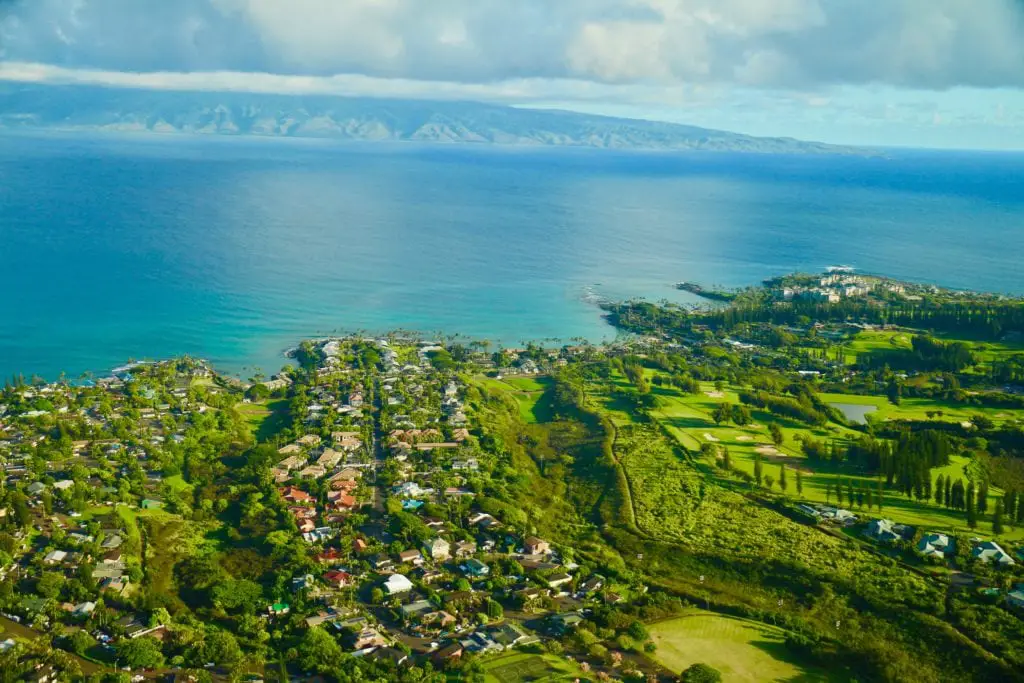
Maui’s beaches break into four geographic clusters and each has a personality. West Maui (Kaanapali, Kapalua, Napili) is the calm-water, family-resort coast. South Maui (Wailea, Makena, Kihei) is the dry, sunny, snorkeling-friendly coast. The North Shore (Paia, Hookipa) is for surfers and wind. Hana and the east side hide a handful of remote knockouts that take 2 to 3 hours to reach by car. Four factors drove the ranking: ocean safety in normal trade-wind conditions, parking and access (post-fire West Maui access has tightened significantly), shade and facilities, and how well each beach rewards a full day there.
Three free public tools are worth checking before any Maui beach day: the Maui Ocean Safety swell and surf reports at oceansafety.hawaii.gov/maui/, the NOAA tide and marine forecast for Kahului at tidesandcurrents.noaa.gov, and the Hawaii DLNR alerts page at dlnr.hawaii.gov/dar for any current closures (jellyfish blooms, shark sightings, brown-water advisories). If you check these the night before, you avoid 90% of the bad-beach-day stories you hear.
The 12 Best Beaches on Maui, Ranked
1. Kapalua Bay Beach (West Maui)
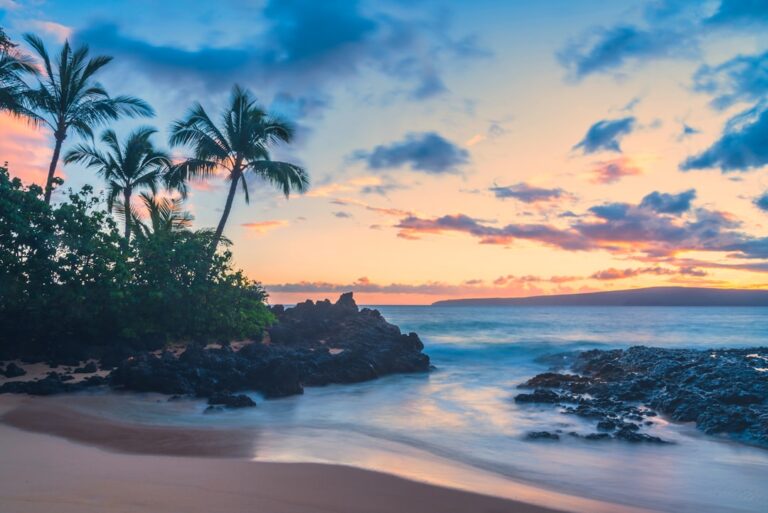
Kapalua ranks first because it’s the most reliably calm, swimmable, and snorkel-friendly beach on Maui’s lee shore. The bay is shaped like a near-perfect crescent with two rocky points that knock down the swell, so most days you get 1- to 2-foot water inside the bay even when outside it is 4 feet.
Free public parking is at the small lot off Lower Honoapiilani Road and fills by 9 a.m.; arriving by 7:30 a.m. or again after 3 p.m. is the reliable workaround. There are public restrooms and outdoor showers at the entrance. Snorkeling is best on the right (north) point where you’ll see yellow tang, butterflyfish, and occasional honu (green sea turtles, which are federally protected — keep 10 feet of distance per NOAA Fisheries).
2. Wailea Beach (South Maui)
Wailea is the south-shore equivalent of Kapalua: a half-mile crescent with consistent calm water, soft white sand, and well-maintained public access despite being fronted by the Four Seasons and Grand Wailea resorts. Hawaii law guarantees public beach access (per HRS Chapter 205A), and Wailea’s two free public parking lots (one between the Four Seasons and Grand Wailea, one north of the Andaz) hold maybe 50 cars combined — they fill by 10 a.m. on weekends. Restrooms, showers, lifeguards on weekends. Snorkeling along the south point toward Polo Beach is decent in the morning before trade winds pick up around 11 a.m.
3. Big Beach / Oneloa (Makena State Park, South Maui)
Two-thirds of a mile of wide golden sand, very few buildings in sight, and the kind of view that makes you stop talking. The catch: Big Beach has a punishing shorebreak that breaks directly onto sand, and the Hawaii Department of Health’s ocean injury data routinely lists Makena as one of the top three Maui beaches for spinal injuries. Don’t bodysurf this one unless you’re experienced. Parking is in two paved state-park lots, $10 per non-resident vehicle, and the lots open at 5 a.m. and close at 7 p.m. (per the DLNR Makena State Park page). Lifeguards staff the central tower 8 a.m. to 4:30 p.m.
4. Hamoa Beach (East Maui, near Hana)
James Michener called Hamoa “the only beach I’ve seen that is in every detail flawless,” and the verdict still holds with most visitors. It’s a 1,000-foot crescent of dark gold sand backed by 30-foot lava cliffs, with body-surfable shore break and almost no shade. The reason it’s at #4 and not #1: you have to drive the Road to Hana to get there — 52 miles, 620 curves, 59 one-lane bridges, and 2.5 to 3 hours one-way from Kahului. The parking pull-off is tiny (8 to 10 cars) and unmarked. Pack water and reef-safe sunscreen — no facilities except resort-side restrooms reserved for Travaasa Hana guests.
5. Kaanapali Beach (West Maui)
The classic 3-mile West Maui resort strip running from Black Rock at the Sheraton south to the Hyatt Regency. Wider sand than Kapalua, more services (rentals, bars, beach chairs), more bodies. Public parking is at Kahekili Beach Park (north end), Hanakao’o Beach Park (south end, also called Canoe Beach), and the smaller Kaanapali Beach Park lot — all free, all fill by 9:30 a.m. on weekends.
Black Rock at the north end is one of Maui’s most popular shore snorkeling spots and home to a nightly cliff-jumping ceremony at sunset (the Sheraton has run it since 1963). Lahaina town just south of here was destroyed in the August 2023 fire and is still rebuilding — see the section below.
6. Napili Bay (West Maui)
A 600-foot pocket bay between Kapalua and Kaanapali that’s the size of a soccer field and feels like a private cove even when it’s busy. Easy entry into chest-deep water within a few steps. Sea turtles forage on the south point most mornings — Visitors regularly see 3-4 turtles in a single snorkel session here. Free street parking on Napili Place is the only public option and runs out by 8 a.m. Restrooms at the south end. No lifeguards, but the water is forgiving enough that this is one of the few beaches calm enough for a confident young snorkeler.
7. Hookipa Beach Park (North Shore)
This is where Maui sleeps its sea turtles. Every afternoon between roughly 3 p.m. and 5 p.m., anywhere from 20 to 60 honu haul out on the sand at the east end. Volunteers from the Hawaii Wildlife Fund cordon them off with orange tape (stay 10 feet back; the federal Endangered Species Act fine starts at $500). The west end is one of the best windsurfing and surfing breaks on the island and an actual world tour venue (Aloha Classic, late October). Free parking on the bluff above. Don’t swim here unless you surf — strong rip currents and shallow reef.
8. Honolua Bay (NW Maui)
Marine reserve since 1978, no fishing or take of any kind, and on calm summer days one of the top 5 snorkel sites in the state. Entry is over slippery basalt boulders (water shoes are not optional) and the bay opens up underwater into a textbook horseshoe reef with 30-foot visibility most of June through September. Winter (November to March) brings 15- to 25-foot swell and turns Honolua into a world-class right point break — not swimmable in those months. Free parking is along the highway shoulder above the trail; the 5-minute jungle trail down is unmarked but obvious.
9. DT Fleming Beach Park (West Maui)
Named “Best Beach in America” by coastal scientist Dr. Stephen Leatherman in 2006 for its mix of soft sand, body-surfable but lifeguarded shore break, picnic facilities, and pine-tree shade. The shore break gets pushy in winter — November to April you’ll see 4- to 6-foot waves breaking on sand. Lifeguards 9 a.m. to 5 p.m. daily. Free paved parking (about 40 stalls) and clean restrooms with outdoor showers. The top pick for families with kids who want to bodyboard but you also want a lifeguard in sight.
10. Kamaole Beach Parks I, II, and III (Kihei)
Three adjacent neighborhood beach parks along South Kihei Road. Kam I has the deepest water (good for adult swimmers), Kam II has the largest grass picnic lawn, and Kam III has the playground and is where most families with toddlers end up. Combined, the Kams give you about 1.5 miles of usable south-shore coast with consistently calm morning water, lifeguards at I and III, and free parking that’s actually findable. Sunset crowd is heavy at Kam III — bring a chair if you want a spot at the south rocks.
11. Polo Beach (South Maui)
The lesser-known southern neighbor of Wailea Beach, sitting in front of the Fairmont Kea Lani. Smaller than Wailea but almost always less crowded. Same calm water, same white sand, same morning snorkeling on the rocks. Public parking is a small free lot at the south end of Kaukahi Street, maybe 30 stalls. If the Wailea Beach lot is full by 10 a.m., Polo is the go-to backup. Restrooms and outdoor showers.
12. Baldwin Beach Park (North Shore, Paia)
The North Shore’s calm-water alternative to Hookipa. Wide, mile-long crescent of soft sand with a protected swimming hole called “Baby Beach” at the west end where toddlers and dogs play in knee-deep water (it’s a federal misdemeanor to bring dogs to many Hawaii beaches per Maui County Code §13.04A; Baldwin allows them on-leash in the designated west section only). Lifeguards 9 a.m. to 5 p.m. Free parking lot ~50 stalls; fills on weekends by 10 a.m. Five-minute walk to Paia town for lunch.
2026 Updates — What’s Changed Since the Lahaina Fire
The August 8, 2023 Lahaina fire killed 102 people and destroyed roughly 2,200 structures in Lahaina town (figures per the Fire Safety Research Institute’s official report released August 2024). The fire did not directly burn the major resort beaches north of town — Kaanapali, Napili, Kapalua, DT Fleming, Honolua all remain open.
What did change: in the months after the fire, West Maui visitor access was managed through a phased return that ran from October 8, 2023 through April 1, 2024. Mayor Richard Bissen lifted the last entry restrictions in spring 2024, and as of October 2026 all of the West Maui beaches listed here are openly accessible to visitors. Honolulu Civil Beat’s ongoing Lahaina coverage remains the best place to track rebuilding milestones.
Lahaina town itself — Front Street, the harbor, the banyan tree — is in active rebuild. The banyan survived and was certified alive in 2024 per Honolulu Star-Advertiser reporting. Visitors are asked to stay away from the burn zone (roughly the area between Front Street and the highway) which remains fenced. Almost every Lahaina-based business that survived has reopened somewhere else along the West Maui coast. If you stayed at a Kaanapali resort before the fire, you’ll find your beach unchanged but your sunset-dinner restaurant likely relocated.
October–November 2026 beach conditions: October marks Maui’s seasonal transition—north swells build mid-month, progressively narrowing Honolua Bay’s snorkel window and drawing surfers to Hookipa and DT Fleming. South Maui (Wailea, Makena, Kihei) remains the most reliable zone for calm swimming through October and into November. By mid-November, Honolua Bay’s world-class surf season opens in earnest; humpback whales typically arrive around November 15, making snorkeling at Kapalua Bay and Napili a late-November bonus. One note for fall visitors: University of Hawaii tiger shark research shows shallow-water activity peaks in October and November in Maui waters—avoid murky river-mouth areas (Honokowai, Kahana stream outflows) at dawn or dusk during this period, and check the DLNR Division of Aquatic Resources for current advisories.
Best Maui Beach by Trip Style
Match the beach to the day you actually want to have.
| If you want… | Go to | Why |
|---|---|---|
| Calm water with snorkeling | Kapalua Bay or Napili Bay | Reef-protected, easy entry, turtles common |
| Resort amenities + lifeguards | Wailea Beach or Kaanapali | Showers, food, rentals, gentle surf |
| Wide sand and dramatic scenery | Big Beach (Makena) or Hamoa | Postcard views; respect the shore break |
| Sea turtle viewing | Hookipa (afternoons) | 20 to 60 honu daily; 10-foot rule |
| Toddler-friendly | Baby Beach (Baldwin) or Kam III | Knee-deep, lifeguards, playground |
| Marine-reserve snorkeling | Honolua Bay (summer only) | No-take zone since 1978; 30-foot viz |
| Surf and wind | Hookipa (advanced) | World-tour venue, strong currents |
| Sunset views | Kam III, Wailea, or Kaanapali | Unobstructed west-facing horizon |
That covers the common trip styles. The rest is logistics.
Safety, Parking, and Practical Notes
Maui Ocean Safety reports about 50 to 75 rescues per year at lifeguarded beaches, and the most common cause is non-residents underestimating shore break and rip currents on south swells (June through September) and north swells (November through March). The Hawaii Department of Health spinal-cord injury data shows shore break breaks more vertebrae than any other ocean activity on Maui. The rule that matters: if a wave is breaking on dry sand instead of in the water, stay out of it.
Reef-safe sunscreen has been state law since January 1, 2021 (per Hawaii Department of Health Act 104). Oxybenzone and octinoxate are banned; mineral zinc or titanium dioxide is the alternative. The DLNR fine for selling non-compliant sunscreen is up to $1,000 but enforcement against tourists is typically a warning. Bring your own reef-safe sunscreen from home — Maui ABC stores mark it up roughly 2x compared to mainland prices, which matches the broader pattern documented in our Hawaii grocery prices guide.
Parking on Maui is almost always free at public beaches (DLNR state parks like Makena charge $10 per non-resident vehicle plus $5 per person; Hawaii residents are free). Resort-fronted public lots fill by 9 to 10 a.m. on weekends and by 11 a.m. on weekdays. The workable plan is an 8 a.m. arrival or a 3 p.m. arrival. Midday arrivals between 11 a.m. and 2 p.m. usually mean driving four beaches before finding parking, which is a waste of a Maui day.
How Maui’s Beaches Compare to Other Islands
Maui has more lifeguarded beaches per capita than any other Hawaiian island (about 16 lifeguarded stations across roughly 30 miles of useful coast, per Maui Ocean Safety’s 2024 staffing report). The water at Wailea and Kapalua is reliably calmer than the best Oahu beaches; Maui’s calm-water options rank ahead of Oahu’s in our best beaches on Oahu guide. The trade-off is Maui has fewer snorkel sites at world-class fish-density levels than the Big Island’s Two-Step or Kauai’s Tunnels Beach — see our best snorkeling locations in Hawaii roundup for cross-island comparisons.
If you’re trying to pick which island to visit primarily for beaches, the consistent pattern across the data is that Maui wins for variety, Oahu wins for accessibility (everything is 30 minutes from Honolulu Airport), and Kauai wins for raw beauty per square mile. We’ve broken this down month-by-month in our best time to visit each Hawaiian island guide, and seasonally in our best time to visit Maui breakdown.
Frequently Asked Questions
What is the safest beach for kids on Maui?
Baby Beach at the west end of Baldwin Beach Park in Paia is the most toddler-friendly water on the island — a natural reef-rim creates a 200-foot wading pool that stays knee-deep at most tides. For older kids who can swim, Kamaole III in Kihei has lifeguards on duty 9 a.m. to 5 p.m., a playground, picnic tables, and the gentlest shore break on the south coast.
Can I visit Lahaina beaches after the 2023 fire?
Yes. All of the West Maui beaches listed here — Kaanapali, Napili, Kapalua, DT Fleming, Honolua — remained physically untouched by the fire and have been openly accessible since spring 2024. Lahaina town itself is still rebuilding and visitors are asked to stay clear of the fenced burn zone, but the resort beaches just north of town are operating normally with full lifeguard coverage.
Do I need to pay to visit Maui beaches?
Most Maui beaches are free for everyone. Hawaii law guarantees public shoreline access. The exception is state parks — Makena (Big Beach), Waianapanapa, and Iao Valley charge $10 per non-resident vehicle plus $5 per non-resident person. Hawaii residents enter free. Resort-fronted beaches like Wailea and Kaanapali have free public parking lots that fill early.
When is the best time of year for Maui beaches?
April through October gives you the calmest south-shore water (Wailea, Kihei, Makena) and the best snorkel conditions in Honolua Bay. November through March brings 6- to 25-foot north swell that makes West and North Shore swimming dicey but powers world-class surfing at Honolua, Hookipa, and Peahi (Jaws). South-shore beaches stay swimmable year-round.
Are there sharks at Maui beaches?
Tiger sharks live in Maui waters year-round and the DLNR records 5 to 10 reported shark encounters per year across all Hawaiian islands. The University of Hawaii’s tiger shark research at the Hawaii Institute of Marine Biology shows tiger activity peaks in October and November in shallow Maui waters. The standard precaution is to avoid murky river-mouth water after heavy rain (Honokowai, Kahana stream outflows) and dawn or dusk swims.
What about jellyfish on Maui?
Box jellyfish swarm South Maui beaches 8 to 10 days after each full moon — the schedule is predictable and DLNR publishes the influx dates 12 months ahead. Check the calendar at the DLNR Division of Aquatic Resources page before your trip. Box stings hurt for hours but rarely require hospitalization. Vinegar at lifeguard stations neutralizes the stingers.
The Bottom Line on Maui Beaches
If you have one day, go to Kapalua Bay in the morning and Wailea in the afternoon. If you have three days, add Hookipa for the afternoon turtle haul-out and Hamoa as a Hana-day capstone. If you have a week, work in Honolua Bay snorkeling (summer only), Kamaole III for the kid-friendly sunset, and Big Beach for one big-sky walking afternoon. The beaches haven’t changed since the fire. The town next door has. Plan around respect, ocean safety, and an 8 a.m. or 3 p.m. arrival, and Maui’s coast will still deliver what made you book the ticket.