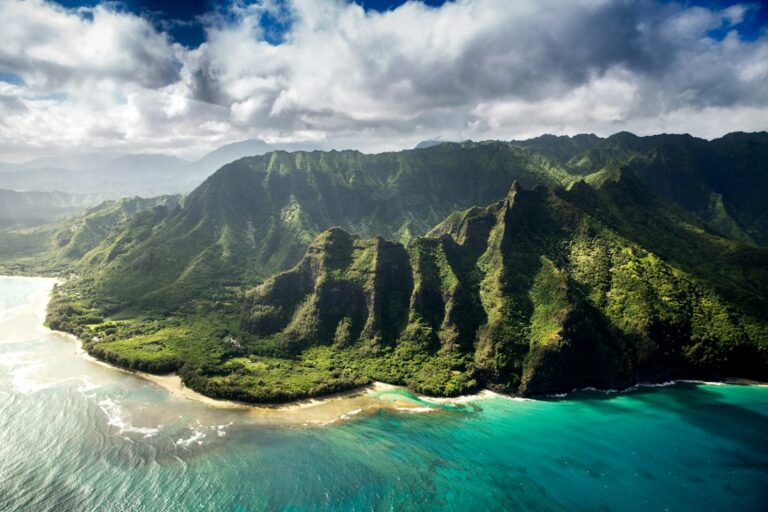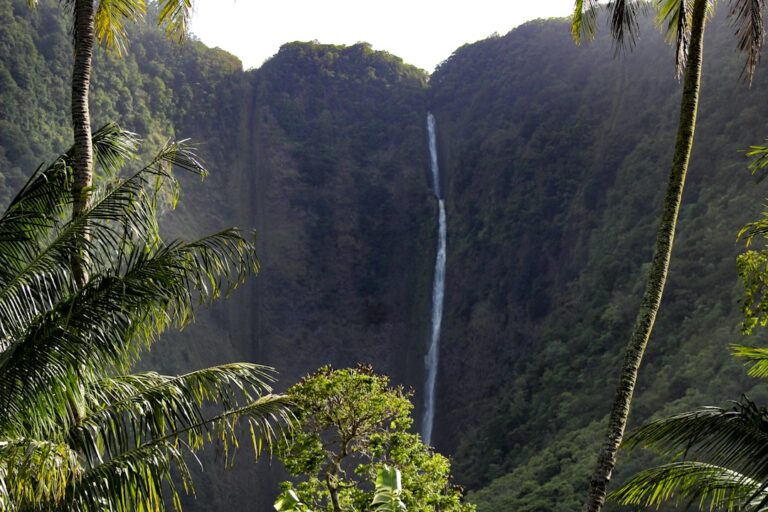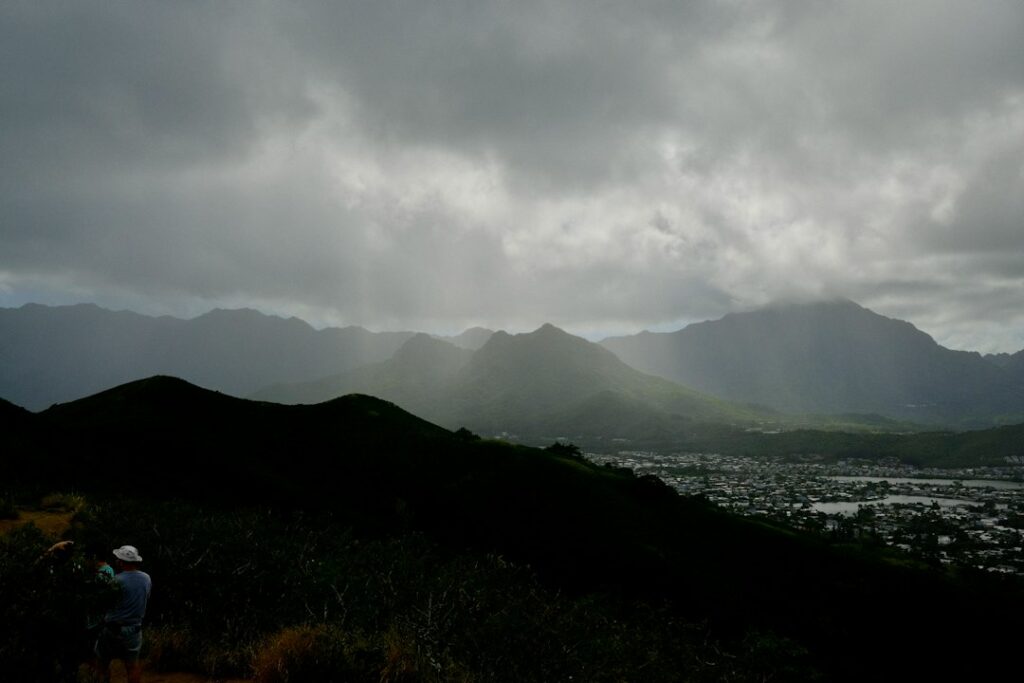
Iao Valley State Monument sits three miles west of Wailuku town in central Maui, at the head of a green amphitheater carved by Iao Stream into the West Maui Mountains. The park protects the 1,200-foot Iao Needle — known in Hawaiian as Kukaemoku — and a 0.6-mile paved loop that most families finish in roughly 45 minutes. Non-residents pay $10 total: $5 per vehicle and $5 per person.
The monument has earned its reputation as Maui’s most reliable rainy-afternoon backup. When Hana Highway closes because of debris flows across mile markers 12 through 30, Iao Valley offers a paved, sheltered stroll that stays open through most weather. The upper valley receives more than 300 inches of rain a year, but the loop drains quickly, and Wailuku’s leeward pocket often stays drier than the windward Hana coast.
This article walks through reservation logistics on gostateparks.hawaii.gov, the loop layout, the 1790 Battle of Kepaniwai that gives the neighboring Heritage Gardens their name, and how a soggy morning on Hana Highway can pivot into a rewarding central-island afternoon plan.
What Iao Valley State Monument protects
The 4,000-acre valley cradles the headwaters of Iao Stream and the eroded volcanic pillar called Iao Needle. Geologically, the needle is a resistant basalt spine left behind as softer rock washed away over roughly 1.7 million years. It rises 1,200 feet above the valley floor and 2,250 feet above sea level, framed by ridgelines that regularly pull mist off the trade winds every afternoon.
The site holds deep cultural weight for Native Hawaiians. Iao was one of the traditional burial places for Maui ali’i (chiefs), and the valley walls hide caves that remain kapu (restricted) to this day. Visitors stay on the paved loop precisely because much of the surrounding land is considered sacred; off-trail scrambling is prohibited and can trigger citations from state park rangers stationed at the entrance kiosk.
The monument itself covers 6.2 acres, a small slice of the wider valley managed by the Hawaii Department of Land and Natural Resources. Core visitor infrastructure — parking lot, restrooms, the paved loop, ethnobotanical garden, and a covered overlook shelter — sits inside that footprint. Everything past the shelter belongs to watershed reserve, which is why the trail feels short compared to Kauai’s canyon parks like the Kokee tier system.
Reservation and entry fees
Hawaii’s state parks charge non-residents a per-person entry fee plus a per-vehicle parking fee. At Iao Valley the breakdown is $5 per non-resident visitor and $5 per vehicle, so a car with two mainland adults pays $15 total. Children age 3 and younger enter free, and Hawaii residents with a valid state ID pay nothing for either the vehicle or the per-person charge.
Reservations open 30 days in advance through gostateparks.hawaii.gov, the official state parks portal. Time slots run in two-hour windows starting at 7 a.m. and closing at 6 p.m. Same-day bookings often show availability on weekdays outside spring break, but weekend afternoons in March, June, and December frequently fill by 10 a.m. The system mirrors the Diamond Head Crater booking window used on Oahu.
Each reservation returns a QR code by email. Rangers scan it at the entry kiosk between the parking lot and the trailhead. Refunds require cancellation at least 24 hours before the reserved slot; no-shows forfeit the full amount. Groups larger than six vehicles must contact the parks division directly rather than book through the standard online system.
What the fee compares against
| Attraction | Non-resident entry | Reservation system | Booking window |
|---|---|---|---|
| Iao Valley State Monument | $10 per car of 2 | gostateparks.hawaii.gov | 30 days |
| Diamond Head Crater (Oahu) | $5 per person + $10 vehicle | gostateparks.hawaii.gov | 30 days |
| Hanauma Bay (Oahu) | $25 per person 13+ | pros.hnl.info | 48 hours |
| Haleakala Sunrise (Maui) | $1 permit + $30 park fee | recreation.gov | 60 days |
| Waianapanapa (Hana) | $5 per person + $10 vehicle | gostateparks.hawaii.gov | 30 days |
The table shows why Iao often becomes the value pick on a Central Maui itinerary: two adults pay $15 total instead of the $50 that Hanauma Bay’s per-person model would extract on Oahu, or the recreation.gov queue that Haleakala’s summit slot demands 60 days out.
The 0.6-mile paved loop
The loop begins at the ranger kiosk and follows a paved footpath across a footbridge over Iao Stream, then climbs a set of concrete stairs to a covered overlook. From the overlook, the paved path continues down the far side of the ridge and returns through an ethnobotanical garden showcasing Polynesian introduced plants like kalo (taro), ‘ulu (breadfruit), and ki (ti). The full circuit runs 0.6 miles round trip.
Elevation gain is modest — about 133 steps up to the overlook, or roughly 100 vertical feet. The paved surface handles strollers, walking canes, and most mobility devices, though the two staircase sections are unavoidable if the overlook itself is the goal. A lower streamside path bypasses the stairs entirely and reaches a small pool where locals sometimes wade on hot afternoons.
Most visitors budget 45 minutes at the monument, including 10 minutes at the overlook for photos and 15 minutes in the ethnobotanical garden. Add another 20 minutes if the streamside path draws people in. Rangers close the gate at 6 p.m. sharp, and cars still inside the lot after closing can face a $50 late-exit fee posted on the kiosk board.
Loop feature summary
| Feature | Distance from lot | Time to explore | Notes |
|---|---|---|---|
| Footbridge over Iao Stream | 200 feet | 5 minutes | Photo point for the needle |
| Overlook shelter (133 steps) | 0.15 mile | 10 minutes | Best framing of Kukaemoku |
| Return switchback | 0.35 mile | 5 minutes | Downhill, paved |
| Ethnobotanical garden | 0.5 mile | 15 minutes | Labeled Polynesian plants |
| Streamside path | 0.05 mile off loop | 15 minutes | Optional wade |
The 1790 Battle of Kepaniwai
Iao Valley’s most famous historical event unfolded in the spring of 1790, when Kamehameha I invaded Maui with roughly 1,200 warriors and two mounted cannons acquired from Western traders. Maui’s forces, led by Kalanikupule, retreated up Iao Valley expecting the terrain to favor defenders. The narrow walls of the valley funneled the fight into hand-to-hand combat along Iao Stream.
Kamehameha’s cannons — nicknamed Lopaka — devastated the Maui line. So many warriors fell into and across the stream that their bodies temporarily dammed the flow. The battle earned the name Kepaniwai, which translates as “the damming of the waters.” Historians estimate the fight lasted less than a day, and Maui was effectively absorbed into Kamehameha’s growing kingdom shortly afterward.
Interpretive signage inside the monument tells this story in condensed form, and Kepaniwai Heritage Gardens next door expands on it through cultural pavilions. Reading the signage before the overlook adds real texture to the view — the same slopes that funnel afternoon showers today once channeled musket fire and stone weapons into a bottleneck battle that consolidated the Hawaiian Islands under one ruler.
Kepaniwai Heritage Gardens pairing
Kepaniwai Heritage Gardens sits 0.4 miles downhill from the Iao Valley entrance on Iao Valley Road. Entry is free, parking is free, and the county-managed grounds open daily from 7 a.m. to 7 p.m. The gardens feature architectural pavilions representing the ethnic groups that shaped modern Maui: a Hawaiian hale, a Chinese pagoda, a Japanese teahouse, a Portuguese villa, a Filipino nipa hut, and a Korean shrine.
Because Kepaniwai charges nothing, it functions as the natural “before or after” stop for Iao Valley. Many visitors reserve an 11 a.m. Iao slot, exit around noon, then spend 60 minutes walking Kepaniwai’s pavilions and eating a packed lunch at the covered pavilion tables. Restrooms, drinking fountains, and shaded picnic benches make it a friendlier lunch stop than the monument itself, which has no food service.
The gardens also give context to the battle — a Hawaiian pavilion sits at the site where the stream reportedly ran red, and interpretive plaques describe Kalanikupule’s escape route over the pali. Together, the two stops cover roughly 2 hours end to end, which happens to be the length of one state highway closure notification cycle when Hana Highway is under active debris removal.
When Hana Highway is washed out
Hana Highway (State Route 360) closes multiple times a year because of flash floods, rockfalls, and downed trees between Paia and Hana. Winter storms from November through March are the most common trigger, but summer Kona storms and tropical remnants can also push the highway offline. The Hawaii Department of Transportation posts real-time closure notices on its road status portal, usually within an hour of a closure decision.
Drivers who committed to a Hana day only to see a closure email at 6 a.m. face a fork: attempt the Piilani Highway back-road loop from Kula, pivot to Haleakala summit, or drop the east side altogether and pull toward Central Maui. Iao Valley is the most weather-proof of those pivots because its paved loop drains fast and the valley walls block trade-wind rain from Kula altitudes.
Rain-day pivot matrix
| Original plan | Closure signal | Best pivot | Drive time from Kihei |
|---|---|---|---|
| Hana Highway drive | Route 360 closed east of Keanae | Iao Valley + Kepaniwai | 25 minutes |
| Waianapanapa State Park | Same as above | Iao Valley loop only | 25 minutes |
| Haleakala Sunrise | Summit fog above 8,000 ft | Iao morning + Paia lunch | 25 minutes |
| Molokini snorkel | Small craft advisory | Iao + Maui Ocean Center | 25 minutes |
| Beach day South Shore | Kona storm heavy rain | Iao (Wailuku is drier) | 25 minutes |
The pivot works because Wailuku’s rainfall pattern is bimodal: the upper valley catches 300+ inches a year, but the town itself averages roughly 28 inches. Storms that flood Hana at 60 inches per event can leave Wailuku with an inch or less. Rangers rarely close the Iao loop for weather; they close it only for structural safety after major rockfall.
Weather, timing, and what to wear
Iao Valley’s microclimate splits sharply between the parking lot and the overlook. The lot sits at 800 feet elevation and typically runs 74–80°F in daytime. The overlook, only 100 feet higher, catches more mist and can feel 6–8°F cooler. Afternoon showers roll through most days between 2 p.m. and 4 p.m., often lasting only 10 to 15 minutes before the sun returns.
Rangers recommend closed-toe shoes because the paved loop grows slick in rain, and the concrete steps hold moisture. Sandals with grip work in dry weather; flip-flops are risky year-round. A lightweight rain shell packs down into a daypack and handles nearly every scenario the valley delivers. Umbrellas fight the wind at the overlook, so a hood is more practical.
Monthly climate snapshot at Iao Valley
| Month | Avg high (°F) | Avg rainfall (in) | Reservation demand |
|---|---|---|---|
| January | 77 | 4.5 | Moderate |
| March | 79 | 3.8 | High (spring break) |
| June | 83 | 0.6 | High |
| August | 85 | 0.8 | Moderate |
| October | 84 | 1.9 | Low |
| December | 78 | 3.6 | High (holiday) |
Weekday mid-morning slots (9 a.m. or 11 a.m.) offer the best balance of clear light and low crowd density. Sunset visits are technically possible until the 6 p.m. gate closure, but the valley walls block direct light from about 4:30 p.m. onward. Photographers should aim for the 10 a.m. slot when the sun clears the ridge and lights the needle head-on.
Getting there from the resort corridors
Iao Valley Road (State Route 32) begins in downtown Wailuku and dead-ends at the monument parking lot after 3.1 miles. From Kahului airport, the drive is 8.5 miles and takes 18 minutes without traffic. From Kihei via the Mokulele Highway, plan on 25 minutes across 15 miles. From Wailea, add another 10 minutes. From the Kaanapali/Lahaina corridor, expect 40 to 55 minutes depending on Honoapiilani Highway traffic.
Rental car fuel matters on Maui because gasoline in Hawaii runs consistently above the national average — often $1.30 to $1.80 per gallon higher. A round trip from Wailea to Iao Valley burns roughly 2.5 gallons in an economy car, or about $11 at recent Maui pump prices. The math changes if a full Hana Highway pivot day is chained together with Kepaniwai and Wailuku downtown.
Parking at Iao holds roughly 60 cars, and rangers turn away vehicles without a valid time-slot reservation. Overflow parking does not exist within the monument, though a small pull-off near Kepaniwai Heritage Gardens allows short-term stops. Tour buses use a separate loading zone and generally clear the area by 3 p.m.
Drive times from major Maui hubs
| Origin | Distance (miles) | Drive time (min) | Route |
|---|---|---|---|
| Kahului airport | 8.5 | 18 | Route 32 west |
| Kihei north | 15 | 25 | Mokulele Highway |
| Wailea | 21 | 35 | Piilani + Mokulele |
| Kaanapali | 27 | 45 | Honoapiilani Highway |
| Lahaina | 24 | 40 | Honoapiilani Highway |
| Paia | 10 | 22 | Hana Highway west |
| Haiku | 16 | 30 | Hana + Route 32 |
Families relocating to Haiku’s upcountry pockets often use Iao Valley as their default “guests are visiting” outing because it costs less than resort activities and delivers real cultural content in under an hour of trail time.
Combining Iao with Central Maui stops
Central Maui rewards a full-day loop that starts at Iao, drops into Wailuku’s Market Street for lunch, and finishes at either Maui Tropical Plantation in Waikapu or the Bailey House Museum. The plantation charges $20 per adult for a tram tour and free entry to its gardens. Bailey House, run by the Maui Historical Society, charges $10 for adults and holds a rotating collection of Hawaiian featherwork.
Coffee lovers can pair the visit with a stop at Wailuku Coffee Company on Market Street. The shop roasts on-island and pulls one of the shorter espresso shots on the roundup at the Maui coffee guide. Grand Prize Barbecue, Sixtwelve, and Tin Roof (a food truck near the airport) round out the lunch options within a 15-minute drive of Iao.
Households moving to Maui with school-age children often build a first-week orientation loop from Iao to Kepaniwai to Maui Nui Botanical Gardens. The route works because it costs under $30 total for a family of four, involves less than 45 minutes of driving between stops, and covers volcanic geology, plantation history, and Native Hawaiian ethnobotany in a single afternoon window suitable for jet-lagged mainland kids.
Half-day itinerary math
| Stop | Time budget | Cost (family of 4) | Notes |
|---|---|---|---|
| Iao Valley loop | 45 min | $15 | 2 adults + 2 kids under 12 |
| Kepaniwai Gardens | 60 min | Free | Bring picnic |
| Wailuku Coffee Co. | 20 min | $16 | 4 drinks |
| Bailey House Museum | 45 min | $20 | 2 adults, kids free |
| Maui Tropical Plantation | 60 min | Free (gardens) | Tram optional |
| Total half-day | ~3.5 hours | $51 | All-weather itinerary |
What relocating households should know
Mainlanders moving to Maui often discover that state park entry fees remain non-resident charges until they hold a Hawaii driver’s license or state ID. The transition takes 30 to 60 days after arrival, once residency documents (lease, utility bill, and vehicle registration) are filed. During that window, expect to pay the same $10 rate at Iao that vacationers pay.
Hawaii residents also gain access to annual state parks passes that cover parking across the system. The pass costs $40 a year for individuals and covers unlimited entries at Iao, Waianapanapa, Polipoli, and other units. For a household in Wailuku that visits Iao monthly on weekend walks, the pass pays for itself within four visits.
Central Maui’s cost of living pressures — reflected in Honolulu-area consumer price data that stands in for statewide inflation trends — make free or cheap outings like Iao and Kepaniwai valuable long-term. Maui’s housing and utility math already stretches most relocation budgets before entertainment is factored in.
Rules, safety, and stream conditions
Iao Stream can rise several feet in under 20 minutes during heavy rain, even when no rain falls at the parking lot. Water flowing off the valley walls collects in the drainage above the loop. Rangers close the streamside path when the stream reaches “brown water” status, meaning sediment-heavy flow from the upper valley. Wading during a brown-water condition risks flash-flood injury.
Off-trail hiking is prohibited across the entire monument. The lush green ridges tempt hikers, but they conceal loose scree, unstable soil, and sacred sites still used for cultural practice. State parks staff issue citations that can reach $200 per person for off-trail violations. Drone flights are also prohibited without a Special Use Permit from DLNR, which requires 60 days lead time.
Leptospirosis lives in Hawaii freshwater streams, and the Department of Health tracks cases annually through its epidemiology division. Swimming with open cuts or drinking unfiltered stream water carries real risk. Rangers post advisories at the trailhead when local water samples exceed safe thresholds, which happens seasonally after big rain events in December, January, and February.
Local news outlets like Hawaii News Now regularly cover valley closures after major weather events. In February 2023, extended rainfall caused a rock slide near the ethnobotanical garden that closed the loop for six days while crews cleared debris. Booking confirmations sent by the state parks system flag active closures automatically, and refunds are honored for reservations that fall within official closure windows.
Cultural respect and etiquette
Iao Valley remains an active site for Native Hawaiian cultural practice. Visitors sometimes see practitioners leaving ho’okupu (offerings) on stones near the overlook — small wrapped bundles of ti leaves, coins, or lei. These are not litter and should never be moved or photographed up close. Rangers ask that visitors give practitioners space and lower their voices around anyone in what looks like private ceremony.
The valley walls hold burial caves that pre-date Western contact. Removing rocks, plants, or soil from the monument is prohibited under Hawaii Revised Statutes and carries fines up to $500. Stacking rocks into cairns — a habit some mainland hikers picked up from national parks — is discouraged here because ahu (Hawaiian rock stacks) carry ceremonial meaning that casual tourism can accidentally disrupt.
Guides and cultural practitioners featured in the Honolulu Star-Advertiser have repeatedly asked visitors to approach the site with the same reverence they would show a memorial. Speaking softly, keeping strollers on paved paths, and skipping selfies on top of the overlook railing all fall within the range of respectful behavior that Iao’s community expects from paying visitors.
Accessibility notes
The 0.6-mile loop is the most wheelchair-friendly section of any Maui state park, though it stops short of full ADA certification because of the overlook staircase. Wheelchair users typically complete the streamside portion (about 0.25 miles round trip) without assistance and skip the stairs entirely. The paved surface is smooth enough for standard mobility devices and jogging strollers.
Restrooms at the parking lot include ADA-accessible stalls and a changing table. There is no potable water fountain inside the monument, so pack water in from Wailuku. Cell service on Verizon and T-Mobile networks reaches the parking lot but drops out at the overlook itself, so plan to make any calls or upload photos before descending back into the trees.
Service animals are welcome on the loop. Pet dogs are not permitted inside the state monument boundary, which surprises some visitors. Kepaniwai Heritage Gardens, by contrast, allows leashed dogs, so households traveling with pets often split the day: one adult walks the dog at Kepaniwai while the other does the Iao loop, then swap.
Frequently asked questions
Do Hawaii residents pay to enter Iao Valley?
No. Hawaii residents with a valid state driver’s license or state ID enter free at the kiosk, and their parked vehicle is also exempt from the $5 per-car fee. The exemption applies to any household member showing residency. Recent movers who have not yet transferred their license still pay the non-resident $10 rate until the new ID is issued.
Can Iao Valley be visited without a reservation?
Same-day walk-ups are possible when the online system shows open capacity, but rangers turn away drivers with no confirmed slot when the lot is full. Weekday morning slots outside of peak spring break and holiday weeks frequently show availability within an hour of arrival. Weekends and afternoons during March, June, and December almost always sell out ahead of time.
How does the fee compare to Hana Highway parks?
Waianapanapa State Park in Hana uses the same $5 per person plus $5 per vehicle pricing and the same gostateparks.hawaii.gov booking portal. Two mainland adults pay $15 at either park. The main difference is drive time: Waianapanapa sits 52 miles east on Hana Highway, while Iao Valley is 3 miles from downtown Wailuku, so the fuel cost differs sharply.
Is the overlook accessible for people with limited mobility?
The overlook itself requires climbing 133 concrete steps with handrails, which excludes wheelchair users and many older visitors. The streamside path and ethnobotanical garden remain fully paved and level, providing solid needle views from below. Households traveling with a family member who cannot climb stairs still get real value from the flat sections of the loop.
What happens if it rains during a reserved time slot?
The monument stays open in rain, and rangers do not issue refunds for weather. Light showers actually enhance the valley’s appearance as mist rises off the ridges. Rangers close the loop only for lightning within five miles, active rockfall, or flash-flood watches with visible brown water in the stream. In those cases, the parks division reissues time slots by email.
Can drones be flown over the needle?
No. Drone operation is prohibited across the state monument without a Special Use Permit issued by the Hawaii Department of Land and Natural Resources. Applications require 60 days of lead time and typically deny recreational photography requests. Enforcement is active, and rangers regularly confiscate drones flown without a permit, imposing fines up to $250 per incident.
Is Iao Valley worth it if only 45 minutes are available?
Yes. The paved loop is designed for the 45-minute window: 5 minutes across the bridge, 10 minutes at the overlook, 15 minutes in the ethnobotanical garden, and 15 minutes returning to the parking lot. Visitors who add Kepaniwai next door can extend the outing to 2 hours without doubling back to their original itinerary or facing additional entry fees.
How does Iao compare to Diamond Head as a cultural stop?
Diamond Head focuses on a WWII-era crater trail with sweeping ocean views, while Iao Valley is a rainforest amphitheater with pre-contact Hawaiian history and the 1790 battle site. Iao is shorter (0.6 vs 1.6 miles), flatter, and cheaper for two people. Households comparing island itineraries can consult the Diamond Head booking guide for the Oahu side of the equation.