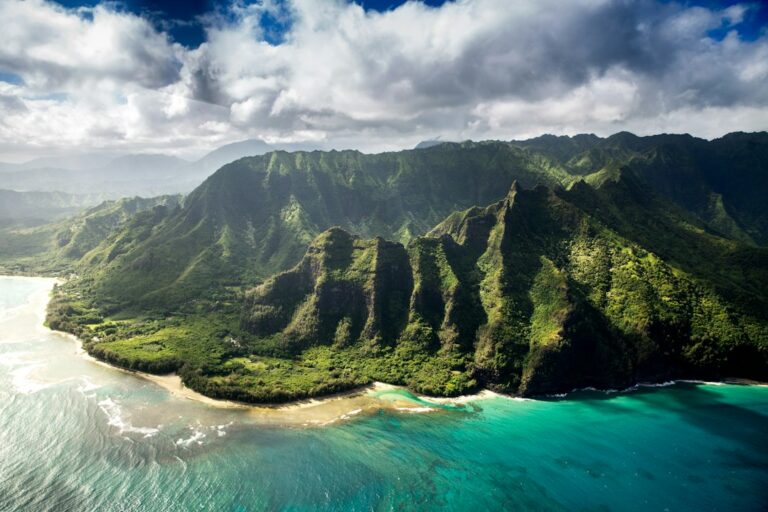
Hideaways Beach — spelled Pali Ke Kua on nautical charts — sits at the base of a 300-foot volcanic cliff on Kauai’s north shore. The cove is tucked between the 1 Hotel Hanalei Bay, formerly the St Regis Princeville, and the Puu Poa condominium complex. No road reaches it, no signage announces it, and the only public access is a rope-assisted trail that filters out casual visitors before they ever see sand.
For research-minded travelers weighing whether Hideaways belongs on a Kauai itinerary, the decision hinges on three variables: physical readiness for the descent, the calendar month of the visit, and the willingness to carry gear down a slick, root-tangled pitch. Households already committed to a Princeville stay often factor the cove in as the reason to book cliff-side units instead of the South Shore.
This article compiles trail data, parking logistics, footwear guidance, swim-season windows, and shoulder-lodging picks so a first-time visitor can decide before booking whether to attempt the cove — or route themselves to a friendlier North Shore alternative like Anini or Hanalei.
Trail specifications: what the 300-foot drop actually feels like
The Hideaways trail is short in horizontal distance and steep in vertical drop. From the tennis-lot trailhead to the sand, the path covers roughly 0.3 miles one way with 300 feet of elevation loss, which produces an average grade near 19 percent. Several switchback sections push past 30 percent, and hikers descend the steepest pitches while gripping thick knotted ropes anchored to trees and steel posts.
Downhill travel takes most people 15 to 25 minutes when the ground is dry. The return climb, done in the heat of afternoon with wet gear and a cooler, typically runs 25 to 40 minutes. Households traveling with children under eight or adults with knee or balance concerns should skip the trail and choose a drive-up alternative from the ranked list of Kauai beaches.
| Trail metric | Value |
|---|---|
| One-way distance | 0.3 miles |
| Elevation change | 300 feet down |
| Average grade | ~19 percent |
| Steepest pitch | Over 30 percent, rope-assisted |
| Descent time (dry) | 15–25 minutes |
| Ascent time (wet gear) | 25–40 minutes |
| Fixed rope sections | 3 primary, plus root scrambles |
| Trail surface | Red clay, exposed roots, loose rock |
Ropes, roots, and the red-clay problem
The ropes on the Hideaways trail are not maintained by any government agency. Local residents and resort staff have historically replaced frayed sections when they notice them, but hikers should treat every anchor as unverified and never load a rope with full body weight if it can be avoided. Testing each rope with a firm two-handed pull before committing weight is standard trail etiquette on rope-assisted descents across Kauai.
The soil under the top-of-cliff canopy is iron-rich red clay that behaves like wet ceramic within minutes of a shower. Princeville records roughly 85 inches of rain per year with the wettest months falling between November and March, and passing squalls are common even in the drier season. A trail that felt secure at 9 a.m. can be genuinely dangerous by 11 a.m. after a five-minute cloudburst.
Exposed hala and ironwood roots form the primary steps on the middle third of the descent. These roots stay slick well into late morning even on sunny days because the canopy blocks direct sun until the sun climbs above the ridge behind the resort. Hikers should place feet perpendicular to root angles, not parallel, to reduce the chance of a shoe sliding along the length of a wet root.
Parking at the Puu Poa tennis lot
The trailhead sits at the mauka edge of a small public parking area shared with the Puu Poa tennis courts, on Kaweonui Road just past the resort roundabout. The lot holds roughly 15 vehicles and fills quickly on summer weekends, with the first spots turning over between 9 and 10 a.m. as early snorkelers finish and climb out. Overflow street parking is not permitted along the resort access road.
Signage at the lot warns of theft, and Princeville sees regular smash-and-grab incidents targeting rental cars. The Kauai Police Department has repeatedly asked visitors to leave nothing visible in the vehicle, a request also reflected in coverage from Hawaii News Now and other statewide outlets covering North Shore visitor safety trends.
Timing arrivals to avoid the noon squeeze
Because turnover is unpredictable and the lot is small, arriving before 8:30 a.m. dramatically improves the odds of a spot. Households returning from a Kalalau overnight or a doors-off flight often shift Hideaways to a mid-morning slot on a different day. First-time visitors underestimate how long it takes to gear up, descend, snorkel, and climb back out — 3.5 to 4.5 hours is the realistic block for a full-effort visit.
| Arrival window | Typical lot status | Wait time |
|---|---|---|
| 7:00–8:30 a.m. | Half full or better | None |
| 8:30–10:00 a.m. | Filling, some turnover | 5–15 minutes |
| 10:00 a.m.–1:00 p.m. | Full, slow turnover | 20–45 minutes |
| 1:00–3:00 p.m. | Full with steady exits | 10–25 minutes |
| 3:00–5:00 p.m. | Opening up | 0–10 minutes |
Footwear and gear: closed-toe is not optional
The single most common Hideaways injury pattern is a slip on the third or fourth switchback while descending in flip-flops or slide sandals. Closed-toe hiking shoes or trail runners with lugged rubber are the minimum acceptable footwear. Reef water shoes with rigid soles can work on the descent but strain calf muscles on the climb out. Barefoot descents, occasionally attempted by surfers carrying boards, are firmly discouraged.
Beyond footwear, packing volume matters because everything carried down must be carried up. A single 25-liter dry bag per adult keeps hands free for ropes and eliminates the swinging-cooler problem that pulls hikers off balance. Households traveling with snorkel gear typically leave fins strapped to the outside of a pack rather than dangling from a hand.
- Closed-toe trail runners or hiking shoes with lugged soles
- One 25-liter dry bag per adult, hands-free straps
- 2 liters of water per person for a half-day visit
- Reef-safe mineral sunscreen, applied at the top of the trail
- Rash guard for extended snorkel sessions in cooler months
- Small first-aid kit with blister tape and antiseptic wipes
- Waterproof phone pouch on a lanyard, not loose in a pocket
What to leave in the car
Full-size coolers, hard suitcases, beach carts with rigid wheels, and infant strollers cannot make the descent safely. Households with a baby or toddler in a soft carrier can technically reach the sand, but few return a second time. Boogie boards and short soft-top surfboards fit under one arm; longboards over 8 feet routinely snag branches on the middle switchback and are not recommended for solo carry.
Swim conditions: summer only, and even then with respect
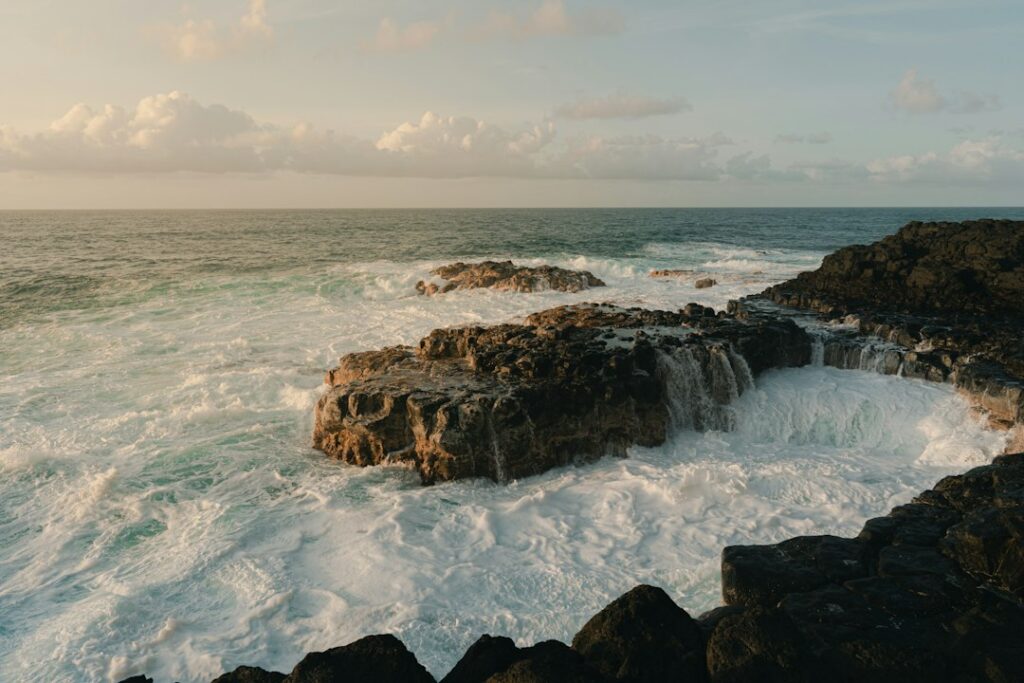
Hideaways is a north-facing pocket cove exposed to the same Pacific swells that make Hanalei Bay world-famous for winter surf. Between October and April, wave faces at Hideaways can build from 6 feet to over 25 feet within hours of a distant storm firing, and the small sand pocket becomes a shore-break kill zone where visitors have been swept off dry sand. Ocean safety data published by the Tunnels Reef in Haena, where winter surf closes the reef entirely from October through April.
Rip currents at Hideaways tend to form along the west edge of the sand pocket where a lava spine funnels outbound water. Swimmers caught in the drift should not fight it toward shore but instead angle sideways along the beach until the pull weakens, then swim in through the calmer middle section. There are no lifeguards, no rescue tubes, and cellular coverage inside the cove is intermittent.
Tides and the shrinking sand pocket
Kauai tides swing roughly 2 feet between low and high, and the Hideaways sand pocket contracts noticeably at high water. During spring tides in June and December, the beach can lose 15 to 20 feet of width at the west end where the lava spine juts out. Visitors planning long snorkel sessions typically anchor a towel above the debris line and check the tide chart before descending the trail.
What the reef and cove look like on a good day
On a calm summer morning, Hideaways delivers roughly 120 yards of golden-brown sand backed by ironwood trees, with a shallow inner reef and a deeper outer reef separated by a sand channel. Green sea turtles rest on the sand along the east wall between June and August, and honu sightings during a two-hour snorkel session are common enough that most visitors see at least one. Federal rules require staying at least 10 feet away.
Reef fish inside the cove include yellow tang, moorish idol, achilles tang, saddle wrasse, and the state fish humuhumunukunukuapuaa. The east-wall coral shelf holds cauliflower coral in the 3–8 foot depth range, with lobe coral heads deeper along the outer reef. Snorkelers accustomed to Maui’s Ulua Beach turtle cleaning stations will find Hideaways less structured but more secluded.
Surfing at Pali Ke Kua
Local surfers know the break as Pali Ke Kua and treat it as a shoulder-season reef spot for experienced riders. The wave breaks left off the outer reef on a west or northwest swell, requires a paddle-out around exposed rocks, and is not appropriate for beginners under any conditions. Longboards are the dominant equipment; shortboards work on cleaner morning windows before trade winds fill in.
Princeville shoulder-season lodging picks
Because Hideaways swim conditions are best from mid-May through mid-September, and because peak summer pricing on Kauai runs from mid-June through early August, the true shoulder-season sweet spots are the last two weeks of May, the first two weeks of June, and all of September. These windows deliver swimmable water, thinner crowds, and nightly rates 20 to 35 percent below peak.
Princeville’s cliff-top layout puts most rentable units within a 10-minute walk of the Puu Poa trailhead, but the specific complex matters. Puu Poa condos, Pali Ke Kua condos, and the Cliffs at Princeville sit closest to the trail, while units farther inland require a longer walk with gear. Broader tradeoffs between the north and south shores are covered in the Poipu vs Princeville lodging split.
| Complex | Walk to trailhead | Shoulder nightly rate | Best for |
|---|---|---|---|
| Puu Poa | 2 minutes | $375–$525 | Trailside snorkelers |
| Pali Ke Kua | 4 minutes | $285–$425 | Value cliff-top studios |
| 1 Hotel Hanalei Bay | 6 minutes | $925–$1,650 | Full-service resort stay |
| Cliffs at Princeville | 8 minutes | $260–$395 | Longer stays, kitchens |
| Hanalei Bay Resort | 10 minutes | $310–$495 | Bay views, tennis |
| Westin Princeville | 15-min drive | $440–$680 | Timeshare exchanges |
The Princeville rain factor
Shoulder-season lodging is only a value if a household can accept the rain pattern. Princeville averages substantially more rainfall than Poipu, and mornings that begin gray in Hanalei often stay gray while Poipu sees sun by 10 a.m. Households prioritizing beach days over resort amenities frequently choose Poipu; those prioritizing Hideaways, Tunnels, and the Napali coast choose Princeville and accept the tradeoff, as detailed in the Princeville relocation overview.
Cost-of-living data published by the Bureau of Labor Statistics Honolulu index tracks statewide inflation trends that show up in Kauai lodging rates on a lag of roughly six months. Households booking 9 to 12 months in advance for a summer stay generally lock in better rates than those pricing 60 days out.
HOA rules that affect renters
Puu Poa and Pali Ke Kua each carry HOA rules that restrict short-term rental behavior — quiet hours starting at 9 p.m., no charcoal grills on lanais, and pool-area attire requirements. Rental listings do not always surface these rules, and households arriving with large parties occasionally clash with resident owners. Reviewing HOA documents before booking prevents surprise fees, which have run $150 to $500 for cited violations.
Getting to Princeville and moving around the North Shore
Lihue Airport is the only commercial gateway to Kauai, and the drive from LIH to Princeville covers 30 miles on Kuhio Highway (route 56) with a typical drive time of 55 to 75 minutes. Rush-hour congestion in Kapaa can push the trip past 90 minutes on weekday afternoons. Rental car reservations should be secured months in advance; last-minute availability during summer routinely runs $130 to $180 per day for a compact.
Past Princeville, the road narrows and crosses several one-lane bridges into Hanalei and beyond to Haena State Park. The Hawaii Department of Transportation maintains this stretch, and construction closures on the bridges are frequent. Beyond the Haena end-of-road, the Kalalau Trail into Napali begins the roadless coastline.
Fuel, groceries, and the Princeville shopping center
The Princeville Shopping Center anchors the resort area with a small grocery store, a hardware store, a couple of restaurants, and a gas station. Fuel prices in Princeville run 15 to 30 cents per gallon above the Lihue average tracked by the EIA weekly gasoline survey. Households on longer stays typically stock up in Lihue at Costco or Safeway before driving north to avoid the resort-area markup.
Alternatives when Hideaways is closed by surf
From roughly October through April, Hideaways is not a viable swim beach on most days. North Shore visitors during those months rotate through a handful of protected alternatives, each with its own access profile and skill requirement. Understanding the alternates before arrival prevents the frustration of driving to a closed cove and driving right back to the resort empty-handed.
Anini Beach
Anini offers the longest fringing reef in Hawaii and calm, waist-deep water inside the reef line for most of the year. The reef takes the swell and creates a protected lagoon safe for children and beginner snorkelers, with drive-up parking and no cliff descent. Further details on launching a kayak from the same shoreline appear in the coverage of the Anini Reef kayak launch.
Hanalei Bay
Hanalei’s 2-mile crescent offers safer swimming near the pier during summer and a scenic walk any time of year. Winter transforms the bay into a surf zone with expert-only breaks; casual swimming is unsafe from November through March. The pavilion side hosts a permanent lifeguard tower and cleaner facilities than most Kauai beach parks.
Queen’s Bath, with caveats
The Princeville tidepool known as Queen’s Bath has drowned enough visitors that local news outlets, including Honolulu Civil Beat, have called for its closure. Visitors should treat the site as off-limits from October through April and approach with extreme caution even in July. The trailhead sits inside a residential neighborhood with severe parking restrictions.
Kauai activities that pair with a Hideaways morning
A well-paced Kauai day pairs the Hideaways descent with an afternoon activity that does not require another physically demanding hike. Doors-off helicopter flights, farm tours, and low-effort beach picnics all work; a second cliff scramble the same afternoon does not. Planning the descent for the first activity of the morning keeps energy reserves available for the climb out.
Aerial views of the Napali coast
Fifty-minute doors-off flights out of Lihue cover the full Napali coastline and the Waimea Canyon interior, and depart nearly hourly during summer daylight. Comparison of operators appears in the writeup on Blue Hawaiian versus Jack Harter doors-off flights.
Farm visits and food stops
Kauai’s east side hosts several agritourism destinations that pair well with a north-shore beach morning. The Steelgrass Chocolate Farm tour in Kapaa runs three-hour bookings, and westside food stops like the Ishihara Market poke counter handle post-beach appetites without cutting into evening resort time.
Safety, insurance, and the honest risk picture
Hideaways is not the deadliest beach on Kauai — that distinction belongs to Lumahai and the winter shore break at Hanalei — but the combination of steep trail, rope-assisted footing, and unguarded ocean creates a compounded risk profile. Households traveling with an out-of-network health plan should confirm coverage before the trip, because Kauai’s only trauma-capable hospital is Wilcox Medical Center in Lihue, roughly 32 miles from Princeville.
Ocean rescue response times on the north shore vary. Ambulance response from Princeville station to the Hideaways trailhead runs 6 to 12 minutes, but reaching a patient on the sand requires a technical rope carry-out that can take 45 to 90 minutes depending on conditions. Building this reality into a trip plan is more useful than treating the cove as a resort amenity.
- Carry a whistle on a lanyard for signaling from the sand
- Note the trailhead pin in a downloaded offline map before descending
- Log the trip with someone off-island who expects a check-in text
- Turn around at the first sign of afternoon rain on the descent
- Do not attempt the return climb in bare feet after losing shoes to surf
Comparison with other Hawaii cliff-descent coves
Hideaways is not unique in the state — several other Hawaii coves require rope-assisted or ladder-assisted descents. Comparing them helps calibrate expectations for a first-time visitor and clarifies whether the required effort matches the visitor’s fitness and gear.
| Cove | Descent type | Vertical drop | Best season |
|---|---|---|---|
| Hideaways (Kauai) | Rope + roots | 300 ft | May–September |
| Hulopoe (Lanai) | Ladder | 15 ft | Year-round |
| Ulua (Maui) | Stairs + ladder | 25 ft | Year-round |
| Kapalua Bay (Maui) | Sand entry | None | Year-round |
| Kahekili (Maui) | Sand entry | None | Year-round |
Snorkelers accustomed to easy sand entries at Kapalua Bay on West Maui should not assume Hideaways offers a similar experience. The physical demand and seasonal restrictions place it in a different category, closer to the ladder entry at Hulopoe Cove on Lanai in terms of gatekeeping effort.
Frequently asked questions
Is Hideaways Beach open to the public?
Yes. All beaches in Hawaii are public up to the high-water mark, and Hideaways is accessed via a public trail that begins at the Puu Poa tennis lot in Princeville. The resort adjacent to the cove does not control access to the sand. Visitors may use the trail regardless of whether they are staying at the 1 Hotel Hanalei Bay or any nearby condo complex.
Can children safely make the descent?
Children roughly 8 years and older who hike regularly can handle the trail with adult supervision on the rope sections. Younger children and toddlers in carriers are not recommended because the switchbacks require both hands free for balance. Households traveling with strollers or beach carts should choose Anini or Hanalei Bay, both of which offer drive-up sand access without cliff descents or rope-assisted footing.
Are lifeguards stationed at Hideaways?
No. Hideaways is one of many unguarded Kauai beaches, and there is no lifeguard tower, rescue tube, or emergency call box at the sand. The nearest permanent lifeguard station is at Hanalei Pavilion Beach Park, roughly 3 miles west by road. Visitors should assume full personal responsibility for water assessment and stay within their skill level, especially outside of the mid-May to mid-September calm window.
What is the best month to visit Hideaways?
July and August deliver the calmest water, warmest temperatures near 80°F, and clearest snorkel visibility, but they coincide with peak lodging rates and the busiest trail traffic. Late May, early June, and September offer nearly identical ocean conditions with 20 to 35 percent lower nightly rates and thinner crowds at the tennis-lot parking area. October brings the first north-shore swells and closes the swim window.
Can visitors reach Hideaways by boat instead of the trail?
Private boats occasionally anchor off the outer reef during flat summer conditions, but there is no commercial water taxi to Hideaways and the outer reef is not a safe overnight anchorage. Kayakers launching from Anini Beach can paddle the coastline west toward Hanalei, but landing at Hideaways involves a shore-break approach that is technical even in summer. The trail remains the standard access route.
What happens if it rains during the visit?
Light passing showers are manageable if the visitor is already on the sand; the trail becomes hazardous within 10 to 15 minutes of any real rainfall. Households caught by an afternoon downpour should wait out the squall under the ironwood canopy at the top of the beach, then reassess before starting the climb. If red clay is visibly running on the trail, remaining at the beach until conditions dry is safer.
Is the trail marked or maintained?
The trailhead is unmarked at the tennis lot and the path itself receives no official maintenance from Kauai County or the state. Ropes are installed and periodically replaced by local volunteers and resort staff, without warranty. Hikers should treat every rope, root, and foothold as unverified and test each anchor before committing weight. This informal maintenance model is common across Kauai’s steeper access trails.