Hulopoe Bay sits on the south-facing coast of Lanai, protected as a Marine Life Conservation District since 1976. The cove has become one of the most researched day-trip destinations in the Maui County channel system, drawing snorkelers who cross the Auau Channel by ferry from Lahaina Harbor. Its combination of protected reef, tide pool tables, and a resident spinner dolphin pod makes the logistics of visiting more regulated than any beach on Maui itself.
Reaching the bay requires a 9-mile passenger ferry crossing operated by Expeditions Lanai, followed by a short walk from Manele Small Boat Harbor. There is no vehicle transport for casual visitors, so day-trippers arrive on foot and either walk to the beach, ride the free Four Seasons shuttle if staying there, or arrange resort transport. The absence of rental cars for most drop-in guests shapes every packing and timing decision that follows.
This article describes the practical mechanics households face when planning the trip: ferry departure windows, the pedestrian route from harbor to sand, ladder entry at the tide pool tables, the NOAA-enforced 50-yard rule for spinner dolphins, reef-safe sunscreen requirements, and the day-use options at Four Seasons Resort Lanai. Every figure reflects public schedules, published fares, and federal regulations rather than personal itinerary claims.
The Expeditions Ferry from Lahaina to Manele Harbor
Expeditions Lanai has operated the passenger ferry service between Lahaina Harbor on Maui and Manele Small Boat Harbor on Lanai for more than three decades. The crossing spans the Auau Channel — roughly 9 nautical miles of relatively protected water between the two islands. Actual runtime depends on swell and wind but typically falls between 45 and 60 minutes each direction. Vessels are twin-hull catamarans carrying up to 150 passengers.
The company runs five daily round trips in most seasons, with departures spaced to accommodate both day-trippers and Lanai residents who commute to Maui for work, medical appointments, or shopping. Reservations are strongly recommended for weekend departures and any Monday morning trip carrying commuters, since the 150-passenger vessel can sell out on peak weeks. Weather-related cancellations are more common between November and March.
Booking Windows and Peak Cabin Demand
Round-trip ferry fares run about $60 per adult and $40 per child ages 2 to 11, with children under 2 free when held on a lap. Booking opens roughly 90 days in advance, and holiday weeks — Thanksgiving, Christmas, spring break in March, and the July 4 window — fill first. Same-day walk-ups can succeed on shoulder-season Tuesday and Wednesday sailings but should never be counted on for a critical itinerary day.
| Direction | Departure | Duration | Arrival |
|---|---|---|---|
| Lahaina to Manele | 6:45 AM | 45 min | 7:30 AM |
| Manele to Lahaina | 8:00 AM | 45 min | 8:45 AM |
| Lahaina to Manele | 9:15 AM | 45 min | 10:00 AM |
| Manele to Lahaina | 10:30 AM | 45 min | 11:15 AM |
| Lahaina to Manele | 12:45 PM | 50 min | 1:35 PM |
| Manele to Lahaina | 2:00 PM | 50 min | 2:50 PM |
| Lahaina to Manele | 3:15 PM | 50 min | 4:05 PM |
| Manele to Lahaina | 4:30 PM | 50 min | 5:20 PM |
| Lahaina to Manele | 5:45 PM | 50 min | 6:35 PM |
Post-Fire Lahaina Harbor Access
After the August 2023 fire, Lahaina Harbor operations were substantially disrupted. Ongoing coverage by the Honolulu Star-Advertiser and Hawaii News Now has tracked reconstruction milestones and ferry staging adjustments. Households should confirm current departure procedures with Expeditions Lanai in the 24 hours before travel, since staging points and vehicle access continue to evolve as harbor infrastructure is rebuilt block by block.
Backup parking exists in lots along Front Street and Prison Street when the primary harbor lot is closed. The check-in window opens 30 minutes before departure. Boarding cutoffs are firm — arriving five minutes before sail time is not a plan, since ticketed passengers who miss check-in forfeit fares without refund.
The Walk from Manele Harbor to Hulopoe Cove
Manele Small Boat Harbor and Hulopoe Bay share the same coastal indentation, separated only by a rocky headland with a paved path across it. Walking distance from the ferry landing to the sand pavilion at Hulopoe measures roughly 0.5 miles — a 10 to 15 minute walk with light gear. The route is stroller-friendly with one modest hill, and shade is intermittent along the exposed harbor lot section.
A concrete sidewalk runs from the harbor exit past the harbor parking area, climbs briefly along a fence line, then descends into the Hulopoe park zone. There is no cost for pedestrian entry to the bay itself — parking fees apply only to vehicles arriving from Lanai City. Households carrying a full cooler, umbrella, and snorkel bags may prefer a wheeled tote to backpacks, since pavement heat can climb past 90°F in July afternoons.
The Four Seasons Shuttle and Public Transit
Guests staying at Four Seasons Resort Lanai receive complimentary shuttle service between Manele Harbor, the resort lobby, and Hulopoe beach access points. Non-guests cannot use this shuttle. The Lanai Community Association operates limited public shuttle service between Lanai City and Manele, though schedules are geared toward residents and workers rather than tourists. Rental cars must be reserved weeks in advance and are limited in inventory across the island.
Hulopoe Bay Layout and Marine Life Conservation District Status
The bay is protected under Hawaii state law as a Marine Life Conservation District (MLCD), one of 11 such designated waters statewide. Fishing, feeding fish, and removing anything living from the reef are prohibited. The MLCD boundary encompasses the entire cove from headland to headland out to a defined offshore line. Enforcement is handled by the Hawaii Division of Conservation and Resources Enforcement (DOCARE) alongside occasional federal presence.
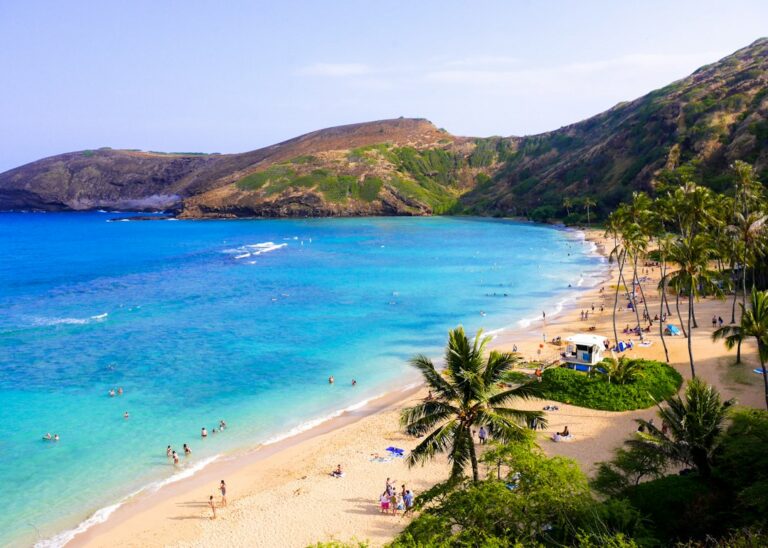
Hulopoe’s crescent of white sand sits between two rocky headlands: the western headland leads toward Puu Pehe (Sweetheart Rock), and the eastern headland contains the tide pool tables. The cove opens south, which explains its calm summer conditions when trade-wind swell wraps around the north shore of Lanai but leaves the south face protected. Winter south swells can still spike surf conditions with little warning.
Reef structure inside the bay ranges from sandy patches at 8 to 12 feet in the center to fringing coral along both headlands at 4 to 15 feet. Green sea turtles, spinner dolphins, and the state fish humuhumunukunukuapuaa are frequently observed. Visibility on calm summer mornings often exceeds 60 feet, comparable to conditions snorkelers experience at other South Maui reef sites reached from Wailea beaches.
Lanai’s small resident population — approximately 3,367 people according to Census QuickFacts data — means Hulopoe rarely faces the crowd density found at more populated Oahu snorkel sites. Even peak-season Saturdays feel manageable relative to Hanauma or Kailua-side beaches. The bay does hit a soft daily cap when both ferries and Four Seasons occupancy peak simultaneously.
The Tide Pool Ladder Descent
The eastern headland of Hulopoe hosts a series of large sandstone tide pool tables carved by wave action over centuries. A metal ladder bolted into the pool wall provides access to a small keyhole entry protected from most swell. This is not the primary snorkeling entry — most visitors walk into the water from the sand — but the ladder allows entry directly into deeper reef water on the eastern edge of the cove.
The ladder descends about 6 feet from the pool ledge into a channel of 8 to 12 feet of water. On days with any south swell, the ladder area becomes hazardous — surge can slam swimmers against the ledge. State signage warns that the ladder is intended for use only in flat conditions, and even summer mornings can develop chop by 11 AM. Households with children should default to sand entry rather than the ladder route.
Reaching the ladder requires a 5-minute walk east from the main beach across a lava rock shelf. Sturdy reef shoes or water-tolerant sandals are essential — bare feet fail against basalt edges and urchin spines that populate the intertidal zone. The tide pools themselves host juvenile fish, hermit crabs, and small blennies worth observing from above without touching or disturbing the pool ecology.
Comparing Ladder Entries Across the Islands
Ladder entries at protected coves are a signature Hawaii feature that lets snorkelers bypass shorebreak. Similar bolted-ladder access exists at several sites — including one well-documented at Ulua Reef in Wailea. Each site’s ladder rules and swell tolerances differ, but the underlying principle applies everywhere: use ladders only in flat water, keep three points of contact, and never enter with fins already strapped on.
The NOAA 50-Yard Spinner Dolphin Rule
Hulopoe Bay is home turf for a resident Hawaiian spinner dolphin pod (Stenella longirostris). Spinners forage offshore at night and rest in shallow protected bays during the day, meaning encounters at Hulopoe most often occur between roughly 8 AM and noon. Because human interruption of daytime rest patterns causes measurable stress and fitness loss to the animals, federal regulators codified a specific approach distance rule in 2021.
Under a rule finalized by the National Oceanic and Atmospheric Administration (NOAA) Fisheries in October 2021, and enforced under the Marine Mammal Protection Act of 1972, swimming with or approaching Hawaiian spinner dolphins within 50 yards is prohibited across the main Hawaiian Islands. The 50-yard buffer applies to swimmers, snorkelers, kayakers, stand-up paddleboarders, and any vessel. Violations are federal offenses carrying civil penalties up to $11,000 per infraction.
The practical implication for Hulopoe visitors: if the pod enters the bay while you are already swimming, you must not approach. Slow reverse-fin motion or simply remaining still while the dolphins pass is compliant behavior. Chasing, splashing to attract attention, or diving down to swim beneath them all constitute pursuit under the rule. Boat operators face the same 50-yard limit and cannot deposit swimmers into a pod’s path.
Difference Between Passive Encounter and Pursuit
NOAA guidance distinguishes between an incidental sighting — where a dolphin voluntarily approaches a stationary or slow-moving human — and active pursuit. A curious dolphin that swims within 50 yards on its own initiative does not create a violation for the human, provided the human does not then move to close distance or maintain proximity. The burden falls on people to yield space, not on animals to yield first.
| Activity | Minimum Distance | Legal Basis |
|---|---|---|
| Swimming approach | 50 yards | NOAA 2021 rule / MMPA |
| Vessel approach | 50 yards | NOAA 2021 rule / MMPA |
| Aerial drone | 1,000 feet altitude | NOAA Fisheries guidance |
| Feeding attempts | Prohibited outright | MMPA 1972 |
| Chase or pursuit behavior | Prohibited outright | MMPA harassment clause |
| Photography with lens | 50 yards; no closing | NOAA 2021 rule |
Enforcement patterns since the rule took effect have emphasized commercial tour operators and repeat individual offenders documented in social media posts. A first-time incidental violation typically results in a warning; documented pursuit or commercial violation escalates to civil penalty proceedings. Community reporting through the NOAA Fisheries hotline drives most enforcement leads.
Reef-Safe Sunscreen and Act 104 Compliance
Hawaii’s Act 104, effective January 1, 2021, banned the sale and distribution of sunscreens containing oxybenzone or octinoxate statewide. Maui County added a separate ordinance in October 2022 requiring mineral-only (non-nano zinc oxide and titanium dioxide) sunscreens on county beaches. Lanai falls under Maui County jurisdiction, so mineral-only rules apply at Hulopoe Bay. The reasoning is coral protection — trace chemical filters accelerate bleaching in stressed reef ecosystems.
Visitors bringing sunscreen from the mainland should verify labels ahead of packing. The Act 104 rules and enforcement mechanics apply statewide, but Maui’s mineral-only rule is stricter and does show up in occasional harbor bag checks. Reef-friendly options are widely stocked at Lanai City stores and the Four Seasons boutique, though prices run 30 to 50 percent higher than mainland retail averages.
Recommended Alternatives and Physical Protection
- Non-nano zinc oxide sticks and creams from mineral-only brands, applied 15 minutes before entry.
- UPF 50 rash guards and swim leggings to reduce sunscreen surface area needed.
- Wide-brim hats for beach time between snorkel sessions on the sand.
- Reapplication every 80 minutes when swimming or sweating in tropical sun.
- Zinc-based lip balm to cover the frequently missed lip and ear cartilage zones.
Four Seasons Resort Lanai Day-Trip Access
Four Seasons Resort Lanai sits directly above Hulopoe Bay and overlooks the western headland. It is the only resort on this side of the island. Day-trippers arriving by ferry cannot book rooms on arrival at meaningful rates, but the beachfront restaurant One Forty and pool bar are open to non-guests with reservations. The beach itself is public — no resort can privatize a Hawaiian shoreline under state law.
Room rates at the Four Seasons typically start above $2,000 per night in high season and can exceed $8,000 for beachfront suites. Day-use amenity packages are not routinely sold, though a lunch reservation at One Forty ($75 to $150 per person for lunch entrees) grants restroom, shower, and lounger access during the meal window. Beach towels are Four Seasons property; day-trippers should bring their own from Maui.
Public Restrooms and Freshwater Rinse
Hulopoe Beach Park maintains public restrooms, outdoor rinse showers, picnic pavilions, and a small parking area on the beach side of the property. These facilities are free and open regardless of resort status. The rinse showers matter more than they might elsewhere because most day-trippers must sit on the ferry for the return crossing in swimwear if they haven’t rinsed and toweled off before the 4:30 PM boarding call.
Dry-Bag Packing List for the Crossing
The Auau Channel crossing rarely produces sea spray on the enclosed cabin decks, but return trips run into afternoon trade winds that can spatter the outer deck. Anything electronic or paper-based should ride inside a sealed dry bag. A 10-liter dry bag holds essentials for two adults; a 20-liter version accommodates a family of four with snorkel gear and towels compressed together.
- Reef-safe mineral sunscreen (non-nano zinc oxide) in a leak-proof container.
- Snorkel, mask, and fins — rentals are scarce and expensive on Lanai itself.
- Rash guard or UPF sun shirt for both adults and children in the group.
- Two liters of drinking water per person, minimum, for the full day.
- Cash for tip jars, snack bar purchases, and shuttle drivers.
- Waterproof phone pouch on a neck lanyard for underwater photos.
- Reef-appropriate footwear for lava rock walking near the tide pools.
- Sealed snacks — no elaborate picnic setups allowed inside MLCD boundaries.
- Change of dry clothes for the return ferry ride back to Lahaina.
- Compact microfiber towel that packs down small and dries fast.
What to Leave Behind
Coolers larger than 40 quarts, glass bottles of any kind, drones (federally restricted near marine mammals), fishing rods (illegal within MLCD boundaries), and shell-collection bags all fall into the leave-behind category. Ferry operators regularly turn back oversized coolers at check-in. Alcohol is permitted for personal consumption but discouraged for the return crossing — sea sickness on a hot afternoon in the channel after a beach beer ranks among the more common complaints Expeditions crews field.
Seasonal Timing and Weather Windows
South-facing Hawaiian bays swap swell exposure by season. Hulopoe’s south orientation means summer south swells (roughly May through September) can produce surf conditions incompatible with snorkeling, while winter’s north Pacific swell trains generally leave the bay protected. The paradox: winter can offer calmer Hulopoe water than summer, though winter also brings shorter daylight, cooler air, and slightly lower water temperatures than the July peak.
Trade winds strengthen in the afternoon most days between April and October, so morning ferries produce smoother crossings and clearer snorkeling conditions. The 6:45 AM Lahaina departure is a favorite among serious snorkelers because arrival at Hulopoe coincides with the pre-crowd window and the highest probability of spinner dolphin sightings, which happens before the pod continues moving through its daytime rest cycle.
| Month | Avg Water Temp | Prevailing Swell | Spinner Dolphin Sightings |
|---|---|---|---|
| January | 74°F | North (blocked by island) | High |
| February | 74°F | North (blocked) | High |
| March | 75°F | North (blocked) | Moderate |
| April | 76°F | Transitional | Moderate |
| May | 77°F | Building south | Moderate |
| June | 78°F | South (exposed) | High |
| July | 79°F | South (exposed) | High |
| August | 80°F | South (exposed) | High |
| September | 80°F | South (fading) | Moderate |
| October | 79°F | Transitional | Moderate |
| November | 77°F | North (blocked) | High |
| December | 75°F | North (blocked) | High |
Ferry Cancellations and Backup Plans
Weather cancellations happen most often between November and March when north Pacific storms produce channel-crossing swell above the vessel’s operating threshold. Expeditions notifies ticket holders by email or SMS the evening before or the morning of a canceled sailing. Full refunds or rebooking to the next available departure are standard. Households with tight island schedules should not book Hulopoe on their last full day before a mainland return flight.
Costs and Full-Day Budget
A conservative day-trip budget for two adults ferrying from Lahaina to Hulopoe and back runs $175 to $275 depending on food choices. That budget assumes packed lunches or a modest snack purchase, not a Four Seasons meal. Households who add a One Forty lunch reservation or Four Seasons pool bar drinks should expect the total to double or triple. Rental gear on Lanai is limited enough that bringing snorkel gear from Maui saves both time and money.
| Item | Cost | Notes |
|---|---|---|
| Adult round-trip ferry | $60 | Expeditions Lanai fare |
| Child round-trip ferry (2–11) | $40 | Under 2 free on lap |
| Snorkel gear rental (Maui) | $15–$25 | Full-day rate per set |
| Lahaina harbor parking | $0–$20 | Variable post-fire |
| Packed lunch supplies | $15–$25 | Two adults, sandwiches |
| Mineral sunscreen (4 oz) | $18–$32 | Non-nano zinc formula |
| Water bottles (2 L per person) | $6–$10 | Two-adult supply |
| One Forty lunch (optional) | $75–$150 | Per person, entrees |
| Dry bag (one-time buy) | $25–$45 | 10 to 20 liter |
Comparing Hulopoe to Other Hawaii Snorkel Destinations
Hulopoe belongs to a small group of Hawaii bays where marine protection, reef quality, and access logistics align. It sits at the higher-effort end of the day-trip spectrum given the ferry requirement. Other bays with similar protection levels — reachable by car from other islands — offer different tradeoffs on crowding, entry difficulty, and marine life density that day-trippers should weigh against the Lanai commitment.
Hanauma Bay on Oahu requires a 48-hour advance reservation and a $25 non-resident entry fee. Kapalua Bay on West Maui offers similar reef quality without a ferry commitment. Tunnels Reef on Kauai’s north shore has stronger currents and winter surf closures. Hulopoe’s differentiator is the combination of dolphin residency and MLCD status without the crowd density of Hanauma on a peak weekend.
Snorkelers seeking similar close-quarters marine life without any island transfer commitment can research options at the Hawaii Tourism Authority’s public resources, which catalogs beach access and protected reef sites across all inhabited islands. Cross-island logistics work poorly for tight itineraries; single-island plans usually deliver more actual water time per vacation day.
Legal Framework, Enforcement, and Reporting
Three overlapping legal frameworks govern behavior at Hulopoe: federal Marine Mammal Protection Act oversight of dolphin approaches, state Marine Life Conservation District rules on take and disturbance, and Maui County ordinances on sunscreen composition and beach parking. Each framework has its own enforcement agency and reporting number, and violations at Hulopoe can theoretically draw penalties from all three simultaneously in the worst cases.
- NOAA Fisheries Office of Law Enforcement — dolphin harassment: 1-800-853-1964.
- DOCARE — MLCD take violations and reef disturbance: 808-643-DLNR (3567).
- Maui County Ocean Safety — beach hazards and rescues: 808-244-6400.
- Lanai Police Substation — general and non-emergency contact: 808-565-6428.
The state’s Department of Health publishes water-quality advisories that occasionally affect Hulopoe after heavy runoff. The Department of Transportation oversees Manele Harbor infrastructure and posts closure notices during severe weather. Household planners crossing multiple islands may find state-level regulatory pages more current than commercial travel sites during weather disruptions or federal rule updates.
Planning Adjacent Days on Maui
Because Hulopoe requires a one-day round-trip commitment from a Maui base, most visitors sequence it into a longer West Maui itinerary. The 6:45 AM ferry means a Lahaina-area hotel is functionally required — waking in Wailea or Kaanapali and reaching harbor check-in by 6:15 AM adds an hour of predawn driving to an already long day. West-side lodging within a 15-minute drive of Lahaina Harbor eliminates that timing stress entirely.
Complementary Maui outings that pair naturally with a Hulopoe day include Lahaina-area snorkeling the day before to test gear, a stop at Ululani Shave Ice on the return afternoon, and a longer Pipiwai Bamboo Forest hike on a scheduled rest day. Households planning shoulder-season trips can consult a May-specific Hawaii planning breakdown for pricing and crowd context across islands.
Frequently asked questions
Can visitors reach Lanai without booking the Expeditions ferry?
Yes — Mokulele Airlines flies from Kahului on Maui to Lanai Airport in about 25 minutes, and Hawaiian Airlines connects Lanai from Honolulu. Flights cost $80 to $150 one way. For a single-day beach visit, the ferry remains cheaper, lands closer to Hulopoe, and produces less carbon per passenger than the aircraft option. Flying makes more sense for overnight stays than pure day trips.
Is snorkel gear rental available directly at Hulopoe Bay?
A small concession operated near the Four Seasons rents snorkel gear at the beach, but inventory is limited and pricing runs $25 to $40 per set per day. Bringing gear from Maui — rented from any Lahaina, Kihei, or Kaanapali shop for $15 to $25 per day — is more reliable. The same applies to boogie boards, umbrellas, and beach chairs, none of which the ferry rents to passengers.
What should a snorkeler do if spinner dolphins swim toward them?
NOAA guidance instructs the snorkeler to remain still or slowly retreat while maintaining position. Facing the dolphins passively is acceptable, but pursuit — swimming toward them, diving under them, or actively swimming alongside — becomes a federal violation the moment the human closes distance. Photographing an incidental encounter is fine. Posting videos of chase behavior online has directly generated NOAA enforcement in past documented cases.
Are there lifeguards on duty at Hulopoe Beach?
Maui County has stationed lifeguards at Hulopoe Bay during peak hours in recent years, though tower staffing varies by season and county budget cycles. Coverage generally runs 9 AM to 5 PM daily during summer months. Visitors should not assume lifeguard presence outside those hours, particularly on the tide pool ladder end of the cove, which sits beyond the standard tower’s direct visual coverage zone.
Can day-trippers use the Four Seasons pool or spa facilities?
Only registered Four Seasons guests may use the resort pool, hot tubs, and adult-only pool deck. Day-trippers arriving by ferry cannot purchase pool day-passes at the desk. Non-guests can, however, book meals at Nobu Lanai, One Forty, or Views restaurants, and can drink at the pool bar with a valid meal reservation. Restaurant reservations often require booking one to two weeks in advance during high season.
What is the realistic time budget for a Lanai day-trip from Maui?
The complete round trip runs 9.5 to 10 hours door to door: 6:15 AM check-in at Lahaina, 6:45 AM sail, 7:30 AM arrival, walk to the bay by 8:00, snorkel and beach through mid-afternoon, walk back to harbor by 3:45 PM, catch the 4:30 PM return, and clear Lahaina by roughly 5:30 PM. Building slack into any of these transitions reduces stress substantially for families.
Do rental cars operate for casual visitors on Lanai?
A limited rental fleet exists on Lanai — primarily 4WD Jeeps used to reach off-road destinations like Shipwreck Beach and the Munro Trail. Rates start around $175 per day and inventory sells out weeks in advance. For a Hulopoe-only day trip, walking the 0.5 mile from Manele Harbor is sufficient. Rentals make sense only when adding upcountry Lanai City sightseeing to a multi-day visit.