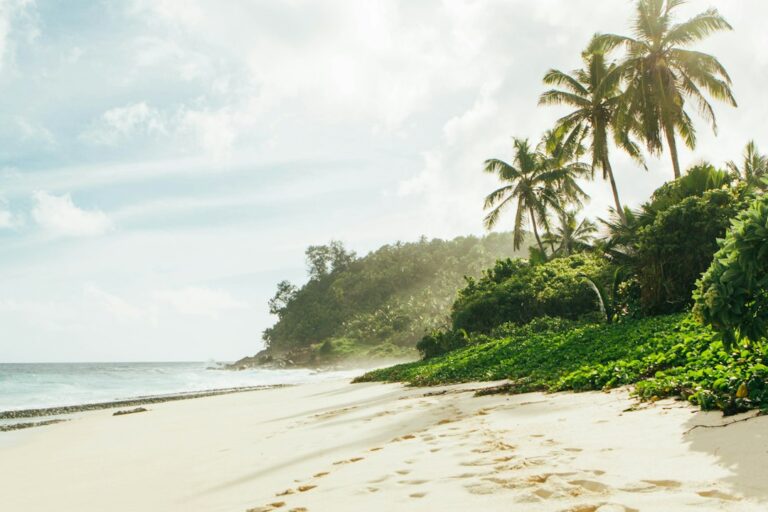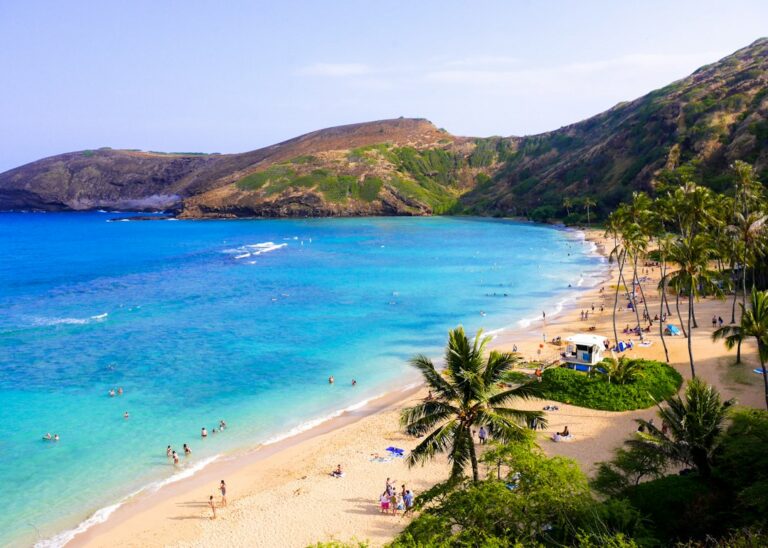
Anini Beach sits along Kauai’s north shore between Kilauea and Princeville, sheltered by what marine surveys describe as the longest fringing coral reef in the Hawaiian Islands. The barrier runs roughly two miles offshore, creating a shallow lagoon that stays glassy on days when surrounding beaches close to swimmers.
For families, snorkelers, and paddlers researching Kauai’s north shore, the appeal is the calm. Water inside the reef often measures waist to chest deep, with visibility reaching 30 to 60 feet in summer and daytime temperatures on the sand hovering near 82°F from June through September.
The tradeoff is complexity beyond the beach itself. The reef pass at the western end funnels tidal currents that have swept experienced paddlers offshore, camping permits require paperwork submitted weeks in advance, and rental outfitters cluster in Hanalei rather than at Anini itself. This article covers what relocating households and long-stay visitors need to plan a defensible day on the water.
The two-mile reef that shields the shore
The fringing reef at Anini extends roughly 10,000 feet along the coast — approximately two miles — and sits between 500 and 1,500 feet offshore depending on the section. State reef surveys and University of Hawaii marine biology work consistently identify it as the longest continuous fringing barrier in the archipelago.
Fringing reefs differ from barrier reefs in a critical way. There is no deep channel between reef and shore; the entire lagoon is shallow, ranging from 2 to 8 feet inside the wall. That geometry is what makes Anini feel like a swimming pool while waves crash on the exposed reef crest a quarter mile away.
The reef structure hosts hard coral coverage estimated at 20 to 35 percent in the mid-lagoon zones, with the highest live coral density closer to the crest. State monitoring under the Hawaii Department of Health tracks water quality and coral bleaching events at multiple north shore sites, including Anini.
Reef fish density is high but skews toward smaller herbivores rather than the pelagic species found off headlands. Snorkelers typically encounter yellow tang, saddle wrasse, convict tang, Moorish idol, and the occasional Hawaiian green sea turtle grazing on algae in the shallows.
Beach layout and where to enter the lagoon
Anini Beach Road parallels the shoreline for about 1.7 miles, giving access to a series of unmarked pullouts and the main county park in the center. Households treating Anini as a research destination often drive the road end to end first to identify which segments match their skill level.
Entry zones along the road
The eastern end sits closer to Kalihiwai and has the shallowest, calmest water — ideal for children and first-time snorkelers. The middle section fronts the county park with lifeguard-free but supervised camping and picnic areas. The western end approaches the reef pass and demands respect for currents.
Sand quality varies. Most stretches offer soft golden sand entering into a mix of sand patches and sea grass. Wading out from the beach, snorkelers typically encounter sand for the first 40 to 80 feet before reaching scattered coral heads and reef flats worth exploring at high tide.
| Section | Distance from park | Best use | Skill level |
|---|---|---|---|
| Eastern flats | 0.6 miles east | Kids, wading, learning | Beginner |
| Central lagoon | At county park | Camping, family snorkel | Beginner |
| Mid-reef zone | 0.4 miles west | Turtle sightings, SUP | Intermediate |
| Reef pass approach | 0.9 miles west | Experienced kayak launch only | Advanced |
Snorkeling the inner lagoon
The lagoon delivers what many first-time Kauai visitors want: shallow, clear water with reasonable fish density and near-zero surf risk on typical trade-wind days. Snorkelers moving parallel to shore between coral heads generally see 15 to 25 species over a one-hour swim.
Best snorkel windows
Morning conditions before 11 AM offer the flattest surface and best light for underwater photography. Trade winds typically build after noon, pushing 12 to 18 mph gusts across the lagoon that ripple the surface and cut visibility. High tide expands the accessible reef zone by 2 to 3 feet of water depth.
Summer visibility peaks between May and September when north swell activity drops. Winter visits often see visibility drop to 10 to 20 feet after rain events flush red mud from Anini Stream into the lagoon, sometimes turning the water tea-colored for 24 to 48 hours.
What snorkelers actually see
- Green sea turtles grazing on limu algae, typically 3 to 6 sightings per two-hour session
- Schools of convict tang and yellow tang above sand patches
- Moorish idols in pairs near larger coral heads
- Occasional Hawaiian reef octopus in crevices at low tide
- Cornetfish and trumpetfish shadowing larger fish
Compared to Kauai’s more famous snorkel entry at Tunnels Reef in Haena, Anini trades reef structure diversity for calmer conditions and lower risk. Tunnels offers cathedral-like coral formations but shuts down entirely during winter north swells; Anini’s inner lagoon stays swimmable across a wider range of days.
The Anini reef pass and why it turns deadly
At the western end of the reef, the coral wall opens into a channel roughly 200 feet wide and 20 to 40 feet deep. This is the reef pass, and it is the single feature that has claimed lives at what is otherwise Kauai’s safest beach.
Water inside the lagoon must exit somewhere. Wave energy pushes water over the reef crest continuously, and gravity pulls it back to sea through the pass in what oceanographers describe as a rip-return current. Flow rates can exceed 2 knots on a large swell day, faster than most swimmers or paddlers can fight.
When the pass turns dangerous
Kauai lifeguards and the county’s ocean safety division document the pattern clearly, and Honolulu Civil Beat coverage has traced fatal incidents at north shore reef passes back to similar conditions. Danger peaks when north or northeast swell reaches 4 feet or higher, when tides are moving between phases, and after prolonged trade winds pile water that must then drain outward.
The specific hazard is that the pass looks deceptively calm on the surface — no breaking waves mark its edges from a kayak. Paddlers who drift into the pass while sightseeing along the reef can be pulled through before they recognize the current, then face open ocean on the far side with three-foot chop and no easy return.
| Condition | Pass current speed | Recommendation |
|---|---|---|
| Swell under 2 ft, low wind | Under 0.5 knots | Experienced paddlers only, close to pass edges |
| Swell 2-4 ft, trades 15 mph | 0.5 to 1.5 knots | Stay 500+ ft from pass; no swimming near it |
| Swell 4-6 ft | 1.5 to 2.5 knots | Kayaks stay east of central lagoon |
| Swell over 6 ft | Over 2.5 knots | Lagoon-only paddling; pass off-limits |
Kayak and SUP launch etiquette
Anini is one of the easiest kayak launches on Kauai because the beach shelves gently and the lagoon offers protected water immediately. That accessibility also means it gets busy, particularly on weekends when local families paddle alongside vacationers who rented equipment that morning.
Launch mechanics
The standard launch involves walking the boat to knee-deep water at the county park frontage, stabilizing perpendicular to any wave direction, and paddling out at a 45-degree angle to avoid drifting into swim zones. Most launches take under two minutes with a partner and require no surf-timing skill on typical days.
SUP boards launch even more easily. Riders can wade the board out to thigh-deep water, mount kneeling first, and stand once past the initial sand shelf. The lagoon’s flat surface makes it a common first-timer SUP location on the island, second only perhaps to sheltered south shore bays.
Etiquette that keeps everyone safe
- Yield right of way to swimmers and snorkelers at all times
- Stay at least 30 feet from anyone with a snorkel in the water
- Never anchor on live coral; use sand patches only
- Keep 100 feet from any sea turtle encountered while paddling
- Return to shore if trade winds build past 20 mph
Paddlers should also carry a whistle, wear a personal flotation device, and file a rough plan with someone on shore. There is no lifeguard tower at Anini as there is at nearby Hanalei Bay, and cell service on the water is reliable only for the section closest to Princeville’s cliffs.
Rental outfitters in Hanalei and Princeville
No commercial rental operator sits directly at Anini Beach itself. Kayaks, SUPs, snorkel gear, and beach chairs come from outfitters clustered five to nine miles west in Hanalei town or south in Princeville. Rentals typically transport on soft roof racks or in truck beds, with most shops offering both.
Typical rental pricing
Rates in 2026 tend to fall within predictable ranges across the north shore. Multi-day discounts of 10 to 20 percent apply at most outfitters when equipment stays out for three days or longer, and weekly rates run roughly four times a single-day price rather than seven times.
| Equipment | Half day | Full day | Weekly |
|---|---|---|---|
| Single kayak | $35-45 | $50-65 | $180-240 |
| Double kayak | $55-70 | $75-95 | $275-350 |
| SUP board | $40-50 | $55-70 | $200-260 |
| Snorkel set | $8-12 | $12-18 | $45-65 |
| Roof rack straps | Included | Included | Included |
What to ask before booking
Confirm whether the outfitter provides current-condition briefings for Anini specifically. The strongest shops brief renters on the reef pass hazard before handing over kayaks, while some tourist-oriented operations simply hand out equipment with no local context. Ask directly: what should paddlers know about the western pass at Anini?
Also ask about pickup and return windows. Many north shore outfitters open at 8 AM and close by 5 PM, meaning a full-day rental effectively means 8 hours on the water. Households renting for multi-day trips get the best value staying nearby, which raises the parallel question of where legal vacation rentals cluster under Kauai’s TVR ordinance.
Camping permits at Anini Beach County Park
Anini Beach County Park operates one of Kauai’s most sought-after tent camping areas, with grassy sites directly behind the beach. Permits come from the County of Kauai Department of Parks and Recreation and require advance application, payment, and specific ID documentation at check-in.
How the permit system works
Camping is legal only with a permit displayed at the site. Rates for 2026 run $3 per adult per night for Hawaii residents and $30 per adult per night for non-residents, with children charged at reduced rates. Permits can be issued for up to five consecutive nights at any one park.
The county’s online portal accepts reservations up to 30 days in advance. Weekend and holiday sites — particularly Friday and Saturday nights between June and August — sell out within hours of the reservation window opening. Households planning summer camping should have accounts created and payment methods stored before the 30-day window opens.
Site conditions and facilities
- Grass tent sites shaded by ironwood and monkeypod trees
- Cold outdoor showers, flush restrooms, and covered picnic pavilions
- Potable water spigots at central locations along the park
- No electrical hookups; generators are not permitted
- Park closes to vehicles at 10 PM enforced by county rangers
The camping area falls under county-level regulations similar in structure to those posted through the county government portals used across Hawaii, though Kauai’s system runs separately from Oahu’s. Enforcement includes checks of permit paperwork against ID, and un-permitted campers face fines and eviction.
For overnight adventures beyond Anini, the paperwork burden ramps up significantly. Backpackers researching the Kalalau Trail overnight camping reservation cadence face a state-level permit system that opens 90 days out and typically sells out within minutes.
Weather, surf windows, and seasonal timing
Anini’s water clarity, safety, and overall appeal shift dramatically by season. The north shore of Kauai receives its winter swell energy from October through April, with peak surf months of December, January, and February. Forecast tracking through Hawaii News Now and NOAA sources gives paddlers day-ahead visibility on swell arrival.
Monthly conditions overview
| Month | Avg air temp | Water temp | Swell risk | Rain days |
|---|---|---|---|---|
| January | 72°F | 75°F | High | 15 |
| April | 76°F | 76°F | Moderate | 12 |
| July | 82°F | 80°F | Low | 7 |
| October | 81°F | 79°F | Moderate | 10 |
| December | 74°F | 76°F | High | 16 |
Rainfall patterns matter beyond comfort. Anini Stream drains agricultural land inland and flushes brown runoff into the lagoon after heavy rain events. Visibility typically stays impaired for 24 to 72 hours following storms delivering more than half an inch of rain in a 12-hour window.
The transition months of April, May, October, and November offer strong compromise conditions. Water temperatures hold above 76°F, air temperatures sit in the high 70s, and swell risk drops from peak winter but has not yet reached the flat-calm of midsummer.
Getting there, parking, and facilities
Anini Beach lies about 25 miles north of Lihue Airport, a drive that takes 45 to 55 minutes depending on traffic through Kapaa. The turnoff onto Anini Road is unmarked from the state highway system tracked by the Hawaii Department of Transportation except by a small sign, and GPS occasionally routes drivers past the intersection.
Directions from Lihue
Northbound on Highway 56 through Kapaa and Kilauea, drivers pass the Kalihiwai Road turnoff at mile marker 25 and take the second Kalihiwai Road entry — the first descends to Kalihiwai Beach. Anini Road branches left after about half a mile, drops downhill through a hairpin, and follows the shoreline.
Parking realities
The county park lot holds roughly 40 vehicles with additional roadside parking along Anini Road stretching another quarter mile in each direction. Peak weekend arrivals from 10 AM to 2 PM fill available spaces, and late arrivers may park up to a half mile from their intended entry point.
- Free public parking at county park and along Anini Road
- No overnight parking without valid camping permit
- Restrooms at park pavilion, closed by ranger nightly
- Picnic tables and grills at central pavilions
- Outdoor cold showers at bathhouse
For households timing a north shore day trip carefully, the return drive south to Lihue coincides with commuter traffic through Kapaa if departure runs after 3 PM. This factors into logistics for anyone catching a red-eye departure requiring rental return at Lihue, though Kahului on Maui operates on different timing.
Safety, reef etiquette, and cultural notes
Anini presents lower ocean risk than most Kauai north shore beaches but not zero risk. The reef pass hazard is documented and consistent; the lagoon hazard is more subtle — coral cuts, urchin spines, and dehydration in strong summer sun account for most non-fatal incidents recorded by state health tracking.
Reef protection basics
Hawaii state law bans oxybenzone and octinoxate sunscreens in over-the-counter sales. Reef-safe mineral sunscreens using non-nano zinc oxide remain legal and effective. Snorkelers should reapply every 90 minutes because tropical sun degrades protection faster than continental UV exposure.
Standing on coral kills it. Even brief contact from a fin or hand can strip protective mucus and open pathways for disease. State reef monitoring under the Hawaii Department of Agriculture and DLNR tracks bleaching events that have reduced live coral cover across the archipelago by an estimated 15 to 40 percent since 1980.
Cultural and community context
Anini remains a functional community beach for north shore residents. Local families have gathered there for generations for weekend camping, fishing, and beach parties. Visitors are welcomed but expected to observe quiet hours, respect posted signage, and avoid parking that blocks driveways along Anini Road.
Comparable stewardship expectations apply at other Hawaii reef entries. Kapalua Bay on West Maui and Ulua Reef in Wailea both enforce distance rules around resident sea turtles, and Punaluu Black Sand on Hawaii Island posts explicit basking-distance signage.
Combining Anini with north shore day plans
Because Anini itself has no restaurants, shops, or organized attractions beyond the beach, households often build day plans that combine the lagoon with nearby experiences. The most common pairings involve Hanalei town for lunch, Kilauea for the lighthouse and bakery, and Princeville for lodging or restaurant dining.
Common pairings
- Morning snorkel at Anini, lunch in Hanalei, sunset at Ke’e
- Camping overnight, morning paddle, afternoon at Hanalei Bay
- Anini lagoon in the morning, then chocolate tour at nearby farm
- Beach morning, helicopter tour from Lihue, dinner in Princeville
Households wanting to layer an educational stop can visit Steelgrass Chocolate Farm near Kapaa, which offers bean-to-bar tours by advance booking. For high-adrenaline contrast to a calm lagoon morning, some visitors pair Anini with an afternoon doors-off helicopter tour over the Napali coast.
For paddlers looking for a second kayak destination on Kauai, the Wailua River paddle to Fern Grotto offers a completely different environment — freshwater, jungle canyon, and cultural sites rather than open reef and marine life.
Frequently asked questions
Is Anini Beach safe for young children to swim?
Yes, the inner lagoon is considered one of the safest swimming spots on Kauai’s north shore for children. Water depth stays under three feet for the first 50 to 80 feet from shore, waves rarely reach the beach, and the reef blocks larger ocean surge. Parents should still supervise directly and avoid the western pass entirely.
Do visitors need a permit to snorkel or kayak at Anini?
No permit is required for day-use snorkeling, swimming, or paddling. Beach access, parking, and use of pavilions are free. Only camping requires a paid county permit obtained in advance. Kayaks and SUPs launched from the beach do not need registration for personal use, but rentals include documentation from the outfitter.
How does Anini compare to Tunnels Reef for snorkeling?
Tunnels Reef offers more dramatic coral structure and larger fish density but requires summer conditions and closes during winter swells. Anini has smaller coral formations but stays swimmable across a wider range of days and offers easier entry for beginners. Households often visit both to compare when summer conditions allow.
What time of year is best for camping at Anini?
May, June, September, and October offer the best combination of dry weather, calm surf, and lower crowds than peak summer. July and August fill fastest and require booking exactly 30 days out. Winter months from December through March see more rain and swell but often deliver empty campgrounds for those tolerating variable weather.
Can experienced kayakers paddle through the reef pass?
Physically yes, but Kauai lifeguards and local paddlers strongly advise against it. The pass current can accelerate mid-crossing, and returning against outbound flow after a swim or wildlife stop has stranded multiple paddlers. Those who insist should go only on flat-calm summer days, in pairs, with tow lines and PFDs.
Where can rental gear be returned outside outfitter hours?
Most Hanalei-area outfitters offer after-hours return options with equipment left in secured racks and forms dropped through a slot. Confirm the specific process at booking because policies vary. Late returns without prior notice may incur additional day charges. Roof-rack straps typically remain with the vehicle for morning return the following day.