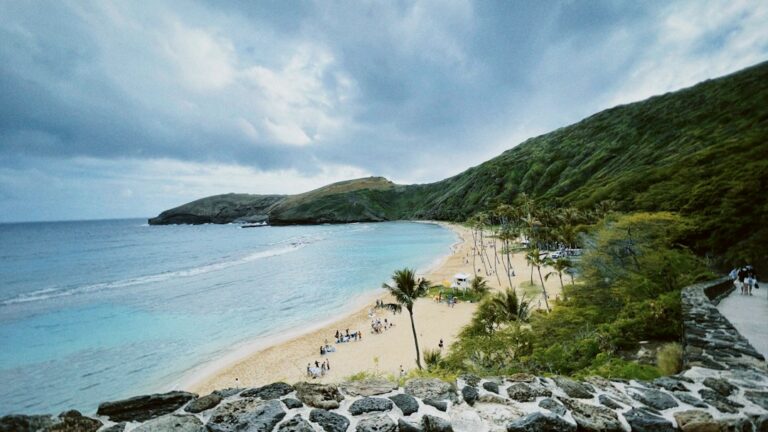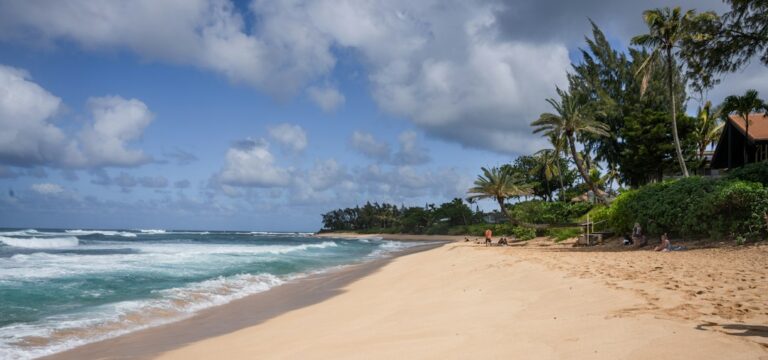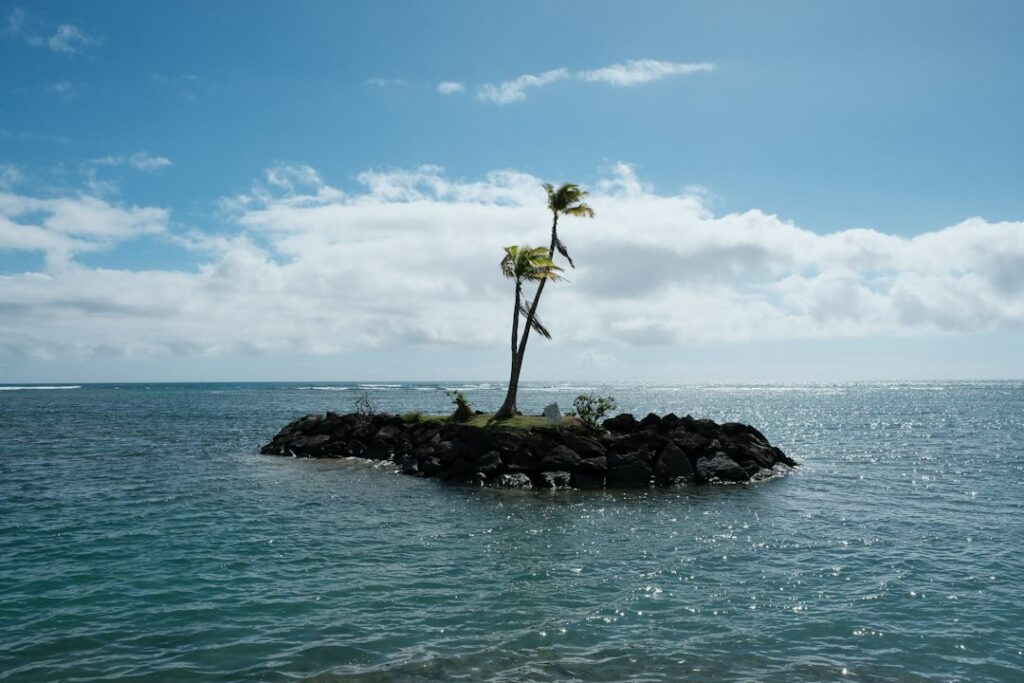
Kua Bay, formally Manini’owali Beach, sits inside Kekaha Kai State Park on the Kona Coast of the Big Island. The half-mile crescent of white coral sand backs onto black lava, sits about 12 miles north of Kailua-Kona, and draws visitors who want swimmable water without a snorkel-first orientation. What separates it from easier stops is the 1.5-mile access road — a lava-rutted spur that turns a $10 entry into a full driving decision.
The bay rewards a morning arrival with clear water, mild wave action, and parking still available. It punishes an afternoon walk-in with punishing shore break, full lots, and shadeless sand that clears 90°F on cloudless summer days. The gap between those two visits is a few hours.
This guide covers road conditions, rental car realities, the state park fee structure, swim timing, packing lists, and how Kua Bay fits alongside other Kona-coast stops for households researching a Big Island trip or relocation.
Where Kua Bay sits on the Kona Coast
Kekaha Kai State Park stretches along roughly 4 miles of coast north of Kona International Airport. It contains three main beaches: Mahaiula, Makalawena, and Manini’owali (Kua Bay). Each has a separate entrance, and the Kua Bay turnoff is the northernmost — around mile marker 88.5 on Highway 19.
From the Kona airport, expect about a 10-minute drive north on Highway 19 to reach the turnoff. From downtown Kailua-Kona, it runs closer to 25 minutes depending on Palani Road traffic. From Waikoloa Village resorts, the drive is about 20 minutes south.
The turnoff itself
The Kua Bay turnoff is marked with a brown state park sign that reads Manini’owali. It is easy to miss at highway speed — 55 mph on that stretch. Setting a phone marker before leaving pavement is standard advice, because the sign faces only northbound and southbound traffic differently.
Once off the highway, the road immediately drops in quality. The first 200 yards look paved but degrade fast. This is the point where households in rental sedans should decide whether to continue based on how the surface looks that day.
The 1.5-mile access road
The access road runs 1.5 miles from Highway 19 down to the beach parking lot. It descends across old lava flows, alternating between broken pavement, exposed lava rock, and patched sections. Average speed drops to 10-15 mph, meaning the drive in takes 15-20 minutes each way.
Big potholes appear after any hard rain, and standing water in the low sections hides deeper ruts. Locals in lifted trucks make it look easier than it is. Visitors in economy rentals should slow further and pick lines carefully.
Rental sedan reality
Standard rental sedans manage the road when dry. A Toyota Corolla or Nissan Versa has around 5.3 inches of ground clearance, which is enough for the shallow potholes but leaves no margin for the deep ones. Drivers who go slowly, avoid straddling ruts, and turn back if a section looks worse than the last one reach the lot without damage.
Full-size SUVs with 7-9 inches of clearance handle the road without drama. Jeep Wranglers rented from Kona airport for around $150 per day are overkill in dry conditions but useful for anyone visiting in winter or planning to also try the Mahaiula road further south.
When to avoid the road
Skip the drive within 24 hours of hard rain. Water pools in the low sections, ruts fill, and rental cars regularly bottom out. The Kona coast averages under 20 inches of rain per year, so most days are fine — but a February or November storm can leave the road unsafe for a rental for two days after.
Damage to rental undercarriages routinely runs $500-2,000, and standard rental agreements exclude damage from off-highway or restricted-access roads. The state park does not explicitly ban rentals, but many rental contracts do restrict use on unpaved roads. Read the paperwork before signing at the Kona airport counter.
Fees, hours, and what the $10 actually covers
Hawaii moved to a paid-entry model at Kekaha Kai State Park in 2023, matching a broader push to fund state park maintenance through non-resident fees. Hawaii residents with valid state ID enter free. Non-residents pay $10 per person and $10 per vehicle at Kua Bay.
Payment happens at a self-serve kiosk in the parking lot. Credit cards work; cash does not. Advance reservations through the Hawaii State Parks portal are recommended during holiday periods, though walk-in payment is typically available. Households comparing timed-entry sites can weigh the Diamond Head Crater booking window against Kua Bay’s more flexible model.
Park hours run 7:00 a.m. to 6:45 p.m. in spring and summer, closing earlier in winter. The gate is locked at closing, so cars still in the lot get trapped overnight. Rangers begin clearing at 6:15 p.m. Road-condition alerts for the coastal highway feeder are posted through Hawaii DOT channels.
| Fee type | Non-resident | Hawaii resident (ID) |
|---|---|---|
| Per-person entry | $10 | Free |
| Vehicle parking | $10 | Free |
| Family of 4 + car | $50 | Free |
| Payment method | Credit card only | ID at gate |
| Reservation needed? | Recommended holidays | Recommended holidays |
Swim conditions change every 4 hours
Kua Bay is a shore-break beach, not a snorkel-first beach. The bottom drops from ankle-deep to chest-deep within 15-20 feet of the sand. On calm mornings it swims like a resort pool; on windy afternoons it slams shoulders into the sand. The transition between those two states happens fast — sometimes over a single lunch break.
The morning window
Arrive between 7:00 and 10:00 a.m. from May through September and expect glassy conditions, water clarity of 30-50 feet, and easy entry across shallow sand. Water temperature runs 78-82°F in summer, cool enough to refresh but warm enough for extended swims without a rash guard.
This is when families with young children can safely stand in waist-deep water. Turtle sightings are common near the north end of the bay in the mornings. The lot is usually half-empty before 9:00 a.m., even in July.
The afternoon shore break
Between 11:00 a.m. and 2:00 p.m. trade winds pick up and wave energy hits the beach. The shore break becomes a 3-5 foot dumping wave that breaks in ankle-deep water. This is the mechanism behind the beach’s reputation for spinal injuries. Local lifeguards post yellow flags most summer afternoons.
Getting knocked flat by a shore-break wave — where the wave crest lands directly on hard sand — has resulted in emergency evacuations. Anyone unfamiliar with reading waves should exit the water by noon and switch to lying on shore with a book.
Winter reality
From November through March, north and northwest swells send 6-15 foot faces at the bay. Swimming becomes unsafe for hours or entire days. The Kona coast is more sheltered than the Hilo side, but Kua Bay’s exposure catches winter swells more than Kahalu’u or Magic Sands. For similar winter cutoff logic on Kauai, households can review the Tunnels Reef winter surf pattern.
| Window | Water temp | Typical wave face | Swim rating |
|---|---|---|---|
| Summer 7-10 a.m. | 78-82°F | 1-2 ft | Excellent |
| Summer 11 a.m.-2 p.m. | 79-82°F | 3-5 ft shore break | Advanced only |
| Summer 3-6 p.m. | 80-82°F | 2-4 ft | Caution |
| Winter mornings | 74-77°F | 6-15 ft swell | Often closed |
| Winter afternoons | 74-77°F | 8-15 ft | Watch only |
Packing list: reef shoes, cooler, shade
Kua Bay has no vendors, no shade trees, and no potable water tap. Everything a group needs comes in with them. The parking lot is a 3-minute walk from the sand, which adds friction to any round trip back to the car.
Reef shoes are not optional
The name Manini’owali translates loosely to a type of surgeonfish. The bay looks like pure sand but has lava rock patches on both ends and near the shore-break line. Reef shoes ($15-30 at Kona Costco or Longs Drugs) prevent cuts on entry and exit, and matter more on the shoulder rocks.
Closed-cell water shoes with a hard sole beat neoprene socks. The sand also heats past 130°F on cloudless afternoons, which turns a barefoot walk to the water into a small burn. Households used to reef entries on Maui — such as the Kapalua Bay coral entry — should still pack a spare pair here.
Cooler packing
A 20-40 quart cooler covers a family of four for a half-day. Ice retention on a mid-range cooler at 90°F ambient runs 24-36 hours if the cooler was pre-chilled overnight. Pack 1 gallon of water per person minimum. Sports drinks help offset trade-wind dehydration.
Costco in Kailua-Kona and the Kona Commons Safeway are the standard stops for cooler stocking on arrival day. Big Island grocery pricing sits well above mainland averages — households can benchmark against the Hawaii grocery pricing comparison to plan food costs. Freeze water bottles overnight to double as ice packs.
Shade and sun
Bring a pop-up canopy or beach umbrella. The 8×8 ft pop-up shade tents sold at Costco Kona ($60-90) fit easily in a rental trunk and set up in five minutes. Umbrellas need deep sand anchoring or a screw stake — regular beach umbrellas blow over in the 15-20 mph afternoon winds.
SPF 50+ reef-safe sunscreen is required under Hawaii’s 2021 ban on oxybenzone and octinoxate products. The state’s UV index reaches 10-12 in summer, meaning unprotected skin burns in 10-15 minutes. Reapply every 90 minutes, not every four hours.
| Item | Why it matters | Typical Kona cost |
|---|---|---|
| Reef shoes | Lava rock, hot sand, shore break | $15-30 |
| 20-40 qt cooler | No vendors on-site | $40-120 |
| 1 gallon water per person | No potable tap | $1.50-3 per gallon |
| Pop-up shade tent | No trees, 90°F+ sand | $60-90 |
| Reef-safe SPF 50+ | UV index 10-12 | $12-25 |
| Two-person mask/snorkel | North-end rocks calm days | $20-45 |
What actually exists at the beach
The parking lot holds about 40 vehicles and a small motorcycle area. Portable bathrooms — usually four — sit at the lot edge. There is a cold-water rinse shower near the trail down to the sand. That is the entire amenity list. No food, no drinks, no rental gear, no chair rentals.
Lifeguards staff Kua Bay daily during daylight hours, based out of a small stand at the south end. They post condition flags: green (calm), yellow (caution), red (closed to swimming). Flag decisions are made hourly based on wave height and rip risk.
Cell coverage is spotty. AT&T tends to hold one bar; Verizon drops entirely for many households. Anyone expecting to work remotely between swims should plan on downloading materials before leaving Kailua-Kona. Emergency 911 calls work even without service bars.
Parking fills by 10 a.m.
On summer weekends and any holiday, the lot fills by 9:30-10:00 a.m. Late arrivers wait at the gate for a car to leave, and the wait can run 30-90 minutes. Some visitors park along the highway shoulder and walk in, but that turns 1.5 miles into a hot exposed hike each way.
Wildlife: turtles, monk seals, and giving space
Kua Bay hosts consistent green sea turtle activity, especially along the north end near the rocks. Turtles rest on the sand in the mornings and forage in the shallows. Federal law under the Endangered Species Act requires a 10-foot minimum distance; state guidance recommends 20 feet.
Hawaiian monk seals are less frequent but do haul out on Kua Bay a few times per year. When they do, lifeguards cordon off a 150-foot buffer with rope. Any household finding a monk seal outside a cordoned area should back away and report the sighting to NOAA’s marine hotline.
Fish life around the rocks includes yellow tang, convict tang, moorish idol, and occasional trumpetfish. Calm mornings support short snorkel sessions along the north point in 5-8 feet of water. Visibility on flat days runs 30-50 feet; on wind-blown afternoons it drops to under 10 feet.
Safety beyond shore break
The shore break is the highest-frequency injury source, but not the only one. Rip currents form on medium-swell days along the south rocks. Sea urchins sit in crevices at both ends. Portuguese man-of-war occasionally wash up during onshore winds — usually after storms.
Ocean safety for the entire island is tracked through Hawaii Department of Health resources, and county lifeguard incident reports are summarized periodically in Hawaii Star-Advertiser coverage. Households planning multiple beach days should read a couple of these before arrival.
Sunburn is the most common ranger-reported injury at Kua Bay. The reflection off white sand and clear water intensifies exposure. Households from cool-climate mainland cities should expect to burn in half their normal time. Aloe pre-purchased in Kailua-Kona at $8-12 saves the drive back for supplies.
How Kua Bay compares to other Kona beaches
Kua Bay is one of several swimmable beaches on the Kona coast, and picking between them depends on skill level, kids’ ages, and travel style. The exhaustive ranking of Big Island beach options provides a full comparison across black sand, green sand, and white sand picks.
Hapuna Beach — 25 miles north — has similar white sand but easier access on paved roads and full amenities. Magic Sands is closer to Kailua-Kona but disappears seasonally. Kahalu’u is best for snorkeling with beginners. Kua Bay wins on water color and on the sense of a genuine wild-coast destination.
| Beach | Drive from KOA airport | Access road | Best for |
|---|---|---|---|
| Kua Bay | 15 min + 20 min rough road | 1.5 mi lava | Morning swim, view |
| Hapuna | 35 min all paved | Paved | Families, all-day |
| Magic Sands | 20 min paved | Paved lot | Bodyboarding |
| Kahalu’u | 25 min paved | Paved lot | Beginner snorkel |
| Mahaiula | 10 min + 15 min very rough | 1.5 mi worse | Solitude, hikers |
Building Kua Bay into a Kona itinerary
A common household pattern: arrive at Kua Bay by 8:00 a.m., swim and shore-sit until 11:30 a.m., leave before wind and traffic peak, and grab lunch in Kailua-Kona around 12:30. That opens the afternoon for a coffee farm tour or a nap ahead of an evening activity.
For a full-day plan, pair a morning at Kua Bay with an afternoon Kona coffee farm tour on the Belt Road between Captain Cook and Holualoa. The elevation gain cools by 10-15°F and the driving is much easier. That combination keeps rental sedans away from any risky roads after mid-morning.
Evening options run to a manta ray night snorkel departing from either Keauhou Bay or Kailua Pier. That schedule — beach morning, coffee afternoon, manta evening — is one of the most common Kona day templates households run during a week-long trip.
For a longer itinerary, a Chain of Craters Road drive through Hawaii Volcanoes National Park on a separate day pairs well with Kua Bay’s white sand contrast. Households comparing overall Big Island timing can consult the full breakdown of when to visit the Big Island for seasonal tradeoffs.
When Kua Bay is worth skipping
The bay is not a universal must-do. Households with mobility issues, families with children under three, snorkeling-first travelers, or anyone visiting during a December storm cycle may get more value elsewhere on the Kona coast.
Mobility limits matter because the parking-lot-to-sand trail includes a 15-foot descent over rock steps. Wheelchairs and strollers do not make it. The state has not built accessible infrastructure at Kua Bay as of 2026, so families needing that should choose Hapuna, where beach wheelchairs are available.
Snorkeling-focused visitors get more value at Two Step at Honaunau or at Kahalu’u, where fish density and reef structure exceed anything at Kua Bay. Kua Bay is a swim-and-body-surf beach with a beautiful view, not a snorkel destination.
Cost, logistics, and rental-car tradeoffs
A family of four visiting Kua Bay pays about $50 in park fees ($40 people + $10 vehicle). Gas from Kailua-Kona and back at Big Island prices — tracked through the EIA gasoline price series — adds roughly $8-12. Water and snacks run $25-40 for the day. Total half-day cost lands around $85-100 before lunch.
Rental-car upgrades are the biggest hidden lever. Booking a compact SUV like a RAV4 instead of a Corolla adds about $20-30 per day but eliminates most access-road anxiety. Over a 7-day trip that is $140-210 extra — often justified for households planning two or more visits to rough state park roads.
Broader Big Island cost planning — including groceries, gas, and lodging — is tracked through the BLS Honolulu Consumer Price Index and the Census QuickFacts for Hawaii. Households evaluating relocation costs use these to benchmark actual purchasing power.
The drive back and post-beach logistics
Leaving Kua Bay before 11:30 a.m. avoids the worst of the wind and the parking overflow. The drive back up the access road is easier than the drive down — gravity helps rental sedans clear the rougher sections. Budget the same 15-20 minutes to reach Highway 19.
Once back on Highway 19, options branch. Southbound leads to Kailua-Kona and Costco for restocking. Northbound leads to Waikoloa’s resort strip for a poolside lunch, or further to Hapuna Beach for households wanting a second beach afternoon on paved roads.
Sand cleanup matters more at Kua Bay than at paved-access beaches. Coral sand tracks into rental cars aggressively. A pre-packed spray bottle of fresh water, plus a small dedicated beach towel for feet, saves the vacuum bill at rental return.
Common visitor mistakes at Kua Bay
Eight patterns recur in ranger and lifeguard reports. Understanding them ahead of time removes the most common ways a Kua Bay visit gets ruined.
- Driving the access road after rain and losing an oil pan.
- Arriving at 1:00 p.m. and walking straight into shore break.
- Bringing no shade and burning severely by 11:30 a.m.
- Underpacking water and dehydrating before the 20-minute drive back.
- Wearing flip-flops onto lava rock at the south point.
- Ignoring red flags because the water looks fine from shore.
- Trying to snorkel on a wind-blown afternoon with 2-foot chop.
- Getting locked in after 6:45 p.m. and paying for a tow.
The fixes for all eight are the same: arrive early, pack heavier than expected, listen to lifeguards, and leave before the wind peaks. That pattern applies across most Big Island wild-coast beaches, not just Kua Bay.
Frequently asked questions
Is Kua Bay open to non-residents year-round?
Yes. Kekaha Kai State Park stays open to non-residents 12 months a year, subject to weather closures on high-surf or hazardous-storm days. Non-residents pay $10 per person and $10 per vehicle at the kiosk, and pay by credit card only. Winter closures usually last a day or two, not weeks, and are posted at the gate.
Can a Toyota Corolla really make it down the road?
In dry weather, yes — driven at 10-15 mph with careful line choice. A Corolla has around 5.3 inches of clearance, enough for the smaller potholes but not for deep ruts. After rain, water hides the ruts and rental sedans routinely bottom out. When conditions look uncertain, turn around at the top.
How does Kua Bay compare to Hanauma Bay on Oahu?
The Hanauma Bay reservation system on Oahu requires a 48-hour advance booking and $25 non-resident entry. Kua Bay is swim-first, cheaper at $10, and typically walk-up. Water clarity favors Hanauma; ease of getting in the water favors Kua Bay. Both close occasionally for weather and both fill by mid-morning.
What months have the calmest water at Kua Bay?
May through September offer the calmest mornings, with wave faces under 2 feet and water temperatures 78-82°F. October and April are transitional and can produce good days between fronts. November through March bring 6-15 foot north swells that close the bay to swimming on many days. Morning arrival still gives the best odds year-round.
Are there lifeguards at Kua Bay all day?
Yes. County lifeguards staff the bay during daylight hours, typically 9:00 a.m. to 5:30 p.m., with a stand at the south end. They post green, yellow, and red flags based on hourly wave and rip assessments. Before and after those hours the beach is unpatrolled, which is one reason a mid-morning arrival is safer than a dawn arrival.
How does the $10 fee compare to Diamond Head or Hanauma Bay?
Kua Bay’s $10 per-person plus $10 per-vehicle fee sits lower than Hanauma Bay’s $25 per person and matches Diamond Head Crater’s $5 person and $10 vehicle roughly evenly on the vehicle side. Payment is credit-card-only and can be made at the kiosk in the lot rather than through a reservation portal.
Can visitors combine Kua Bay with Makalawena Beach in the same day?
Yes, with the right vehicle. Makalawena sits about 1 mile north of Kua Bay and is reachable by a 20-30 minute hike from the Kua Bay lot across lava fields, or by a very rough 4WD-only road from the Mahaiula entrance. A morning swim at Kua Bay followed by an afternoon Makalawena hike is doable in cooler months.
Is Kua Bay safe for children?
For strong-swimming children over eight in the morning window with lifeguards on duty, yes. For toddlers or non-swimmers, the shore break creates real risk even at knee depth on rougher days. Families with young children can watch from shore and swim at Hapuna or Kahalu’u instead. Green flag mornings are the only safe window for beginners.