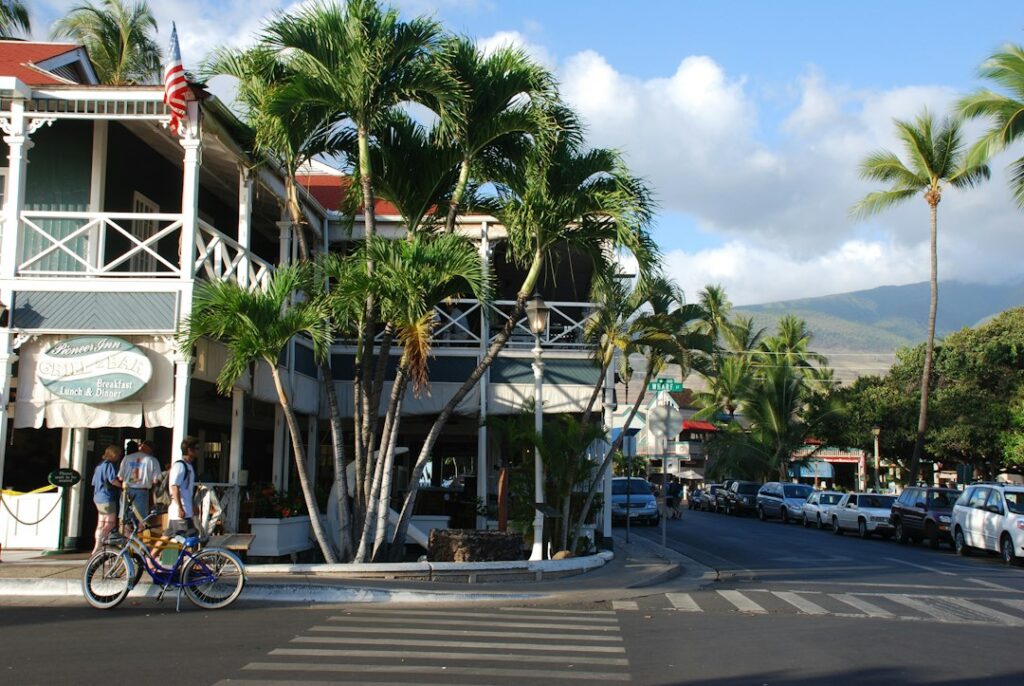
Haiku sits on the windward slope of Haleakala, above the sugar-era town of Paia and below the ranch country of Makawao. Relocating households know it as the rainy, green shoulder of Maui’s north shore, where two-lane roads wind past guava thickets and old pineapple fields toward the start of the Hana Highway.
The zip code 96708 covers roughly 20 square miles of ridges, gulches, and coastline between Kaupakalua and Peahi. Rainfall runs 60 to 100 inches per year across that range, and much of the housing stock sits outside the Department of Water Supply’s piped service area, relying instead on private wells or roof catchment.
This profile pulls together the practical variables a mainland household actually needs to weigh: water source, road access through Paia, school assignments to Haiku Elementary and King Kekaulike, and the way agricultural CPR lots and ohana dwellings shape density compared to nearby Makawao. Numbers come from public data; interpretation comes from research on relocation patterns, not lived experience.
Where Haiku sits on Maui’s north shore
Geographically, Haiku is not a single town but a rural district with several named neighborhoods: Kokomo, Kaupakalua, Pauwela, Peahi, Kuiaha, and the historic Haiku town center around the old cannery. Elevations range from sea level at Peahi Bay up to roughly 1,500 feet on the higher ag lots inland. Most residential parcels sit between 200 and 1,200 feet.
The community lies about 12 miles east of Kahului Airport by road, along Hana Highway (Route 36). Drive time in average traffic runs 20 to 30 minutes to Kahului and 35 to 50 minutes to the medical corridor at Wailuku. Makawao town sits roughly 4 miles inland by way of Kokomo Road.
Named neighborhoods within 96708
Real estate listings often distinguish between “Haiku town” near Haiku Community Center, “upper Haiku” on Kokomo and Kaupakalua roads, and the coastal cliff parcels near Peahi that overlook the famous Jaws big-wave break. Each pocket carries different rainfall, road quality, and water-source expectations.
- Haiku town center: cannery buildings, post office, small businesses
- Kokomo: mid-elevation, transitions toward Makawao pastureland
- Kaupakalua: higher elevation, wetter, larger ag lots
- Pauwela: coastal side, closer to Paia and the highway
- Peahi and Kuiaha: north-facing cliffs, big-wave surf territory
Rainfall, trade winds, and the upcountry microclimate
Haiku’s climate is defined by the northeast trade winds pushing moist air up Haleakala’s windward flank. The University of Hawaii Rainfall Atlas records annual totals of roughly 60 inches near the Hana Highway junction and climbing past 100 inches at higher ag parcels toward Kaupakalua. That gradient can produce noticeably different building conditions on parcels only a mile apart.
Temperatures stay mild year-round. Coastal Haiku averages daytime highs of 78–83°F and overnight lows of 62–68°F. Higher parcels near 1,200 feet run 3–6°F cooler, especially on winter mornings from December through February. Frost is essentially unheard of, but ground fog and heavy dew are common upcountry.
Seasonal patterns matter for anyone planning construction or catchment sizing. The wetter half of the year runs November through April, when storm systems can deliver 4–8 inches in 48 hours. May through October brings lighter, more scattered showers, though the trade-wind mist still keeps yards green and roofs damp most mornings.
Micro-climate variation by neighborhood
Rainfall on the Haiku ridge falls unevenly across short distances. Kaupakalua Road parcels at 900–1,200 feet frequently record 90–110 inches annually, while lower Haiku homes closer to the highway typically log 55–75 inches. Peahi cliff parcels, exposed to northeast trades but at lower elevation, come in between at 65–85 inches per year.
Historical event totals matter for engineering catchment overflow. The March 2021 storm dumped over 6 inches in 24 hours across parts of Haiku; January 2020 produced a 48-hour total exceeding 11 inches at higher Kaupakalua stations. Sizing catchment overflow and gulch drainage for these events is not optional.
What the rain does to houses
Persistent moisture accelerates mildew, wood rot, and corrosion of exposed metal fittings. Copper gutters, stainless fasteners, and treated framing all cost more upfront but reduce maintenance across a 20-year horizon. Households familiar with the coffee-belt upcountry parcels above Poipu will recognize a similar building physics challenge, though Haiku typically runs wetter than Kalaheo.
The Hawaii Department of Health tracks mold-related indoor air complaints and publishes guidance on ventilation. Homes with covered lanais on multiple sides, deep eaves, and cross-ventilation designs age better than closed-in mainland-style layouts.
Water supply: wells, catchment, and DWS boundaries
This is the single variable most mainland buyers underestimate. The Maui County Department of Water Supply operates piped municipal water in Paia, parts of lower Haiku along the highway, and portions of Makawao. Large sections of upper Haiku, Kaupakalua, and Kokomo sit outside that piped service area entirely.
Parcels outside DWS boundaries typically rely on one of three water sources: a private drilled well, a roof-catchment system with tanks, or a shared agricultural water line served by East Maui Irrigation ditches. Each carries different upfront cost, testing burden, and long-term reliability.
| Water source | Typical upfront cost | Annual maintenance | Testing frequency |
|---|---|---|---|
| DWS meter (if available) | $14,000–$30,000 hookup | $800–$1,500 water bill | Utility-provided |
| Drilled private well | $45,000–$85,000 | $400–$900 pump/filter | Annual coliform test |
| Roof catchment (10,000 gal) | $18,000–$32,000 | $300–$700 UV bulbs, filters | Quarterly recommended |
| Ag line share | $3,000–$12,000 buy-in | $150–$500 assessment | Non-potable — treat separately |
Well drilling in the Haiku aquifer typically hits productive water between 180 and 450 feet, though rates and salinity vary. Drilling permits go through the Commission on Water Resource Management, and completion reports become public record — worth pulling for any listed property that claims well water.
Catchment realities
Catchment sized for a two-adult household at Haiku rainfall typically means 10,000 to 15,000 gallons of storage plus a roof area of 1,600 square feet or more. Household use of 40 gallons per person per day is a conservative planning target. Systems require sediment filtration, UV disinfection, and periodic tank cleaning.
Households moving from mainland municipal service should study the same catchment discipline used by residents of Volcano Village on Hawaii Island, where catchment is nearly universal. The engineering translates almost directly, though Haiku’s ambient temperatures reduce biological growth pressure compared to the rainforest at 4,000 feet elevation.
Testing and treatment for wells
Hawaii Department of Health guidance recommends annual coliform testing on private wells, with lead, arsenic, and nitrate testing at initial commissioning. Costs run $80–$180 for a basic coliform panel and $250–$550 for a full inorganic panel. Some Haiku aquifers show mild iron or manganese staining that benefits from a whole-house sequestration filter.
Hana Highway access and the commute through Paia
The Hana Highway (Route 36) is the single road connecting Haiku to Kahului, the airport, Costco, and the primary hospital. Traffic bottlenecks at Paia town, where the highway narrows to a two-lane village street with pedestrian crossings and a heavily used surf spot at Ho’okipa. Morning peak between 7:00 and 8:30 a.m. can double baseline travel time.
The Hawaii Department of Transportation publishes counts on Route 36 volumes that regularly exceed 22,000 vehicles per day near Paia. Accident closures on this two-lane stretch can trap Haiku residents for hours; alternate routes through Kokomo Road to Makawao add 15–25 minutes but bypass the coastal bottleneck.
| Destination from Haiku town | Distance (miles) | Off-peak time | Peak time |
|---|---|---|---|
| Kahului Airport (OGG) | 12 | 22 minutes | 40–55 minutes |
| Maui Memorial Medical Center | 17 | 32 minutes | 50–70 minutes |
| Costco Kahului | 13 | 25 minutes | 45–60 minutes |
| Makawao town | 4 | 10 minutes | 15 minutes |
| Paia town | 4 | 8 minutes | 18–25 minutes |
| Hana town | 52 | 2 hours 15 minutes | 3+ hours |
Road quality on interior lanes
Once off the state highway, many Haiku parcels sit on private or partially maintained roads. Kaupakalua, West Kuiaha, and the mauka-side pineapple roads range from smooth pavement to washboard gravel with seasonal potholes. Four-wheel drive is not always required, but ground clearance and all-weather tires ease access during heavy November–March storm cycles.
School assignments: Haiku Elementary and King Kekaulike
Public school assignments in 96708 follow the Baldwin-Kekaulike-Maui complex boundaries. Elementary students within the geographic zone attend Haiku Elementary School on West Kuiaha Road. Middle-school students shift to Kalama Intermediate in Makawao, and high schoolers attend King Kekaulike High School in Pukalani.
Haiku Elementary enrolls approximately 340 students in grades K–5 and consistently reports strong parent involvement. Kalama Intermediate serves roughly 900 students in grades 6–8, drawing from Paia, Haiku, Makawao, Pukalani, and Kula. King Kekaulike High School enrolls close to 1,100 students in grades 9–12.
Bell schedules and bus logistics
School start times matter for the highway commute. King Kekaulike historically starts around 8:00 a.m., and school buses from Haiku pick up 45–70 minutes before bell. Families with multiple children across two campuses often build morning routines around the earliest pickup, then a return trip for the elementary student.
Private and charter alternatives
Households considering non-public options frequently look at Haleakala Waldorf School in Kula (K–12, tuition roughly $16,000–$26,000 depending on grade), Seabury Hall in Olinda (grades 5–12, tuition around $30,000+), and the Kula-based Kihei Charter (public charter, no tuition but limited seats). All add commute distance.
- Haiku Elementary — public, grades K–5, on West Kuiaha Road
- Kalama Intermediate — public, grades 6–8, in Makawao
- King Kekaulike High — public, grades 9–12, in Pukalani
- Haleakala Waldorf — private, K–12, Kula campus
- Seabury Hall — private, grades 5–12, Olinda campus
Housing stock: agricultural CPRs, ohana units, and lot sizes
Haiku’s residential inventory is dominated by two zoning categories: agricultural districts (typically 2-acre or 5-acre minimums) and older rural residential lots. What outside buyers often do not realize is how much of the ag inventory has been split into Condominium Property Regimes — a Hawaii-specific tool that carves a large parcel into smaller “condo” units on shared common land.
A 15-acre ag parcel might legally contain three CPR units: three separate homes and yards on paper, but with shared roads, water lines, and easement rules. Each CPR unit trades and finances more like a house than a condo, though the legal structure imposes governance quirks a mainland buyer should read carefully before closing.
Ohana dwellings
Maui County’s ohana ordinance allows a second dwelling on qualifying lots, typically capped at 1,000 square feet. On ag land, a farm dwelling plus a farmworker dwelling plus an ohana can produce three legal residences on a single parcel. Understanding what is permitted, what is grandfathered, and what is unpermitted matters enormously to valuation.
| Housing type in 96708 | Typical lot size | Median list price 2026 | Water source |
|---|---|---|---|
| Older plantation cottage | 7,500–15,000 sq ft | $925,000–$1.35M | DWS (often) |
| 1990s subdivision home | 10,000–20,000 sq ft | $1.15M–$1.65M | DWS or well |
| Ag CPR unit (2 acres) | 2 acres common land | $1.45M–$2.4M | Well or catchment |
| Full ag parcel (5–15 acres) | 5–15 acres | $2.2M–$5.5M+ | Well typical |
| Coastal cliff parcel (Peahi) | 2–20 acres | $3.5M–$18M+ | Well |
Prices reflect 2026 listing patterns and can shift with each market cycle. For broader Maui context, the general island-wide relocation guide covers price movement across South Maui, West Maui, and Upcountry submarkets.
Haiku vs. Makawao: density, character, and price
Prospective buyers often shortlist both Haiku and Makawao because they share upcountry character and Kekaulike-complex schools. The two feel meaningfully different on the ground. Makawao town centers on a walkable main street with a paniolo history, boutique shops, and residential density inside town of roughly 3 to 6 units per acre.
Haiku has no equivalent town-center density. Its “downtown” is a cluster of buildings at the old cannery, not a walkable retail street. Housing spreads across ag parcels and rural residential zones with far lower density. That means quieter, greener parcels — and also longer drives to a coffee shop or a school bus stop.
Which fits which household
Families who want walkability, established neighbor networks, and Makawao-town proximity often prefer Makawao or the cooler Kula uplands. Households prioritizing acreage, agricultural use, or wave access at Peahi more often land in Haiku. Both share the King Kekaulike high school assignment.
| Attribute | Haiku 96708 | Makawao 96768 |
|---|---|---|
| Typical elevation range | 0–1,500 ft | 1,400–2,200 ft |
| Annual rainfall | 60–100 inches | 35–55 inches |
| Coastal proximity | Direct — Peahi, Pauwela | None — inland only |
| Walkable town center | No | Yes (Baldwin Ave) |
| Typical ag parcel size | 2–15 acres | 1–5 acres |
| DWS coverage share | Partial | Extensive |
| Median home price 2026 | ~$1.55M | ~$1.4M |
Utilities, solar, and off-grid considerations
Maui Electric (part of Hawaiian Electric) serves most Haiku parcels, though very remote or newer ag CPR units sometimes rely on off-grid solar with battery banks. Grid-connected rates track statewide upcountry pricing at roughly 43–48 cents per kilowatt-hour, per EIA data — among the highest in the United States.
Solar economics on the windward side require careful modeling. Haiku’s cloud cover during winter storm cycles reduces PV production by 25–40% versus a comparable Kula or Kihei installation. System sizing should account for the wetter shoulder months rather than the sunniest summer week.
Solar water heaters and permitting
Hawaii requires solar water heating on new single-family homes under HRS 196-6.5, with narrow variances allowed for lots where solar exposure is inadequate. Some heavily shaded Haiku parcels under gulch canopies qualify for the variance, but most standard clearings do not.
Internet, cell coverage, and outages
Broadband availability varies sharply parcel to parcel. Spectrum cable extends along Hana Highway and into portions of upper Haiku along main paved roads. Homes past the pavement often rely on fixed wireless, Starlink, or DSL. Cell coverage is generally solid on Hana Highway and thins in gulches and behind ridges.
- Cable broadband: available on paved highway-adjacent lots
- Fixed wireless: patchy but functional on ridgetop parcels
- Starlink: reliable across almost all of 96708
- Cell service: Verizon and T-Mobile both usable on main roads
- Power outages: 4–10 per year, storm-driven
Daily life, groceries, and medical access
Haiku has a small grocery inside the Haiku Community Center building and a few farm stands along the highway. Full grocery runs happen at Foodland Pukalani (about 20 minutes upslope) or Safeway, Costco, and Target in Kahului (25–40 minutes depending on traffic). Farmers markets in Paia and Makawao supplement produce sourcing.
Medical care follows the same pattern as most of Maui: primary care in Kahului or Wailuku, hospital-level care at Maui Memorial Medical Center. Specialty care sometimes requires interisland flights to Honolulu. Households with children enrolled in Hawaii’s developmental disability Medicaid waiver often plan around case-manager visit distance from Haiku.
Surf, ocean access, and Peahi
Coastal Haiku includes Peahi (Jaws), one of the world’s premier big-wave breaks. During the winter north-swell season from October through March, swells over 30 feet arrive at Peahi. Ho’okipa Beach Park at the boundary with Paia is a year-round windsurf destination with more accessible surf conditions.
Cost of living context
The Honolulu-area CPI is the closest official cost proxy for Maui, and Maui typically runs 6–12% higher on groceries and 3–7% higher on housing than Honolulu neighborhoods. Gasoline in upcountry Maui runs 15–35 cents above the state average per EIA gas data, largely a delivery-cost function.
Agricultural use and the Real Property Tax classification
Many Haiku ag parcels are enrolled in Maui County’s Agricultural Use Real Property Tax classification, which reduces the assessed valuation in exchange for active agricultural use. Qualifying uses include fruit orchards, ornamental plants, livestock, aquaculture, and dedicated pasture. The reduction can trim annual property tax bills by thousands relative to non-ag classification.
Reclassification and dedication periods are typically 10 years for the deepest rate reduction. Rolling out of ag use before the dedication period ends triggers rollback taxes. Buyers acquiring dedicated parcels should confirm the current status and any transferable obligations at closing, since ag violations can produce surprise back-tax exposure.
Common Haiku ag operations
- Tropical fruit: lychee, longan, rambutan, avocado, citrus
- Coffee: small acreage on lower-elevation Haiku parcels
- Flowers: protea, ginger, heliconia, tuberose
- Livestock: sheep, goats, chickens on smaller acreage
- Cattle: limited by parcel size; more common in Makawao
Small-scale coffee growers in Haiku sometimes ship green beans to Maui roasters profiled in the island coffee guide. The lower elevations of Haiku (200–700 feet) suit specific varietals adapted to warmer humid conditions and higher rainfall than the classic Kona coffee belt.
Buying process, closing costs, and moving logistics
Purchasing an ag CPR or well-served home involves due-diligence steps a mainland buyer often has never encountered. Well flow tests, water quality panels, catchment sizing verification, septic inspections, and CPR document review each carry cost and time. Rushed closings can leave a household unaware of a shared road maintenance obligation until the first storm cycle.
The Hawaii Department of Taxation imposes conveyance tax at rates that scale with price and owner-occupancy status. Non-occupant purchases and second homes carry higher rates. Property taxes are set at the county level, with Maui County publishing its own rate schedule across owner-occupied, non-owner, and agricultural use classifications.
Shipping household goods
Most household goods arrive on Matson or Pasha Hawaii containers to Kahului Harbor. A 20-foot container from the West Coast runs roughly $9,500–$14,500 in 2026, plus inland trucking on both ends. Vehicles ship separately at $1,700–$2,900 per car depending on origin port.
| Move component | Typical 2026 cost | Timing window |
|---|---|---|
| 20-ft container West Coast → Kahului | $9,500–$14,500 | 10–18 days |
| Passenger vehicle shipping | $1,700–$2,900 | 10–21 days |
| Agricultural inspection at origin | $150–$450 | Pre-shipment |
| Pet air travel (dog, in-cabin) | $125–$450 | Day-of |
| Pet quarantine bypass fees | $185–$300 | 120-day prep |
Timeline for a Haiku-bound relocation
A realistic timeline from decision to move-in runs 6 to 12 months. Financing an ag CPR often requires a lender familiar with Hawaii-specific documents; not every mainland bank will underwrite one. Households should plan for temporary rentals in Paia or Makawao if the closing lags the container arrival at Kahului.
Frequently asked questions
Is Haiku, Maui a safe area to raise children?
Haiku consistently reports low property crime and violent crime rates relative to statewide averages. Rural risks are different — car break-ins at beach trailheads, occasional package theft, and road-hazard incidents during storms. Families raising children in 96708 typically point to strong Haiku Elementary parent networks and the King Kekaulike complex as anchors of community stability.
Do most Haiku homes have air conditioning?
Most Haiku homes lack central air conditioning because the trade winds and elevation keep interior temperatures comfortable through much of the year. Coastal parcels near Pauwela may see 82–85°F afternoons in August and September; upper Haiku averages 4–6 degrees cooler. Ceiling fans, cross-ventilation, and deep eaves handle cooling in most houses.
How does school assignment work if a family lives just inside 96708?
Public school assignment on Maui follows Hawaii DOE geographic boundaries, not zip codes alone. Households near the Haiku-Paia border may fall into either Haiku Elementary or Paia Elementary depending on the exact street. The state DOE geographic exception process allows out-of-zone requests, but seat availability at King Kekaulike often limits transfers into the complex.
Can catchment water be used for drinking?
Catchment water can be made potable with a properly designed treatment train: first-flush diverter, sediment filtration, activated carbon, and ultraviolet or reverse-osmosis polishing. The Hawaii Department of Health publishes catchment guidance recommending quarterly testing and annual UV bulb replacement. Many Haiku households treat catchment as household water and buy bottled water for drinking as an added precaution.
What is the difference between an ag CPR and a full ag parcel?
A full agricultural parcel is a single deeded lot with clear boundaries and one owner. An ag CPR takes that parcel and legally subdivides it into condominium units — often two to five — with shared roads, water, and easements. Each CPR unit sells separately but carries governance obligations to the other unit owners similar to a small homeowners association.
How reliable is emergency response in rural Haiku?
Maui Fire Department and Maui Police Department respond to Haiku from stations in Paia and Makawao. Response times average 8–14 minutes depending on parcel location and road conditions. Storm closures on Hana Highway can extend that meaningfully. Households on remote lanes often coordinate with neighbors for medical emergencies and file address-plus-GPS location information with dispatch in advance.
Do buyers need special financing for a Haiku ag CPR?
Ag CPR financing is more limited than conventional single-family mortgages. Some national lenders decline the product outright, while others require larger down payments, typically 25–30%. Local Hawaii credit unions and portfolio lenders often handle these deals more comfortably. Buyers should confirm lender familiarity before writing an offer, since a late financing pivot can jeopardize closing.