Kona’s leeward coast holds three snorkeling sites that dominate every Big Island itinerary: Kealakekua Bay’s Marine Life Conservation District, Two Step at Honaunau Bay, and Kahaluu Beach Park just south of Kailua-Kona. Each site offers a different entry mode, skill floor, and reef density.
All three sit within a 22-mile stretch of the Māmalahoa Highway, so a rental car and a single tank of gas cover them in one day. Water visibility runs 60 to 100 feet from May through September, with winter storms occasionally dropping clarity to 20 feet for a few days at a time.
Rule changes at Kealakekua Bay in 2021 rerouted access to the Captain Cook Monument snorkel zone to permitted boats and kayaks only, and that shift shapes how relocating households plan a Kona snorkel day. This research-based rundown walks through each site’s access rules, entry logistics, wildlife encounters, and practical costs.
Why Kona’s leeward coast holds the clearest water
The Big Island’s western shore sits in the wind shadow of Mauna Kea (13,796 ft) and Mauna Loa (13,678 ft). These giants block the trade winds that hammer the Hilo side, producing the calm surface conditions snorkelers need. Kona coastal areas receive roughly 20 to 30 inches of rain annually; Hilo receives more than 130 inches.
Cold upwelling from the deep offshore drop-off keeps water temperature between 76°F and 80°F year-round, warmest in August and September and coolest in February. With no continental runoff and minimal agricultural drainage on the leeward side, particulate loads stay low and reef visibility holds.
The seasonal weather pattern on the Big Island favors morning snorkeling. Onshore breezes typically build after 11 a.m., so the glassy “glass-off” window that photographers value runs from roughly 7 to 10 a.m. at every Kona site.
Kealakekua Bay MLCD: the boat-and-kayak-only reef since 2021
Kealakekua Bay is a designated Marine Life Conservation District covering 315 acres of coastline and reef, and it holds arguably the best hard-coral cover on the Big Island. The Captain Cook Monument on the north end of the bay marks the reef zone where dolphin pods regularly appear and where reef fish density is highest.
In 2021, the Hawaii Department of Land and Natural Resources changed access rules for Ka’awaloa Cove, the water in front of the monument. Independent shore access via the old Ka’awaloa Trail was closed to snorkelers because the descent was creating safety and cultural-site pressure. Entry to the Cook Monument snorkel zone now requires a permitted boat or kayak operator.
Permitted operators and how the system works
DLNR issues a small number of Commercial Use Permits (CUPs) authorizing kayak and boat access to Ka’awaloa. The list of permitted operators is published on the DLNR website; most legitimate outfits leave from Napo’opo’o Wharf, Keauhou Bay, or Kailua Pier and land or moor near the monument for a 60- to 90-minute snorkel window.
A kayak tour with a permitted concession typically runs $95 to $135 per person and lasts 3.5 to 4 hours including the paddle across. A larger snorkel-catamaran from Keauhou Bay runs $150 to $220 per person, includes lunch, and covers the crossing in 25 minutes each way. Booking 2 to 3 weeks in advance is standard during winter and spring.
For a deeper breakdown of departure options and permit-holder differences, see the Napo’opo’o-focused guide on Kealakekua Cook Monument snorkel logistics. A parallel logistical comparison for Kauai’s cliffed coastline is the Napali Coast boat versus kayak trade-off, which uses the same operator-license structure.
What snorkelers actually see there
The Ka’awaloa Cove reef drops from 8 feet at the shelf edge to more than 100 feet on the outer wall. Common sightings include yellow tang schools, Moorish idols, saddle wrasse, Achilles tang, and the state fish humuhumunukunukuapua’a. Spinner dolphins (Stenella longirostris) rest in the bay’s deeper center between 8 a.m. and 2 p.m., which is exactly when tour boats arrive.
| Access mode | Cost per person | Duration | Water time | Departure point |
|---|---|---|---|---|
| Permitted kayak tour | $95–$135 | 3.5–4 hours | 75–90 minutes | Napo’opo’o Wharf |
| Snorkel catamaran | $150–$220 | 4–5 hours | 60–75 minutes | Keauhou Bay |
| Zodiac raft charter | $135–$185 | 4 hours | 60 minutes | Kailua Pier |
| Private charter (6-pax) | $1,200–$1,800 total | 4 hours | 90 minutes | Honokohau Harbor |
| Shore entry (Ka’awaloa) | Closed to snorkelers | N/A | N/A | N/A |
Two Step at Honaunau Bay: shore entry over lava
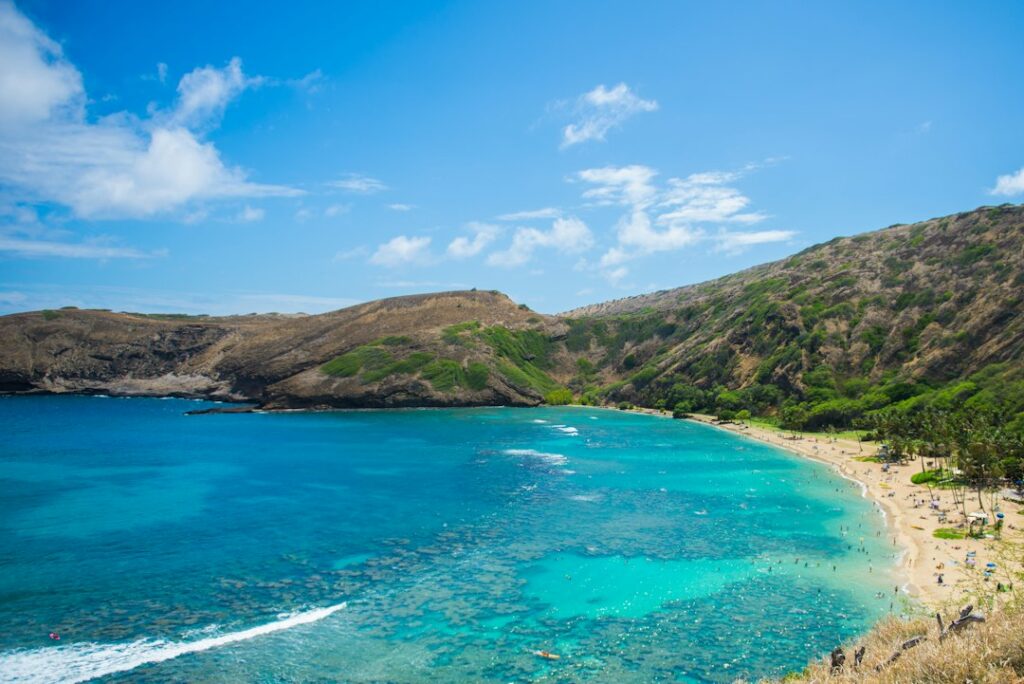
Two Step sits inside Honaunau Bay, directly adjacent to Pu’uhonua o Honaunau National Historical Park. The name comes from a two-tiered lava shelf that functions as a natural entry ladder into water that drops immediately to 15 or 20 feet. There is no beach; entry is over bare pahoehoe lava.
Parking is the first friction point. A private lot next to the entry charges $10 per vehicle for the day and typically fills by 8:30 a.m. in high season. The national park visitor lot charges $20 per vehicle for a 7-day pass and requires a 5-minute walk along the coastline. Roadside parking on Highway 160 is limited and enforced.
Reading the entry
The two-step ledge works only when swell is under 2 feet. Snorkelers wait for a wave lull, sit on the upper step, lower to the lower step, and roll or slide forward into the water. Fins and mask go on in the water, not on the rocks. Exits work in reverse; watch for surge that can push a swimmer sideways into urchin-covered lava.
Water shoes are strongly recommended for the walk from the parking lot to the ledge and for the entry itself. A dedicated primer on water shoes and lava-rock entry technique covers footwear choices for Two Step specifically. The rocks are hot after 10 a.m. and razor-edged where sea urchins have colonized crevices.
What the reef holds
Two Step’s inshore reef is a large, healthy coral-head field with visibility routinely between 70 and 100 feet in summer. Spinner dolphin pods enter the bay several mornings per week to rest, and green sea turtles feed on algae along the north wall most afternoons. Deeper divers see manta rays cruising the outer bay in late spring.
Peak snorkel time is 7 to 10 a.m., before winds pick up and before the day-tour catamarans that anchor in the outer bay disembark their swimmers. By noon, the near-shore water is crowded and the surface chop makes visibility feel worse than the actual clarity.
Kahaluu Bay: the beginner classroom with resident turtles
Kahaluu Beach Park is 5 miles south of Kailua-Kona at the north end of Keauhou. A shallow, protected cove behind a broken lava breakwater keeps water calm on all but the biggest south swells, and the sandy-bottom entry means no lava technique is required. Depth averages 3 to 6 feet across most of the swimming zone.
The park is Hawaii County-managed and has restrooms, outdoor showers, picnic tables, and a lifeguard tower staffed daily from 9 a.m. to 4:45 p.m. Parking is free but limited to roughly 60 spots; overflow parks along Alii Drive. Bay access is free of charge.
Green sea turtles and the ReefTeach volunteer program
Kahaluu hosts a resident population of green sea turtles (honu) that graze on limu algae on the reef flats. Hawaii state law and the federal Endangered Species Act prohibit touching, chasing, or approaching within 10 feet. NOAA’s guidance sets a preferred distance of 10 feet in the water and 10 feet on the beach.
ReefTeach, a Kohala Center-run volunteer program, stations trained docents at the beach daily from roughly 9 a.m. to 3 p.m. Volunteers wear orange shirts, explain reef etiquette to visitors, identify fish, and enforce distance rules with green sea turtles. First-time snorkelers benefit from the free 5-minute briefing before entering the water.
Skill floor and best hours
Kahaluu is the least demanding of the three sites and the standard recommendation for someone learning to snorkel or bringing children. Rental gear is available at a shack next to the beach for $8 to $15 per day. Water is warmest and calmest between 8 and 11 a.m.; afternoon trades push a chop across the surface.
The site does have currents. A rip current runs out through the reef gap on the north end during outgoing tides, and lifeguards flag the boundary. Snorkelers who feel pulled offshore should swim parallel to the beach until out of the current, then back in.
Spinner dolphins and the NOAA 50-yard rule
Hawaiian spinner dolphins forage at night in deep water and rest in shallow bays during the day. Kealakekua Bay and Honaunau Bay are two of the most reliable resting bays on the Big Island’s west side. Swimming toward resting pods disrupts their sleep and, over time, degrades reproductive success.
In October 2021, NOAA Fisheries finalized a rule that prohibits swimming with, approaching, or remaining within 50 yards of a Hawaiian spinner dolphin, in the water or from a vessel. The rule applies within 2 nautical miles of the main Hawaiian Islands. Violations carry civil penalties up to $11,000.
What the rule looks like in practice
Snorkelers who enter a bay and encounter a resting pod are legally required to leave the 50-yard zone by any reasonable means. Boat operators who anchor near a pod must reposition. Kayakers must paddle away. The rule does not apply to incidental proximity when animals approach the person, but proactive movement toward the pod is prohibited.
Reputable Kona snorkel operators brief guests on the rule before departure. Operators found violating the rule risk permit suspension. A comparable in-water etiquette regime for a smaller bay appears in the piece on Hulopoe Cove Lanai dolphin etiquette, which uses the same underlying NOAA framework.
Reference details and current wildlife-viewing guidance are posted through the state’s Hawaii Tourism Authority information portal and via ocean-safety updates from state agencies.
Gear that works on the Kona coast
Snorkel gear rentals on the Big Island run $8 to $15 per day at beach shacks and $30 to $50 for a weekly package at dive shops. Renters get mask, snorkel, fins, and (usually) a mesh bag. Prescription-optical mask upgrades add $5 to $10 per day. The tradeoff: rental fit is imperfect and mask leaks cost real snorkel time.
Owners of their own gear reliably fare better in Kona’s morning windows. A silicone mask that has been fitted at home holds a seal against the water pressure of a 15-foot free-dive better than a mystery rental. The full breakdown of what to buy versus rent lives in the Hawaii snorkeling gear checklist.
The five things Kona sites actually need
- Low-profile silicone mask with a tempered-glass lens (not plastic).
- Dry-top snorkel or dry-valve snorkel for windy afternoons.
- Open-heel fins with a stiff blade for offshore currents.
- Reef-safe mineral sunscreen (zinc oxide, non-nano) applied 20 minutes before entry.
- Rash guard or 1mm shortie for extended sessions in February water.
Water shoes are non-negotiable at Two Step and useful at Kahaluu, where the entry is sandy but the reef flats are studded with sea urchins in shallow zones. Closed-toe hiking sandals do not protect against wana (urchin) spines the way a dedicated neoprene bootie does.
Getting there: rental cars, parking, and the boat-tour alternative
Kona International Airport (KOA) is 8 miles north of Kailua-Kona. Standard midsize rental cars run $55 to $85 per day in shoulder season and $95 to $145 per day in December-January and June-August. A 4WD is not required for any of these three snorkel sites, though it helps on the road to Green Sand Beach and Waipi’o.
Fuel prices on the Big Island track the EIA’s weekly retail gasoline survey for the Pacific region, typically $1.10 to $1.40 higher per gallon than mainland West Coast prices. Budget $70 to $95 to fill a midsize sedan on arrival.
Drive times from Kailua-Kona
| Destination | Distance | Drive time | Parking cost | Lifeguard |
|---|---|---|---|---|
| Kahaluu Beach Park | 5 miles | 12 minutes | Free | Yes, 9 a.m.–4:45 p.m. |
| Two Step (Honaunau) | 22 miles | 40 minutes | $10 lot / $20 park | No |
| Napo’opo’o Wharf | 18 miles | 35 minutes | Free (limited) | No |
| Keauhou Bay | 7 miles | 15 minutes | Free (tour-validated) | No |
| Kailua Pier | 0 miles | In town | Metered street | No |
Renters comparing island itineraries can cross-check the best time to visit each Hawaiian island guide, which layers airfare seasonality onto rental pricing.
Reef-safe sunscreen and Hawaii’s law
Hawaii became the first U.S. state to ban the sale of oxybenzone and octinoxate sunscreens, effective January 1, 2021. Maui County extended the ban in 2022 to include all non-mineral sunscreens. Enforcement at retail is real: local pharmacies and grocers no longer stock non-compliant brands. Bringing banned sunscreen from home is not illegal for personal use, but reef damage is what the law targets.
Mineral sunscreens formulated with zinc oxide (non-nano) or titanium dioxide meet the standard. A 3-oz tube runs $12 to $22 at Kona ABC stores and Costco, and applying 20 minutes before water entry allows the product to bind to skin. Aerosol sunscreen sprays are banned in Hawaii state parks regardless of active ingredient.
Water conditions on the Big Island are monitored by state agencies including the Hawaii Department of Health, which publishes advisories after heavy rain events on the leeward coast. Post-storm runoff can push bacteria counts above safe swim thresholds for 24 to 72 hours.
Seasonal windows and water conditions by month
Winter (December–February) brings North Pacific swells that occasionally reach Kona through wrap-around energy. South-facing sites like Two Step see the most impact, with swell events lasting 2 to 4 days at a time. Summer south swells originate off New Zealand and Antarctica; they arrive June through September with 3- to 6-foot faces.
Kahaluu, protected by its lava breakwater, stays snorkelable through most swell events. Kealakekua’s inner cove is protected by the bay’s natural curve. Two Step is the most swell-sensitive of the three because it is a straight-shot lava shelf with no natural break.
| Month | Water temp (°F) | Visibility | Swell risk | Kona coast rain |
|---|---|---|---|---|
| January | 76°F | 50–80 ft | North swell | 2.5 in |
| April | 77°F | 70–90 ft | Low | 1.3 in |
| July | 79°F | 80–100 ft | South swell | 0.3 in |
| September | 80°F | 80–100 ft | Low | 0.4 in |
| December | 77°F | 50–80 ft | North swell | 2.2 in |
For a monthly breakdown of Big Island travel conditions including rainfall on the Kona side, the month-by-month Big Island guide pairs weather data with pricing and volcano-status context.
Cost of a Kona snorkel day: three budgets
| Item | Budget day | Standard day | Premium day |
|---|---|---|---|
| Rental car (24 hr) | $65 | $85 | $145 |
| Fuel | $12 | $18 | $25 |
| Parking | Free (Kahaluu) | $10 (Two Step lot) | $20 (national park) |
| Gear rental | $12 shack rental | $0 (own gear) | $0 (own gear) |
| Boat/kayak tour | $0 shore only | $115 kayak | $195 catamaran |
| Lunch (2 people) | $18 (grocery) | $42 (poke bowl) | $95 (Kealakekua deck) |
| Sunscreen (mineral) | $15 | $15 | $22 |
| Day total (2 pax) | $122 | $400 | $1,073 |
Grocery-side savings on lunch are real. Poke bowls in Kailua-Kona run $16 to $22 versus $28 to $35 at resort restaurants. The Hawaii grocery prices by island breakdown quantifies the Kona-side markup on staples like eggs, milk, and produce.
Related activities and next-door snorkel options
The Kailua-Kona coast holds several other snorkel spots that pair well with a three-site day. The Keauhou versus Kailua Pier manta ray night snorkel is the most-booked evening activity in Kona, typically running $110 to $175 per person and lasting 90 minutes to 2 hours in the water.
Broader beach research on the island appears in the ranked 12 best beaches on the Big Island guide, which covers black-sand and green-sand alternatives on the south coast. Post-snorkel dining options are catalogued in the 2026 Big Island restaurants guide.
Cultural context: Pu’uhonua o Honaunau
Two Step’s parking area shares a border with Pu’uhonua o Honaunau National Historical Park, one of the most significant cultural sites in the Hawaiian Islands. The 420-acre park was a place of refuge where ancient Hawaiians who broke kapu (sacred law) could reach sanctuary and be absolved by a kahuna. Entry is $20 per vehicle for a 7-day pass.
Snorkelers benefit from stopping at the park after their morning session. Reconstructed heiau (temple platforms), a re-created ali’i (chiefly) compound, and interpretive trails contextualize the same shoreline the snorkel entry uses. Rangers offer free guided walks Wednesday through Sunday at 10:30 a.m.
Federal statistics from the U.S. Census QuickFacts for Hawaii put the Native Hawaiian and Other Pacific Islander share of the state population at approximately 10.6 percent, the highest of any state. Reef sites like these are living cultural landscapes, not just recreation venues.
Frequently asked questions
Can snorkelers still hike down to the Cook Monument at Kealakekua?
No. The 2021 DLNR rule closed independent shore access to the Ka’awaloa Cove snorkel zone in front of the monument. The Ka’awaloa Trail is still hikable to the monument itself, but entering the water requires a permitted boat or kayak operator. Enforcement is real and includes citations. Book a permitted tour from Napo’opo’o Wharf or Keauhou Bay instead.
Is Two Step safe for a first-time snorkeler?
Two Step is intermediate. The lava-ledge entry demands timing waves, footing on wet basalt, and confidence swimming into 20-foot water immediately. Beginners should learn at Kahaluu Bay first, where the sandy entry, shallow depth, and on-duty lifeguards remove most of the friction. Once comfortable, moving to Two Step in a morning glass-off window is straightforward.
How close can snorkelers legally get to spinner dolphins?
NOAA Fisheries prohibits approaching or remaining within 50 yards of Hawaiian spinner dolphins in Hawaiian waters, in effect since October 2021. Snorkelers who see a resting pod must leave the 50-yard zone. Incidental proximity when animals swim toward the person is not a violation, but proactively swimming toward them is. Civil penalties run up to $11,000 per violation.
What is the best month for Kona snorkeling?
September delivers the ideal combination: 80°F water, 80- to 100-foot visibility, minimal swell risk, and only 0.4 inches of average rainfall on the leeward coast. May and October come close. February and December have decent water but face the highest chance of a North Pacific swell event that closes Two Step for 2 to 4 days.
Do rental cars need to be 4WD for these three sites?
No. All three snorkel sites — Kahaluu, Two Step, and the Napo’opo’o and Keauhou boat departure points — are on paved roads accessible by any midsize sedan. Renters going on to Green Sand Beach at South Point, the Waipi’o Valley overlook road, or Mauna Kea’s summit road need 4WD, but not for the Kona snorkel triangle itself.
What does the ReefTeach volunteer program actually do?
ReefTeach is a Kohala Center program that stations trained volunteers in orange shirts at Kahaluu Beach Park daily from roughly 9 a.m. to 3 p.m. They brief incoming snorkelers on reef etiquette, identify fish species, and enforce the 10-foot distance rule with resident green sea turtles. The service is free and takes 5 minutes at the water’s edge.
How much of the Kealakekua tour fee covers the DLNR permit?
Permitted kayak and boat operators pay annual CUP fees plus per-passenger conservation surcharges to DLNR; those costs generally amount to $8 to $15 per snorkeler within a $95 to $220 ticket price. Operators without a valid permit are cheaper by roughly 30 percent but risk citations that can end the trip mid-water. Only book with published permit-holders.