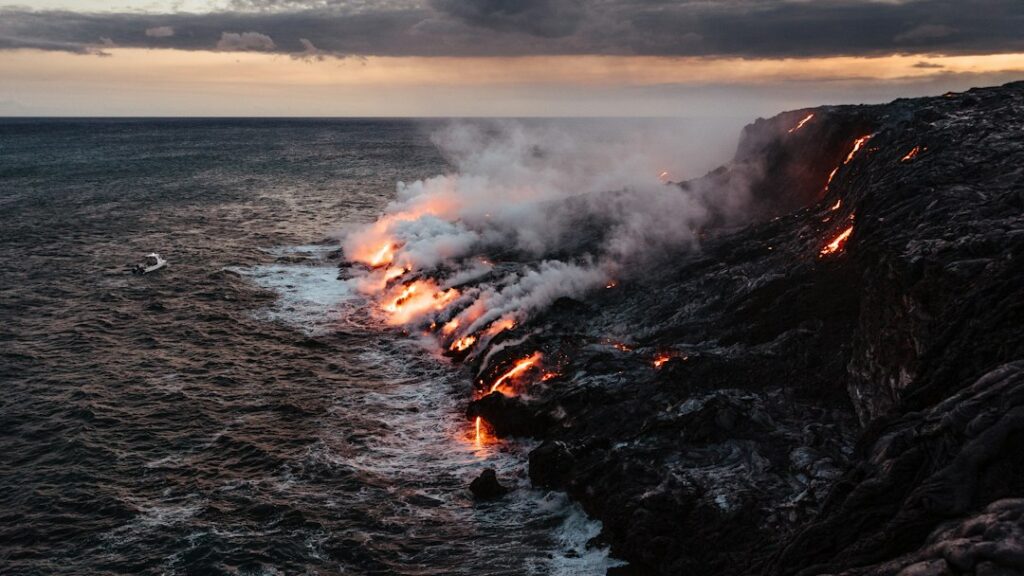
Halemaumau is the collapse crater set within the larger Kilauea caldera on Hawaii Island, and its molten lava lake — when active — produces a nocturnal orange glow visible from designated rim vantages inside Hawaii Volcanoes National Park. Since the 2018 collapse and the eruptive episodes that have followed, glow visibility has swung from spectacular fountain-fed radiance to weeks of dormant blackness, so trip planning turns on same-day USGS Hawaiian Volcano Observatory (HVO) status rather than photos taken last year.
Two developed viewpoints anchor evening visits: Kilauea Overlook, a reopened site on the caldera’s northwest rim, and Uekahuna, the highest publicly accessible caldera-edge point at roughly 4,077 feet elevation. Both sit inside the $30 vehicle-fee zone, both close nothing in the evening (the park itself is open 24 hours), and both give a direct line of sight into Halemaumau from about 1.6 to 2 miles across the caldera floor.
This article walks through the current status-check workflow, the difference between the two rim vantages, arrival timing before and after sunset, air-quality checks for sulfur dioxide (SO2), the $30 entry fee structure, family-safety fence policies, and how full moon phases actually degrade — not enhance — glow contrast for most cameras and eyes.
The Halemaumau setting today
Halemaumau sits within the summit caldera of Kilauea, one of Earth’s most active shield volcanoes. The 2018 lower Puna eruption drained the summit lava lake and triggered a caldera collapse that dropped the crater floor by more than 1,600 feet. Subsequent eruptions from December 2020 onward have partially refilled Halemaumau, with intermittent lava-lake activity that resumes and pauses on cycles of days, weeks, or months.
The observable result for evening visitors is variable. During active eruptive episodes, a broad reddish reflection can paint low clouds directly above the crater; during pauses, the same viewpoint shows only starlight, city glow from Hilo, and the outline of Mauna Loa to the southwest. Because timing is unpredictable, USGS Hawaiian Volcano Observatory releases daily status updates that filter to Hawaii County emergency channels and park bulletin boards.
Visitor centers post the current alert level on chalkboards near the entrance, but a smartphone with cached HVO updates avoids surprises after the ranger station closes. The four USGS volcano alert levels — Normal, Advisory, Watch, Warning — correspond to green, yellow, orange, and red aviation color codes. Watch or Warning status usually means visible surface activity is possible.
Why the 2018 collapse reshaped the view
Before May 2018, Halemaumau was a much smaller pit with a persistent lava lake near the rim. Then the caldera floor subsided approximately 500 meters over about 90 days, widening Halemaumau roughly threefold and rendering pre-2018 photos and trail alignments obsolete. Popular former viewpoints like Jaggar Museum sit on ground that shifted, cracked, or dropped, and remain permanently closed for structural reasons.
Uekahuna, opened to visitors in mid-2023, replaced the Jaggar function as the western-rim high-elevation vantage. Kilauea Overlook, farther north along the same rim road, offers a lower elevation and different sight angle. Both are ADA-accessible from paved parking lots with short walks under 300 feet from car to fence line.
Kilauea Overlook vs Uekahuna: two rim vantages
Choosing between the two viewpoints depends on wind direction, crowd tolerance, and how much elevation drop between parking and rail the visitor wants. Both sit off Crater Rim Drive north of the Kilauea Visitor Center, and both are reachable in under 15 minutes from the park entrance during off-peak traffic.
| Feature | Kilauea Overlook | Uekahuna |
|---|---|---|
| Elevation | ~4,000 ft | ~4,077 ft |
| Parking to rim rail | ~250 ft | ~150 ft |
| Line to Halemaumau vent | ~1.8 miles | ~1.6 miles |
| Parking capacity | ~35 vehicles | ~40 vehicles |
| Restroom on site | Yes (vault) | Yes (vault) |
| Wheelchair grade | Under 5% | Under 3% |
| Evening wind exposure | Moderate | High (open summit) |
| Post-2018 reopening year | 2021 | 2023 |
Sight-angle differences
Uekahuna sits slightly farther west and higher, so the sightline dips more steeply into Halemaumau. This angle catches molten surfaces near the western pit wall better when a lava lake is active in that quadrant. Kilauea Overlook’s flatter angle shows more of the crater floor overall, which favors seeing spatter cones and secondary vents that form during eruptive cycles.
Neither vantage looks straight down into a lava lake — the crater is deep enough that the actual molten surface is often obscured, with only the reflected glow on rising gas plumes visible from either rim. Photographers with 200mm+ telephoto lenses catch more detail; unaided eyes see mainly the sky-reflected orange dome when eruption is vigorous.
Which vantage on which night
When trade winds blow from the northeast (the dominant Hawaii pattern), Uekahuna sits upwind of the plume and stays SO2-free while Kilauea Overlook can occasionally receive drift. When Kona winds arrive, typically in winter months of December through February, the plume can wrap around and affect Uekahuna first. Ranger boards inside Kilauea Visitor Center note that afternoon’s actual wind direction.
Crowds concentrate at Uekahuna because it is the newer, higher, and most-promoted stop. Kilauea Overlook is quieter on average, sometimes with a quarter of the vehicle count. Visitors seeking solitude or long-exposure photography usually favor Kilauea Overlook; visitors seeking ranger-staffed talks and interpretive signage favor Uekahuna, where seasonal evening programs often set up folding tables with telescopes.
Evening arrival strategy for glow visibility
Glow visibility depends on ambient light. During the golden hour before sunset, the crater’s orange reflections wash out against the sky. Serious viewers therefore aim to arrive 45 to 60 minutes before sunset, walk the rim in daylight, and stay 30 to 90 minutes past astronomical dark, when contrast between the black caldera and the glowing vent reaches its peak.
Practical arrival windows shift with the season. Sunset on the Big Island falls between roughly 5:48 PM in late December and 7:18 PM in late June. Winter visitors get a compressed timeline — daylight arrival, dinner in the car, dark departure — while summer visitors face a late night with the drive back to Hilo or Volcano Village not starting until nearly 9:00 PM.
| Month | Sunset at Kilauea summit | Astronomical dark | Recommended arrival |
|---|---|---|---|
| January | 6:05 PM | 7:20 PM | 5:15 PM |
| March | 6:35 PM | 7:50 PM | 5:45 PM |
| June | 7:15 PM | 8:30 PM | 6:20 PM |
| September | 6:35 PM | 7:45 PM | 5:45 PM |
| December | 5:50 PM | 7:05 PM | 5:00 PM |
Why the 45-minute buffer matters
Walking the rim path in twilight lets the eye adapt to darkness gradually, which improves subjective glow perception dramatically. Arriving after full dark forces the eye to work against every parked-car headlight and cell-phone screen in the lot. Ranger volunteers routinely ask arriving vehicles to switch off high beams within the last 100 yards of the parking area to preserve group dark adaptation.
The buffer also allows for finding parking, locating restrooms, and setting up any tripod or camera equipment before the rush of dusk visitors. On weekends and during eruption events, Uekahuna’s lot can fill by 45 minutes before sunset, with overflow parked along the road shoulder if allowed by rangers that evening.
The $30 NPS vehicle fee and access options
Hawaii Volcanoes National Park charges a $30 per-vehicle entrance fee valid for seven consecutive days. A pedestrian or cyclist enters for $15. An annual park-specific pass runs $55. The federal America the Beautiful annual pass at $80 covers this park and every other federal fee area for 12 months and pays back after roughly three national-park stops.
Fee stations sit at the Highway 11 entrance and typically staff from about 8:00 AM through 4:30 PM. After hours, visitors self-register via the automated kiosk, which accepts credit cards; cash is not accepted. Rangers occasionally spot-check receipts at parking areas, and unpaid vehicles risk a citation carrying fines several times the entrance fee.
| Pass | Cost | Duration | Best for |
|---|---|---|---|
| Vehicle day pass | $30 | 7 days | Single trip, up to 4 adults |
| Motorcycle pass | $25 | 7 days | Two-wheel entry |
| Individual (walk/bike) | $15 | 7 days | Solo or ride-in visit |
| Hawaii Tri-Park annual | $55 | 12 months | Kilauea + Haleakala + Puuhonua |
| America the Beautiful | $80 | 12 months | All U.S. federal fee sites |
| Senior lifetime (62+) | $80 | Lifetime | Older U.S. citizens/residents |
| Fourth-grader family pass | Free | School year | Families with a 4th grader |
Free-entry dates
The National Park Service designates several fee-free days each year — typically the Martin Luther King Jr. holiday in January, the first day of National Park Week in April, the Great American Outdoors Act anniversary in August, National Public Lands Day in September, and Veterans Day in November. These days waive the $30 vehicle charge but not concession, camping, or backcountry permit fees.
Ongoing eruption status via USGS HVO
The USGS Hawaiian Volcano Observatory posts daily updates that include activity summary, sulfur dioxide emission rates in tonnes per day, seismicity counts, deformation trends, and photograph or thermal imagery from monitoring stations on the caldera rim. Serious visitors bookmark the update page and check it on the day of arrival, since eruption episodes have been starting and pausing on cycles as short as 12 to 24 hours.
Between 2020 and 2025, Halemaumau saw multiple discrete eruption episodes ranging from a few hours to several months. During the late-2024 and 2025 episodic series, fountaining events reached over 1,000 feet on peak nights, generating tourism spikes as news outlets like the Honolulu Star-Advertiser and Hawaii News Now covered the activity.
Peak fountaining episodes typically pause within 24 to 72 hours, after which the crater cools and glow fades. During deflation phases, no visible surface lava appears; visitors should not expect glow simply because an eruption was reported the previous week. Real-time Civil Beat reporting and the HVO webcam feed together give the clearest same-day read.
Reading the HVO update
An HVO update marked “eruption paused” means no molten surface activity at the moment, but the volcano remains at Watch level pending re-inflation. “Eruption continues” indicates active lava emission. “No eruption; background” indicates purely thermal glow, very dim, sometimes invisible to the eye but showing on long-exposure cameras. Understanding this distinction prevents driving up the mountain expecting fountaining and finding only faint reflection.
The HVO also publishes SO2 emission rates. Rates above 5,000 tonnes per day generally correspond with visible lava at the vent; below 500 tonnes per day usually indicates only fumarolic degassing without visible molten surface. Between episodes, rates typically settle into the 100–500 range.
SO2 vog advisory and air quality checks
Sulfur dioxide is the primary gas hazard at Halemaumau. Concentrations near the rim can spike from safe background levels to health-hazard thresholds within minutes when plumes shift. Children, pregnant visitors, and anyone with asthma, emphysema, or heart conditions face elevated risk and should check advisories from the Hawaii Department of Health before ascending to the summit area.
The state maintains a real-time air quality sensor network with stations in Volcano Village, Pahala, and other downwind communities. Readings under 100 ppb SO2 are generally comfortable; 100–200 ppb triggers a moderate advisory; above 500 ppb is unhealthy for sensitive groups and may prompt temporary closure of viewpoints closest to the vent.
Deeper background on vog patterns lives in the Hawaii vog SO2 advisory reference, and the vog direction and trade-wind chart explains why downwind communities like Ocean View and Naalehu bear the brunt during Kona wind episodes while Hilo, sitting upwind of the trades, generally stays clear.
When to skip the trip
Rangers close individual overlooks — not the whole park — during acute SO2 events. If the ranger station reports Kilauea Overlook is closed but Uekahuna is open, wind direction is the reason, and the open vantage sits upwind of the plume. If both close, the eruption is either extremely gas-heavy or wind is calm enough to let the plume pool along the rim. Try again tomorrow.
Symptoms of SO2 exposure include eye burning, throat irritation, coughing, and tightness in the chest. Adults noticing any of these should walk back to the vehicle and drive out — the effects typically resolve within 30 to 60 minutes of leaving the plume. N95 respirators do not filter SO2 gas; only proper acid-gas cartridge respirators help, and those are impractical for casual viewing.
Family safety and rim-distance policies
The rim rails at both viewpoints stand roughly 42 inches high — standard NPS overlook guardrail height. The actual crater edge sits several feet beyond the rail, and the ground between rail and edge is unstable, fractured lava that continues to shift after the 2018 collapse. Crossing the fence carries a citation and, historically, has produced fatalities at Kilauea overlooks.
Children require close supervision. Rangers advise keeping hands on toddlers within 10 feet of any rim fence and using strollers with wheel locks on paved overlook paths. The paths themselves are wheelchair-friendly, but the drop-off on the caldera side is real: gaining a better photo angle is not worth the fall risk on friable ground.
Nighttime visibility compounds the hazard. Once dark, the actual location of the caldera edge is invisible from a few feet away. Stay on paved surfaces, keep headlamps pointed downward (never scanning the crater), and treat any low fencing as absolute — cattle fencing sometimes marks closed extensions of the old trail system that predates the 2018 collapse.
Suitable and unsuitable for kids
- Suitable: infants in carriers, kids old enough to obey “stay behind the rail” instructions.
- Suitable: school-age kids briefed on SO2 warning signs and dressed in warm layers.
- Marginal: toddlers ages 2–4, who may bolt in low light near the fence line.
- Unsuitable: any child with asthma when SO2 readings exceed 100 ppb.
- Unsuitable: any visitor who cannot tolerate a warm jacket at 55°F in wind.
Headlamps, layers, and cold-weather prep
The summit area sits at about 4,000 feet elevation, and evening temperatures routinely drop into the low 50s Fahrenheit even in July, and into the low 40s from December through February. Wind can push the felt temperature 10°F lower. Mainland visitors dressed for beach weather at sea level in Hilo (25 miles and 4,000 feet lower) arrive at the rim shivering within 20 minutes of standing still.
Recommended layers are a base T-shirt, a fleece or midlayer, a windproof shell, long pants, and closed-toe shoes. Rain shells help against occasional light drizzle common in the Kau district. A knit cap and thin gloves add significant comfort at the rail on nights when wind pushes across the caldera at 15–25 mph.
Headlamps with red-light modes preserve night vision for the wearer and neighboring viewers; white-light headlamps blast dark-adapted eyes and provoke annoyed glances at any dark-sky viewpoint. Small clip-on red LEDs suffice; the point is to see the paved path, not to illuminate the crater.
Bring one water bottle per person and a small snack — the rim has no concessions, and evening ranger programs occasionally run long. Vault toilets exist at both overlooks; running water and flush toilets exist at the Kilauea Visitor Center about 5 minutes’ drive back toward the entrance.
Full moon considerations and glow contrast
Popular thinking assumes a full moon enhances any outdoor viewing. For Halemaumau glow, the opposite is closer to true. A full or gibbous moon significantly brightens the ambient scene, washing out the subtle red-orange reflection that only a truly dark sky reveals. Photographers report the crater glow appears roughly two f-stops dimmer against a fully moonlit sky than against a moonless one.
The best glow-viewing nights fall within a few days on either side of new moon. During full-moon week, the moon rises around sunset and stays up all night, so waiting for moonset is not an option. Visitors targeting glow should check a lunar phase calendar before locking dates and prioritize new-moon or last-quarter windows.
| Moon phase | Glow contrast | Notes |
|---|---|---|
| New moon | Excellent | Darkest sky, best contrast |
| Waxing crescent | Very good | Moon sets by 9 PM |
| First quarter | Good | Moon sets around midnight |
| Waxing gibbous | Fair | Ambient light noticeable |
| Full moon | Poor | Glow washed out overnight |
| Waning gibbous | Fair | Late-night moonrise helps |
| Last quarter | Good | Moon rises after midnight |
| Waning crescent | Very good | Dark evening window |
Stars, Milky Way, and the trade-off
The counter-argument for full moon nights is safety and general scenery. A moonlit rim path is easier to walk; a moonlit landscape reveals Mauna Loa’s silhouette and the caldera’s geometry. Visitors who want a mixed experience — some glow, some moonlit landscape — can compromise around first or last quarter, when the moon sets or rises in the middle of the evening window.
Milky Way viewing at the rim runs strongest from April through September, when the galactic core rises high overhead. During those months, combining a new-moon evening with a Halemaumau glow event puts the orange crater in the same field of view as the Milky Way’s brightest arch — a memorable combination that dark-sky photographers plan for months in advance.
Combining Halemaumau with other Kilauea stops
Most visitors treat Halemaumau glow as an evening cap on a full day inside the park. The park’s other headline attractions cluster within a 15-minute drive of the visitor center, making a single-day itinerary easy to build without repeat gate fees.
Daytime pairings that fit before evening glow viewing include the Kilauea Iki crater floor loop, the Chain of Craters Road overlook drive, and the Puu Loa petroglyph plank walk on the coastal end of that same road.
Anyone driving the full Chain of Craters route down to sea level should study the rim-to-sea fuel plan before starting, because the 38-mile round trip has no gas stations, no water refills, and no cell service for most of its length. Fill up in Volcano Village or Hilo before entering the park.
Multi-day visitors on a broader Big Island itinerary often combine Kilauea with a northern loop that includes the Pololu Valley switchback overlook and the Kukuihaele overhead vantage above Waipio Valley. A three-day plan generally works: Hilo side one day, Volcanoes park (with glow viewing) day two, north/Kohala day three.
Lodging base for evening returns
The closest lodging to the rim vantages is inside Volcano Village, roughly 3 miles from the park entrance and 15 minutes’ drive from Uekahuna. Nightly rates for small cabins and vacation rentals typically run $180–$300 in-season, with occasional shoulder-season rates around $140. Hilo lodging averages lower — around $150–$220 — but adds a 45-minute drive each direction.
Volcano House, the historic in-park lodge on the caldera rim, is the only accommodation with rooms overlooking the caldera itself. Rates for caldera-view rooms start around $340 nightly, and booking often requires reservations 3 to 6 months ahead during peak eruption interest.
Weather, visibility, and backup plans
The summit area sits in a rainy microclimate — annual precipitation exceeds 100 inches in some years. Cloud cover routinely obscures the caldera in late afternoon and can persist through the evening. When low clouds sit directly over Halemaumau, the glow diffuses into the cloud belly and can actually look more dramatic than a clear night; when clouds sit at rim level, they blank the view entirely.
National Weather Service Hilo issues a forecast specifically for the summit area. Rain in Hilo does not always mean rain at Volcano, and vice versa. A quick check of the caldera webcam feed before leaving Hilo saves a wasted 90-minute round trip when conditions are socked in.
Rangers post current weather at the entrance and at the visitor center. If a fog advisory is up, expect low visibility on the rim road; if a high-wind advisory is up, tripods and light umbrellas will not stay upright at either overlook. Adjust plans for the following evening rather than pressing through a night where the rim is invisible.
Backup plans if the summit is fogged in include the Volcano House lobby (open to non-guests), the visitor center exhibits (open until roughly 5:00 PM), and the Volcano Art Center gallery next door. A dinner in Volcano Village at one of two or three sit-down restaurants can push the evening later, with a second attempt after 9:00 PM sometimes catching a clearing.
Frequently asked questions
Is Halemaumau erupting right now?
Status changes frequently, sometimes within hours. Check the USGS Hawaiian Volcano Observatory daily update on the day of your visit rather than relying on news articles more than 48 hours old. Recent years have produced a pattern of short episodic eruptions separated by pauses of days to weeks, so a positive report last week does not guarantee visible activity tonight.
Can you see the lava lake directly from the rim?
Rarely. The crater floor sits hundreds of feet below the rim, and the actual lava surface is typically obscured by depth, gas plume, or the crater’s western wall. Visitors usually see reflected orange glow on rising gas rather than molten lava itself. Telephoto lenses in the 200mm range help capture more detail than unaided eyes provide.
Do children need to pay the $30 entrance fee?
The $30 charge is per vehicle, not per person, so children add no extra cost inside a private car up to the standard passenger capacity. Individual entry for a pedestrian or cyclist age 16 and up is $15; those 15 and younger enter free. A fourth-grader family pass provides free entry for families with an enrolled 4th grader.
How long should you plan to stay at the rim after dark?
Most viewers stay 30 to 90 minutes past astronomical twilight, which gives eyes time to fully dark-adapt and increases odds of catching intermittent brightening. Photographers with tripods often stay two to three hours. Casual visitors satisfied with a look and a photo may leave within 20 minutes of full dark. Wind chill often cuts stays short.
Is the drive back down safe in the dark?
Highway 11 from the park entrance toward Hilo or Volcano Village is a well-maintained two-lane road with reflectors and painted center lines. Fog can reduce visibility, and mongoose or feral pig crossings appear at night. Reduce speed 10 to 15 mph below posted limits and use low beams when oncoming traffic approaches to avoid dazzle from mist.
What is the best month for a first-time glow viewing trip?
April through early June generally offers the best mix of dry weather, mild summit temperatures around 55–65°F, longer daylight for arrival, and clear skies for full contrast. Winter months from December through February have shorter days but produce dramatic low-cloud reflection nights. Avoid full-moon weeks and Golden Week Japanese holidays, which produce large summit crowds.
Is glow viewing feasible with a stroller or wheelchair?
Yes at both Uekahuna and Kilauea Overlook. Paved paths from parking to rim rails are under 300 feet with grades below 5 percent. Rail heights suit standing and seated viewers. Vault toilets sit within short walking distance. Bring warm layers and consider the transfer from vehicle to path in low light — a red-light headlamp helps caregivers safely.