Hawaii can work well for travelers who use wheelchairs, but how well depends on the island and the attraction. Some places are close to fully accessible, like the USS Arizona Memorial and the Kīlauea Visitor Center. Others are not accessible at all, like the 175-step Diamond Head summit trail. Most beaches fall in between. They depend on a loaner beach wheelchair or a mobility mat that may or may not be out on a given morning.
This guide covers each piece of a wheelchair accessible Hawaii trip: beach equipment by island, the national park overlooks, Pearl Harbor and Hanauma Bay, accessible van rentals, TheBus and Handi-Van on Oahu, airport assistance at Honolulu (HNL) and Kahului (OGG), and the questions that separate a true ADA room from a room that only has grab bars.
Policies, fares and equipment locations change often in Hawaii. The figures below come from published agency and operator information. Travelers should confirm details directly before booking anything that cannot be refunded.
How accessible Hawaii is: the big picture
Hawaii is a U.S. state, so the Americans with Disabilities Act applies to its hotels, public transit, airports and government facilities. That gives travelers a legal baseline that many international beach destinations lack. Oahu’s buses all have lifts or ramps. Every major airport has jet bridges or lift equipment. Federal parks publish accessibility details.
Terrain is where things get harder. The islands are volcanic, so the best viewpoints are often high, steep or reached over lava rock. Many famous beaches have soft sand, a steep shore break, or a long walk from the parking area. The resort zones are the exception. Waikiki, Ka’anapali, Wailea and the Kohala Coast were built more recently and are mostly flat, with paved promenades.
Which island is easiest
Oahu is the easiest island for wheelchair users by a wide margin. It has the only full fixed-route bus network with paratransit backup, the most accessible hotel inventory, and flat, paved Waikiki. Maui comes second because its resort coasts are flat and its summit visitor center is reachable by car.
The Big Island and Kauai mostly require a rental vehicle, since their bus service runs infrequently. Even so, Hawaii Volcanoes National Park has several of the most accessible overlooks in the state. Travelers combining two islands can use the site’s two-island itinerary guide to work out which pairing has the least transfer friction.
| Island | Fixed-route bus | Paratransit | Flat resort zone | Accessibility rating |
|---|---|---|---|---|
| Oahu | TheBus, 100+ routes, $3.00 adult fare | Handi-Van, island-wide | Waikiki, about 2 miles of promenade | Highest |
| Maui | Maui Bus, about $2 per boarding | ADA paratransit near routes | Ka’anapali, Wailea beach walks | Good |
| Big Island | Hele-On, limited schedules | Limited, within ¾ mile of routes | Kohala resorts, Kona seawall | Moderate |
| Kauai | Kauai Bus, about $2 adult | Paratransit near routes | Poipu, Kapa’a path segments | Moderate |
Beach wheelchairs and mobility mats on each island
Beach wheelchairs have wide balloon tires that roll over soft sand, and some models float. Mobility mats are rigid roll-out pathways laid from the parking area toward the waterline. In Hawaii both are supplied by a mix of county lifeguard divisions, state and city parks, resorts and nonprofits. No single statewide registry exists.
Equipment is almost always free and handed out first-come, first-served. Many locations keep only one or two chairs. Users generally need a companion to push them, because sand chairs are not self-propelled. Arriving before 10 a.m. noticeably improves the chance of finding a chair available.
Oahu
The City and County of Honolulu runs most of Oahu’s beach parks. Its lifeguard and parks divisions have placed beach wheelchairs and seasonal mats at several high-use beaches. Ala Moana Regional Park, Kailua Beach Park and Hanauma Bay are commonly cited. Current locations are listed through the City and County of Honolulu parks and ocean safety pages.
Ala Moana stands out because a reef breakwater keeps the water calm and a paved path runs the length of the park. In Waikiki, the Kuhio Beach area has paved walkways and protected wading basins behind its seawalls. The site’s guide to family-friendly Oahu beaches compares water conditions and facilities at these same parks.
The nonprofit AccesSurf has run free adaptive ocean days on Oahu for years, usually at White Plains Beach near Kapolei. Volunteers assist with transfers, beach wheelchairs and adaptive surfboards. Sessions are typically held monthly on Saturday mornings and require advance registration.
Maui
Maui’s best-known accessible beaches are on the resort coasts. Ka’anapali’s beach walk is paved for about 1.5 miles behind the hotels. Wailea’s coastal path runs roughly the same distance. Several resorts keep beach wheelchairs for guests, so travelers should ask when they book rather than at check-in.
The County of Maui has also deployed mats and loaner chairs at some county beach parks in Kihei, including the Kamaole parks. Equipment rotates, so travelers should call the county’s aquatics or parks office before planning a day around one location.
Big Island
On the Big Island, Hapuna Beach State Recreation Area and Kahalu’u Beach Park are the locations most often reported with beach wheelchair access. Kahalu’u is a shallow, reef-protected snorkel spot. Spencer Beach Park in Kohala has calm water and paved paths to its pavilions. Current information is posted through the County of Hawaii parks department.
Kauai
Kauai’s county lifeguards have kept beach wheelchairs at several guarded beaches, with Po’ipu Beach Park and Lydgate Beach Park cited most often. Lydgate has two lava-rock-enclosed swimming ponds that are among the calmest water on the island. The Ke Ala Hele Makalae coastal path runs about 8 miles near Kapa’a and is paved and flat for most of its length.
Hanauma Bay: the tram, the reservations and the beach
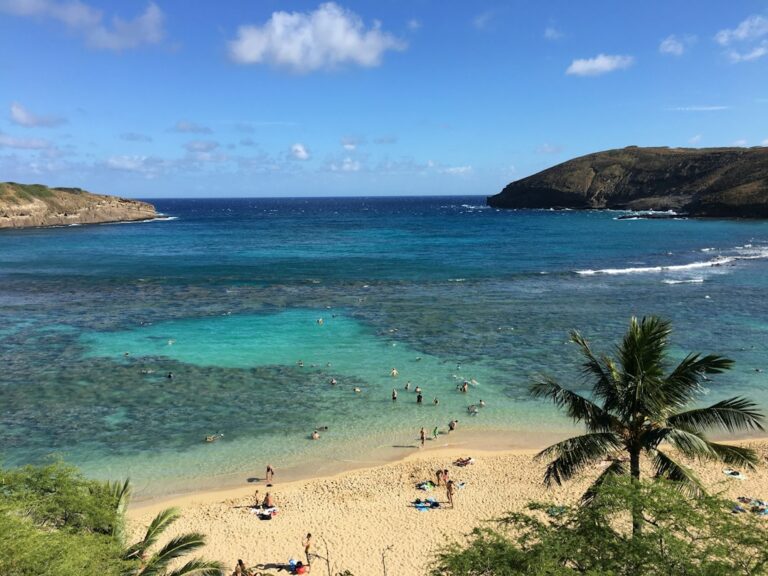
Hanauma Bay is Oahu’s most popular snorkeling preserve. The beach sits in a volcanic crater about 300 feet below the visitor center, connected by a steep paved road. A tram runs between the top and the beach for a small per-ride fare, usually a few dollars each way. Wheelchair users and others with mobility limits rely on it.
Entry for nonresidents costs $25 per person, and parking costs $3 per vehicle. Hawaii residents and children under 13 enter free. Every visitor must watch a short educational video before going down to the beach. The preserve is closed Mondays and Tuesdays.
Online reservations open two days ahead at 7 a.m. Hawaii time and often sell out within minutes. The guide to Hawaii parks that require reservations explains the booking windows. The site’s Oahu snorkeling breakdown covers water conditions inside the bay.
What wheelchair users report
- The tram is lift-equipped or ramp-equipped. Ask staff at the top before going through the video line.
- Beach wheelchairs have been available on the sand on a first-come basis.
- Sand gets soft quickly past the paved apron, so a sand chair is close to essential.
- Entering the water means crossing shallow reef. Reef shoes help companions as well.
- Accessible parking stalls fill early. Arriving at the 6:45 a.m. opening gives the best chance.
Pearl Harbor: one of the most accessible sites in the state
The Pearl Harbor National Memorial visitor center is flat, paved and free to enter. Its two museum galleries, the bookstore and the waterfront paths are all wheelchair accessible. Most visitors come for the USS Arizona Memorial program, which lasts about 75 minutes and includes a documentary film and a Navy boat ride.
The Navy shuttle boats load from a ramp, and the memorial itself is a single level. Arizona tickets are free but carry a $1 online reservation fee. They open eight weeks ahead, and a smaller batch is released the day before. The site’s Pearl Harbor planning guide covers timing and the strict no-bag policy.
The Ford Island sites
The USS Missouri and the Pearl Harbor Aviation Museum are on Ford Island. Visitors reach them on a shuttle that leaves from the Bowfin area, and the shuttles have wheelchair lifts. On the Missouri, the main deck and the surrender deck can be reached by ramp. The lower decks use steep ladders and are not accessible.
At the aviation museum, Hangar 37 and Hangar 79 are both flat-floored. The USS Bowfin submarine itself cannot be entered by wheelchair because of narrow hatches and ladders. The Bowfin museum and its waterfront park are accessible. The Pearl Harbor historic sites bundle guide explains which ticket combinations make sense.
| Site | Cost | Wheelchair access | Time needed |
|---|---|---|---|
| USS Arizona Memorial | Free + $1 reservation fee | Full: ramped boat, single-level memorial | 75 minutes |
| Visitor center galleries | Free | Full | 45–60 minutes |
| USS Missouri | Paid admission | Main deck only | 1.5–2 hours |
| Aviation Museum | Paid admission | Full in both hangars | 1.5–2 hours |
| USS Bowfin (submarine) | Paid admission | Museum yes; submarine interior no | 1 hour |
National park overlooks: Volcanoes and Haleakala
Hawaii’s two national parks each charge $30 per private vehicle, and the pass is valid for 7 days. Both have accessible visitor centers and overlooks reachable by car. That makes them some of the best-value accessible experiences in Hawaii.
Hawaii Volcanoes National Park (Big Island)
The Kīlauea Visitor Center sits at about 3,970 feet, where daytime temperatures commonly fall between 55°F and 70°F. It has accessible restrooms, exhibits and ranger programs. Uēkahuna overlook, near the former Jaggar Museum site, has accessible parking and a paved viewing area above the Kīlauea summit caldera.
Devastation Trail is paved and roughly 1 mile round trip through a 1959 cinder field. Short paved stretches of the Crater Rim Trail near Volcano House give caldera views without steep grades. Nāhuku, the Thurston Lava Tube, has uneven ground and stairs and is not wheelchair accessible.
Chain of Craters Road descends about 3,700 feet over 19 miles to the coast. It has many roadside pullouts that can be enjoyed from a vehicle. The Volcanoes National Park day-trip guide compares a Kona base and a Hilo base. Hilo is about 45 minutes from the park, and Kona is about 2 hours.
Haleakala National Park (Maui)
The Haleakala summit area rises to 10,023 feet. The Haleakalā Visitor Center at about 9,740 feet has accessible parking, restrooms and a paved viewing area over the crater. A short ramped approach leads to the Pu’u ‘Ula’ula summit shelter, the highest viewpoint, from the upper parking lot.
Sunrise entry between 3 a.m. and 7 a.m. requires a $1 reservation on top of the entrance fee. Reservations open 60 days ahead, and a smaller block is released two days before. The drive from Kahului takes about 1.5 to 2 hours on a winding road. Pre-dawn temperatures often sit between 30°F and 45°F.
The National Park Service warns that the altitude can affect visitors with heart or lung conditions. Travelers who use supplemental oxygen at sea level should talk to a physician first. Sunset and midday visits need no reservation and are noticeably warmer.
| Feature | Hawaii Volcanoes NP | Haleakala NP |
|---|---|---|
| Vehicle entry fee | $30, valid 7 days | $30, valid 7 days |
| Main visitor center elevation | About 3,970 ft | About 9,740 ft |
| Typical temperatures | 55–70°F daytime | 30–45°F at sunrise |
| Paved trail option | Devastation Trail, about 1 mile round trip | Short summit approach paths |
| Extra reservation | None | $1, sunrise only (3–7 a.m.) |
| Not accessible | Nāhuku lava tube | Sliding Sands crater trail |
The NPS Access Pass: free entry for permanent disability
The America the Beautiful Access Pass is a free, lifetime pass for U.S. citizens and permanent residents who have a medically determined permanent disability. It waives the entrance fee at both Hawaii national parks and at more than 2,000 federal recreation sites across the country.
At sites that charge per vehicle, which includes Hawaii Volcanoes and Haleakala, the pass covers the holder and everyone in the same private vehicle. At per-person sites, it typically covers the holder plus up to three adults. Some recreation.gov amenity fees, such as camping, may be discounted by 50 percent.
How to get it
- In person at a federal site: free, with proof of disability and of residency or citizenship.
- Online or by mail through USGS: a $10 processing fee applies.
- Accepted proof includes a physician’s statement, an SSDI or SSI award letter, or a VA disability document.
- Mailed applications can take several weeks, so applying before the trip avoids delays.
The pass does not cover Hawaii state parks. Diamond Head State Monument, for example, charges nonresidents $10 per person plus $10 for parking. The pass also does not waive the $1 sunrise or Arizona reservation fees, which are processing charges rather than entrance fees.
Accessible van rentals and adapted vehicles
Outside Oahu, a vehicle is close to mandatory, and that holds even more for travelers bringing a power wheelchair. Two options exist. Specialist companies rent ramp-equipped minivans. Mainstream rental agencies fit hand controls and swivel seats to standard cars, usually at no added charge.
Ramp-equipped minivans
A small number of specialist operators rent side-entry and rear-entry ramp minivans on Oahu, Maui, the Big Island and Kauai. Accessible Vans of Hawaii is the longest-running of them. Rates commonly fall between $150 and $250 per day. Weekly totals often land between $1,000 and $1,600 before taxes.
Inventory is very small, sometimes only a handful of vans per island. Travelers going in December, March or the summer months should reserve as early as possible. The site’s island-by-island seasonal guide shows which months book up first. Many operators deliver to the airport, which removes a shuttle transfer.
Hand controls and swivel seats from major agencies
Hertz, Avis, Enterprise, National and Budget all offer hand controls and spinner knobs at their Hawaii airport locations. They generally need 48 to 72 hours of notice, and the equipment is free. Standard rates apply. The site’s Hawaii rental car price guide breaks down typical daily rates by island and season.
| Option | Typical daily cost | Typical weekly cost | Notice needed | Best for |
|---|---|---|---|---|
| Ramp minivan (specialist) | $150–$250 | $1,000–$1,600 | Weeks to months | Power chair users who stay seated |
| Standard car + hand controls | $60–$120 | $400–$800 | 48–72 hours | Drivers who transfer independently |
| Standard minivan, folding chair | $90–$160 | $600–$1,100 | Normal booking | Manual chair, able to transfer |
| Accessible taxi or WAV rideshare (Oahu) | $25–$60 per trip | Varies | 30–60 minutes or prebook | Short Honolulu hops |
Disability parking
Hawaii honors valid disability placards and plates issued by other states. Visitors should bring their home placard and hang it as they would at home. Accessible stalls at popular beach parks and trailheads fill early, so arriving before 9 a.m. noticeably improves the odds.
TheBus and Handi-Van on Oahu
Oahu’s public transit system is the most complete accessibility option in Hawaii. TheBus runs more than 100 routes, and every bus has a lift or ramp plus securement positions for wheelchairs. The guide to TheBus and getting around Oahu without a car covers routes, the HOLO card and how travel times compare.
TheBus fares
The standard adult fare is $3.00, and a 1-day HOLO pass costs $7.50. Riders with qualifying disabilities can pay a reduced fare, about $1.25 per ride, once they hold a Disability HOLO card. That card is issued by the city transit office and requires documentation.
Visitors on short stays often find the paperwork for the discounted card is not worth it. A standard HOLO card with daily fare capping is easier. Bus operators deploy ramps on request and allow extra boarding time. Riders should signal their stop early so the driver can position the ramp.
Handi-Van and visitor eligibility
Handi-Van is Oahu’s ADA paratransit service. It provides shared-ride, origin-to-destination trips for people who cannot use fixed-route buses because of a disability. Under federal ADA rules, paratransit systems must serve eligible visitors for up to 21 days within a 365-day period.
Visitors already certified for ADA paratransit at home qualify by presenting that agency’s eligibility documentation. Visitors without home certification can submit proof of residency and, if the disability is not apparent, proof of disability. Applications go through the City and County of Honolulu Department of Transportation Services.
- Ask the home transit agency for a letter or ID confirming ADA paratransit eligibility.
- Contact Handi-Van at least 1–2 weeks before arrival to register visitor status.
- Book each trip at least one day ahead; same-day requests are rarely accepted.
- Expect a pickup window of about 30 minutes either side of the scheduled time.
- Keep a HOLO card loaded to pay the per-trip fare.
A visitor staying longer than 21 days in a year has to apply for full Oahu eligibility, which includes an in-person assessment. Handi-Van trips are shared and can take much longer than a direct drive. Travelers should allow 60 to 90 minutes for cross-island trips.
Neighbor island transit
Maui Bus, the Big Island’s Hele-On and the Kauai Bus all run lift-equipped buses, and each provides ADA paratransit within ¾ mile of its fixed routes. Schedules are much thinner than Oahu’s, and some routes run only every 90 minutes. Hele-On schedules are posted on the County of Hawaii site.
Airport assistance at HNL and OGG
Honolulu’s Daniel K. Inouye International Airport (HNL) and Maui’s Kahului Airport (OGG) are run by the state Department of Transportation. Airport accessibility information and terminal maps are published on the Hawaii Department of Transportation site. Wheelchair escorts, aisle chairs and boarding help are arranged through each airline.
Booking airline assistance
- Request wheelchair service when booking, then confirm it by phone at least 48 hours before departure.
- State the chair type, battery type and folded dimensions for power chairs.
- Ask for an aisle chair if transferring to the airplane seat.
- Request that the personal wheelchair be returned at the aircraft door, not baggage claim.
- Photograph the chair before check-in to document any damage claim.
The TSA Cares helpline at 855-787-2227 arranges passenger support specialists for screening. TSA asks travelers to call at least 72 hours before their flight. The flight from the West Coast to Hawaii runs about 5 to 6 hours, so travelers should plan restroom access and pressure relief accordingly.
HNL specifics
HNL is spread out, and the walk between Terminal 1 and the far gates of Terminal 2 can exceed half a mile. The Wiki Wiki inter-terminal shuttle is wheelchair accessible. Airline escorts usually take passengers through the terminals, and passengers who need help should not decline the escort to save time.
OGG specifics
OGG is more compact, with a single main terminal. Its consolidated rental car facility is reached by an accessible tram from baggage claim. Travelers who have booked a specialist ramp van should arrange a curbside handoff in advance rather than taking the tram.
Service animals
Hawaii is rabies-free, so service dogs must meet state animal quarantine rules to be released at the airport. The rules include microchipping, rabies vaccinations and documentation sent in advance. Requirements and checklists are published by the Hawaii Department of Agriculture Animal Quarantine Station. Preparation can take several months, so travelers should start early.
Choosing an ADA hotel room: what to ask
The word “accessible” on a booking site covers a wide range of rooms. A true ADA mobility room has wider doors and clear turning space. Its bathroom has either a roll-in shower or a tub with a transfer bench. Many Hawaii resorts list only a few such rooms, and online systems do not always guarantee one.
Questions that matter
- Is the bathroom a roll-in shower or a tub with grab bars?
- Is there a fold-down shower seat and a hand-held showerhead?
- What is the bed height from floor to mattress top?
- Is there clearance under the bed for a patient lift?
- Are the lanai door and threshold level, or is there a step?
- Is the pool equipped with a lift, and is it charged and staffed?
- Is the route from the parking lot to the room step-free?
- Can the specific accessible room be guaranteed in writing?
The ADA requires doorways with at least 32 inches of clear width and a 60-inch turning circle in accessible bathrooms. Travelers with larger power chairs should ask for measurements rather than relying on the label. A follow-up call 3 to 5 days before arrival lets them confirm the room is blocked and not reassigned.
Hotel costs to factor in
Waikiki and Maui resort hotels often add daily resort fees of $30 to $50. Self-parking or valet commonly runs $35 to $60 per night. Accessible rooms are priced the same as standard rooms in the same category, but they sell out first during peak weeks.
A condo or vacation rental may offer more space, but ADA rules rarely apply to private units. The site’s comparison of vacation rentals versus hotels covers the trade-offs. Wheelchair users should ask rental hosts for photos of bathroom entries and measured doorway widths.
Accessible tours and activities beyond the beach
Many standard tours can work with advance notice. Operators should be called directly rather than booked through an online reseller. The key questions are whether the vehicle has a lift, whether the stops include unpaved ground, and how long the tour runs between restroom stops.
Activities that tend to work
- Helicopter tours: most require a transfer into the seat; some accommodate with advance notice.
- Submarine tours in Waikiki and Kona: entry typically requires stairs, so travelers should confirm first.
- Luau: most resort venues are flat lawns or paved courtyards.
- Whale watching, December through April: larger catamarans may have boarding ramps.
- Botanical gardens: Foster Botanical Garden in Honolulu has paved main paths.
The site’s guide to Hawaii helicopter tours by island compares operators and prices. Some companies have weight limits per seat and need passenger weights in advance. Travelers who can transfer with help often find helicopter tours a practical way to see terrain that cannot be reached by wheelchair.
Sample accessible day on Oahu
A practical Oahu day starts at Pearl Harbor at 7 a.m. and is back in Waikiki by early afternoon. The rest of the day goes to the Kuhio Beach promenade and an accessible sunset dinner. The site’s best things to do on Oahu lists more options, and many fit a step-free plan.
Planning timeline and budget
An accessible trip to Hawaii needs more lead time than a standard one, mainly because adapted vans and ADA rooms are scarce. The timeline below shows when each step usually needs to happen.
| When | Task | Typical cost |
|---|---|---|
| 4–6 months out | Reserve ramp minivan and ADA hotel room | $1,000–$1,600 per week for van |
| 3–4 months out | Apply for NPS Access Pass by mail or online | $10 processing fee |
| 8 weeks out | Book USS Arizona Memorial program | $1 per ticket |
| 60 days out | Book Haleakala sunrise window | $1 per vehicle |
| 1–2 weeks out | Register Handi-Van visitor eligibility | Free to register |
| 72 hours out | Call TSA Cares; confirm airline wheelchair service | Free |
| 2 days out, 7 a.m. HST | Book Hanauma Bay entry | $25 per nonresident |
Food and supplies cost more than on the mainland, and medical supplies are no exception. The site’s grocery price comparison by island shows how wide the gap is. Many travelers ship catheters, ostomy supplies or spare chair parts ahead to the hotel instead of buying locally.
Repair and backup planning
Wheelchair repair shops exist mainly in Honolulu, with limited options on Maui and the Big Island. Travelers using power chairs should pack spare fuses, a tire repair kit and the manufacturer’s service number. Durable medical equipment suppliers on Oahu can rent backup manual chairs, typically for $15 to $40 per day.
Frequently asked questions
Is Hawaii wheelchair accessible overall?
Mostly, with large differences by island and site. Oahu has full lift-equipped bus service, Handi-Van paratransit and flat Waikiki. Pearl Harbor and both national park visitor centers are accessible. Many beaches and hiking trails are not, so travelers should rely on beach wheelchairs, mobility mats and paved overlooks.
Where can visitors borrow a beach wheelchair in Hawaii?
County lifeguard divisions, state parks and resorts lend them, usually free and first-come. Commonly cited spots include Ala Moana and Hanauma Bay on Oahu, Kihei and Ka’anapali on Maui, Hapuna on the Big Island, and Po’ipu and Lydgate on Kauai. Travelers should call ahead, since equipment rotates.
Can visitors use Handi-Van on Oahu?
Yes. Federal ADA rules require paratransit systems to serve eligible visitors for up to 21 days within a 365-day period. Visitors present ADA paratransit certification from their home agency, or proof of residency and disability. Trips must be booked at least one day ahead and are shared rides.
Is the NPS Access Pass really free?
Yes. The lifetime Access Pass is free for U.S. citizens and permanent residents with a permanent disability when obtained in person at a federal site. Applying online or by mail adds a $10 processing fee. It covers the $30 vehicle entry at both Hawaii Volcanoes and Haleakala national parks.
Is the Haleakala summit reachable by wheelchair?
Largely, yes. The visitor center at about 9,740 feet has accessible parking, restrooms and a paved viewing area, and the summit shelter has a short ramped approach. Sunrise visits need a $1 reservation. The altitude and temperatures near freezing may pose health risks for some visitors.
How much does an accessible van rental cost in Hawaii?
Ramp-equipped minivans from specialist operators generally cost $150 to $250 per day, or about $1,000 to $1,600 per week before taxes. Fleets are very small, so booking 4 to 6 months ahead is advisable. Major agencies fit hand controls to standard cars free with 48 to 72 hours of notice.
Does the Hanauma Bay tram accommodate wheelchairs?
The tram links the visitor center with the beach about 300 feet below. It is the standard way for wheelchair users to reach the sand, and fares are a few dollars per ride. Beach wheelchairs have been available on the sand. Entry costs $25 for nonresidents, and the preserve is closed Mondays and Tuesdays.
Can a wheelchair user tour the USS Arizona Memorial?
Yes. The Navy shuttle boats load by ramp and the memorial is a single level, so the full 75-minute program is accessible. Tickets carry a $1 reservation fee and open eight weeks ahead. The USS Missouri is accessible on its main deck only, and the Bowfin submarine interior is not accessible.