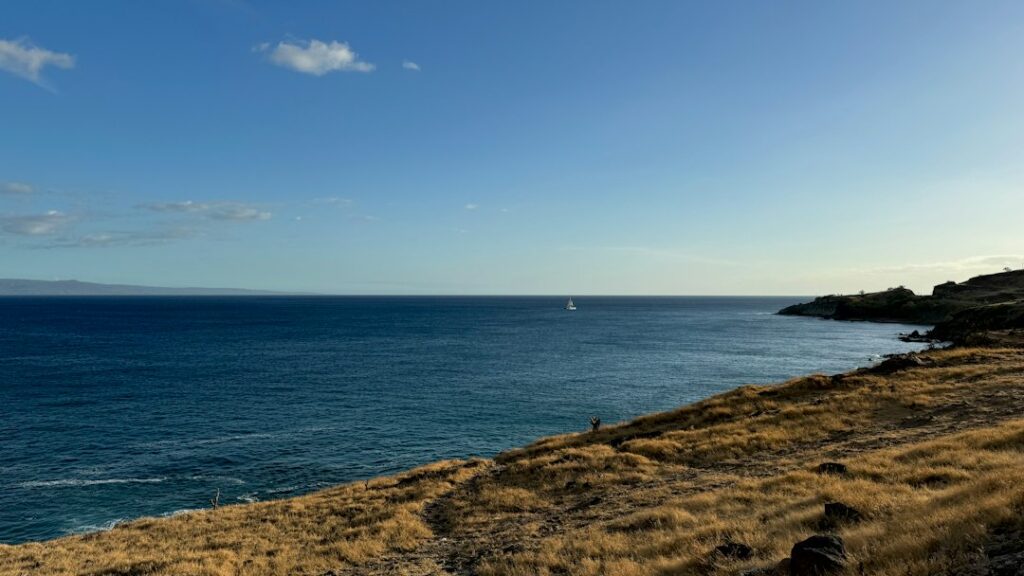
Molokini is a partially submerged volcanic crater roughly 2.5 miles off Maui’s southwest coast, formed about 230,000 years ago and protected today as a Marine Life Conservation District. The crescent’s tiny landmass hosts two very different underwater experiences: a sheltered inner rim and an exposed vertical backwall.
Relocating households researching Maui water activities often ask which route suits beginners, which requires certification, and which charter boats reach the outer face. The answer depends on skill level, sea state, and departure timing from Maalaea Harbor, where nearly every commercial Molokini boat launches.
This comparison lays out the split between inner-rim and backwall routes, the 6am boarding routine, the wind and swell thresholds that dictate whether captains open the outer face, and where the Snuba mid-depth add-on fits alongside conventional snorkel and scuba options.
Molokini’s geography and two distinct faces
Molokini rises less than 160 feet above the Alalakeiki Channel, but the volcanic remnant plunges dramatically underwater. The crescent opens northward, forming a natural amphitheater roughly 2,000 feet across the mouth. Inside sits the shallow coral-studded inner rim; outside, the southern face drops as a near-vertical wall into blue water.
Charter operators generally describe three anchorage zones: the inner crescent (mooring buoys 5 through 13), Reef’s End at the northeast tip, and the outer backwall itself. Most tours begin at the inner crescent because it faces away from the prevailing northeast trade winds and remains calm on days when the backwall is impassable.
The state tourism agency lists Molokini as one of Hawaii’s most photographed marine sites. Traffic is heavy: on typical mornings, 15 to 20 permitted vessels rotate through the crescent between 7:30 and 11:30 a.m., which is why arrival order and buoy assignment shape the entire trip.
Why the crescent stays calm
Trade winds blow out of the northeast at 10 to 20 knots most days from May through October. The crescent’s high southern rim blocks that wind, so the water inside typically shows only 1- to 2-foot ripples while the backwall side may see 3- to 6-foot swells rolling in from the open channel.
Inner rim: the beginner-friendly experience
The inner crescent averages 10 to 35 feet deep across most mooring positions, with a sandy bottom sloping gently up to the fringing reef along the crater walls. Visibility routinely reaches 100 to 180 feet, though the crescent is often described in charter marketing as offering 100-plus feet on average — the 20–40 ft figure represents rougher conditions.
Reef fish inside the crescent number more than 250 documented species. Yellow tang, saddle wrasse, moorish idol, parrotfish, and the humuhumunukunukuapua’a — Hawaii’s state fish — appear on nearly every trip. A broader Hawaii snorkeling species overview covers what to expect at other reefs across the islands.
Green sea turtles cruise through in mid-morning, and eagle rays occasionally glide past in deeper sand channels. Whitetip reef sharks rest under ledges near buoy 9 but rarely interact with swimmers. Manta rays and hammerheads are rare inside the crescent but occasionally reported.
Who should stay inside
The inner rim suits swimmers who have not snorkeled before, children as young as 5 with a flotation vest, and anyone uncomfortable in deep water. Boats deploy floating noodles, life vests, and often a floating rest platform tethered near the swim ladder for tired swimmers.
The 300-foot backwall: advanced water only
The backwall — the exposed southern face of the crater — drops from the waterline to roughly 300 feet in a series of terraced ledges and vertical drops. The upper 40 feet host black coral, wire coral, and cauliflower coral formations that snorkelers can view from the surface when captains allow drift snorkeling above the wall.
Because the wall faces open ocean, deep-water species appear that never enter the crescent: pyramid butterflyfish schooling in the blue, whitetip reef sharks patrolling ledges at 60 to 100 feet, and — for scuba divers — occasional black-tip and gray reef sharks. Detailed operator selection for scuba is covered in the backwall dive boat guide.
Snorkelers who float above the wall report the visual of an infinite blue void below them as the primary draw. Depth perception collapses; the reef edge appears roughly 20 feet down while the actual bottom sits 280 feet below. This is disorienting for some swimmers and thrilling for others.
Currents and drift technique
The backwall almost always has a lateral current running 0.5 to 2 knots east or west along the wall face. Charters typically drop swimmers upcurrent, then follow the group in a live-boat drift pickup at the downcurrent end. Swimmers who try to hold position or swim against the current tire quickly.
Maalaea Harbor 6am boarding routine
Nearly every Molokini charter departs from Maalaea Small Boat Harbor on Maui’s south-central coast, roughly 10 miles south of Kahului Airport and 20 minutes from Lahaina or Wailea. Slip assignments range from A dock through H dock; check-in typically happens dockside at the operator’s slip, not at a central terminal.
Check-in windows generally open at 5:45 a.m. for a 6:15–6:30 a.m. departure. Boats that hit the water first claim the best crescent mooring buoys and, on backwall-approved days, get the calmest early conditions before wind builds after 10 a.m.
Parking and arrival timing
Maalaea Harbor has three main paid lots: the north lot near the Maui Ocean Center (roughly 250 spaces at $10 per day), the harbor perimeter lot ($5 per day), and a small free lot that fills by 5:30 a.m. on peak days. A shuttle from Wailea resorts adds 25 minutes; from Kaanapali or Kapalua, budget 45 minutes.
| Departure origin | Drive time | Suggested leave time (for 6am check-in) |
|---|---|---|
| Wailea / Kihei | 15–25 min | 5:20 a.m. |
| Kahului Airport area | 20–25 min | 5:15 a.m. |
| Lahaina town | 25–35 min | 5:05 a.m. |
| Kaanapali / Kapalua | 35–50 min | 4:50 a.m. |
| Hana | 2.5–3 hrs | Not practical same-day |
| Kula upcountry stays | 35–45 min downhill | 5:00 a.m. |
What to bring aboard
Most charters supply mask, snorkel, fins, and flotation. Reef-safe sunscreen is required under Hawaii’s 2021 law banning oxybenzone and octinoxate. A dry bag, a hooded rash guard, water bottle, and motion-sickness medication taken 30 to 60 minutes before boarding round out a typical packing list.
Weather windows that decide backwall access
Captains make the backwall call after leaving the harbor and observing conditions in the Alalakeiki Channel. No boat commits to the outer wall until the crew reads live wind, swell, and current. Roughly 55 to 70 percent of mornings between April and October qualify; the winter percentage drops to 25 to 40 percent as north swells wrap the crater.
The Hawaii Department of Health and local safety agencies publish surf and marine forecasts that captains monitor. Small Craft Advisory conditions — sustained winds above 25 knots or seas above 10 feet — usually force cancellation of the entire Molokini run, not just the backwall.
| Condition | Backwall likely open | Backwall likely closed |
|---|---|---|
| Trade winds | Under 15 knots | Over 20 knots sustained |
| South swell | Under 2 ft period 8s | Over 4 ft any period |
| Current on wall | Under 1.5 knots | Over 2 knots |
| Visibility from surface | Over 80 ft | Under 50 ft |
| Small Craft Advisory | None in effect | Any SCA in Alalakeiki Channel |
Best months statistically
April, May, September, and October tend to combine light trade winds, minimal north swell, and warm 78–80°F water temperatures. December through March brings the strongest north and northwest swells, which refract around Molokini’s west end and make the outer face rough even on otherwise calm days.
Charter comparison: which boats reach which zones
Not every Maalaea charter offers the backwall. Some boats are limited by permit, hull configuration, or insurance to inner-crescent moorings only. Others advertise “backwall optional” and only add it when conditions align. A few premium dive-focused operators run backwall-first itineraries with the crescent as backup.
| Boat category | Typical vessel size | Passenger cap | Backwall access | Snuba offered | Adult price range |
|---|---|---|---|---|---|
| Large catamaran (mass-market) | 55–65 ft | 100–149 | Occasional, weather-permitting | Yes, on select boats | $130–$170 |
| Mid-size catamaran (premium) | 45–55 ft | 40–60 | Regular when conditions allow | Yes, most boats | $170–$230 |
| Small catamaran / raft | 28–40 ft | 16–24 | Frequent (nimble anchoring) | Rare | $190–$260 |
| Dedicated dive boat | 32–46 ft | 12–20 | Primary destination | No (scuba focus) | $180–$275 |
| Sailing charter | 50–65 ft | 30–50 | Rare | Occasional | $150–$200 |
Group-size trade-offs
Larger catamarans reach the crescent more comfortably in choppy channel crossings and offer restrooms, freshwater showers, and full lunches. Smaller vessels move faster, reach less-crowded moorings, and get first crack at Turtle Town on the return leg — but the ride is wetter and less stable, and food service is limited to snacks or a light deli lunch.
Snuba on Molokini: bridging snorkel and scuba
Snuba uses a 20-foot air hose tethered to a raft-mounted tank at the surface, letting non-certified swimmers breathe underwater without carrying gear. Divers descend to a maximum of 20 feet — deep enough to explore the inner crescent floor at buoys 5 through 8 but shallow enough that no certification, medical, or logbook is required.
Snuba is offered almost exclusively on the inner rim, not the backwall. The 20-foot hose depth and required stationary raft make it incompatible with backwall drift currents. Cost typically runs $75 to $100 as an add-on to a standard snorkel fare, and slots book out; reserve at the point of ticket purchase rather than dockside.
Minimum age is generally 8 years, with a parent or certified adult accompanying children under 12. Divers use a standard scuba regulator and BCD-style vest, breathe compressed air, and follow a 15- to 25-minute guided loop. The Snuba add-on booking detail breaks down operator differences.
Snuba vs snorkel vs scuba on the crescent
| Activity | Max depth | Certification required | Min age | Typical add-on cost |
|---|---|---|---|---|
| Snorkel (surface) | 0 ft | None | 5 with vest | Included |
| Snuba | 20 ft | None (briefing only) | 8 | $75–$100 |
| Discover Scuba (intro) | 40 ft | None (briefing + pool) | 10 | $120–$180 |
| Certified scuba (crescent) | 60 ft | Open Water card | 10 (Jr OW) | $100–$160 |
| Certified scuba (backwall) | 100+ ft (usually 60–80) | Advanced Open Water preferred | 15 | $150–$220 |
Booking window and cancellation patterns
Peak-season charters (mid-December through mid-April, plus June through mid-August) sell out 5 to 14 days in advance. Shoulder-season openings often appear 24 to 72 hours out. Backwall-optional trips do not guarantee the wall, so the same ticket may deliver a crescent-only day; refunds are rarely offered for weather calls.
Cancellation policies vary sharply. Large operators typically require 24 to 48 hours’ notice for a full refund and issue rain checks — not cash — for captain’s-call weather cancellations. Small dive operators sometimes offer a partial cash refund if the boat cancels but no refund for guest no-shows or missed departures.
Insurance and health screening
Scuba passengers must complete a PADI or DAN medical questionnaire before boarding. Yes-answers to heart, lung, ear, or pregnancy questions require a signed dive physician release. Snorkel and snuba passengers sign a liability waiver but face no medical screening beyond a swimming-ability self-attestation.
Cost breakdown for a two-adult trip
A conservative two-adult budget for a mid-tier Molokini charter with snuba runs roughly $500 to $625 all-in. Premium boats and add-on transportation push the total closer to $750. Below is a representative build.
| Line item | Low estimate | Mid estimate | Premium estimate |
|---|---|---|---|
| 2 adult snorkel fares | $260 | $380 | $520 |
| 2 snuba add-ons | $150 | $180 | $200 |
| Harbor parking (day) | $5 | $10 | $10 |
| Reef-safe sunscreen tube | $14 | $22 | $32 |
| Motion-sickness meds | $8 | $12 | $18 |
| Crew tip (15–20%) | $60 | $90 | $140 |
| Post-trip lunch for 2 (Maalaea) | $45 | $70 | $110 |
| Total | $542 | $764 | $1,030 |
Where the money actually goes
Fuel is the largest variable cost for operators — a mid-size catamaran burns 30 to 60 gallons on a round trip to Molokini. Fuel prices published by the Energy Information Administration for Hawaii routinely run $1.20 to $1.80 per gallon above the U.S. average, which is why Maui charter prices are structurally higher than mainland comparables.
Gear card: what to bring versus what boats supply
Charters typically supply the safety and rental gear; passengers bring comfort items, personal medications, and any specialized optical mask needed. The list below reflects standard practice on Maalaea-based Molokini boats.
Charter typically supplies
- Silicone mask in adult and youth sizes (adjustable strap, tempered lens).
- Dry-top or J-tube snorkel, sanitized between uses.
- Open-heel fins with adjustable strap; sizes XS through XXL.
- Coast Guard-approved life vest or foam noodle for flotation.
- Freshwater rinse hose and outdoor freshwater shower on deck.
- Continental breakfast on outbound leg; deli lunch on return.
- Bottled water, sodas, and post-swim mai tais or beer.
Passengers should bring
- Reef-safe mineral sunscreen (zinc oxide or titanium dioxide only).
- Prescription mask if optical correction is needed; rental options rare.
- Long-sleeve rash guard or thin wetsuit top for wind exposure.
- Waterproof phone pouch or GoPro on floating wrist strap.
- Motion-sickness tablets (Bonine or Dramamine) taken 45 minutes pre-departure.
- Dry bag for phones, wallets, and dry change of clothes.
- Cash for crew tip; card tipping possible but not universal.
Tour booking card: choosing the right route
Snorkelers focused on ease, calm water, and maximum fish variety should book any inner-crescent trip; the choice becomes vessel size and lunch quality. Swimmers targeting the backwall experience should book a smaller premium catamaran or dive-oriented boat that lists backwall as a routine destination, not an optional stop.
Route decision tree
- New snorkeler or family with kids under 10: book any mass-market catamaran, inner crescent only.
- Confident swimmers who want deeper immersion: book a mid-tier boat with snuba add-on preselected.
- Strong swimmers seeking backwall drift: book a small premium catamaran with a documented backwall track record.
- Certified divers: skip snorkel boats; book dedicated two-tank dive charters targeting Reef’s End and backwall.
- Uncertain about seasickness: book the earliest 6:15 a.m. departure and take medication the night before plus 45 minutes pre-boarding.
How to compare listings quickly
Look for four data points on any operator’s listing: passenger capacity (lower is calmer), stated backwall policy (routine vs weather-permitting), snuba availability (with pricing), and slip location at Maalaea. A boat at slip A near the harbor entrance leaves 5 to 8 minutes earlier than one at H dock, which matters on days when 15 boats are racing for the same buoys.
Adjacent Maui itineraries for the same trip
Because Molokini charters return to Maalaea by 11 a.m. to 12:30 p.m., the afternoon opens for a second activity. Households pairing a Molokini morning with a north-shore or upcountry afternoon should account for a 1- to 2-hour drive plus fatigue from six hours of sun and salt exposure.
Common same-day pairings
- Maui Ocean Center at Maalaea Harbor: 5-minute walk from the boat.
- Kihei beach lunch and nap: 15 minutes east.
- Iao Valley State Monument: 20 minutes north through Wailuku.
- Upcountry lavender or agriculture stops leading toward a Kula farmstay overnight.
- Lahaina town for evening walkabout (verify current post-fire access).
Snorkelers extending an island-hop should note that inter-island connections through Kahului and Honolulu often depend on tight terminal transfers; the Wiki Wiki shuttle route at HNL covers the Honolulu side. Big Island snorkelers may also compare with the Kealakekua Cook Monument charter option.
Environmental rules and marine protections
Molokini has been a Marine Life Conservation District since 1977. Taking, killing, or damaging any marine life is prohibited. Fishing gear, spearguns, gloves, and rubber-tipped touching sticks are banned. Anchoring on the reef is prohibited; boats must use one of the 22 permanent mooring buoys or hold position in blue water.
Hawaii’s reef-safe sunscreen law (Act 104, effective January 2021) bans the sale and distribution of any product containing oxybenzone or octinoxate. Rangers do not typically inspect sunscreen bottles on the water, but many operators refuse boarding to guests whose sunscreen fails the mineral-only test.
Marine debris and swim conduct
Swimmers should avoid touching coral (contact kills the polyp), chasing turtles or monk seals (federally protected — stay 10 feet from turtles, 50 feet from seals), and standing on the reef structure. Fine reporting for violations runs $500 to $10,000 per incident. Local news outlets such as Honolulu Star-Advertiser and Civil Beat regularly cover enforcement cases.
Frequently asked questions
Is the Molokini backwall snorkeling accessible to non-certified swimmers?
Yes, but only as a surface drift. Snorkelers float above the wall in 300 feet of water while the boat live-tracks the group. It requires strong swimming ability, calm nerves in blue water, and captain approval based on that morning’s sea state. Non-swimmers and children under 12 should stay inside the sheltered inner crescent instead of attempting backwall floats.
How early do Molokini charters actually depart from Maalaea Harbor?
Check-in typically opens between 5:45 and 6:00 a.m., with lines untying between 6:15 and 6:45 a.m. First boats reach the crescent by 7:15 a.m., which gives them roughly two hours at prime buoys before wind and other traffic build. Later 8:30 a.m. departures exist but arrive after 20-plus boats have already claimed the calmest mooring positions inside the crater.
What visibility should snorkelers realistically expect at Molokini?
Inside the crescent, visibility averages 100 to 180 feet on trade-wind days, dropping to 40 to 80 feet after a south swell stirs sediment. Backwall visibility routinely exceeds 150 feet in blue water because there is no shallow reef to cloud the column. Winter storms can cut both zones to under 30 feet for several days at a time, mostly December through February.
Does Snuba replace the need for a scuba certification course?
No. Snuba is a supervised recreational activity limited to 20 feet of depth with a surface-tethered air hose; it is not a certification and does not transfer credit toward a PADI or SSI Open Water course. Guests who enjoy Snuba and want deeper access should complete a Discover Scuba experience or a full 3- to 4-day Open Water certification through a Maui dive shop.
What months offer the highest chance of backwall approval?
April, May, September, and October historically deliver the calmest combination of trade winds under 15 knots and minimal north or south swell. Captains open the backwall on 55 to 70 percent of mornings in those months. Winter months from December through March drop that rate to 25 to 40 percent because of persistent north swell wrapping around the western tip of the crater.
Are there charters that skip Molokini entirely for other Maui reefs?
Yes. When Molokini closes for weather, most operators reroute to Coral Gardens off Olowalu, Turtle Arches near Makena, or Five Graves near Ahihi-Kinau. These backup sites offer solid inner-reef snorkeling with 40 to 80 feet of visibility. Turtle Town, on the Makena coast, is a frequent second stop even on successful Molokini days, giving snorkelers a green sea turtle encounter before the harbor return.
How much should crew tips be on a Molokini charter?
Industry standard on Maui runs 15 to 20 percent of the ticket price per passenger. On a $180 ticket that works out to $27 to $36 per person, or $54 to $72 for a couple. Tips are pooled among captain, first mate, and in-water guides. Cash is preferred; several operators accept credit card tips at checkout but a percentage may go to processing rather than crew.
Can inner-crescent snorkelers see the same fish species as backwall divers?
Most reef species overlap. Inner-crescent snorkelers see 60 to 80 percent of Molokini’s documented fish, including all the iconic tropicals. Backwall trips add pelagic species — schooling pyramid butterflyfish, larger jacks, occasional reef sharks, and rarely manta rays or pilot whales cruising past. Snorkelers seeking maximum species count without the backwall risk should focus on multiple crescent buoys rather than a single wall drift.