The Back Wall of Molokini Crater draws advanced divers to Maui for one reason: a submerged cliff that drops from roughly 60 feet at the crater rim to well past 250 feet along the outer face, with clear-water visibility that regularly exceeds 100 feet. The site sits on the seaward side of the crescent-shaped tuff cone, exposed to open Pacific swell and current.
Inside-the-crater snorkel-plus-shallow-dive charters price around $150 for a two-tank trip suitable for Open Water divers. Back Wall itineraries typically run $180–$220 and require Advanced Open Water certification, a recent dive log, and a briefing that accounts for real down-current risk. This article compares the leading Maui operators, contrasts the Ma’alaea and Kihei departure points, and lays out how the December–March humpback window changes the calculus.
Households considering a permanent move — the audience for howtoliveinhawaii.com — often ask whether a Back Wall dive is worth booking during a scouting trip. The short answer is yes for certified divers with 40+ logged dives, and no for anyone still building comfort at depth. The longer answer, involving operator differences and seasonal variance, unfolds below.
What Makes the Back Wall Distinct From Inside the Crater
Molokini is a partially submerged volcanic crater roughly 2.5 miles off Maui’s south shore. The inner bowl shelters shallow reef between 10 and 80 feet, calm most mornings, and packed with reef fish. Snorkelers and open-water dive classes fill that space daily. The outer wall — the Back Wall — begins at the crater’s exposed rim and plunges to more than 250 feet.
The two experiences share almost nothing beyond a boat ride. Inside dives feature warm water, hard coral, and low-effort navigation. Back Wall dives feature big-fish encounters (whitetip and Galapagos sharks, tuna, jacks, occasional manta), pelagic blue water on one side, and vertical rock on the other. The wall is a drop-off, not a reef — depth control and buoyancy skill dominate every minute.
Depth Profile and Marine Life
Most Back Wall dive plans keep certified guests between 60 and 100 feet along the wall, with a maximum of 130 feet for anyone Deep-certified. Bottom time runs 30–40 minutes on air and up to 50 minutes on 32% nitrox. Guides target black coral trees around 90 feet, cleaning stations for reef sharks near 80 feet, and pelagic corridors slightly offshore.
Visibility along the wall averages 100–150 feet from April through October and can hit 200 feet on the calmest days. Winter months (December–March) sometimes drop clarity to 60–80 feet when north swells wrap around the crater. Water temperature ranges from 74°F in February to 81°F in late September, cool enough that most divers wear a 3mm full wetsuit year-round.
Certification and Experience Prerequisites
Every operator that runs the Back Wall requires — at minimum — Advanced Open Water certification from PADI, SSI, NAUI, or equivalent. Advanced training covers the deep dive (100 feet) and navigation modules that the site demands. Some charters also want proof of a Nitrox specialty, a Deep specialty for the 130-foot ceiling, or a recent refresher for anyone whose last logged dive was more than 12 months ago.
Logged experience matters more than paper. A guest with 15 dives and an Advanced card is, on paper, eligible; captains still routinely refuse Back Wall dives to guests below 25–30 logged dives if conditions are marginal. Anyone who cannot demonstrate neutral buoyancy at safety-stop depth becomes a hazard on a vertical wall. Divers with cardiovascular concerns can consult state guidance at health.hawaii.gov before booking.
Documentation Operators Request
- Certification card (physical or digital app) showing Advanced Open Water or higher
- Dive log showing at least 15–25 recent dives, ideally within 12 months
- Medical statement or physician’s clearance for divers 45+ or with flagged conditions
- Nitrox card if requesting enriched-air fills, plus signed gas analysis at boatside
- Photo ID matching the certification name for liability paperwork
Operators that run inside-the-crater trips will happily accept Open Water divers, discover-scuba students, and snorkelers. The Back Wall is a different product with a different liability profile — expect stricter vetting during booking and at the boat.
Operator Profiles: Trilogy, Kai Kanani, Pacific Whale Foundation
Three Maui operators run the Molokini Back Wall as a scheduled itinerary rather than a private charter. Each has a distinct fleet, departure harbor, and diver-to-guide ratio. Selecting between them turns on group size, boat comfort, and whether the trip includes a second dive site.
Trilogy Excursions
Trilogy operates a fleet of custom sailing catamarans out of Ma’alaea Harbor and Ka’anapali Beach. Their two-tank Back Wall dive typically departs Ma’alaea at 6:30 a.m., reaches Molokini in 25–30 minutes, and pairs the wall with a second inside-crater dive. Group sizes run 6–12 divers with 1 guide per 4 divers. Pricing lands near $199 including tanks, weights, breakfast, and a warm lunch.
Kai Kanani Sailing Charters
Kai Kanani departs from Makena Beach — a short beach launch south of Kihei — rather than a hard harbor. The advantage is proximity: Molokini sits roughly 3.5 miles offshore, a 15-minute run in flat water. The catamaran carries fewer divers, typically 8–10, and often adds a Turtle Town dive on the return leg. Rates run $185–$215 depending on season and inclusions.
Pacific Whale Foundation
PWF is a nonprofit conservation operator with the largest boats on the route — Ocean Voyager and Ocean Odyssey — sailing from Ma’alaea Harbor. Trips carry 12–18 certified divers alongside a snorkel contingent, keeping per-guest pricing near $159–$189. The larger platform trades intimacy for stability; the wide catamaran hulls handle winter chop far better than a monohull. Certified naturalists narrate the boat ride during whale season.
Two other names appear in traveler research: Maui Dive Shop (which resells slots on partner boats rather than owning its Molokini fleet) and Lahaina Divers. Lahaina Divers historically ran Molokini trips from Lahaina Harbor before 2023, but harbor damage from the August 2023 wildfires — reported extensively at civilbeat.org — forced most Lahaina-side charters to relocate through Ma’alaea for the foreseeable future.
Operator Comparison at a Glance
| Operator | Departure | Vessel Size | Divers/Trip | Base Price | Second Dive |
|---|---|---|---|---|---|
| Trilogy Excursions | Ma’alaea Harbor | 55-ft catamaran | 6–12 | $199 | Inside crater |
| Kai Kanani | Makena Beach | 46-ft catamaran | 8–10 | $185–215 | Turtle Town |
| Pacific Whale Foundation | Ma’alaea Harbor | 65-ft catamaran | 12–18 | $159–189 | Inside crater or Turtle Town |
| Ed Robinson’s | Kihei | 36-ft dive boat | 6 (small group) | $220 | Deep second dive |
Ma’alaea vs. Kihei: Harbor Selection and Boat Ride Length
Ma’alaea Harbor sits on the isthmus between West Maui and Haleakala, roughly 8 miles southwest of Kahului Airport. Kihei — technically Makena Beach for Kai Kanani — is 15 minutes farther south. The two departure points produce meaningfully different mornings for the same 7–8 a.m. dive window.
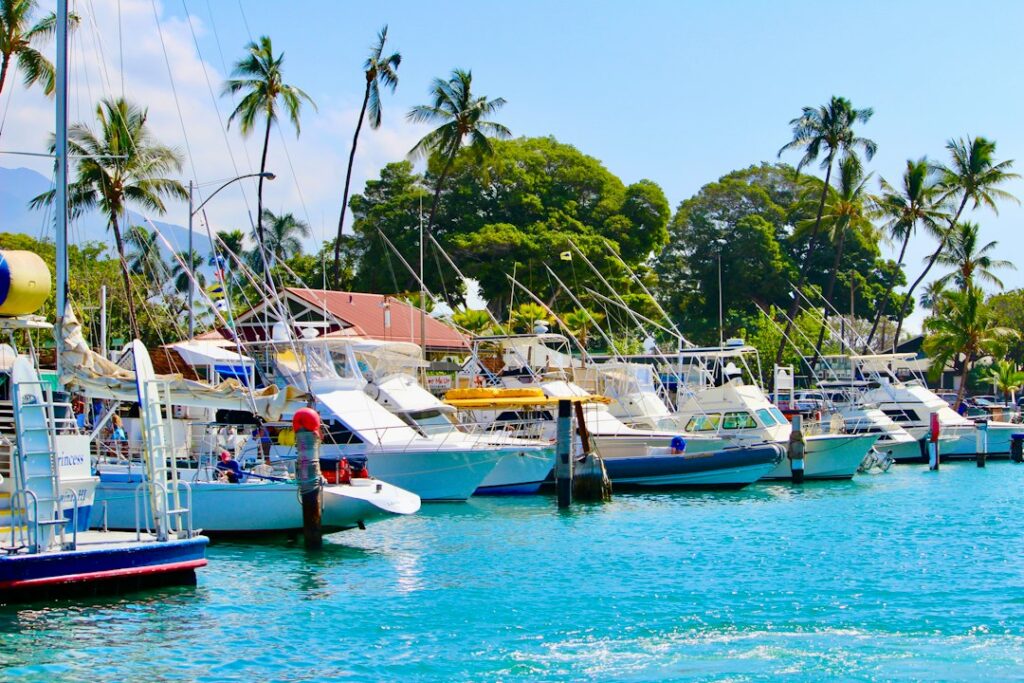
Ma’alaea Harbor is a working commercial harbor with paid parking, restrooms, a small commercial strip, and reliable morning access. It sits closest to Ma’alaea Bay and requires a 25–30 minute boat ride around McGregor Point to reach Molokini. Kihei/Makena launches beach-load from the sand, skip harbor fees, and cut the boat ride to 15 minutes.
Drive Time From Common Lodging
| From | To Ma’alaea Harbor | To Makena Beach | Pre-Dawn Traffic Risk |
|---|---|---|---|
| Kahului Airport area | 15 minutes | 35 minutes | Low |
| Kihei (central) | 15 minutes | 10 minutes | Low |
| Wailea resort core | 25 minutes | 15 minutes | Low |
| Ka’anapali | 35 minutes | 55 minutes | Medium (Honoapiilani) |
| Lahaina town | 30 minutes | 50 minutes | Medium |
| Hana | 2 hours 45 minutes | 3 hours | High |
Households renting in Kihei or Wailea should default to a Kihei/Makena departure to save 20–40 minutes of pre-dawn driving and an equal amount of boat time. Guests staying in Ka’anapali or Lahaina generally choose Ma’alaea; the additional harbor drive is offset by not having to cross to Makena. The Kaanapali vs. Wailea vs. Kihei lodging analysis shows why divers with early boat times often prefer the south shore condo market.
Return Timing
Most Back Wall charters return between 11:30 a.m. and 1:00 p.m. Ma’alaea returns arrive in a working harbor with sinks, hoses, and immediate parking access. Makena beach returns require a wet wade back to shore and a change on the sand. Guests who plan a Haleakala summit sunset or a Piilani Highway loop after the dive should factor 45–60 minutes of gear rinse and repack.
Pricing Analysis: What $150–$220 Actually Buys
Advertised prices rarely match the final receipt. The $150 headline for an inside-crater trip climbs with equipment rental, nitrox, gratuity, and Hawaii’s 4.712% general excise tax passed through to consumers, per tax.hawaii.gov. Back Wall trips include most equipment by default but still stack rental, camera, and gratuity add-ons.
| Line Item | Inside Crater (2 tank) | Back Wall (2 tank) |
|---|---|---|
| Base charter fee | $149 | $199 |
| BCD + regulator rental | $25 | Usually included |
| Wetsuit rental (3mm) | $15 | Usually included |
| Nitrox 32% upgrade | $20 | $15–25 |
| Underwater camera rental | $45–75 | $45–75 |
| Standard gratuity (15%) | $22 | $30 |
| GET pass-through (4.712%) | $7 | $9 |
| Realistic all-in | $233–283 | $253–353 |
Back Wall pricing typically bundles tanks, weights, wetsuit, BCD, and regulator because the operator wants gear it can verify before a 100-foot dive. Guests bringing personal gear can request a $15–25 rebate, though it is not always advertised. Nitrox extends bottom time by roughly 30% at 80 feet and reduces post-dive fatigue meaningfully — one of the highest-value add-ons per dollar.
Cash vs. Card and Deposit Structure
- Deposits usually run $50–100 per diver and hold the seat 24–72 hours before departure
- Full charter charge lands 24 hours before boarding; cancellation past that point forfeits the balance
- Weather cancellations by the operator refund in full or reschedule at no charge
- Gratuity is usually cash; ATMs at Ma’alaea Harbor are limited and often out of service
Resident (Kama’aina) Pricing
Hawaii residents with a state ID receive 10–20% discounts at most Maui dive operators. On a $199 Back Wall charter that saves $20–40 per trip. Full-time Maui residents also qualify for shop memberships that bundle unlimited tank fills at $60–90 monthly, dropping the marginal cost of any dive to the charter fee alone.
Residents on relocation scouting trips should treat the $253–353 all-in cost as a rare experience rather than a monthly recreational spend. The Kihei cost-of-living breakdown puts a two-person household discretionary budget near $600 monthly after housing, food, and utilities, per BLS Honolulu figures at bls.gov. A monthly dive habit on that budget requires either personal gear or a resident shop rate.
Humpback Season Overlap: December Through March
North Pacific humpback whales migrate to the Auau Channel between Maui, Molokai, and Lanai from mid-November through mid-April, with peak density in January and February. The state tourism authority at gohawaii.com and the federal whale sanctuary program track pod counts near 10,000 individuals annually. Molokini sits inside the sanctuary boundary, and Back Wall dives during this window carry a legitimate probability of underwater whale song audibility.
Direct visual encounters underwater are rarer but documented; surface encounters during the boat ride are near-guaranteed on any December-through-March charter. Federal regulations require boats to maintain a 100-yard buffer from any whale, so operators frequently idle or reroute mid-trip. That adds 15–30 minutes to the trip length and occasionally pushes the second dive shorter or closer inshore.
Month-by-Month Whale Probability
| Month | Surface Sightings | Underwater Song | Trade-off |
|---|---|---|---|
| November | 30–50% | Occasional | Fewer whales, warmer water |
| December | 80–90% | Common | Holiday pricing peaks |
| January | 95%+ | Very common | Winter swells reduce viz |
| February | 95%+ | Very common | Coolest water (74°F) |
| March | 85–95% | Common | Best combo of whales and viz |
| April | 40–60% | Occasional | Last whales, spring pricing |
March is the most-recommended month by working dive guides on the route. Whale probability remains high, water clarity begins to rebound, air temperatures reach the mid-70s°F on the boat, and pricing has not yet climbed to summer rates. Deeper background on that window appears in the Hawaii in March 2026 planning brief. April, May, and November each function as shoulder months worth considering — see the April, May, and November overviews.
Conditions, Current, and Safety Reality
The Back Wall is exposed to the same swell and current that the Molokai Channel funnels through the Auau. Prevailing trades push a longshore current along the wall from northwest to southeast most mornings, ranging from 0.2 to 1.5 knots. Down-currents — vertical sinking water off the outside face — are the specific hazard that separates this site from a warm-water reef dive.
Guides brief hand signals for a downwelling encounter (kick horizontally away from the wall, do not fight the vertical column) and typically position themselves outside the group toward the open water. Dive computers should have a high-ascent-rate alarm enabled. Any diver who cannot comfortably manage a slightly negative buoyancy check at 30 feet has no business on this profile.
Down-Current Response Protocol
Down-currents at Molokini feel like slow-motion elevator descents rather than dramatic pulls. The first indicator is a dive computer showing 3–5 feet of unintentional descent per minute. The correct response is to swim horizontally away from the wall into open water, add small bursts of BCD inflation, and drop weight only as a last resort. Panic-inflation causes runaway ascents that risk decompression injury.
Every Back Wall guide carries a surface marker buoy (SMB) and expects certified divers to have their own. Any Advanced Open Water student who did not train SMB deployment should practice at a shallower site the day before. Rental units are available for $10–15 daily at all Kihei and Ma’alaea shops.
When Operators Cancel or Reroute
- Sustained swell above 6–8 feet from the south or southwest scratches the Back Wall
- Winter Kona storms (Nov–Feb) can shut Molokini entirely for 2–4 day stretches
- Small-craft advisories at Ma’alaea trigger automatic reroute inside the crater
- Marginal current pushes some operators to inside-only; others still run with tighter briefings
The Hawaii Department of Transportation’s marine bulletins at hidot.hawaii.gov flag harbor closures, and the National Weather Service Honolulu marine forecast is the standard tool captains reference. Guests booking a single-morning window during a short scouting trip should build a backup snorkel plan for a canceled dive.
Gear, Nitrox, and Camera Configuration
Personal gear reduces cost over multiple dive days and improves comfort on any single dive. The trade-off for a scouting-trip diver is baggage weight and TSA scrutiny. Renting on-island is convenient and, for a single two-tank morning, usually more economical than checked-bag fees.
Personal vs. Rental Gear Math
| Item | Rental per Trip | Purchase Cost | Break-even Dive Days |
|---|---|---|---|
| Mask + snorkel | $8 | $60–120 | 8–15 |
| Fins | $10 | $80–200 | 8–20 |
| 3mm wetsuit | $15 | $120–250 | 8–17 |
| BCD | $25 | $400–800 | 16–32 |
| Regulator + octo | $25 | $450–900 | 18–36 |
| Dive computer | $15 | $200–500 | 13–33 |
For a household relocating to Maui, buying a complete personal kit pays back inside the first year at any consistent dive cadence. For scouting trips, renting mask/fins/wetsuit and using the operator’s BCD/regulator is standard. Personal dive computers are the highest-value personal item because rental units vary in interface and alarm settings.
Nitrox on the Back Wall
Enriched Air Nitrox at 32% oxygen extends allowable bottom time at 60–90 feet by roughly 25–35% versus air, and materially reduces post-dive fatigue on a two-tank morning. Nitrox has a maximum operating depth of 111 feet at 32% and 95 feet at 36%, both above the wall’s typical dive plan of 100 feet. Every advertised Back Wall trip should offer nitrox for $15–25 upgrade.
Camera Considerations
Housed mirrorless and DSLR rigs are welcome on all three named operators, though most guests bring a GoPro or a compact housed camera. The wall’s vertical geometry demands a wide-angle lens to capture scale; long lenses see nothing but blue water 4 feet away. Video autofocus at 90 feet with limited ambient light benefits from a video light in the 2000–3000 lumen range.
Private Charter Alternative: Cost and Structure
A private six-pack charter to the Back Wall runs $1,600–$2,400 for a half-day. Split among six certified divers, that translates to $267–400 per person — more than a shared trip, but with faster ratios and a customized dive plan. Two-couple groups often pool with another buddy pair to hit the mid-range price point.
Advantages of a private charter include first-descent timing at the site (before shared boats arrive), a 3:1 diver-to-guide ratio or better, and the ability to combine Back Wall with a Molokini shark-ledge descent past 130 feet for deep-certified guests. Private charters also handle scattered experience levels — one advanced diver plus two intermediates — without splitting the group.
Bookings for private Back Wall charters generally require a $500–1,000 deposit and a 14-day cancellation window. Operators offering these charters include Ed Robinson’s Diving Adventures (Kihei-based, small-group specialty), Extended Horizons, and Mike Severns Diving. The DLNR mooring permit rules constrain how private charters use Molokini’s day-use buoys.
Booking Timing and Weather Cancellation Patterns
Peak Back Wall demand overlaps whale season and school breaks: late December through mid-January, mid-February president’s week, and mid-March through early April spring break. Available seats during those windows fill 3–6 weeks ahead of departure. Non-peak windows (May, September, early November) frequently have same-week availability.
Weather cancellation rates on the Back Wall specifically run higher than inside-crater cancellations. Operators track roughly 15% Back Wall cancellation across a calendar year, weighted toward the November–March storm season. Guests with only one morning free should book the earliest available date in a multi-day window, allowing at least one rebook attempt.
Booking Order of Operations
- Confirm certification level and log currency before contacting operators
- Reserve lodging in Kihei or Wailea if planning a Makena beach launch
- Book the dive 4–8 weeks ahead for December–April, 1–3 weeks for other months
- Add trip insurance for weather cancellation coverage on non-refundable air tickets
- Purchase or refresh a dive medical exam if any flagged condition applies
Anyone considering more time on the water should also compare Maui charters against the Kauai Napali Coast boat versus kayak decision, since inter-island scheduling changes fast during whale season and interisland flight availability tightens the same weeks.
Practical Dive-Day Logistics
Check-in for Back Wall trips typically opens 45 minutes before departure. Ma’alaea Harbor slip assignments change between operators; the check-in kiosk or dockside sign points to the right vessel. Makena beach launches gather at a signed staging area on the sand — guests wade approximately 30–50 feet to reach the boat.
Breakfast on board is usually pastries, fresh fruit, and coffee; lunch is often a warm entree with a vegetarian option. Anyone prone to seasickness should take medication (meclizine, scopolamine) 60–90 minutes before departure — the trip crosses open water regardless of harbor. Bonine tablets are commonly stocked at the boat but not always free.
What to Bring, What to Leave
- Sun protection: reef-safe SPF 30+ zinc formulation, rash guard, wide-brim hat
- Reusable water bottle; most boats provide filtered refills
- Cash for gratuity ($25–40 per diver is standard on a $200 charter)
- Insulating layer for the pre-dawn boat ride, especially in December–February
- Personal dive computer, mask (optional), and any prescription mask inserts
- Leave: hard-sided coolers, glass bottles, non-reef-safe sunscreen
Post-Dive Timing and Flight Considerations
Divers should not fly within 18 hours after a single dive or 24 hours after a two-tank day, per DAN and PADI guidelines. Scouting itineraries planning a Back Wall morning should build the flight home for at least the following afternoon. Households already relocated and driving to Haleakala’s summit (10,023 feet) after a dive should apply the same 18-hour rule to that ascent.
Frequently asked questions
How much experience does the Back Wall really require?
Operators mandate Advanced Open Water certification, but the practical minimum is 25–30 logged dives with recent depth experience past 60 feet. Guests with the paper card but only a dozen dives frequently get rerouted to inside-the-crater profiles at the captain’s discretion. Refresher dives at a Kihei shore site 24 hours before boarding help significantly.
Is nitrox worth the $15–25 upgrade?
For most guests, yes. Enriched air 32% extends bottom time at 80 feet by roughly 30% and cuts residual nitrogen enough to reduce post-dive fatigue during a two-tank day. It also opens a longer safety margin around the 100-foot ceiling. Nitrox certification (a half-day course) runs $150–200 at any Maui shop.
What’s the actual chance of seeing a shark on the wall?
Whitetip reef shark encounters along the Back Wall happen on roughly 60–70% of dives year-round. Galapagos shark sightings are far rarer — perhaps 10–15% of dives. Occasional visitors include tiger sharks and, in deeper open-water columns off the wall, oceanic whitetips. All are viewing encounters; guides brief non-approach protocols at every departure.
Can non-certified partners come along for the boat ride?
Most Back Wall trips accept snorkelers as observers at a reduced rate ($80–110). Snorkelers stay near the boat in the inside-crater lagoon while divers descend the wall on the other side of the crater. Pacific Whale Foundation’s larger vessels have the most accommodating structure for mixed-activity groups; smaller Trilogy and Kai Kanani boats sometimes do not.
How does the December–March whale window change the dive itself?
Whale song is often audible underwater across 3–5 miles, and the sound envelope is one of the loudest natural noises divers experience. Direct visual encounters remain rare because guides comply with the 100-yard federal buffer. Trip length can grow 15–30 minutes as boats reroute around active pods, and visibility sometimes drops to 60–80 feet on north-swell days.
What happens if the Back Wall gets canceled the morning of the trip?
Operators typically reroute to inside-the-crater or a south Maui reef site like Turtle Town at no additional charge. Guests who paid the Back Wall premium sometimes receive a partial rebate. Full weather cancellations refund or reschedule at no charge. Trip insurance covers non-refundable air only when a documented cancellation event occurs during the coverage window.