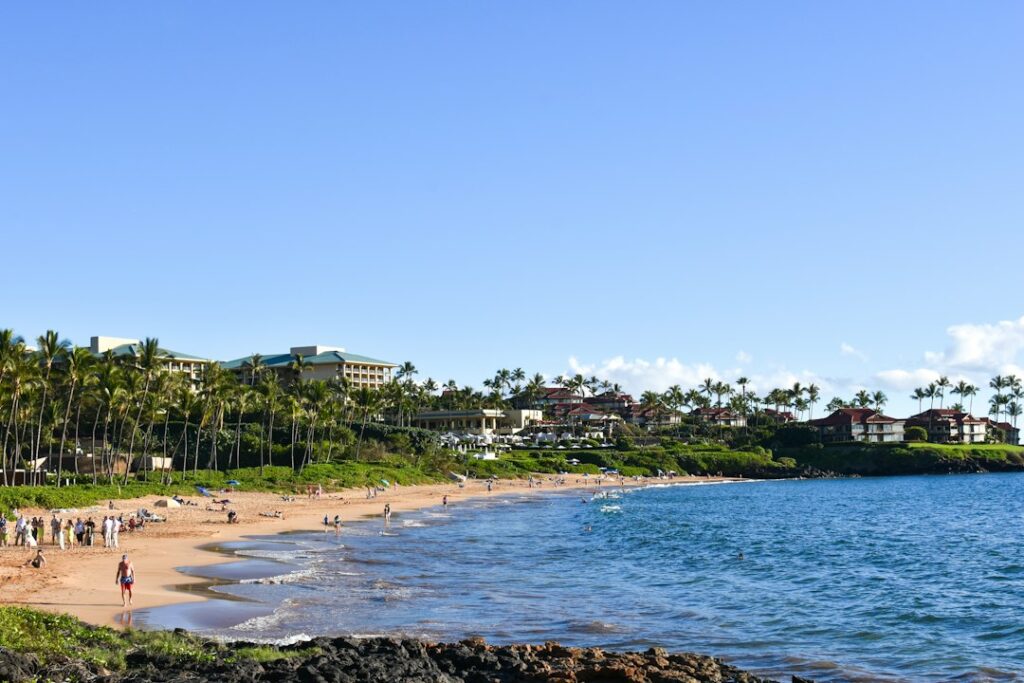
Kaimana Beach, also mapped on older signs as Sans Souci Beach, forms the quiet eastern bookend of the Waikiki shoreline. It sits along Kalakaua Avenue between the Waikiki Aquarium and the Kaimana Beach Hotel at 2863 Kalakaua Avenue, roughly a 12-minute walk east of the Duke Kahanamoku statue at the crowded center of the strand.
Diamond Head crater rises directly beyond the sand, and Kapiolani Park frames the mauka side with about 300 acres of open lawn, banyans, and running paths. The east-facing pocket is small — the usable sand runs roughly 800 feet — but it opens onto a protected reef basin that many transplants prefer to the busier central stretch fronting the Royal Hawaiian and Moana Surfrider hotels.
For households researching relocation to Honolulu, this corner matters. It offers a low-adrenaline swim, walkable amenities, and Route 8 bus service, without the resort surcharges that dominate the middle of Waikiki. The details below describe how the approach works from the eastern Kalakaua entrance, how the reef basin behaves through the year, and how the New Otani sunset window fits a weekly routine.
The eastern Kalakaua approach
Kalakaua Avenue runs about 2.3 miles from the Ala Wai Boulevard junction near Fort DeRussy to its terminus at Diamond Head Road. The eastern quarter-mile past Kapahulu Avenue is the calmer end. Traffic thins, the sidewalk widens along Kapiolani Park, and the beach fronting the Aquarium becomes visible as walkers pass the Waikiki Natatorium war memorial.
The Sans Souci name traces to a small 1880s guesthouse where Robert Louis Stevenson stayed in 1893 and wrote his often-quoted line about the beach. The current Kaimana Beach Hotel, rebranded from the New Otani Kaimana Beach Hotel in 2021, occupies the same footprint and still anchors the sand. State signage marks it as Kaimana Beach; longtime residents use both names interchangeably.
The eastern approach differs from central Waikiki in scale. Buildings step back rather than crowd the shore, the beach opens onto Kapiolani Park instead of a shopping corridor, and the reef geometry produces flatter water for most of the year. That trio — low-rise setting, park backing, sheltered basin — explains why the pocket attracts local swimmers and long-stay residents rather than day-trip tourists.
Where the pocket begins and ends
The usable sand starts at the Waikiki Aquarium seawall and runs east to a rocky point below the hotel. A groin near the Natatorium marks the western boundary; a small basalt outcrop under the hau trees marks the eastern one. Between them, entry is barefoot-friendly on a mix of soft imported sand and coarser natural material.
Getting there by TheBus and by car
TheBus Route 8 is the most direct transit line to the eastern Kalakaua entrance. It runs a Waikiki–Ala Moana loop, boards at both the Ala Moana Center transit stop and multiple Waikiki curb stops along Kuhio Avenue, and drops passengers at the Kapahulu/Kalakaua intersection — a five-minute walk from the Kaimana sand.
Adult one-way fare on TheBus is $3.00 in cash or via the HOLO smart card. HOLO caps daily fares at $7.50 and monthly fares at $80, so relocating households who plan to ride Route 8 several times per week generally load a card at a 7-Eleven or Foodland. Route 8 buses run roughly every 10–15 minutes between 6 a.m. and 10 p.m.
Drivers arriving from H-1 westbound exit at Kapiolani Boulevard, then follow Kapahulu Avenue makai until it hits Kalakaua. From Diamond Head Road eastbound approaches, a shorter drop-in via Paki Avenue lands directly at the Kapiolani Park bandstand parking loop. Both routes clock about 18 minutes from downtown Honolulu outside peak traffic.
Route 8 stops closest to the basin
- Kuhio Avenue at Uluniu Avenue — most central Waikiki hotels board here.
- Kalakaua Avenue at Kaiulani Avenue — closer to eastern Waikiki condominiums.
- Monsarrat Avenue at Paki Avenue — the drop nearest to Kapiolani Park bandstand.
- Kapahulu Avenue at Winam Avenue — westbound return stop after the beach.
The final leg from any Route 8 stop crosses Kapiolani Park on paved walkways past the bandstand and the aquarium. A useful reference for coordinating rides across the island is the overview of Honolulu Skyline rail stations and fare structure, which now connects to TheBus system through shared HOLO fare capping.
Parking options and the morning free window
Street parking along Kalakaua Avenue and around Kapiolani Park operates on a mixed schedule that catches many first-time visitors. Metered stalls on Kalakaua fronting the aquarium charge $1.50 per hour and cap at four hours between 8 a.m. and 6 p.m. daily. Free parking runs before 8 a.m. and after 6 p.m., which produces the well-known morning window that residents use.
The unmetered lot behind the Kapiolani Park bandstand offers roughly 60 stalls with no fee and no posted time limit outside event days. It fills between 8:30 a.m. and 9:30 a.m. on weekends, especially during Diamond Head 5K runs staged from the same bandstand.
The Kaimana Beach Hotel offers valet-only parking at approximately $45 per night for guests and $12 for the first two hours for restaurant patrons, with validation required at the front desk. Self-parking is not available on the hotel lot. Households planning repeated visits generally use the free Paki lot, arriving before 8 a.m.
Parking comparison at the eastern entrance
| Location | Cost | Time limit | Typical fill time |
|---|---|---|---|
| Kalakaua meters (aquarium frontage) | $1.50/hr, free before 8 a.m. | 4 hours | 9:15 a.m. weekends |
| Paki Ave lot at bandstand | Free | None posted | 9:30 a.m. weekends |
| Monsarrat Ave curbside | Free | Signed 2 hour zones | 10:00 a.m. weekends |
| Kaimana Beach Hotel valet | $12 for 2 hr with validation | Valet only | Reserved for guests |
| Waikiki Shell overflow (event days) | Free or $5 | Event-based | Varies by concert |
On flat-water summer weekdays, arriving by 7:30 a.m. lets a driver take a metered stall for free, swim during the calmest water, and leave before the 8 a.m. meter clock starts. That routine is what most transplants build around Kaimana rather than any resort valet arrangement.
The sheltered inner-reef basin
The defining feature of Kaimana is the inner-reef swimming basin. A shore-parallel reef edge sits roughly 180–220 yards offshore, and a shallow lagoon of sand and scattered coral heads runs between that edge and the beach. The reef breaks incoming swell into a light chop before it reaches the sand, producing the flat conditions that give the pocket its swimming reputation.
Inside the basin, typical water depth ranges from waist-deep near shore to about 6–8 feet in the sand channels. Waves inside the reef line generally stay under 1.5 feet on non-high-surf days. Water temperatures at the surface run 74°F in February and reach 80°F by August, similar to the Waikiki central strand but with fewer wave-driven surges.
The Kaimana Beach Mile — an unofficial half-mile out-and-back course used by open-water swim clubs — runs east along the reef line toward Diamond Head, then loops back to the shore. Waikiki Roughwater Swim training groups use this course throughout the year, and the Labor Day 2.4-mile Waikiki Roughwater race starts here.
Reading the swim conditions
Three signals tell a swimmer whether the basin is holding calm. Look at the surf line at the reef edge from the hotel wall: consistent white break means the reef is doing its job. A brownish tint inside the basin after heavy rain indicates the Ala Wai Canal outflow has drifted east and swimming should wait 24–48 hours per state Department of Health guidance.
A clean blue-green tint with visible sand patches from the walkway means visibility inside the basin is 25–40 feet, ideal for both lap swimming and snorkel introduction. Households comparing snorkel conditions across the islands can cross-check season by season with the month-by-month snorkel conditions guide, which tracks Oahu’s south shore separately from windward and North Shore breaks.
Lifeguard tower placement and water safety
Honolulu Ocean Safety staffs Tower 2K at the western end of the Kaimana sand, near the boundary with the Natatorium footprint. Tower 2K is generally staffed 9 a.m. to 5:30 p.m. daily, with staffing extended earlier during summer swim competitions. Response time to the middle of the basin from Tower 2K averages under two minutes.
The Honolulu Department of Emergency Services publishes daily beach hazard flags at the tower base — green, yellow, red — reflecting surf height, current, and stinger presence. Kaimana rarely flies a solid red flag in summer, but Portuguese man-o-war advisories are common on windward days one to three days after a south-southeast wind shift, especially April through July.
Basin-specific safety notes
- The Waikiki Aquarium reef spur produces a channel current outbound during dropping tides.
- Sea urchins concentrate on the eastern basalt point below the hotel.
- Reef sandals are advised for the Natatorium end; the middle sand is barefoot-safe.
- The Ala Wai plume can shift east; brown water advisories cover both zones.
State health data on brown-water advisories is posted at the Hawaii Department of Health portal. Because the Ala Wai drains most of urban Waikiki, its post-storm plume is the single most common reason to skip a Kaimana swim, more so than surf height.
Snorkel access to the outer reef
The outer reef — the coral edge that shelters the basin — is the second attraction that draws intermediate snorkelers to Kaimana. Reaching it requires swimming across the sand-and-scattered-coral basin, then along the inside face of the reef where a fringing garden of finger coral, cauliflower coral, and lobe coral runs east toward Diamond Head.
Swim distance from the hotel-end shore to the eastern reef face is roughly 220 yards; from the aquarium end it is closer to 260 yards. Depth over the reef face runs 8–14 feet, dropping to about 25 feet outside the reef along the Diamond Head shelf. Yellow tang, saddle wrasse, Moorish idol, and Achilles tang all appear inside the first 200 feet of reef.
Green sea turtles surface intermittently along the eastern edge. Federal Marine Mammal Protection Act and state Department of Land and Natural Resources rules require a minimum 10-foot distance from turtles and 50 yards from Hawaiian monk seals — enforcement is active at Kaimana because seals occasionally haul out on the sand.
Compared with other Oahu and neighbor-island reef entries
Kaimana’s outer reef is friendlier than most named snorkel points because entry starts on sand, not lava rock. Households comparing entries across the state often review the geometry of the Kahekili airport-end coral cove entry on Maui or the Kapalua Bay reef swim entry timing as more advanced counterpoints.
Kauai’s Tunnels Reef at Haena and the Big Island’s Kealakekua and Cook Monument snorkel are more dramatic reefs but require boat access, seasonal timing, or long paddles. Kaimana’s appeal is precisely that a swimmer can practice snorkeling inside the basin, then extend to the reef when comfortable, without leaving the visual sight line of Tower 2K.
Kaimana Beach Hotel showers, restrooms, and amenities
Public rinse showers sit on the sand at two points. A pair of freshwater rinse posts stand between the hotel wall and the eastern basalt point, and a second pair sits near the aquarium boundary. Water pressure is moderate; the fixtures are basic pipe stands, not enclosed showers.
The nearest public restrooms are inside the Kapiolani Park facility on Kalakaua opposite the aquarium, roughly a 100-yard walk from the sand. Waikiki Aquarium restrooms are accessible with a paid admission of $12 for adults and $5 for youth. The Kaimana Beach Hotel lobby restroom is reserved for guests and Hau Tree patrons with a food or drink order.
Beach service on the sand fronting the hotel — chairs, umbrellas, towels — is provided by the property and generally requires either room stay or restaurant purchase. Independent beach chair rentals are not offered at the Kaimana pocket; households making it a routine bring their own gear or use the free county-owned park lawn behind the sand.
Amenities at a glance
| Amenity | Location | Access | Cost |
|---|---|---|---|
| Freshwater rinse showers | Sand, 2 stations | Public | Free |
| Public restrooms | Kapiolani Park comfort station | Public | Free |
| Aquarium restrooms | Waikiki Aquarium lobby | Ticketed | $12 adult |
| Beach chair service | Kaimana Beach Hotel | Guests / diners | Included with room or food |
| Lifeguard tower | Tower 2K, western end | Public | Free, 9 a.m.–5:30 p.m. |
| Bike rack | Kapiolani Park makai side | Public | Free |
The park comfort station is the practical anchor for households not staying at the hotel. It houses toilets, cold rinse showers, and shade under monkeypod trees — enough infrastructure for a half-day swim without any paid access.
The Hau Tree sunset window at the Kaimana
The Hau Tree — the beachside restaurant and bar at the Kaimana Beach Hotel, formerly branded as the Hau Tree Lanai under the New Otani ownership — occupies the ground floor directly on the sand. Its west-facing table line captures the Waikiki sunset arc from October through March, when the sun drops behind the Ewa-side skyline rather than the open ocean.
Sunset times on Oahu shift from about 5:50 p.m. in mid-December to 7:15 p.m. in mid-June. The Hau Tree bar service begins at 4 p.m. daily. The optimal sunset window at the bar runs 45 minutes before official sunset through 20 minutes after, when the Kaimana reef line silhouettes and the sky above Diamond Head takes color.
Walk-up bar seating is first-come; reservations at the restaurant open 60 days in advance through the property’s booking site. Weekend sunset tables typically book out four to six weeks in advance from November through February. The bar area holds roughly 18 stools and turns faster than the dining tables.
Sunset drink cost benchmark
| Item | Approximate price | Notes |
|---|---|---|
| Beach cocktail (mai tai class) | $18 | Add gratuity 18–20% |
| Local draft beer | $10 | Kona and Maui brewery rotation |
| Glass of wine | $16 | By-the-glass list |
| Poke or pupu plate | $24 | Split-friendly |
| Validated 2-hour parking | $12 | Valet only |
Households wanting a comparable off-strip poke experience during the day may prefer the off-strip Waikiki poke shops beyond Ala Moana, which run at roughly half the Hau Tree pupu price for a similar-size portion.
How Kaimana differs from the central Waikiki strand
Central Waikiki — the two-mile stretch from Fort DeRussy Beach through Kuhio Beach — carries the bulk of the district’s 4 million-plus annual visitor beach days. That volume shapes everything from noise levels to reef pressure. Kaimana’s separation from that flow is what a relocating household is most likely to value.
Wave exposure differs, too. The central strand faces incoming south swell more directly, producing the mellow surf that beginner surf schools use. Kaimana’s reef geometry filters more of that swell, so the same day that produces 2-foot waves off Kuhio Beach often produces 1-foot or smaller conditions inside the Kaimana basin. That gap becomes wider on medium south-swell days.
Side-by-side comparison
| Metric | Kaimana / Sans Souci | Central Waikiki (Kuhio Beach) |
|---|---|---|
| Typical basin wave height | 0.5–1.5 feet | 1.5–3 feet |
| Typical weekend crowd density | Moderate, spreads along 800 ft | Very high, packed by 10 a.m. |
| Free parking availability | Paki lot and pre-8 a.m. meters | Rare, mostly paid garages |
| Nearest bus route | Route 8 at Kapahulu | Routes 2, 8, 13, 20, 23, 42 |
| Reef snorkel access | Outer reef 220 yards offshore | Groin-fronted swim lagoons |
| Lifeguard tower | Tower 2K | Towers 2A, 2B, 2C, 2E |
| Sunset dining density | 1 major property (Kaimana) | Dozens (Royal Hawaiian to Moana) |
The central strand also carries commercial activity Kaimana does not — catamaran launches, surf schools, ABC store queues. Households booking a sunset sail typically head to central Waikiki, where the sunset catamaran departure choice between Ka Ohai and Maita i matters. For low-key evenings after work, Kaimana is closer to a neighborhood park than a resort promenade.
Seasonal conditions and monthly timing
Oahu’s south shore weather is more consistent than its windward or North Shore. Daytime highs in Honolulu average 80°F in January and 88°F in August. Rainfall on the Waikiki side averages 17 inches per year, most falling November through March. The National Weather Service posts marine forecasts for the south shore separately.
South-swell season runs roughly April through October and is the reason central Waikiki hosts summer surf schools. Kaimana’s reef geometry mutes that swell; inside-basin conditions stay calm through most south-swell days, though the outer reef face becomes livelier and less suitable for casual snorkeling. Winter north swells do not reach Kaimana at all — Diamond Head blocks the wrap.
Monthly reference for Kaimana swimming
| Month | Avg water temp | Typical inside-basin wave | Best window |
|---|---|---|---|
| January | 75°F | 0.5–1 ft | All day |
| February | 74°F | 0.5–1 ft | All day |
| March | 75°F | 0.5–1.5 ft | Morning |
| April | 76°F | 1–1.5 ft | Before noon |
| May | 77°F | 1–2 ft | Before 10 a.m. |
| June | 78°F | 1–2 ft | Before 10 a.m. |
| July | 79°F | 1–2 ft | Before 10 a.m. |
| August | 80°F | 1–2 ft | Before 10 a.m. |
| September | 80°F | 0.5–1.5 ft | Morning |
| October | 79°F | 0.5–1.5 ft | All day |
| November | 77°F | 0.5–1 ft | All day |
| December | 76°F | 0.5–1 ft | All day |
Households can cross-reference monthly petroleum and utility data at the EIA state electricity portal and price of gasoline at the EIA gasdiesel index — both relevant because driving to Kaimana instead of walking from central Waikiki is only cheap when gas prices allow it and only quick when the H-1 is flowing.
Neighborhood context around the basin
The Kaimana pocket sits at the edge of what maps label the Waikiki Special District, but the immediate feel is much more like Kapiolani Park and Diamond Head than like a resort strip. Kapiolani Community College sits half a mile mauka. Diamond Head Road, Monsarrat Avenue, and Paki Avenue frame a low-rise residential zone with lower turnover and older buildings.
Households evaluating relocation to this side of Oahu often start with the general layout in the practical overview of Honolulu neighborhoods for new residents. The Kaimana zone falls under Waikiki proper but functions more like Diamond Head–Kapahulu for day-to-day errands, groceries, and school access.
Adjacent points of interest
- Waikiki Aquarium at 2777 Kalakaua — 400 species, member discount programs.
- Honolulu Zoo at Kapahulu and Kalakaua — 42 acres, adult $21.
- Diamond Head State Monument trailhead — reservation required, $10 non-residents.
- Kapiolani Park bandstand — free Sunday concerts on select months.
- Waikiki Shell — Hawaiian music and concert venue, seasonal schedule.
For a longer half-day windward escape from the same weekend, the Hoomaluhia botanical garden weekend reservation pairs well with a morning Kaimana swim, while a sunrise trip to the Lanikai Pillbox and Kaiwa Ridge sunrise shows the parking-ban side of Oahu’s beach ethos in contrast.
Practical routine for relocating households
Households treating Kaimana as a weekly stop tend to build one of three routines. The morning swim routine arrives by 7 a.m., parks free at the meters or Paki lot, swims for 45 minutes, rinses at the sand showers, and is home for a 9 a.m. workday. This is the pattern that gets the flattest water and the empty sand.
The Saturday half-day routine uses Route 8 from an eastern Waikiki condo, spends four hours between the sand and the outer reef, and ends with a Hau Tree lunch. It skips the parking problem entirely and matches HOLO’s $7.50 daily fare cap.
The sunset routine leaves work between 4 p.m. and 5 p.m., grabs a Hau Tree bar seat before the sunset window, and walks or catches Route 8 back after full dark. In summer months, this routine works even for 9-to-5 workers because sunset falls after 7 p.m.
Weekly cost snapshot
| Routine | Weekly cost | Time commitment | Vehicle needed |
|---|---|---|---|
| Morning swim x3 | $0 parking | 3 hours | Optional |
| Saturday half-day | $6 HOLO round trip | 4 hours | No |
| Sunset bar x1 | $40–65 food and drink | 2 hours | Optional |
State tax and revenue detail relevant to living in Honolulu long-term is published at the Hawaii Department of Taxation. Household demographic and cost-of-living context appears at the Census QuickFacts page for Hawaii, and Honolulu CPI at the BLS Honolulu consumer price index release. Those figures shape whether a routine like this fits a monthly budget.
Frequently asked questions
Is Kaimana Beach the same place as Sans Souci Beach?
Yes. Kaimana is the official current name used on state signs, while Sans Souci is the historical name from an 1880s guesthouse where Robert Louis Stevenson stayed in 1893. Longtime Honolulu residents use both interchangeably. The two names refer to the identical roughly 800-foot pocket beach fronting the Waikiki Aquarium and the Kaimana Beach Hotel at 2863 Kalakaua Avenue.
How do TheBus Route 8 riders get from a Waikiki hotel to Kaimana?
Route 8 runs a Waikiki–Ala Moana loop about every 10–15 minutes from 6 a.m. to 10 p.m. Board at any Kuhio Avenue stop, ride to the Kalakaua and Kapahulu intersection, then walk five minutes across Kapiolani Park to the sand. Adult fare is $3.00 in cash or via HOLO card, which caps daily fares at $7.50.
When does the free morning parking window end at Kaimana?
Metered stalls on Kalakaua Avenue fronting the aquarium are free before 8 a.m. daily. After 8 a.m., meters charge $1.50 per hour with a four-hour cap until 6 p.m., after which parking becomes free again. The unmetered Paki Avenue lot behind the Kapiolani Park bandstand stays free all day but usually fills by 9:30 a.m. on weekends.
Is snorkeling at the outer reef safe for beginners?
Beginners generally practice inside the sheltered basin, where depth stays under 8 feet and the reef edge breaks incoming waves. The outer reef, roughly 220 yards offshore, is better suited to intermediate snorkelers comfortable with a longer surface swim. Tower 2K lifeguards are visible from the reef face, and green sea turtles and Hawaiian monk seals appear intermittently.
Where are the lifeguards and how long do they staff the tower?
Honolulu Ocean Safety staffs Tower 2K at the western end of the Kaimana sand near the Waikiki Natatorium footprint. The tower generally runs 9 a.m. to 5:30 p.m. daily, with earlier openings during summer swim events. Response time to the middle of the basin averages under two minutes, and the tower posts daily hazard flags reflecting surf, current, and stinger conditions.
When is the Hau Tree sunset bar window most usable at the Kaimana Beach Hotel?
Bar service starts at 4 p.m. daily, and the sunset window runs about 45 minutes before official sunset through 20 minutes after. Sunset falls near 5:50 p.m. in December and 7:15 p.m. in June. Weekend restaurant tables book four to six weeks ahead from November through February; walk-up bar seating turns faster and is a practical option most weeknights.
How does Kaimana differ from the central Waikiki strand?
Kaimana carries a fraction of the visitor volume of the central Waikiki strand and produces flatter inside-basin water because its reef sits closer to shore. Central Waikiki hosts most surf schools, catamaran launches, and resort commerce, while Kaimana backs onto the 300-acre Kapiolani Park with a single hotel property. The eastern entrance also offers free morning parking and easier Route 8 access.
Can Ala Wai runoff affect the swimming basin after storms?
Yes. The Ala Wai Canal drains urban Waikiki and can push a brownish plume east into the Kaimana basin after heavy rain. The Hawaii Department of Health posts brown-water advisories, and standard guidance is to wait 24–48 hours after a strong plume before returning to the water. The plume is the single most common reason to skip a Kaimana swim.