For most mainland households, the choice between Hawaii and the Caribbean comes down to four numbers: hours in the air, nightly room cost, the hurricane calendar, and water temperature. Both regions have warm water and palm-lined beaches. They reach the traveler on very different terms, though, and the gap grows or shrinks sharply depending on which side of the country the trip starts from.
This decision framework compares the two regions on the measures that change a budget or a schedule. It covers nonstop flight times from East Coast, Midwest and West Coast hubs, passport requirements, average hotel rates and taxes, rental cars, hurricane-season overlap, sea conditions, and the very different landscapes travelers find on arrival.
The analysis draws on airline schedules, tax-agency rules, federal price and energy data, and published lodging surveys. Figures are rounded and change by season, so they work best as planning ranges rather than quotes.
The short answer: geography decides most trips
The biggest variable in the hawaii vs caribbean decision is the departure airport. From New York, Boston, Atlanta or Miami, most Caribbean islands are three to four hours away, while Honolulu is ten to eleven hours away. From Los Angeles, San Francisco or Seattle, that relationship flips.
Travelers in the Midwest and Mountain West sit in the middle. Chicago and Denver both reach the Caribbean faster, but from Denver the extra flying to Hawaii is only about three hours each way. Many households accept that for the different scenery.
Beyond flight time, the regions split on cost structure. Hawaii is a single US state with domestic travel rules, high but predictable prices, and one currency. The Caribbean is roughly two dozen countries and territories, each with its own entry rules, taxes and driving side.
- East Coast and Southeast origins: the Caribbean usually wins on time and airfare.
- West Coast origins: Hawaii usually wins on time and is roughly even on airfare.
- Midwest and Mountain origins: a closer call that hinges on budget and scenery.
- Travelers without passports: Hawaii, Puerto Rico and the US Virgin Islands only.
Nonstop flight times from mainland hubs
Flight time shapes the whole trip. A ten-hour flight plus a five- or six-hour time change usually costs a full vacation day in each direction. A three-hour hop to Nassau or San Juan can mean a beach afternoon on arrival day.
The table below lists typical scheduled nonstop flight times. Westbound flights to Hawaii run 30 to 60 minutes longer than the return because of headwinds. The site’s guide to nonstop flight times to Hawaii from US cities covers those routes in more detail.
| Departure hub | To Honolulu (HNL) | To San Juan (SJU) | To Montego Bay (MBJ) | To Nassau (NAS) |
|---|---|---|---|---|
| New York (JFK) | About 11 hr 15 min | About 3 hr 50 min | About 4 hr | About 3 hr |
| Atlanta (ATL) | About 10 hr 30 min | About 3 hr 30 min | About 2 hr 30 min | About 2 hr |
| Chicago (ORD) | About 9 hr 30 min | About 4 hr 30 min | About 4 hr | About 3 hr 30 min |
| Dallas (DFW) | About 8 hr 30 min | About 4 hr 15 min | About 3 hr 30 min | About 3 hr |
| Denver (DEN) | About 7 hr 15 min | Connection, 8–10 hr total | Connection, 7–9 hr total | Connection, 6–8 hr total |
| Los Angeles (LAX) | About 5 hr 45 min | Connection, 9–11 hr total | Connection, 9–11 hr total | Connection, 8–10 hr total |
| Seattle (SEA) | About 6 hr | Connection, 10–12 hr total | Connection, 10–12 hr total | Connection, 9–11 hr total |
Nonstops to the Caribbean from Midwest and western cities are often seasonal and mostly run from December to April. Hawaii flights from the West Coast run year-round, with dozens of daily departures from California alone.
The time-zone factor
Hawaii runs on Hawaii-Aleutian Standard Time and does not observe daylight saving time. That puts Honolulu five hours behind New York from November to March and six hours behind from March to November.
Most Caribbean islands are on Atlantic Standard Time. That matches Eastern Daylight Time in summer and runs one hour ahead of Eastern time in winter. An East Coast traveler has almost no jet lag in the Caribbean. The same traveler typically needs two to three days to adjust in Hawaii.
Interisland and island-hopping logistics
Within Hawaii, flights between Honolulu and Maui, Kauai or the Big Island take 35 to 50 minutes. One-way fares commonly run $60 to $150. The Hawaii Department of Transportation publishes airport information for every state-run airport.
Caribbean island-hopping is less predictable. Some pairs, such as St. Thomas and St. John, connect by a 20-minute ferry. Others, such as Jamaica and Barbados, can require routing through Miami, which turns a short distance into a full travel day.
Passport and entry requirements
Hawaii is a domestic destination. Travelers need only a REAL ID-compliant license or another TSA-accepted document, which airport checkpoints have required since May 7, 2025. There is no customs line on arrival, only an agricultural declaration form.
That agricultural check matters for anyone carrying fresh produce, plants or pets. The Hawaii Department of Agriculture’s quarantine branch sets those rules. Pet owners also go through a separate rabies-quarantine process that can take months to complete.
Most Caribbean destinations are foreign countries and require a valid US passport book for air travel. The two major exceptions are Puerto Rico and the US Virgin Islands (St. Thomas, St. John and St. Croix). These are US territories, and the same ID used for Hawaii gets travelers in.
| Destination | Passport for air travel? | Currency | Driving side |
|---|---|---|---|
| Hawaii | No (REAL ID) | US dollar | Right |
| Puerto Rico | No (REAL ID) | US dollar | Right |
| US Virgin Islands | No, but proof of citizenship advised on return | US dollar | Left |
| Bahamas | Yes | Bahamian dollar, pegged 1:1 to USD | Left |
| Jamaica | Yes | Jamaican dollar, USD widely accepted | Left |
| Dominican Republic | Yes, plus e-ticket form | Dominican peso | Right |
| Aruba | Yes, plus ED card | Aruban florin, USD accepted | Right |
What a first passport costs and how long it takes
A first-time adult passport book costs $165: a $130 application fee plus a $35 acceptance fee. Routine processing has generally taken four to six weeks. Expedited service costs $60 more and cuts that to roughly two to three weeks.
The $30 passport card is cheaper but only works for land and sea crossings, not international flights. One common exception is a closed-loop cruise that starts and ends at the same US port. On those, a birth certificate and government ID can be used instead of a passport.
Airfare and total trip cost
From the East Coast, round-trip economy airfare to Hawaii commonly runs $700 to $1,100. Fares to San Juan, Nassau or Montego Bay run roughly $350 to $650. From the West Coast, Hawaii fares often fall to $300 to $550, about what a Californian pays to reach the Caribbean with a connection.
For a family of four leaving Boston or Philadelphia, that airfare gap alone can exceed $1,500. For the same family leaving San Diego or Portland, it can run the other way.
Daily costs on the ground
Hawaii’s everyday prices run well above the mainland average. The Bureau of Labor Statistics Consumer Price Index for Urban Hawaii tracks food, housing and energy costs. These consistently sit above national levels, and restaurant menu prices reflect them.
Gasoline is another visible example. Hawaii regularly has some of the highest pump prices in the country, often $4.50 per gallon or more, according to Energy Information Administration fuel price data. Residential electricity often costs more than 40 cents per kWh, as the EIA’s Hawaii electricity profile shows.
The Caribbean is not uniformly cheaper. Islands such as Turks and Caicos, St. Barts and the Cayman Islands import nearly everything and often cost more than Hawaii. Puerto Rico, the Dominican Republic and Jamaica tend to cost less, especially away from resort areas.
On payment, Hawaii works like any US state. The site’s breakdown of when cash is still needed in Hawaii covers the farmers markets and food trucks that still prefer it. In much of the Caribbean, travelers should check their cards’ foreign-transaction fees, which are commonly 3%.
Average nightly hotel rates and taxes
Hawaii’s statewide average daily hotel rate has been near $390 in recent years. Maui and Kauai often run above $450, and Waikiki on Oahu is closer to $300 to $330. Those averages cover all properties, so oceanfront resorts typically cost $550 to $900 or more per night.
Caribbean rates vary far more by island. San Juan hotels in Puerto Rico average roughly $220 to $280, while beachfront resorts in Turks and Caicos often cost more than $700. All-inclusive pricing in Jamaica, Mexico’s Caribbean coast and the Dominican Republic makes direct comparison harder.
| Location | Typical average nightly rate | Combined room taxes (approx.) | Common resort fee |
|---|---|---|---|
| Oahu (Waikiki) | $300–$330 | About 19% | $35–$50 |
| Maui | $450–$550 | About 19% | $40–$55 |
| Kauai | $420–$500 | About 19% | $35–$50 |
| Big Island | $350–$450 | About 19% | $30–$50 |
| Puerto Rico (San Juan) | $220–$280 | 9%–15% | $20–$40 |
| Bahamas (Nassau) | $300–$450 | About 10% VAT plus fees | $30–$50 |
| Jamaica (all-inclusive, per room) | $350–$600 | Usually included | Rare |
| Turks and Caicos | $650–$900 | 12% plus service charge | $40–$80 |
How Hawaii’s lodging taxes add up
Hawaii adds several taxes to every room night. The state transient accommodations tax rose to 11% on January 1, 2026, under the so-called green fee law. Each county adds its own 3% tax, and the general excise tax of roughly 4% to 4.7% applies on top.
Together, these come to about 19% before resort fees. Current rates and filing rules are on the Hawaii Department of Taxation site. On a $400 room, taxes alone add roughly $75 per night.
Hotel versus vacation rental
In both regions, condos and houses can lower per-person cost for families or groups who cook some meals. In Hawaii, many counties restrict short-term rentals outside resort zones, which limits supply. The site’s analysis of Hawaii vacation rental versus hotel costs covers cleaning fees, parking and taxes.
All-inclusive resorts are common in the Caribbean but rare in Hawaii. Households that want one price for food, drinks and room will find far more choice in Jamaica, the Dominican Republic and Antigua.
Rental cars and getting around
A rental car is close to essential on Maui, Kauai and the Big Island, and useful on Oahu outside Honolulu. An economy car typically costs $60 to $110 a day, with higher prices in summer and over the late-December holidays. The site’s breakdown of Hawaii rental car prices by island and season shows when those spikes hit.
Drives in Hawaii can be long and slow. The Road to Hana self-drive versus tour comparison shows how a 64-mile route can take most of a day, with more than 600 curves and dozens of one-lane bridges.
In the Caribbean, driving conditions vary widely. Jamaica, the Bahamas, Barbados, the Cayman Islands and the US Virgin Islands drive on the left. Many smaller islands require a temporary local permit, often $20 to $60, and some roads are steep, narrow and poorly lit.
- Hawaii: US license, right-side driving, familiar road signs and insurance rules.
- Puerto Rico: right-side driving, US license, heavy San Juan traffic.
- USVI: left-side driving in cars with the steering wheel on the left, steep switchback roads.
- Jamaica and the Bahamas: left-side driving; many visitors rely on resort transfers.
- Aruba and Bonaire: right-side driving, flat terrain, easy for first-time renters.
Insurance coverage also differs. US auto policies and credit card benefits usually cover Hawaii and Puerto Rico but often exclude Jamaica and other countries. The site’s guide to Hawaii car insurance rates and requirements explains the state’s no-fault system.
Hurricane season overlap
Both regions share an official hurricane season of June 1 to November 30, but the risk is not remotely equal. Based on 1991–2020 averages, the Atlantic basin, which includes the Caribbean, sees about 14 named storms, 7 hurricanes and 3 major hurricanes per year.
The Central Pacific around Hawaii averages roughly four to five tropical cyclones per year. Most pass well south of the islands or weaken over cooler water. Direct landfalls are rare: Hurricane Iniki struck Kauai in September 1992, and Hurricane Dot hit Kauai in August 1959.
Storms that miss Hawaii can still do damage. Hurricane Lane never made landfall in August 2018 but dropped more than 50 inches of rain on parts of the Big Island. The site’s Hawaii hurricane season guide covers warning timelines and preparation.
| Factor | Hawaii (Central Pacific) | Caribbean (Atlantic) |
|---|---|---|
| Official season | June 1 – November 30 | June 1 – November 30 |
| Peak months | August – September | Mid-August – mid-October |
| Average storms per year | About 4–5 tropical cyclones | About 14 named storms |
| Average hurricanes per year | 1–2, rarely near islands | About 7 |
| Recent major landfalls | Iniki, 1992 | Maria and Irma, 2017; Beryl, 2024; Melissa, 2025 |
| Lower-risk areas | Statewide risk is low | Aruba, Bonaire, Curaçao (south of main belt) |
What the overlap means for booking
Caribbean prices drop sharply between late August and October, sometimes by 30% to 50%, because that is when storm risk peaks. Travelers booking then should buy trip insurance before a storm is named, since policies typically exclude storms that are already forming.
Hawaii’s fall shoulder season, from September through early November, carries little added storm risk. That makes it one of the better-value times to visit the islands. Winter brings more rain to windward coasts, which the site’s Hawaii rainy season guide maps by island.
Water temperature, clarity and sea conditions
The Caribbean is consistently warmer. Across the eastern Caribbean, sea temperatures run from about 79°F in February to 84°F to 86°F in September. Hawaii’s water is a few degrees cooler: about 74°F to 75°F in February and March, and 80°F to 81°F in September and October.
That three- to five-degree gap is noticeable. Many swimmers find Hawaii comfortable without a wetsuit year-round. Snorkelers who stay in the water an hour or more in winter often add a thin 2-millimeter top.
| Month | Honolulu sea temp | San Juan sea temp | Nassau sea temp | Grand Cayman sea temp |
|---|---|---|---|---|
| February | 75°F | 79°F | 75°F | 79°F |
| May | 77°F | 81°F | 80°F | 82°F |
| August | 80°F | 84°F | 85°F | 85°F |
| October | 80°F | 84°F | 83°F | 84°F |
| December | 77°F | 81°F | 78°F | 81°F |
Water clarity and marine life
The Caribbean’s limestone islands have little runoff, and places like Bonaire, Grand Cayman and the Bahamas routinely have 80 to 100 feet or more of visibility. Coral reefs sit close to shore in calm, shallow water.
Hawaii’s water is very clear on calm days, often 50 to 100 feet, but clouds up after heavy rain or big surf. What Hawaii offers instead is wildlife: green sea turtles, spinner dolphins, manta rays off Kona, and reef fish species found nowhere else on Earth, about 25% of the total.
The site’s ranking of the best snorkeling spots on Kauai by season shows how much conditions change between summer and winter on a single island.
Surf, currents and safety
Hawaii sits in the open Pacific with no continental shelf, so swells arrive with full force. Between November and March, north-facing shores get waves of 20 to 30 feet or more. Many beaches that are glassy in July are dangerous in January.
Most beaches facing the Caribbean Sea are calmer, with sand that slopes gently into the water. Atlantic-facing coasts in Puerto Rico, the Dominican Republic and the Bahamas can have strong rip currents. Overall, though, the Caribbean suits families with small children better.
Each region has its own nuisances. In Hawaii, box jellyfish show up on leeward shores about eight to ten days after each full moon. The Caribbean has had record sargassum seaweed blooms, heaviest from April to August, which can pile up on eastern beaches.
The Hawaii Department of Health publishes ocean-safety and beach-water advisories. The City and County of Honolulu provides lifeguard information.
Scenery: volcanic peaks versus flat white sand
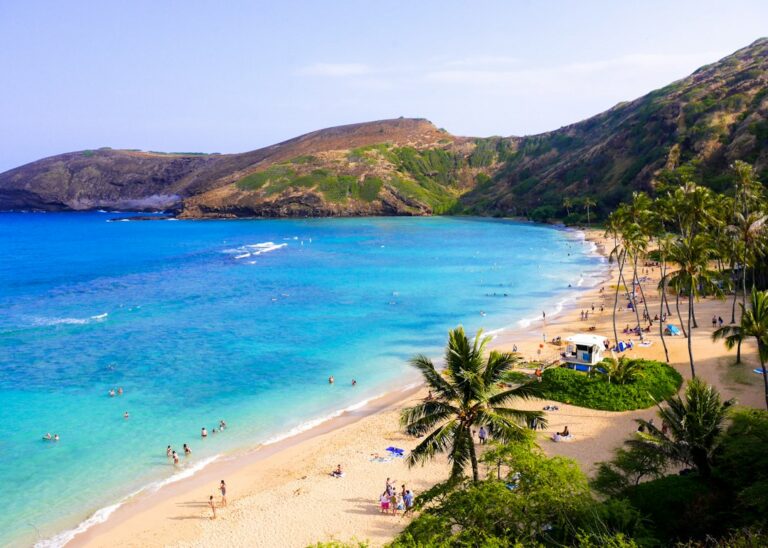
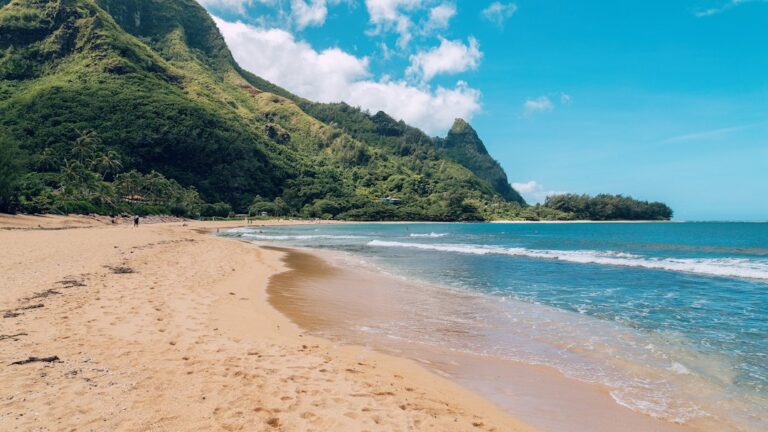
The two regions look fundamentally different, and for many travelers this decides the trip. Hawaii is a chain of young volcanic islands rising straight from deep ocean. Mauna Kea reaches 13,803 feet, Haleakala on Maui reaches 10,023 feet, and Kilauea on the Big Island is still one of the world’s most active volcanoes.
That geology produces sea cliffs, rainforest valleys, waterfalls and beaches in unexpected colors. The site’s guide to Hawaii’s black, green and red sand shores explains where each forms and why.
The Caribbean is two landscapes, not one
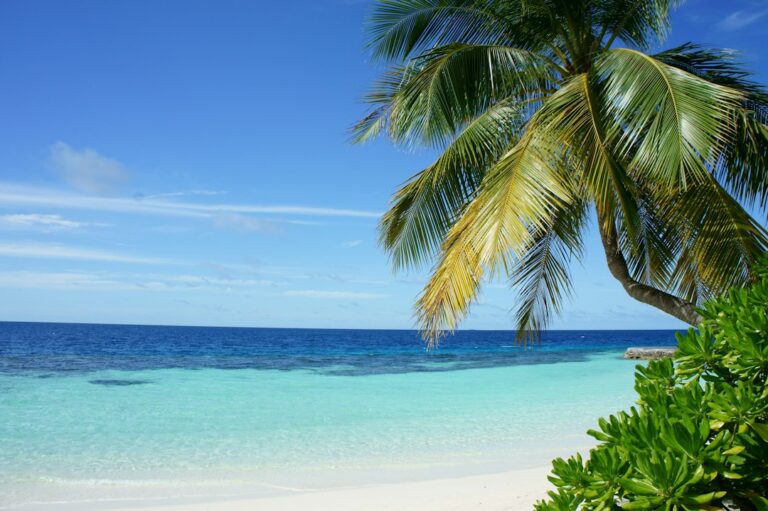
Much of the Caribbean that mainland visitors picture is low limestone and coral islands. That includes the Bahamas, Turks and Caicos, the Cayman Islands and Aruba. The highest point in the Bahamas is just 207 feet. These islands have powdery white sand and shallow turquoise water.
The eastern Lesser Antilles, by contrast, are volcanic. St. Lucia’s Gros Piton rises 2,619 feet straight from the sea, and Dominica is covered in rainforest and hot springs. The Dominican Republic’s Pico Duarte reaches 10,164 feet, though few beach visitors see it.
Beach character compared
- Hawaii: golden, black and occasional green sand; dramatic mountain backdrops; more rock and lava shoreline.
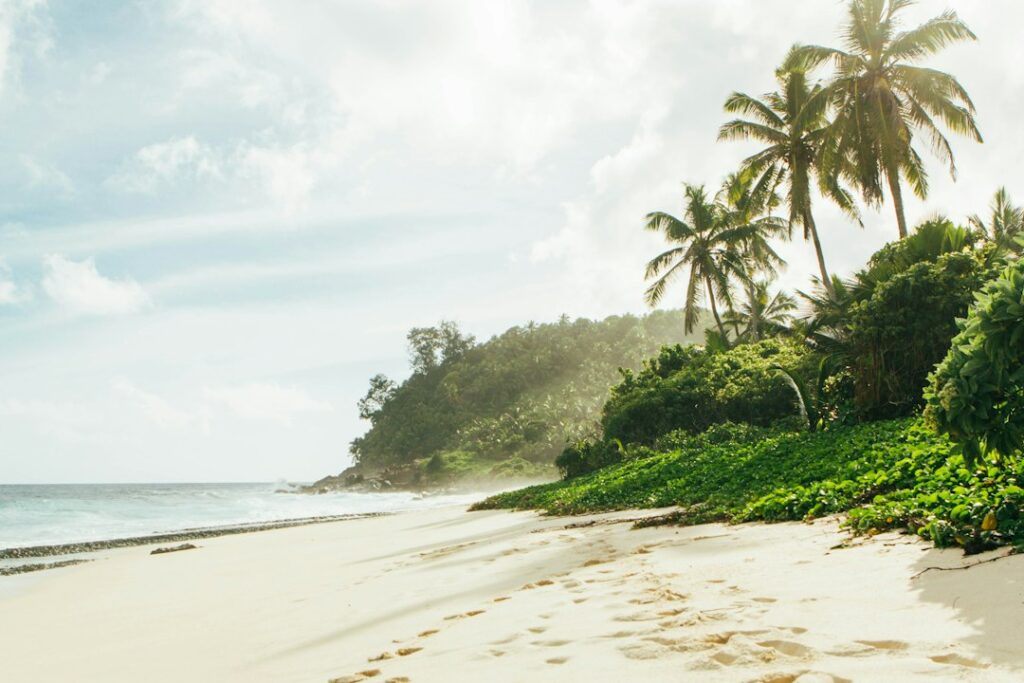
- Low Caribbean islands: wide white sand, shallow turquoise water, flat interiors.
- Volcanic Caribbean islands: darker sand, lush peaks, fewer long white beaches.
Hawaii has white sand too, but it is often tucked between lava fields. The Big Island’s best beaches range from white-sand Hapuna to the black sand at Punaluu, where basking turtles share the shore.
Activities beyond the beach
Hawaii’s appeal leans toward adventure on land. Visitors hike volcanic craters, watch sunrise from 10,000 feet on Haleakala, drive scenic highways and tour Pearl Harbor. Go Hawaii publishes official visitor planning information for each island.
The Caribbean leans toward water and relaxation: sailing between islands, wreck diving, rum distilleries and all-inclusive resort life. Cultural variety is a strength, since a single one-week cruise can stop at islands with Spanish, Dutch, French and British influences.
Cruising itself splits along geography. Caribbean cruises leave from Miami, Fort Lauderdale and Port Canaveral several times a day. Hawaii cruises from the West Coast spend four to five days at sea each way, as the site’s look at cruises to Hawaii from the West Coast shows.
Sample budgets: one week for two travelers
The figures below model a seven-night trip for two adults in mid-range lodging in March, leaving from two different hubs. They are rough estimates meant to show how the departure city changes the balance.
- New York to Oahu: airfare about $1,800; hotel about $2,700 with taxes; car about $500; food about $1,400.
- New York to Puerto Rico: airfare about $900; hotel about $1,900 with taxes; car about $400; food about $1,000.
- Los Angeles to Maui: airfare about $900; hotel about $3,800 with taxes; car about $550; food about $1,500.
- Los Angeles to Jamaica all-inclusive: airfare about $1,400; resort about $3,500 including food; transfers about $150.
The pattern holds broadly. East Coast travelers save $1,500 or more in the Caribbean. For West Coast travelers, the two regions cost about the same, and Hawaii often comes out ahead once the time lost to connections is counted.
Hawaii as a scouting trip for relocation
For households considering a permanent move, the comparison has another layer. A Hawaii vacation doubles as a test of distance from family, the time difference and daily costs. Puerto Rico attracts people relocating for tax reasons, but moving to most other Caribbean islands means dealing with immigration rules.
Hawaii has a population of about 1.4 million, according to the Census Bureau’s Hawaii QuickFacts, and full US infrastructure. Travelers scouting neighborhoods can compare housing costs in the site’s guide to average rent in Hawaii by island.
Pick Hawaii if, pick the Caribbean if
Pick Hawaii if
- The trip starts west of the Rockies, where Hawaii is faster than most Caribbean islands.
- Someone in the group lacks a passport or cannot get one in time.
- Mountains, volcanoes, hiking and scenic drives matter as much as the beach.
- Travel falls between August and October, when Atlantic storm risk peaks.
- US rules for driving, insurance, phones and medical care are a priority.
- The trip doubles as research for a possible move to the islands.
Pick the Caribbean if
- The trip starts on the East Coast or in the Southeast and time is short.
- Warmer water, above 80°F for most of the year, is a priority.
- Calm, shallow, white-sand beaches suit young children or weak swimmers.
- An all-inclusive resort with one fixed price appeals.
- Avoiding jet lag matters, such as for a long weekend.
- Travel falls between December and April, outside hurricane season.
Frequently asked questions
Is Hawaii or the Caribbean cheaper for a vacation?
It depends on the departure city. From the East Coast, the Caribbean is usually cheaper because airfare runs roughly $350 to $650, compared with $700 to $1,100 for Hawaii. From the West Coast, costs are close. Hawaii often comes out ahead once connection time and island-specific hotel taxes are compared.
Do US citizens need a passport for Hawaii or the Caribbean?
Hawaii requires no passport, only a REAL ID or other TSA-accepted document. Puerto Rico and the US Virgin Islands also need no passport. Nearly every other Caribbean destination, including the Bahamas, Jamaica, Aruba and the Dominican Republic, requires a valid US passport book for air travel.
How long is the flight to Hawaii compared with the Caribbean?
From New York, Honolulu takes about 11 hours nonstop, while San Juan takes about 3 hours 50 minutes. From Los Angeles, Honolulu takes about 5 hours 45 minutes, while most Caribbean islands require a connection totaling 9 to 11 hours. Midwest hubs fall in between.
Is the water warmer in Hawaii or the Caribbean?
The Caribbean is warmer year-round by roughly three to five degrees. Caribbean sea temperatures run about 79°F in February and 84°F to 86°F in September. Hawaii ranges from about 74°F to 75°F in late winter to 80°F to 81°F in early fall.
When is the worst time to visit the Caribbean because of hurricanes?
Atlantic hurricane season runs June 1 to November 30, with the highest risk from mid-August through mid-October. Aruba, Bonaire and Curaçao sit south of the main storm track and carry lower risk. Travelers booking during the peak months should buy insurance before any storm is named.
Does Hawaii get hurricanes like the Caribbean does?
Hawaii has the same June-to-November season but far fewer direct hits. The Central Pacific averages about four to five tropical cyclones per year, and most pass south of the islands. The last major landfall was Hurricane Iniki on Kauai in September 1992.
Which has better snorkeling, Hawaii or the Caribbean?
The Caribbean generally has clearer, calmer water and more coral, with 80 to 100 feet of visibility common around Bonaire and Grand Cayman. Hawaii has more fish found nowhere else, frequent green sea turtle sightings and manta rays, though conditions change sharply with season and surf.
Can you drive on the right side of the road in the Caribbean?
Only on some islands. Puerto Rico, the Dominican Republic, Aruba and Bonaire drive on the right. Jamaica, the Bahamas, Barbados, the Cayman Islands and the US Virgin Islands drive on the left. Hawaii drives on the right under standard US rules.