Manoa Falls Trail sits at the back of Manoa Valley on Oahu, a 1.6-mile round-trip through dense rainforest that ends at a roughly 150-foot ribbon cascade. The path parallels Lyon Arboretum’s northern boundary and drains water almost every day of the year — Manoa Valley receives an estimated 165 inches of annual rainfall, several times what Waikiki gets 10 minutes downhill.
The trail reads easy on paper: modest elevation gain of roughly 800 feet, wide surface, and heavy foot traffic. In practice it is one of the muddiest short hikes on the island. After even a light shower the tread turns to slick red-brown clay, roots become polished, and the last quarter-mile requires deliberate step placement. Footwear selection matters more than distance suggests.
This article covers what relocating households and visiting hikers actually experience on the trail — mud grade after rain, the leptospirosis advisory that keeps swimming off the table, current $7 trailhead parking, a drier ridge alternative at Waahila, and the trail-runner versus light-boot debate that dominates local hiker forums.
Where the trail sits and how to reach it
The trailhead sits at the end of Manoa Road, roughly 6 miles from Waikiki and about 15 to 25 minutes by car depending on H1 traffic. TheBus route 5 (Manoa Valley) runs from Ala Moana Center to a stop near Paradise Park; walkers add about 10 minutes on foot to reach the trailhead gate. The valley climbs gradually inland from urban Honolulu into thick native and introduced canopy.
Manoa is a residential neighborhood with narrow streets, so the last mile of the drive winds past homes and the University of Hawaii’s Lyon Arboretum entrance. Signage improved after several years of trail closures and reopenings; the gated entry is now clearly marked. The Honolulu weather forecast page at honolulu.gov is a decent morning check for valley showers before setting out.
Distance from major residential bases
Households house-hunting on the leeward side often underestimate how long Manoa access takes at rush hour. From Kapolei the drive stretches to 45 or 55 minutes each way; from Kaneohe via the Pali Highway it is 25 to 35 minutes; from Kailua via H3 it is 30 to 40 minutes. Weekday mornings before 7:30 and midday windows are the least clogged with commuter traffic.
The 1.6-mile round-trip broken down
Distance is measured door-to-door from the gated trail entry to the falls viewing area and back. Most hikers with normal fitness finish in 60 to 90 minutes. That figure balloons after rain — 2 hours is realistic when the middle section turns to shoe-swallowing mud. The tread is a mix of packed dirt, exposed root ladders, and drainage steps built by volunteer crews over the past decade.
The first 0.4 mile parallels Waihi Stream and stays comparatively firm underfoot. Around the 0.5-mile mark the trail bends inland and climbs a series of rooted risers. From 0.6 to 0.8 mile the tread narrows and gains most of its elevation. The final approach opens into a mossy amphitheater where the falls plunge from the cliff line above.
Segment-by-segment breakdown
| Segment | Distance | Surface | Typical time |
|---|---|---|---|
| Gate to stream bend | 0.4 mile | Packed dirt, gravel | 10–14 minutes |
| Stream bend to root ladder | 0.2 mile | Roots, drainage cuts | 8–12 minutes |
| Root ladder to viewing area | 0.2 mile | Clay, mud, rock steps | 10–18 minutes |
| Falls viewing to gate return | 0.8 mile | Same terrain reversed | 25–35 minutes |
Mud grade after rain — what to expect
Manoa Falls Trail is not a beginner-benign path once precipitation arrives. Local hikers grade the tread on an informal 1-to-4 scale that trailhead regulars share on message boards. Grade 1 is a dry morning after a stretch of steady trade winds; Grade 4 is the day of a Kona storm when the middle section behaves like wet pottery clay under every step.
Because Manoa Valley catches orographic rain almost daily, the tread rarely fully dries in the shoulder zones. Even during an off week for the valley, the section between 0.5 and 0.9 mile keeps residual mud in shaded microclimates. Hikers accustomed to bone-dry Arizona or Utah trails routinely underestimate this and end up on their backs within the first hour.
Rain-to-mud translation table
| Rain in prior 24 hours | Expected mud grade | Slip risk | Recommended tread |
|---|---|---|---|
| Under 0.1 inch | Grade 1 (tacky) | Low | 3 mm+ lugs |
| 0.1–0.5 inch | Grade 2 (soft) | Moderate | 4 mm+ lugs |
| 0.5–1.5 inches | Grade 3 (sticky) | High | 5 mm+ aggressive |
| Over 1.5 inches | Grade 4 (slurry) | Very high | Trekking pole assist |
Rain totals for Manoa are not published widely, but the National Weather Service Honolulu station and local outlets like Hawaii News Now report flash flood advisories that overlap the valley frequently. A morning check saves a wasted trip when brown-water conditions and closure gates activate. Households often set a browser bookmark to the trail’s condition thread on local forums.
Leptospirosis and why the pool is off-limits
The pool at the base of Manoa Falls looks inviting after a sweaty climb, but signage at the trailhead and repeated Hawaii Department of Health advisories discourage swimming or submerging cuts. Leptospirosis is a bacterial infection carried by rodents, mongoose, and other wildlife whose urine contaminates fresh water. Manoa Stream drains a dense wildlife catchment, which puts the pool at persistent risk.
Symptoms begin 2 to 30 days after exposure and can include high fever, muscle aches, jaundice, and in severe cases kidney failure. Hawaii reports higher case rates than most mainland states, and the CDC has tracked cluster outbreaks tied to freshwater exposure on the islands. The realistic advice for hikers is simple: photograph the falls, do not swim.
Actual risk factors to weigh
- Open cuts or abrasions on legs increase entry risk substantially.
- Immersing the head or swallowing water carries the highest exposure.
- Rain events flush wildlife waste into pools within hours.
- Brief wading at the pool edge with intact skin is lower risk but not zero.
- Flu-like symptoms after a valley hike warrant a same-week doctor visit.
Footwear selection — trail runners versus light boots
The trail-runner versus light-hiking-boot debate on Oahu’s short muddy trails does not have a single winner. The choice depends on ankle history, weight preference, and whether the wearer minds throwing the pair straight in the wash afterward. Both categories have valid use cases at Manoa. The wrong footwear entirely — road runners, canvas sneakers, flip-flops — accounts for most stretcher calls from the valley.
The trail-runner case
Modern trail runners with 4 to 5 mm lugs drain quickly, dry overnight, and weigh 9 to 11 ounces per shoe. That matters on a 1.6-mile out-and-back where the tread is more slick than technical. Popular models among Oahu regulars include the Salomon Speedcross, Altra Lone Peak, and Hoka Speedgoat. All shed mud faster than heavy boots and let the foot flex over roots.
The light-boot case
Light waterproof hiking boots — Salomon X Ultra, Merrell Moab, Oboz Sawtooth — trade weight and drying time for ankle wrap and a stiffer plate underfoot. That protection helps hikers with prior sprains or heavier packs. The tradeoff: waterproof membranes fail in reverse when trail water tops the collar, then the boot holds water for days. Manoa mud finds every seam given enough time.
Head-to-head comparison
| Attribute | Trail runner | Light waterproof boot |
|---|---|---|
| Per-shoe weight | 9–11 ounces | 15–20 ounces |
| Dry time after soak | 10–14 hours | 36–72 hours |
| Ankle support | Minimal | Moderate to high |
| Mud shed rate | Fast | Slow, cakes on lugs |
| Typical price | $135–$180 | $140–$210 |
| Best fit | Fit hikers, quick trips | Weak ankles, heavy packs |
Neither answer generalizes to every relocation household. Kids under 12 usually do better in trail runners because their ankles bend rather than snap. Adults with prior sprains lean toward boots. A common island compromise is a trail runner with an aggressive 5 mm lug pattern paired with lightweight gaiters to keep grit and debris out of the collar during the muddiest sections.
Rain shell and day-pack packing
Manoa Valley’s rain arrives without theatrics — no dramatic buildup, just a slow ceiling drop from partly cloudy to steady drizzle in 20 minutes. A packable rain shell weighing 6 to 10 ounces is worth its stow space on every visit, regardless of the morning forecast. The Honolulu Star-Advertiser weather graphics show why valley microclimates diverge from coastal readings.
Baseline day-pack loadout
- Packable rain shell, 6–10 ounces, 3-layer or 2.5-layer nylon.
- 32-ounce water bottle per adult; humidity dehydrates faster than temperature suggests.
- Small microfiber towel for a mud wipe-down at the trailhead.
- Trekking pole for Grade 3+ mud days; even one pole helps.
- Ziploc for wet socks and a dry pair to change into.
- Insect repellent with 20% DEET or picaridin equivalent.
- Waterproof phone case; the mist near the falls carries.
Skip the camp stove, skip the multi-liter hydration bladder, skip the 30-liter pack. A 12- to 18-liter daypack is right-sized for the loop. Overpacking encourages balance mistakes on the wet root sections, and the trail simply does not require alpine-grade equipment. Cheap ponchos work in a pinch but tear on the branches that close in near the pool.
$7 parking at the trailhead
Parking has evolved through several iterations at Manoa Falls over the past decade. Since roughly 2019 the paid lot at the trailhead has charged $7 per vehicle, cash or card at a self-serve kiosk. The lot holds approximately 45 to 60 vehicles depending on how tightly drivers park; overflow is not welcome on the surrounding residential streets and gets ticketed quickly.
Trailhead attendants are on site during peak morning hours and enforce the paid stall requirement. Vehicles parked outside the lot risk tickets from Honolulu parking enforcement or being towed by residents who have grown frustrated with valley overflow. The residential neighborhood does not have public bathrooms, so all visitor amenities cluster at the paid lot itself.
Parking alternatives and their tradeoffs
| Option | Cost | Distance to trailhead | Notes |
|---|---|---|---|
| Paid trailhead lot | $7 flat | 0 mile | 45–60 spots, staffed peak hours |
| Paradise Park private lot | $5–$10 | 0.2 mile | Availability varies by day |
| TheBus Route 5 stop | $3 one way | 0.5 mile walk | Runs about every 30 minutes |
| Rideshare drop-off | $18–$28 from Waikiki | 0 mile | Return service is not guaranteed |
Waahila Ridge as a drier alternative
Waahila Ridge sits on the eastern shoulder of Manoa Valley, accessible from St. Louis Heights via a modest suburban drive. The ridge trail runs about 4.8 miles round-trip if hiked to its practical turnaround, with roughly 1,000 feet of gain along an exposed spine that dries out much faster than the valley floor. It is the standard drier-day backup when Manoa is Grade 3 or worse.
Unlike Manoa Falls, Waahila does not deliver a waterfall payoff. The reward is Koolau ridge views, breeze, and firmer footing. A rocky spine section around the 1.5-mile mark requires hand-over-hand scrambling on damp days. Beginners often stop before this point and turn around at the second obvious clearing, which shortens the outing to about 3 miles round-trip and keeps the risk profile lower.
Manoa Falls vs Waahila Ridge quick compare
| Attribute | Manoa Falls | Waahila Ridge |
|---|---|---|
| Round-trip distance | 1.6 miles | 4.8 miles |
| Elevation gain | ~800 feet | ~1,000 feet |
| Typical mud grade | 2–4 | 1–2 |
| Parking fee | $7 | Free state park lot |
| Payoff | 150-foot cascade | Ridge views, breeze |
| Wet-weather rating | Poor | Fair |
Households who plan to hike weekly on Oahu often develop a two-trail rotation: Manoa on drier weeks, Waahila or another ridge line during rainy stretches. The Hawaii DOT road advisories and state park closure pages are worth bookmarking, as heavy rain occasionally closes access roads independent of trail condition. For another exposed ridge alternative on windward Oahu, see how Lanikai Pillbox above Kailua handles sunrise access.
Timing, weather, and seasonal patterns
Manoa’s dry season loosely runs May through October, matching statewide patterns. Even in July, though, valley rain days outnumber sunny days. November through March is the wet stretch, with days of continuous drizzle that never quite become downpours. Households moving from mainland climates often need a few months to recalibrate what “rain” means in a windward-adjacent valley catchment like this one.
Month-by-month planning notes
- January–February: heaviest rain risk, Grade 3+ mud most days.
- March–April: transitional, still wet mornings but drying afternoons.
- May–June: driest window overall, trade-wind stable weather.
- July–August: warm, humid, popular with visitor volume peaks.
- September–October: light shoulder crowds, occasional Kona storm.
- November–December: pre-holiday visitor uptick, mud returns fast.
Trailhead conditions can differ by 2 mud grades between morning and afternoon on any given day. Early starts around 7:30 to 9 AM catch firmer tread and more parking availability. For anyone comparing this to the mist-shrouded shoulder-season rhythm covered in the November Kauai trip breakdown, Manoa reads similarly during the same stretch of the year.
Comparable rainforest trails across the islands
Manoa Falls is Oahu’s most-visited rainforest waterfall trail, but it is not the only path with this character. Households evaluating a move that includes weekend hiking should sample the alternates on other islands. Each has its own rhythm and payoff, and the comparison sharpens what Manoa is best for — a short, high-visual, weekday-friendly outing near urban Honolulu without a full day of driving.
Cross-island rainforest options
- Maui’s Pipiwai bamboo forest to Waimoku Falls at 4 miles round-trip.
- Maui’s Iao Valley Needle paved loop for rainy afternoons.
- Kauai’s Kokee State Park difficulty tiers for drier ridge work.
- Kauai’s Kalalau Trail overnight camping for multi-day coastal rainforest travel.
- Oahu’s Diamond Head crater with the non-resident booking window for a dry contrast.
A weekly rotation across these can spread wear on any single pair of footwear. Trail runners take a beating fast on Manoa’s grit; alternating with drier ridge trails extends their lifespan by months. Comparing the coastal cliff exposure of Napali Coast access options also underscores how sheltered the Manoa valley canopy actually is by comparison.
Wildlife, flora, and what the canopy contains
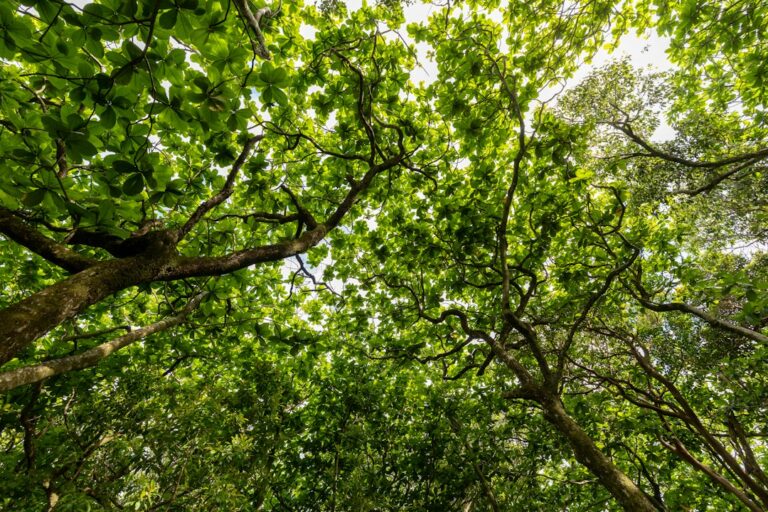
The trail passes through a mix of introduced and native rainforest species. Overhead: African tulip trees, mango, guava, and eucalyptus. Ground layer: ti plants, ginger, taro relatives, and dense fern. Bird calls include Japanese white-eye, red-billed leiothrix, and occasional shama thrush. Nothing on the trail is genuinely dangerous, but centipedes and cane spiders shelter under wet logs and freshly overturned rocks.
Wild pigs move through the upper drainage but rarely intersect with hikers on the main trail. Feral cats congregate near the parking lot and beg opportunistically. Mosquito density spikes at dusk; a repellent application before the last quarter mile pays off during the return leg. Hawaii has no snakes; the tree fauna is comparatively benign for hikers moving from mainland woodlands.
Common plants along the tread
- African tulip: bright orange flowers, invasive canopy dominant.
- Kukui (candlenut): silvery leaves, indigenous introduction.
- Ti plant: red and green fronds, cultural and ornamental use.
- Hapuu tree fern: massive fronds, native and protected.
- Common guava: fruit windfalls attract insects and rodents.
Household logistics for regular hikers
For relocating households who intend to hike Manoa monthly or more, a few one-time purchases sharpen the experience. A dedicated pair of mud shoes stored in the garage prevents rebuilding a routine each visit. A rubberized car mat catches drip after descent. Cash on hand for parking removes a small friction point when the kiosk card reader glitches, which happens more often than the concession admits.
Recommended household kit
- Two-pair rotation: aggressive-lug trail runner plus backup light boot.
- Waterproof stuff sack for wet clothing in the trunk.
- Silicone spray for shoe uppers; extends life against staining.
- Reusable bar-of-soap tin for hand cleaning at trailhead spigot.
- Printed lepto symptom card in the glove compartment.
Households comparing Oahu neighborhoods often prioritize proximity to greenspace. Manoa, Nuuanu, and Palolo all sit within 15 minutes of a trailhead like this one. Access ease reads similarly to how the Ehukai Pipeline vantage points reward North Shore residents — proximity trumps drama for regular use.
Common mistakes that send hikers home early
Trailhead observations from Honolulu Fire Department incident data suggest most Manoa Falls issues involve preventable footwear and pacing errors. Twisted ankles from smooth-soled shoes and dehydration from underpacked water dominate rescue calls. A handful of falls per year cause serious injury when hikers try to scramble beyond the marked viewing area toward the base of the falls on wet basalt.
Preventable errors, ranked
- Wearing flip-flops or road running shoes on wet clay.
- Ignoring the closure gate after brown-water advisories.
- Scrambling off-trail toward the pool base on wet rocks.
- Underestimating humidity and running short on water.
- Attempting the trail during active flash flood watches.
- Bringing children in strollers; the trail is not stroller passable.
Reading Civil Beat’s occasional coverage of trail management debates helps calibrate what changes are underway on public lands. A morning check for gate status becomes routine after one wasted 40-minute drive from Waikiki or leeward suburbs. Habits form quickly once households make the commute more than a handful of times.
Practical cost snapshot for a two-adult household
The out-of-pocket cost of a Manoa Falls outing is modest, especially compared with cross-island alternatives. A two-adult household visiting monthly spends under $200 per year on parking, roughly $85 to $180 on footwear amortization, and negligible per-trip water and snack costs. That total is well below one Neighbor-Island trip and provides a reliable weekend outlet without airfare or overnight lodging.
Yearly cost snapshot
| Item | Assumption | Annual cost |
|---|---|---|
| Parking | $7 x 24 visits | $168 |
| Trail-runner amortization | 1 pair/year x 2 adults | $300 |
| Rain-shell amortization | 3-year replacement | $45 |
| Water and snacks | $4 per trip x 24 | $96 |
| Gas from urban Honolulu | 10 miles round-trip | $62 |
| Estimated total | — | $671 |
For context, the Honolulu CPI tracks how outdoor recreation costs move against grocery and rent basket components. Manoa Falls remains one of the cheaper regular-cost hobbies available on the island, well under the fuel and airfare expenditures associated with Neighbor-Island day trips or overnight excursions.
Post-hike amenities near the trailhead
The residential neighborhood surrounding Manoa Road has limited immediate amenities but plenty of options within a 5-minute drive. Manoa Marketplace at the junction of Woodlawn and East Manoa hosts a Longs Drugs, Safeway, and a handful of restaurants. Hikers frequently rotate through Andy’s Sandwiches, Waioli Kitchen and Bake Shop, or the drive-through at Coffee or Tea within 10 minutes of finishing the outing.
For visitors chasing island food traditions, downhill options open once the drive returns to town. A shave-ice stop at Waiola or Matsumoto for the syrup and density comparison is a common post-hike ritual. Waikiki-based hikers often bookend the outing with a Leonard’s malasada pickup on the return for a hot pastry with damp hair.
Frequently asked questions
How muddy is Manoa Falls Trail really?
Mud grade shifts daily with valley rainfall. On dry summer weeks the tread is tacky but firm; within 12 hours of a half-inch rain event the middle section becomes slick clay. The lower and upper thirds hold their shape better, but the roughly 0.5-to-0.9-mile band retains moisture for days. Expect Grade 2 conditions as the realistic average.
Are trail runners better than hiking boots at Manoa?
Neither wins outright. Trail runners with 4 to 5 mm aggressive lugs drain faster, dry overnight, and cost roughly $135 to $180. Light waterproof boots offer ankle support that helps prior-sprain hikers and heavier packs, but they hold water for days once submerged. Fit adults tend toward runners; anyone with joint concerns leans boot.
Why is swimming discouraged in the pool at Manoa Falls?
Hawaii Department of Health advisories cite leptospirosis, a bacterial infection from rodent and mongoose urine that reaches freshwater catchments. Symptoms appear 2 to 30 days after exposure and can include fever, muscle pain, and jaundice. Cuts and immersion carry the highest risk. Photograph the cascade and skip the swim; the tradeoff is not worth it.
What does trailhead parking actually cost?
Parking at the paid trailhead lot runs $7 per vehicle, payable at a self-serve kiosk. The lot holds around 45 to 60 cars and fills fastest on weekend mornings and holidays. Attendants enforce the paid stall requirement during peak hours. Alternatives include Paradise Park private lots and TheBus Route 5, but neighborhood parking is discouraged and monitored.
Is Waahila Ridge a viable rainy-day alternative?
Yes, with tradeoffs. Waahila’s ridge tread dries faster than the valley floor and offers Koolau views instead of a waterfall payoff. Round-trip is about 4.8 miles with 1,000 feet of gain — longer than Manoa but firmer footing. A scramble section around 1.5 miles rewards experienced hikers; beginners often turn around at the second clearing for a 3-mile day.
How long does the round-trip actually take?
Fit adults finish in 60 to 90 minutes on dry-to-moderate conditions. Wet Grade 3 or Grade 4 mud stretches the outing to 2 hours or slightly beyond. Families with young children should budget 2 to 2.5 hours including breaks and mud transitions. Photography stops at the falls add 10 to 20 minutes depending on light and crowd density.
What should a first-time visitor pack?
Baseline gear includes a packable rain shell weighing 6 to 10 ounces, a 32-ounce water bottle per adult, a microfiber towel, insect repellent with roughly 20% DEET or picaridin, and a waterproof phone case. A single trekking pole helps on Grade 3 days. Keep the daypack under 18 liters; heavier loads unbalance hikers on wet root sections.