Every month, a small translucent predator times its arrival at Oahu’s south shore to the phase of the moon. Alatina alata — the Hawaiian box jellyfish — spawns on a schedule so predictable that lifeguards, hotels, and the Waikiki Aquarium publish the dates in advance. For visitors booking a Waikiki stay, understanding this cycle turns a potential sting into a scheduling problem.
The species pushes into shallow south-facing waters roughly 8 to 10 days after each full moon and stays present for two to three days. During that window, warnings go up at Kuhio Beach, Ala Moana, and other high-traffic swimming spots. Researchers estimate 500 to 800 stings are logged annually at Waikiki alone, though the true count runs higher because most stings never reach an official tally.
The response of long-time residents is not to fear the ocean but to plan around the calendar. This article walks through the lunar mechanics, the beaches affected, the treatment protocols supported by state health guidance, and the alternative bays that stay safer on influx days.
Why Hawaiian box jellyfish follow the moon
Box jellyfish are among the ocean’s most reliable timekeepers. Adult Alatina alata gather in deep water off Oahu’s south coast during the lunar cycle, then migrate shoreward on synchronized spawning runs. The trigger appears to be a combination of moonlight, tidal pull, and reproductive readiness that concentrates the animals into shallow, calm bays where they release eggs and sperm.
Marine biologists at the University of Hawaii and the Waikiki Aquarium have tracked this pattern for decades. The influx typically peaks 8 to 10 days after a full moon, though sightings can begin as early as day 7 and linger through day 11 or 12. Water temperature matters: during summer, when south-shore waters climb into the low 80s°F, the cycle runs slightly longer and the swarms grow denser.
The 8-to-10-day rule in practice
The rule is straightforward to apply. Take any full moon date, add eight days, and mark the next three calendar squares as caution days. A June full moon on the 10th, for example, produces warnings from June 18 through June 20 or 21. The pattern holds across all 12 months, though sting counts spike in the warm window between May and September.
Not every influx is equal. Some months bring hundreds of jellyfish onto a single beach; others produce only scattered animals. Wind direction, swell size, and current patterns all shift the density on any given day. What stays constant is the timing — the moon sets the clock, and everything else adjusts the volume.
The Waikiki Aquarium influx calendar
The Waikiki Aquarium maintains a public box jellyfish calendar that lists projected influx dates for the entire year. The calendar is the reference used by lifeguards, hotel concierges, and dive operators to post daily advisories. It appears online well ahead of each month, and printed versions are stocked at aquarium admission and at several south-shore beach kiosks along Kalakaua Avenue.
The Honolulu Ocean Safety division cross-references the same dates when it schedules warning-sign deployment along Kuhio, Queens, and Kaimana beaches. Signage goes up the evening before the projected influx and stays until the animals disperse. Visitors who check the calendar during trip planning can shift snorkel days to the safe windows — usually days 1 through 6 after a full moon and days 14 through the next full moon.
Sample 2026 south-shore influx projections
| Full moon date | Peak influx window | Season factor |
|---|---|---|
| January 3 | January 11–13 | Cooler water, shorter tail |
| April 1 | April 9–11 | Transition, moderate density |
| June 29 | July 7–10 | Warm summer peak |
| August 27 | September 4–7 | High density common |
| October 25 | November 2–4 | Density tapering |
| December 24 | January 1–3, 2027 | Winter low |
Those dates are projections, not guarantees. Actual sightings can shift a day earlier or later based on ocean conditions. The Aquarium updates its posted calendar if patterns diverge, and Honolulu Ocean Safety posts real-time alerts through its social channels and its dispatch line at (808) 922-3888.
South-facing shores at highest risk
Not every Oahu beach sees box jellyfish. The animals concentrate on the south-facing coast, where the reef geometry and prevailing currents funnel them into shallow, sandy-bottomed bays. Waikiki is the most sting-heavy stretch simply because it holds the highest swimmer volume; the animals themselves are just as present at less crowded south-facing coves further east and west.
Beaches with documented recurring warnings
- Waikiki Beach, especially Kuhio, Queens, and Kaimana Beach segments
- Ala Moana Beach Park, especially the swimming basin
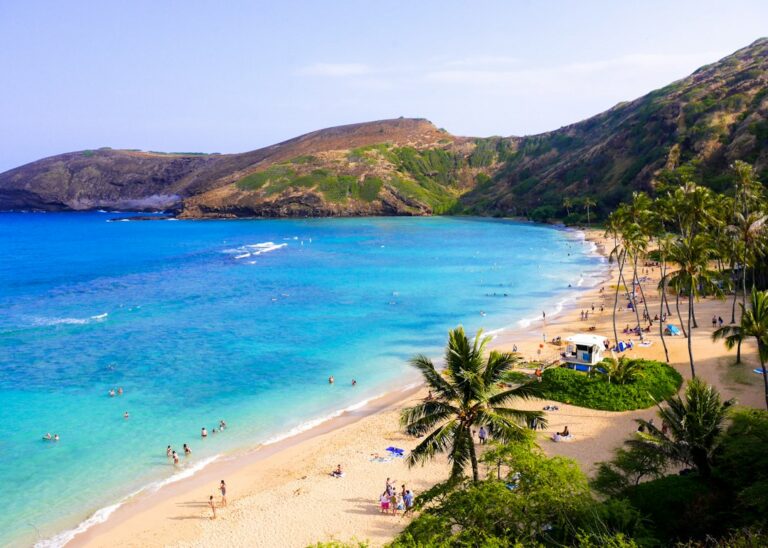
- Hanauma Bay, though the reef reduces open-water exposure
- Sandy Beach and other south-shore bodysurfing spots
- Waialae Beach Park in the Kahala neighborhood
- Ko Olina lagoons on the west-south corner of Oahu
The $25 entry and 48-hour reservation system at Hanauma Bay means most visitors book two or three days ahead. Checking the influx calendar before committing to those dates is the simplest way to avoid a wasted booking. Refunds are typically not offered because of ocean conditions alone.
North-shore and windward beaches are generally not affected by the lunar-timed box jellyfish influx. Waimea Bay, Sunset Beach, Lanikai, and Kailua see occasional Portuguese man-of-war strandings — a different animal that responds to different treatment — but not the Alatina alata swarms that hit the south side.
Bodysurfing spots along the Ka Iwi coast add another layer of concern beyond the jellyfish. Sandy Beach’s shorebreak sends dozens to the emergency room each year, and stings compound that already-elevated injury rate on caution days. Both risks are managed by the same lifeguard tower that posts the daily flag colors.
What a box jellyfish sting actually does
Alatina alata is not the lethal Australian box jellyfish that makes international headlines. Hawaiian stings are painful and occasionally severe but almost never fatal to healthy adults. The animals reach about 3 inches across the bell, with tentacles trailing up to 2 feet behind. Their nematocysts — the stinging cells — fire on contact and inject a venom that produces immediate burning.
Most stings feel like a hot whip across the skin, followed by a raised red welt that traces the tentacle’s path for hours. Reactions escalate over the next 15 to 40 minutes: cramping, sweating, chest tightness, and rarely, difficulty breathing. Children, older adults, and anyone with cardiovascular conditions face higher risk of a serious systemic reaction and should reach medical help immediately, even if the initial pain seems manageable.
Symptom timeline
| Time after sting | Typical symptom | Action |
|---|---|---|
| 0–2 minutes | Sharp burn, immediate welt | Exit water, alert lifeguard |
| 2–10 minutes | Redness deepens, itching starts | Rinse with vinegar |
| 10–30 minutes | Muscle cramping, nausea possible | Cold pack, monitor breathing |
| 30–60 minutes | Peak pain, possible chest tightness | Call 911 if breathing changes |
| 2–24 hours | Welts darken, itching persists | OTC antihistamine, keep clean |
| 3–14 days | Scarring, sensitivity to sun | Reef-safe sunscreen on affected skin |
First-aid that works (and myths that don’t)
The single most important treatment fact for Hawaiian box jellyfish: vinegar works. Household white vinegar (5 percent acetic acid) neutralizes undischarged nematocysts still clinging to the skin, preventing further venom injection. Every Waikiki lifeguard tower carries vinegar, and most south-shore hotels keep bottles at the pool deck for the same reason.
The vinegar rule is species-specific. For Portuguese man-of-war stings — also common on Hawaiian beaches — vinegar can make things worse by triggering additional discharge. That distinction matters because man-of-war and box jellyfish tentacles look similar to a panicked swimmer. When in doubt on a south-shore beach during an influx window, defer to the lifeguard’s identification before applying anything.
Step-by-step response
- Get out of the water calmly; thrashing worsens the sting.
- Do not rub the affected area with sand or towels.
- Rinse liberally with white vinegar for at least 30 seconds.
- Pluck remaining tentacles with tweezers or a gloved hand.
- Apply a hot pack or hot water at 105 to 113°F for 20 minutes.
- Monitor for breathing changes; call 911 if any appear.
Common myths to ignore
- Urine does not neutralize venom and can worsen infection risk.
- Fresh water triggers unfired nematocysts and increases pain.
- Meat tenderizer has no evidence base for Alatina alata stings.
- Alcohol and ammonia are similarly unhelpful and skin-irritating.
The Hawaii State Department of Health publishes guidance echoing this protocol. Their marine sting page notes that severe reactions require emergency room care and that follow-up antihistamines and topical steroids can reduce the residual welt and itching that persists for a week or more after the initial sting.
Safer beach alternatives on influx days
Not every beach on Oahu goes into caution mode during a south-shore influx. Windward and north-shore bays operate on entirely different current systems, and the box jellyfish rarely appear there. For visitors who booked a Waikiki hotel specifically for its ocean access, influx days become an opportunity to explore quieter coasts by rental car or by TheBus.
North-shore options during south-shore warnings
During summer months when the south-shore influx is at its densest, the north shore is also at its calmest. Waimea Bay, Sharks Cove, and Three Tables all offer snorkeling with visibility over 60 feet and no jellyfish activity. Winter reverses the pattern — north-shore waves reach 20 feet, and the safer swim moves back to the south side outside of influx dates.
Windward and east-side options year-round
- Lanikai Beach: calm shore break, no jellyfish influx pattern
- Kailua Beach Park: 2.5 miles of protected white-sand swimming
- Makapuu tidepools: reef pools that keiki can wade in
- Bellows Field Beach: gentle Pacific swell, weekend access only
These beaches sit 20 to 45 minutes by car from Waikiki. TheBus routes reach several of them, though ride time triples versus driving. Visitors staying in Waikiki without a rental car can still salvage a beach day on influx dates by combining rideshare to Kailua with a return on TheBus route 67 or 70 through the Pali tunnel back to town.
For arriving guests planning ground transport before they know the calendar, the HNL-to-Waikiki transport comparison lays out the cost and time trade-offs. Adding a mid-trip rental car for windward exploration is often cheaper than daily rideshare on beach days that fall inside a caution window.
Visitors torn between Waikiki and quieter west-side stays may find the Ko Olina lagoons versus Waikiki lodging trade-off lands differently once the box jellyfish calendar enters the calculation. Ko Olina’s four man-made lagoons still see occasional stings, but reduced exposure to open ocean lowers density during high-influx days.
What to pack in a beach kit
A small beach kit tailored to the box jellyfish cycle takes almost no space and turns a stressful sting into a five-minute inconvenience. Most items fit in a quart-size ziplock stored in the daypack that goes to the beach anyway. Total weight comes in under one pound, and total cost stays under $20 for the entire kit assembled from a single drugstore visit.
Kit contents
| Item | Purpose | Estimated cost |
|---|---|---|
| 4 oz white vinegar bottle | Neutralize nematocysts | $1.50 |
| Fine-point tweezers | Remove tentacle fragments | $3.00 |
| Instant hot pack | 20-minute heat application | $4.00 |
| Diphenhydramine tablets (25 mg) | Reduce histamine response | $4.00 |
| 1% hydrocortisone cream | Manage residual itching | $5.00 |
| Printed influx calendar card | Quick reference at beach | Free |
ABC Stores across Waikiki carry every item on this list, often bundled at higher tourist prices than Longs Drugs or Target. A single Longs run in Ala Moana Center covers the kit for under $15 and adds reef-safe sunscreen and aloe. The kit stays useful throughout the trip; unused items travel home for future beach vacations to Florida or the Caribbean.
Families relocating longer-term often expand this kit with a full first-aid box at home. The same pack works for the wet-weather packing recommended in the Kauai November-through-March packing checklist, which similarly emphasizes small kits over big rentals and store-bought hotel add-ons.
Planning around the cycle for longer stays
Visitors staying seven nights or more on Oahu will almost certainly encounter a box jellyfish influx during their trip. The cycle repeats every 29 or 30 days, so a two-week vacation crosses at least one warning window. The response is not to cancel beach plans but to sequence them: reef snorkels on days 1 through 6 after the full moon, and quieter shore days during the influx itself.
Sample two-week itinerary sequencing
| Trip day | Days from full moon | Suggested activity |
|---|---|---|
| Day 1 | +2 | Waikiki swim, arrival day |
| Day 3 | +4 | Hanauma Bay reef snorkel |
| Day 5 | +6 | Waikiki paddle or catamaran ride |
| Day 8 | +9 | North-shore day, influx active in Waikiki |
| Day 10 | +11 | Kailua Beach and Lanikai |
| Day 12 | +13 | Back to Waikiki beach, safe again |
| Day 14 | +15 | Ko Olina or Pearl Harbor and departure |
Booking snorkel tours around the same window is equally important. Reef trips from Kewalo Basin or the Waikiki catamaran fleet still run on influx days, but shallow snorkel stops shift to reef locations less affected by the swarm. Confirming with the operator the day before departure surfaces any changes to the planned route or drop-in stop.
Sunset sails typically operate without jellyfish concern because passengers do not enter the water. The Ka Ohai versus Maita I departure comparison holds up regardless of influx status. Booking a sunset cruise on a caution day preserves the ocean experience without exposing bare skin to the swarm below.
Neighbor island exposure compared
Oahu’s south shore receives the densest and most predictable box jellyfish influx in the state, but the species appears elsewhere in smaller numbers. Maui, Molokai, and the Big Island all record occasional Alatina alata sightings on south-facing beaches following the same 8-to-10-day post-full-moon window. Kauai reports the fewest events because its south-shore reef geometry differs and the surf pattern disperses the animals.
Regional risk snapshot
| Island | South-shore risk | Notes |
|---|---|---|
| Oahu | High, calendar-tracked | Waikiki, Ala Moana, Hanauma |
| Maui | Moderate | Kihei, Wailea occasionally posted |
| Big Island | Low to moderate | Kona-side sightings less predictable |
| Kauai | Low | Poipu occasional, no formal calendar |
| Molokai | Data sparse | Little formal tracking |
| Lanai | Data sparse | Hulopoe Bay very rare |
West Maui’s more common ocean hazard is swell size rather than jellyfish. Guides comparing beach options often steer visitors toward Honolua Marine Reserve during off-peak swell windows for the same reason Oahu guides check the box jellyfish calendar. Ocean-aware timing beats gear or luck on any island.
Trips scheduled around off-peak pricing also intersect the box jellyfish calendar naturally. May visitor patterns and Lei Day event timing place many mainland families on Oahu during a moderate-density month, when the swarms are present but not yet at their late-summer peak.
What state data and media reporting show
Sting counts published by the City and County of Honolulu’s Ocean Safety division track roughly 500 to 800 recorded incidents per year at Waikiki, with individual influx days occasionally topping 100 stings across the tower zones. The city’s public safety pages publish daily lifeguard reports that include jellyfish counts alongside surf height and current advisories.
Local media has covered the annual pattern for years. Coverage from the Star Advertiser and Hawaii News Now tracks major influx events and interviews Waikiki Aquarium staff each summer when swarms peak. Reporting from Civil Beat has covered the interaction between climate warming, reef change, and shifting influx timing.
The state tourism authority publishes its own visitor-facing advisory. Go Hawaii’s safety pages summarize the vinegar-and-heat protocol for box jellyfish stings and direct visitors to the Waikiki Aquarium calendar for scheduling. Cross-referencing the state advisory with the local lifeguard report is the recommended workflow for trip-day decisions.
Longer-term residents and the cycle
For mainland transplants relocating to Oahu, the box jellyfish calendar becomes part of the routine, alongside surf reports and trade wind forecasts. Locals rarely swim at Waikiki on caution days; they shift to windward beaches, pool workouts, or ocean sports off Ko Olina. The cycle is more predictable than the weather, so it settles into muscle memory within the first few months of residency.
The stakes rise for families with school-age children who swim recreationally. Public schools on the south shore, along with private clubs like the Outrigger Canoe Club, coordinate practice schedules with the Aquarium calendar. Youth surf schools and paddling programs typically move to protected inland pools or shift practice times to before dawn on the highest-risk days when nematocyst density is lowest.
What relocating households learn quickly
- Vinegar lives permanently in the beach bag, not just the pantry
- Full-moon dates get marked on the family calendar in advance
- School swim programs share advisories through parent groups
- Health insurance covers most stings under standard urgent care
- Local pediatricians are familiar with follow-up antihistamine care
Neighborhoods near the water — Kaimuki, Kahala, Diamond Head — trade calendar updates informally through community boards and Nextdoor. The knowledge spreads fast because the consequences of missing it are memorable. New arrivals typically absorb the cycle within their first three months of full-time residency and start planning ocean recreation around it automatically.
Frequently asked questions
Are Hawaiian box jellyfish deadly?
Hawaiian box jellyfish (Alatina alata) are not the lethal Australian species. Stings produce painful welts and occasional severe systemic reactions, but healthy adults recover fully within days. Deaths from Hawaiian box jellyfish are effectively unheard of in modern records. Children, older adults, and anyone with heart or breathing conditions should still seek immediate medical attention after any sting event.
How do beach-goers know if the beach is safe today?
Check the Waikiki Aquarium’s box jellyfish calendar online before heading to the beach, look for posted yellow warning signs at Kuhio and Kaimana beaches, and ask any lifeguard on duty. Honolulu Ocean Safety updates its social channels with real-time conditions. On days without warnings, south-shore swimming is as safe as it appears; the risk is confined to a roughly 3-day monthly window.
Why does vinegar work for these stings?
White vinegar’s 5 percent acetic acid disables unfired nematocysts still clinging to the skin, stopping additional venom from being injected. This response is species-specific and effective against Alatina alata. For Portuguese man-of-war stings, vinegar can trigger more firing and worsen the sting. Because the two look similar in the water, deferring to a lifeguard for identification improves the treatment choice.
What months are worst for box jellyfish?
The monthly lunar cycle repeats year-round, but the warmer months from May through September produce denser swarms and higher sting counts. Peak influx days occur 8 to 10 days after each full moon regardless of season. Visitors targeting summer travel dates should build the calendar into trip planning; winter and shoulder-season trips face lower-density influxes but still see the pattern.
Can hotels warn guests before an influx?
Most Waikiki hotels post the influx dates at concierge desks and pool decks. Larger properties like the Sheraton, Hilton Hawaiian Village, and Halekulani print monthly calendars in their guest information binders. Requesting the current month’s dates at check-in is the most reliable step. Some resorts also add a courtesy note to daily room announcements during active warning windows.
Are keiki more at risk than adults?
Children face proportionally larger venom doses relative to body weight and can develop more severe systemic reactions than adults. Their smaller airways also make any breathing-related response more urgent. Local pediatric emergency departments treat keiki stings with the same vinegar-and-heat protocol but observe them longer. Parents on influx days should keep children in ankle-deep water or shift entirely to windward beaches.
Do surfboards and boogie boards prevent stings?
Boards keep torsos out of the water but leave arms, legs, and hands exposed to trailing tentacles. Board wax and rubber leashes provide no protection against nematocysts. Serious surfers on caution days often wear lycra rash guards with long sleeves and leggings for partial coverage. Full wetsuits reduce risk to almost zero but feel uncomfortable in warm Hawaiian water above 80°F.