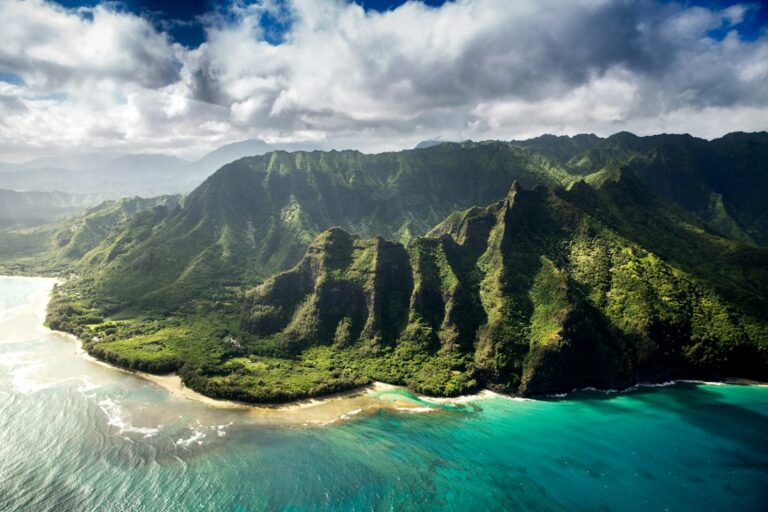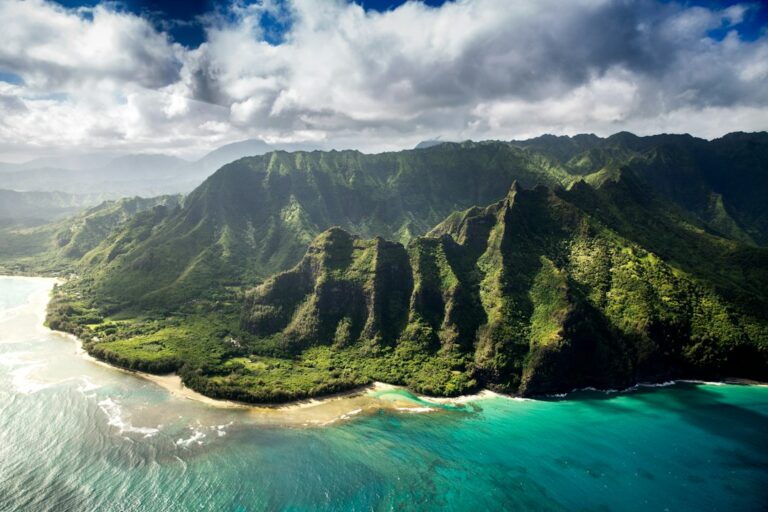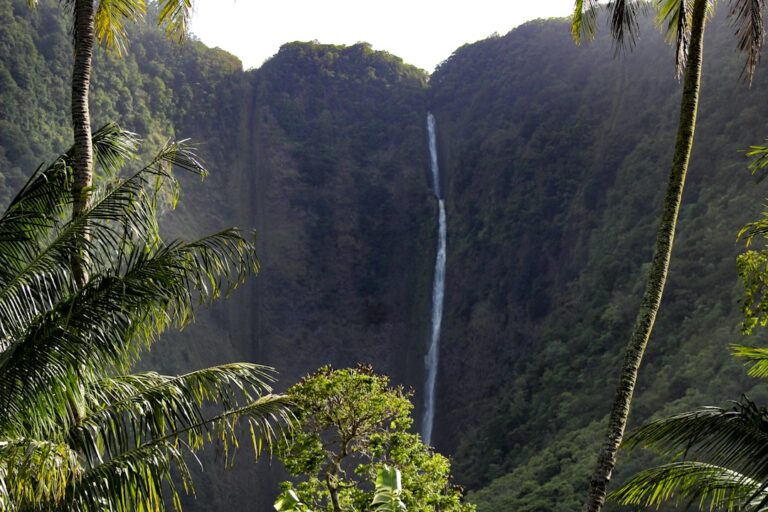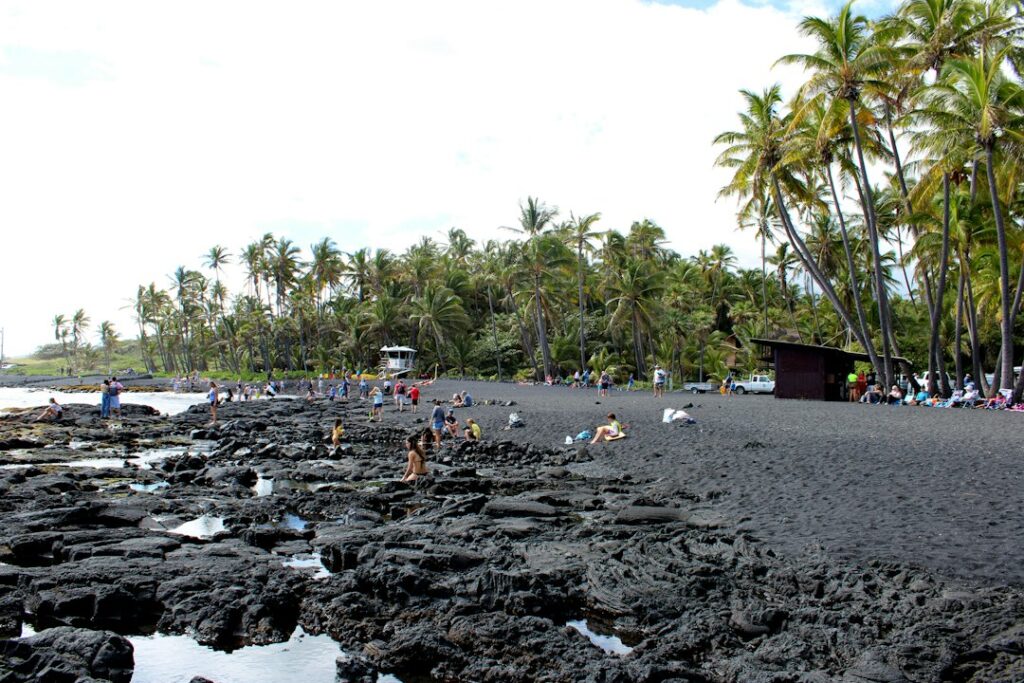
Waianapanapa State Park stretches along Maui’s rugged eastern coast just before Hana town, and it draws steady traffic for its jet-black sand crescent at Pailoa Bay, cold freshwater sea caves, and lava-bench coastal trail. Since March 2021, the Hawaii Department of Land and Natural Resources (DLNR) has required all out-of-state visitors to book a timed entry slot online before pulling into the gate.
The reservation gate has turned what was once a spontaneous roadside stop into a scheduled fixture inside the wider Hana driving day. Vehicles without a confirmed booking are turned away, and the parking lot holds fewer than 100 spaces total. That combination pushes the decision earlier in the itinerary: households need to lock in a Waianapanapa slot before they finalize the rest of their Hana Highway mile-marker sequence.
This piece breaks down how the DLNR portal works, what nonresidents actually pay, how the two daily entry windows shape the visit, and where the park sits inside a broader Hana loop. It also covers the black-sand beach itself, the loop trail past the sea caves, and the mistakes that most often cost visitors their slot at the gate on Waianapanapa Road.
How the DLNR State Parks reservation system works
Waianapanapa reservations are handled through the DLNR Division of State Parks portal at gostateparks.hawaii.gov. The same system also books Diamond Head Crater on Oahu, Haena State Park on Kauai’s north shore, and Iao Valley on Maui. The interface runs in a browser rather than a dedicated app, and login sessions expire quickly, so most bookers complete the transaction in a single sitting.
Every visitor in the vehicle must be counted on the booking, not on arrival. Overcounting is harmless because unused headcount is not refunded, but undercounting forces a second payment at the entrance kiosk if a ranger is on duty and site capacity permits. On busy mornings, adding walk-up passengers is not guaranteed and can eat into the entry window.
The gostateparks.hawaii.gov portal
The portal walks the booker through park selection, calendar date, entry window, vehicle count, and nonresident headcount in that order. The running total updates on screen as fields fill in. A confirmation email arrives within a few minutes and contains the QR code that gate rangers scan on arrival off Waianapanapa Road at roughly mile marker 32 on Hana Highway (Route 360).
Building the reservation record
The system asks for the driver’s name, mainland or state ID, and vehicle license plate. The plate is checked at the gate. Rental swaps happen often on Kahului pickup mornings, so DLNR allows plate edits online right up until the entry window begins. Households picking up a rental at the airport should refresh the record before driving east on the highway.
Fees for out-of-state visitors
Waianapanapa charges two separate nonresident fees stacked on top of each other. The first is a flat $10 parking charge per passenger vehicle. The second is a $5 per-person entry fee for every visitor aged three and older who does not hold a Hawaii state ID. Hawaii residents pay nothing on either line, which mirrors the two-tier pricing at Hanauma Bay on Oahu.
Vehicle versus per-person charges
A family of four in one rental sedan pays $30 total: $10 for the car plus $20 for four visitors. A couple in a compact pays $20. A commercial passenger van sits at a higher tier — $25 for the vehicle plus $5 per rider — which is why guided Hana tour operators build the fee into ticket pricing rather than collecting it at the gate.
| Party | Vehicle fee | Per-person fee | Total |
|---|---|---|---|
| Solo driver, sedan | $10 | $5 | $15 |
| Couple, sedan | $10 | $10 | $20 |
| Family of 4, SUV | $10 | $20 | $30 |
| Family of 6, minivan | $10 | $30 | $40 |
| Passenger van (9 riders) | $25 | $45 | $70 |
| Motorcycle, single rider | $5 | $5 | $10 |
Payment and confirmation
Payment is card-only at booking through the DLNR portal, and a small processing fee (roughly $1) is added to the transaction. Refunds are not issued for weather cancellations, missed windows, or itinerary changes, so budgeting the $20 to $40 as sunk cost is realistic. The QR code in the confirmation email is the only accepted proof; screenshots work if there is no cell signal at the gate.
The two daily entry windows
Waianapanapa offers two arrival windows on the same calendar day. The morning window runs from 7:00 a.m. to 10:00 a.m., and the midday window runs from 10:00 a.m. to 12:30 p.m. Both are entry windows, not stay windows — once inside, visitors can remain until the 6:00 p.m. gate closure so long as they arrived within their booked slot.
Morning slot (7:00 a.m. to 10:00 a.m.)
The 7-10 window is the more competitive of the two and sells out first for most weeks. Bookers targeting quiet beach photos or a swim before trade winds pick up gravitate here. Arriving at 7:15 a.m. typically means walking a nearly empty parking lot, with Pailoa Bay’s black sand still cool underfoot at roughly 72°F air temperature. The trade-off is a very early Paia or Kahului departure.
Midday slot (10:00 a.m. to 12:30 p.m.)
The 10-12:30 window is easier to book but arrives at the busiest stretch of the day. Waianapanapa’s parking lot often peaks between 10:30 a.m. and noon, and both the caves and the trail see the largest tour-van rushes then. Households pairing the stop with a Hana town lunch at Huli Huli or Hana Ranch usually pick this window, exiting before 1:00 p.m. to keep the return drive on schedule.
| Window | Arrival range | Typical fill | Best for | Depart Paia by |
|---|---|---|---|---|
| Morning | 7:00-10:00 a.m. | Sells out first | Empty beach, cool sand, photos | 5:30 a.m. |
| Midday | 10:00 a.m.-12:30 p.m. | Easier to secure | Pairing with Hana town lunch | 8:00 a.m. |
Exit is untimed. A visitor who enters at 7:30 a.m. can stay through mid-afternoon, so morning bookers who want a long visit are not penalized for arriving early in the window. The gate closes to new entries at 12:30 p.m. sharp, and anyone still on the property must be out by 6:00 p.m. when the entry road locks for the night.
The 30-day advance release cadence
DLNR releases new reservation inventory 30 days before each entry date on a rolling daily schedule. A visitor targeting entry on June 15 can book starting May 16 at midnight Hawaii Standard Time (HST). Slots do not release in weekly batches or monthly drops; the calendar simply reveals one new day each night, so the booking window is a moving 30-day horizon.
Timing the booking
Hawaii Standard Time is UTC-10 and does not observe daylight saving. For a household in Pacific Time, midnight HST falls at 2:00 a.m. or 3:00 a.m. depending on the season. Eastern Time bookers see the release at 5:00 a.m. or 6:00 a.m. Most morning slots for the coming Saturday clear the system within the first 24 hours of release during peak Hawaii travel months.
Peak weeks versus shoulder weeks
Weeks around Christmas, spring break, and the July 4 corridor see the tightest inventory. Slots for those dates can fully book within an hour of release. Mid-week entries in early May shoulder season, late September, and the first three weeks of October are the most forgiving; morning slots often remain available a week out. Sundays and Mondays tend to book more slowly than Saturdays.
Cancellations and refills
Cancelled reservations release back into inventory. There is no notification system, so bookers who missed the release refresh the portal periodically in the 48 hours before their target date. Roughly 5-15% of held reservations end up cancelled or unused as trip plans shift, which gives determined bookers a genuine second chance during shoulder-season weeks.
Pailoa Bay and the black-sand beach
Pailoa Bay is the postcard reason most reservations get booked. The crescent runs roughly 350 feet along the head of a small cove, framed by low black lava cliffs on both flanks. The sand is fine, dense volcanic grit that reads deep charcoal in overcast light and near-jet under midday sun. Air temperatures at the beach sit close to 78°F year-round, with water temperatures between 74°F and 80°F.
Swimming conditions
The bay is exposed to open Pacific swell and trade-wind chop. There is no reef to break waves, and shorebreak can slam heavily even on modest surf days. Winter months (November through March) bring the biggest waves; a north-swell forecast above 4 feet at the buoy usually means the beach is safer as a photo stop than a swim. See the broader Hawaii surf season overview before planning water entry.
Sand behavior and etiquette
Black sand heats fast under direct sun and can reach 130°F on lava-rich patches by noon in summer. Sandals matter. Removing sand from the park is prohibited under Hawaii state parks rules — the beach is replenished only by ongoing lava-cliff erosion and cannot regenerate on visitor timescales. Rangers do check bags on exit during heavy traffic days.
Beach access from the parking lot
A short paved path drops from the upper parking area down about 45 vertical feet on a switchback stairway to sand level. The descent takes roughly two minutes and is manageable for most walkers, though the return climb is steeper than it looks. There is no lifeguard on duty, and the nearest emergency response is the Hana fire station about 3 miles east.
The sea caves and coastal trail loop
Waianapanapa’s freshwater caves sit just inland from the beach, reachable by a short paved trail that branches off the main path. The caves are what give the park its name: “Waianapanapa” translates roughly to “glistening water” in Hawaiian, referring to how the pool surface catches light when shrimp move through it.
The freshwater cave pools
The two connected caves hold cold spring-fed pools that stay between 65°F and 68°F year-round, well below the ocean temperature outside. The larger cave has a low overhang that requires ducking; swimming inside is technically allowed but strongly discouraged by DLNR due to leptospirosis risk in standing freshwater. Most visitors observe from the platform rather than entering the water.
The Popoalaea legend
The pools are tied to the Hawaiian legend of Chiefess Popoalaea, who is said to have hidden from her jealous husband Kaakea in the cave before being discovered and killed. Once a year, according to tradition, the pools turn red — an effect botanists attribute to seasonal blooms of tiny red opae’ula shrimp that thrive in the brackish caves and briefly cloud the water.
The King’s Highway coastal trail
The Piilani coastal path (a segment of the ancient King’s Highway) runs south from the beach along the lava sea cliffs. The full one-way stretch to Hana Bay is roughly 3 miles, but most visitors do a 30-45 minute out-and-back to a natural lava sea arch about 0.4 miles down the trail. The path is uneven a’a lava; closed-toe shoes are the practical choice.
Blowholes and lava tubes
Two blowholes fire along the coastal trail during trade-wind swell, most reliably in the afternoon when winds hit 15-20 knots. A collapsed lava tube about 0.2 miles south of the beach is passable at low tide and doubles as a shortcut to a small secondary black-sand pocket. Tide charts on the DLNR site and NOAA Kahului station guide timing.
Fitting Waianapanapa into a Hana driving day
Waianapanapa sits at roughly mile marker 32 on the Hana Highway, about 60 miles from Kahului Airport and 52 miles from Paia town. Google’s stated 2 hours 15 minutes is optimistic for the return leg; most households spend 2.5 to 3 hours each way once roadside stops, one-lane bridges, and lunch traffic are factored in. Fuel planning matters — see the Paia-to-Hana gas station cadence for pump options.
| Starting point | Distance | Drive time | Fuel stops en route |
|---|---|---|---|
| Kahului Airport | 60 miles | 2 h 30 min | Paia (Shell), Hana (Chevron) |
| Paia town | 52 miles | 2 h 15 min | Hana (Chevron) |
| Kihei / Wailea | 72 miles | 2 h 45 min | Paia (Shell), Hana (Chevron) |
| Kaanapali / Lahaina | 85 miles | 3 h 15 min | Paia (Shell), Hana (Chevron) |
| Hana town lodging | 3 miles | 10 min | N/A |
Sample morning-window itinerary
A household booking the 7:00-10:00 window from Paia typically leaves the hotel at 5:30 a.m., grabs coffee at the Paia Bakery at 5:45 a.m., and arrives at Waianapanapa between 7:45 a.m. and 8:15 a.m. That leaves 90 minutes at the park, a Hana Bay lunch stop by 11:00 a.m., and a return through Ohe’o Gulch (Seven Sacred Pools) before starting the loop back at 3:00 p.m.
Sample midday-window itinerary
The 10:00-12:30 window suits a slower start. Leaving Paia at 8:00 a.m. allows roadside stops at Twin Falls, Ke’anae Peninsula, and the Wailua Valley overlook without racing. Arriving at Waianapanapa between 10:30 and 11:30 works, exiting by 12:45 for a late Hana Ranch lunch. The Piilani Highway back road via Kaupo becomes an option for households leaving Hana by 2:30 p.m.
Should the return use the back road
The southern Piilani Highway return via Kaupo shaves the double-drive fatigue but adds roughly 45 minutes and an unpaved stretch that some rental contracts prohibit. It is a one-way loop; there is no backtracking once committed. Cell coverage disappears completely for about 20 miles east of Kaupo Store. Households renting through Turo or paying for a Jeep tend to prefer the loop; standard sedan renters usually double back.
What to pack and on-site logistics
The park has no concessions, no restaurant, and only pit toilets at the parking area. Water fountains are unreliable. Everything a visitor needs for two to four hours on site travels in from the vehicle.
Packing list for a typical stop
- Refillable water — at least 1 liter per person for a two-hour visit
- Sandals plus closed-toe shoes for the coastal lava trail
- Reef-safe sunscreen — Hawaii bans oxybenzone and octinoxate
- Rain shell — east Maui averages 80+ inches of rainfall annually
- Quick-dry towel for beach or cave-pool photos
- Small first-aid kit — lava cuts are the most common injury
- Printed or screenshot confirmation QR code for the gate
On-site facilities
The main lot has pit toilets, roughly 12 shaded picnic tables scattered across the point, and a covered pavilion often reserved for cabin guests. Twelve state-run cabins on the north end of the property book through the same DLNR system, but on a much longer horizon — reserve up to 12 months out for those.
Cell coverage and connectivity
Verizon and AT&T both have marginal LTE coverage at the parking lot; T-Mobile is often no-signal. The QR confirmation can be pre-downloaded and stored in a phone wallet before leaving Paia. Photos and video upload only intermittently, so social posting typically waits until Hana town Wi-Fi or the return to Kahului.
Accessibility, mobility, and family fit
Waianapanapa is not a fully accessible park. The parking lot itself is paved and level, and the pit toilets and picnic area are reachable without stairs. Beyond that, both the beach and the sea caves require descending flights of steps carved into lava, and the coastal trail is uneven a’a lava for most of its length.
Wheelchair users and visitors with limited mobility can still enjoy the point overlook, the picnic pavilion area, and the general coastal views from the upper lot without descending. Companions who wish to visit the beach itself typically split the party — one person stays at the pavilion, others descend.
Kids and stroller access
Strollers do not roll down the beach stairway or the cave path. Baby carriers are the practical option for infants and toddlers under 30 pounds. School-age kids handle the loops well but need clear supervision on the coastal trail; the cliff edges have no railings, and the lava benches drop 15-40 feet straight into the water at several viewpoints.
Senior and slower-paced visitors
Older visitors comfortable with 45 steps of descent and rock scrambling do fine at the beach and the caves. Those who prefer level walking are better served by the upper pavilion viewpoints; the panoramic view over Pailoa Bay from the picnic area is arguably the best photograph in the whole park and requires no elevation change.
Booking calendar patterns through the year
Slot demand at Waianapanapa moves in step with Maui’s overall visitor calendar. Understanding those patterns lets bookers pick weeks where the 30-day scramble is less brutal.
December 20 through January 5 (the Christmas-to-New-Year corridor) is the year’s tightest window. Slots for those dates typically clear within the first hour of release, and cancellations are rare because most bookings tie to non-refundable flights and rental cars. Spring break weeks (mid-March through early April) run a close second.
Summer sees steady demand but slower fills. Weekdays in June, July, and August often have both windows available up to a week out. The Fourth of July week itself is an exception — that seven-day stretch behaves like a mini-holiday spike, and Labor Day weekend behaves similarly.
September, early October, and the first two weeks of November are the shoulder months. Morning slots often stay open two or three days ahead, and midday slots almost always remain available. Households with flexible dates benefit from targeting these weeks explicitly.
Cancellations, weather, and common booking mistakes
Weather cancellations happen most often between November and March, when heavy rain washes out sections of the Hana Highway or turns the coastal trail into slick lava. DLNR does not proactively refund missed slots. Visitors who see a forecast above 2 inches of rain the night before generally either push through with the caves-only visit or write off the fee.
Common booking errors
- Booking the wrong island — Kauai’s Haena uses the same portal
- Choosing “Hawaii resident” without a state ID at the gate
- Undercounting a fifth passenger to save $5
- Booking for the day after the intended visit — check the date twice
- Forgetting to update the plate after a rental swap at Kahului
- Missing the 30-day release by trying to book at 11:59 p.m. Pacific
Rebooking after a missed slot
A missed slot does not automatically release. Bookers who realize they will not make the window can cancel through the confirmation email link, which returns the inventory to the pool for other visitors. There is no financial upside to cancelling — the payment is already sunk — but the goodwill move helps another household who watched the release close.
How Waianapanapa compares to other Hawaii reservation gates
Hawaii has quietly moved much of its high-traffic natural infrastructure onto reservation systems over the last five years. Local news coverage has tracked each rollout, from Diamond Head to Haena. Comparing them side by side clarifies which cadences apply where and helps visitors budget both time and fees.
Hanauma Bay on Oahu uses a much tighter 48-hour release, charges $25 per nonresident aged 13+, and closes on Mondays and Tuesdays entirely. Haena State Park on Kauai (Kalalau trailhead) opens reservations 30 days out at a similar cadence to Waianapanapa but caps parking at just 100 spaces. See the Kalalau Trail overnight camping cadence for its longer permit horizon.
Diamond Head runs a 30-day advance system nearly identical to Waianapanapa’s, priced at $5 per nonresident with a $10 vehicle charge. For visitors comparing several parks across an island-hopping trip, understanding interisland flight baggage fees helps sort which parks are worth flying between and which fit into a single-island week.
Broader context on Hawaii’s park reservation shift
Hawaii’s move toward timed reservations reflects two pressures: post-2020 visitor volume that overwhelmed narrow rural roads, and a state fiscal system that increasingly funds park maintenance from user fees. Civil Beat reporting has traced the fiscal logic behind that transition and the resistance from tour operators who saw booking friction as a market barrier.
For households considering a permanent move to Hawaii, the reservation systems apply only to nonresidents. Getting a Hawaii state ID — the same process covered under Hawaii vehicle registration for new residents — flips access at Waianapanapa, Diamond Head, and Haena from paid gates to free ones. That savings can approach $1,500 annually for an outdoor-active family with Hawaii resident status.
Frequently asked questions
Can Hawaii residents skip the reservation at Waianapanapa?
Residents can enter without paying the vehicle or per-person fees, but they still need a reservation for a specific entry window on peak days. Rangers verify residency with a Hawaii driver’s license or state ID at the gate. On slow weekdays, walk-in residents are sometimes allowed if capacity permits, but this is discretionary and should not be counted on.
What happens if a booked visitor arrives outside the entry window?
Arrivals before the window are held at the gate until the window opens — there is no early entry. Arrivals after the window has ended (10:00 a.m. for morning bookings, 12:30 p.m. for midday) are turned away, and no refund is issued. The DLNR system does not offer a grace period, so building 15 minutes of buffer into the drive from Paia is the safest approach.
Are refunds available if the visit is cancelled due to weather?
No. DLNR treats the fee as nonrefundable regardless of weather, road closures, or personal changes. Cancelling through the confirmation email link releases the slot back to the pool but does not return the payment. Households booking during Hawaii’s wetter months (November through March) should treat the $20-$40 as a sunk cost baked into the Hana day budget.
How many people can be added to a single reservation?
The system caps a single reservation at one passenger vehicle plus up to nine occupants. Larger groups need to book multiple vehicle slots or coordinate through a commercial tour operator that carries a Hawaii state parks concession permit. Two families splitting into two rental cars each need two separate reservations — one booking cannot cover two vehicles.
Do children need their own paid entry?
Children age three and older count as full nonresident visitors at $5 each. Children under three are free but should still be entered on the booking so the vehicle-occupancy count matches at the gate. There is no reduced rate for older minors, seniors, or students under the current DLNR fee structure at Waianapanapa.
Can the reservation be transferred to another visitor?
Reservations are tied to the named driver and vehicle plate, but DLNR allows edits to both fields through the confirmation email link up until the entry window begins. That flexibility covers rental swaps, an unexpected driver change, or a friend taking over the booking. Full name-and-plate rewrites work; a full transfer to a stranger’s separate account does not.
Is camping still allowed at Waianapanapa?
Yes, but on a separate permit track. The park has twelve state-run cabins along the north cliff and a small tent-camping area. Cabin bookings open 12 months in advance through the same gostateparks.hawaii.gov portal and typically fill within days for weekend nights. Tent permits are cheaper but require a separate camping application. Both routes include daytime park access without the vehicle fee.
Does the reservation work for sunrise photography?
The 7:00 a.m. morning window opens after sunrise for most of the year (sunrise on Maui averages 5:45 a.m. to 7:00 a.m. depending on season), so pure sunrise shots from Pailoa Bay are usually not possible under the current gate schedule. Visitors targeting dramatic morning light should book the 7:00 a.m. slot and arrive at 7:15 for post-sunrise golden-hour conditions instead.