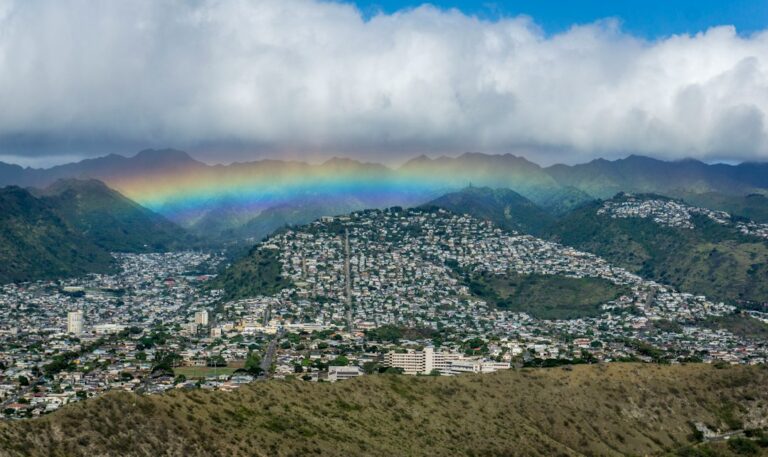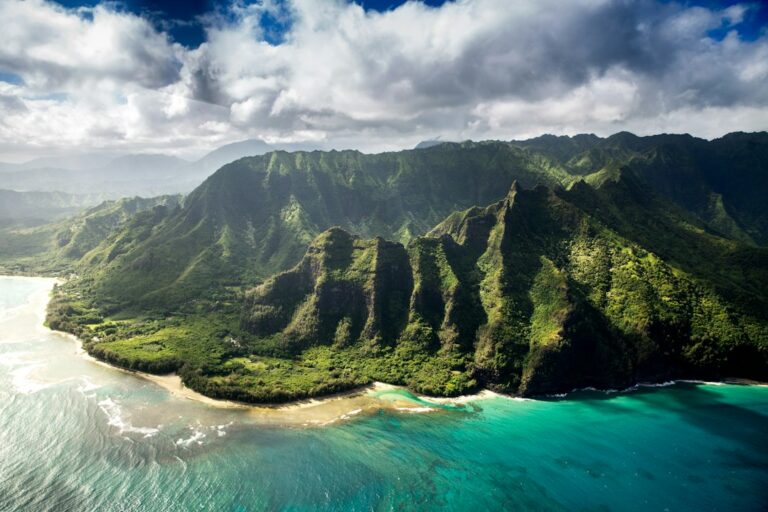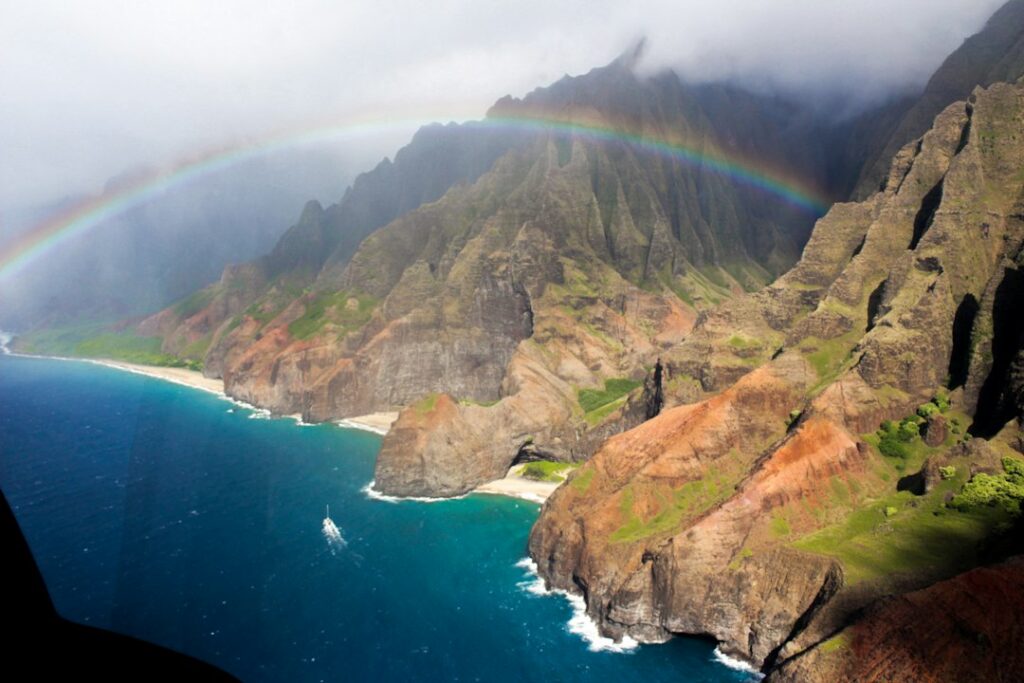
Kauai earns its “Garden Isle” nickname the honest way: through rain. The island’s interior mountain, Waialeale, records an average of roughly 450 inches of rainfall per year, one of the wettest measured spots on Earth. Even the drier southern and western coasts see enough passing showers between November and March that any weeklong visit will likely include at least one washed-out beach day.
The good news for relocating households and visitors alike: Kauai has built a small but well-distributed set of indoor and covered attractions that hold up in a downpour. Museums, garden visitor centers, coffee tasting rooms, a historic plantation estate, a Hindu monastery, mini-golf under partial cover, and cafes with reliable WiFi can carry a full day without repeating a stop.
This guide catalogs every worthwhile rainy day activity Kauai offers, with hours, prices, driving times between them, and honest notes about which options actually stay dry versus those that only shelter part of the experience. The order below follows a rough east-to-west sweep so day-of decisions can lean on geography.
How wet does Kauai actually get?
Kauai’s rainfall varies dramatically by microclimate. The interior around Mount Waialeale collects 400-plus inches annually. Princeville and the North Shore average 70 to 85 inches per year. Lihue on the east coast sees roughly 40 inches. Poipu on the south shore averages closer to 25 inches, and the west side around Waimea can drop below 20 inches — desert-adjacent by island standards.
The wet season runs November through March. During those months, even the drier coasts can see two- to five-day stretches of gray skies and intermittent showers. Summer showers tend to be brief and localized, passing within an hour. Winter systems settle in longer and can trigger flash flood warnings on the North Shore rivers within a few hours of heavy upcountry rain.
Wind matters as much as rainfall. Trade winds from the northeast push moisture over the mountains, dumping it on the windward coasts before the drier air descends to the south and west. On a rainy morning in Kapaa, driving 40 minutes west to Waimea or Kekaha can often reach dry pavement and blue sky.
The National Weather Service issues detailed forecasts for each island microclimate; combined with a look at the Star-Advertiser weather page, most visitors can plan a wet day in advance. Historical rainfall data is also tracked by state agencies including the Hawaii Department of Health, which monitors runoff-related water quality after heavy rains.
Kauai Museum in Lihue
The Kauai Museum sits at 4428 Rice Street in downtown Lihue, a five-minute drive from the airport. Two connected buildings — the 1924 Wilcox Building and the 1960 Rice Building — house permanent exhibits on Kauai and Niihau geology, Native Hawaiian material culture, plantation-era immigration, and the island’s monarchy-period history. Admission runs $15 for adults, $12 for seniors, and $10 for students ages 6 to 17.
Hours are typically Monday through Saturday, 10 a.m. to 4 p.m., closed Sunday. A thorough visit takes 90 minutes to two hours. The museum shop stocks locally made Niihau shell jewelry, books on Hawaiian history that are hard to find on the mainland, and works by Kauai printmakers and painters.
What sets it apart
Two features make the Kauai Museum particularly worthwhile on a wet day. First, the Niihau shell lei collection is one of the most complete public displays anywhere; some pieces represent hundreds of hours of stringing work using shells found only on Niihau’s beaches. Second, plantation-era immigration exhibits give real weight to why Kauai’s population mixes Japanese, Filipino, Portuguese, Chinese, and Puerto Rican heritage today.
For newcomers researching the island, the museum functions as a compressed history course. Understanding the sugar and pineapple era matters for reading the modern landscape — abandoned mill towns, plantation-era housing stock still in use, and place names that reference vanished operations. Anyone considering a long-term move should treat this as a required first stop, rainy day or not.
National Tropical Botanical Garden guided tours
The National Tropical Botanical Garden operates three separate garden properties on Kauai: McBryde Garden and Allerton Garden (both accessed from a shared visitor center on Lawai Road in Poipu) and Limahuli Garden and Preserve on the North Shore near Haena. All three run guided tours; McBryde and Allerton include shuttle transport from the visitor center down into the valley, which cuts most of the exposed walking.
Allerton Garden’s 2.5-hour guided tour runs approximately $75 for adults. McBryde Garden’s self-guided option runs about $40 with tram transport included. Limahuli’s shorter self-guided tour on the North Shore runs around $30. Prices shift annually; the NTBG website carries current numbers. Reservations are required for Allerton and strongly recommended for the others, particularly November through March.
Why “partly covered” matters
These gardens are not indoor attractions. The tram rides cover open ground between shelters, and portions of each tour cross exposed valley floor. However, the visitor centers, restrooms, gift shops, and interpretive shelters provide meaningful respite, and the tram itself has a roof. On a light-rain day, ponchos handle the exposed sections comfortably. Full tropical downpours will still soak shoes.
Kauai’s rain also transforms the gardens. Waterfalls that trickle in summer roar in winter. The Moreton Bay figs at Allerton — famous from the Jurassic Park egg-hatching scene — feel more primeval in mist than in bright sun. Serious tropical horticulture enthusiasts often prefer wet-season visits precisely because the plants look their most alive.
Kilohana Plantation and its distillery
Kilohana Estate on Highway 50 in Lihue was built in 1935 as the home of sugar planter Gaylord Wilcox. Today the restored mansion houses boutique shops in most of its original rooms, a courtyard restaurant called Gaylord’s, and a rum distillery (Koloa Rum Company) with a tasting room in a separate building. Entry to the grounds and mansion is free.
The Koloa Rum tasting samples five rums for around $10 and takes 30 to 40 minutes under full cover. The mansion shops run 9:30 a.m. to 9:30 p.m. daily; the restaurant and distillery keep separate hours. On a full rainy day, Kilohana pairs well with a Kauai Museum morning: both sit in Lihue, five minutes apart by car.
The plantation railway question
Kilohana operated a two-mile narrow-gauge sugar cane train tour for many years; service has been paused or intermittent depending on the operator and rolling stock condition. Anyone specifically hoping to ride should confirm current status by phone before driving out. When the train operates, it includes an animal-feeding stop at a small onsite farm and takes roughly an hour round-trip.
Kauai Coffee Company tasting room
Kauai Coffee’s visitor center in Kalaheo sits on Halewili Road amid roughly 3,100 acres of coffee trees — the largest coffee farm in the United States. The tasting room offers free samples of every roast the company produces (typically 10 or more), plus a small self-guided walking tour of a demonstration orchard. The visitor center is fully covered and stays open 9 a.m. to 5 p.m. daily.
A guided walking tour of the roasting operation runs approximately $30 and lasts 90 minutes. Most of the guided tour crosses open ground, so a light-rain day suits it. The tasting alone can absorb 30 to 45 minutes and shelters visitors completely. Beans sell at competitive prices compared to mainland gourmet shops, and shipping to the mainland is offered at the counter.
Coffee-focused visitors who want a broader comparison should look at the belt road on the Big Island; the Kona coffee farm tour circuit from Captain Cook to Holualoa covers a very different production style at much smaller family farms. Kauai Coffee is industrial-scale; Kona operations are boutique. Both are worth understanding for anyone weighing agricultural work or living near coffee land.
Kauai’s Hindu Monastery
Kauai’s Hindu Monastery on Kaholalele Road above Kapaa is an active Saiva Siddhanta monastery of about 20 resident monks. The grounds include the Kadavul Hindu Temple, which houses one of the largest single-pointed quartz crystals ever found (roughly 700 pounds, discovered in Arkansas in the 1980s), and the under-construction Iraivan Temple, built entirely of hand-carved white granite shipped from Bangalore, India.
Public visitor hours are limited: typically 9 a.m. to noon daily for the Kadavul Temple, with a fuller weekly tour on select mornings. Entry is free; donations support ongoing construction. The temple interiors provide full cover, and covered walkways connect several buildings. Dress code is modest — no shorts, no bare shoulders. Sarongs are lent at the entrance to anyone who arrives unprepared.
Practical realities of visiting
This is a working monastery, not a tourist attraction. Silence in the temples is expected. Photography inside the Kadavul Temple is discouraged; outside is fine. The road up is narrow and can be slick during heavy rain. Allow 90 minutes for an unhurried visit including the outdoor gardens, which contain several thousand ornamental plants and a Rudraksha tree grove.
Anaina Hou Community Park and mini-golf
Anaina Hou sits on Kuhio Highway in Kilauea on the North Shore, roughly 30 minutes north of Kapaa. The property includes an 18-hole botanical mini-golf course themed around Hawaiian and plantation-era history, a bike-path trailhead, a small farmers market on Saturday mornings, a cafe, and a playground. The mini-golf course is partly covered — several holes sit under canopy structures, though most sit in the open.
Green fees run approximately $18 for adults and $12 for children. A round takes 60 to 90 minutes depending on the group. The onsite Namahana Cafe serves espresso, sandwiches, and shave ice under full cover; free WiFi is generally available. The park is a genuine North Shore rainy-day anchor, particularly for families with children who need to burn energy without swimming.
For anyone weighing North Shore basing during winter, comparing Kilauea with the pattern described in the Hanalei township winter overnight analysis helps clarify how far north to push. Kilauea sits at the drier end of the North Shore spectrum; Hanalei and Haena get substantially more rain during the November-through-March window.
Cafes with WiFi across Kauai
Reliable indoor cafe seating with functional WiFi is a genuine need for relocating households handling remote work, and for travelers waiting out a squall. The list below covers venues that consistently deliver on both. Cellular coverage on Kauai is patchy inland; a cafe with wired fiber or dependable T-Mobile home internet is often the better choice for a video meeting than a rented condo with variable Spectrum service.
Kapaa and Wailua corridor
- Java Kai (Kapaa Old Town): outdoor covered lanai plus indoor seats, strong WiFi, 6 a.m. open.
- Small Town Coffee (Kapaa): fully indoor, quieter, good for calls, 6 a.m. open.
- Kickshaws (Wailua): full breakfast menu, table space for laptops, midday closing common.
- Anake’s Juice Bar (Kapaa): smoothies plus solid espresso, benches and small tables inside.
Hanapepe and west side
- Little Fish Coffee (Hanapepe): full indoor seating, WiFi, and pastries; anchors the historic downtown.
- Wong’s Restaurant (Hanapepe): older Chinese-Hawaiian diner with indoor booths; power reliable, WiFi limited.
- Kauai Coffee visitor center (Kalaheo): tasting bar plus a small seating area under full cover.
- The Right Slice (Kalaheo): pie shop with a handful of tables and reliable WiFi.
South shore
- Little Fish Poipu: sibling location with expanded lunch menu, indoor seating, reliable WiFi.
- Kalaheo Cafe and Coffee Company: full breakfast and lunch, indoor tables, strong WiFi.
- Sueoka Snack Shop (Koloa): takeaway plate lunch; not for laptops but great rainy lunch.
For visitors basing on the west side, the Hanapepe Friday art night cluster is worth planning around; the same cafes stay open late, several galleries stay open until 9 p.m., and the town’s historic swinging bridge is worth crossing even in light rain.
Rental vehicle choice for wet weather
Kauai’s roads are almost entirely two-lane. The single perimeter highway (Kuhio Highway on the east and north; Kaumualii Highway on the south and west) does not connect around the Na Pali coast; drivers must double back. In heavy rain, both highways can flood at low-lying stream crossings, particularly on the North Shore between Hanalei and Haena. A vehicle with reasonable ground clearance and functional windshield wipers is a real consideration.
Standard economy sedans (Nissan Versa, Toyota Corolla) handle most wet-season conditions on the paved perimeter road. Compact SUVs (RAV4, CR-V) offer better visibility and ground clearance for driving up Kokee Road to the west side or the road up to the Hindu Monastery. Full 4WD is only necessary for unpaved back roads that most rental agreements prohibit anyway.
Vehicle rental price comparison
| Vehicle class | Winter daily rate | Summer daily rate | Best rainy-day use |
|---|---|---|---|
| Economy sedan | $65-$85 | $45-$60 | Perimeter cafes and Lihue museum days |
| Compact SUV | $95-$130 | $70-$95 | Kokee road, Hindu Monastery, wet backroads |
| Mid-size SUV | $120-$160 | $90-$120 | Families, luggage, North Shore flood runs |
| Jeep Wrangler soft-top | $140-$190 | $110-$150 | Avoid in wet season — leaks common |
Fuel prices on Kauai run consistently above the national average — often 60 cents to $1.20 per gallon more, per the EIA weekly fuel report. Filling a compact SUV runs $55 to $75. A full circuit of the perimeter highway (Lihue to Kee Beach and back, or Lihue to Polihale and back) consumes half a tank in a compact SUV.
Building a rainy-day itinerary by base
Poipu / south shore base
- Morning: Kauai Coffee tasting room in Kalaheo (opens 9 a.m.).
- Late morning: Allerton Garden guided tour or McBryde tram loop.
- Lunch: Kalaheo Cafe or Little Fish Poipu.
- Afternoon: Koloa Rum tasting at Kilohana; browse mansion shops.
- Evening: Gaylord’s at Kilohana for dinner under courtyard cover.
Kapaa / east side base
- Morning: Kauai Museum in Lihue (opens 10 a.m.).
- Late morning: Coffee and pastry at Small Town Coffee back in Kapaa.
- Midday: Kauai Hindu Monastery visit (before noon closing).
- Afternoon: Anaina Hou mini-golf in Kilauea, cafe stop after.
- Evening: Return to Kapaa for indoor dining on the strip.
Princeville / North Shore base
- Morning: Anaina Hou mini-golf in Kilauea (partially covered).
- Late morning: Namahana Cafe or Kilauea Bakery for lunch.
- Afternoon: Drive south to the Kauai Museum in Lihue.
- Return leg: Kilohana Estate shopping and rum tasting.
- Evening: Dinner in Hanalei; check road status before returning.
What to skip on a rainy day
Several popular Kauai activities do not translate to wet weather. Waimea Canyon and Kokee State Park lookouts can be socked in with cloud, offering zero views for a 90-minute drive each way. The Napali Coast boat tours cancel for high surf and rough seas that often accompany winter storm systems. Helicopter tours cancel for low ceilings. Hiking trails on Sleeping Giant, the Powerline Trail, or the Napali Coast turn dangerously slick.
Beach days are the obvious cancellation. Beyond the discomfort, rain-driven runoff from rivers dumps sediment and bacteria into nearshore waters; the Hawaii Department of Health routinely issues brown-water advisories after heavy rain, warning against swimming. Even if the sky clears mid-afternoon, water quality can stay compromised for 24 to 72 hours after a significant storm.
For the swim-focused visitor stuck on the west side during clear-sky windows, Salt Pond Beach in Hanapepe holds up better than most beaches after a rain event because its protected inner pond does not sit at a river mouth. It’s a useful fallback when the North Shore is flood-advised.
Zipline tours are a mixed case. Most operators run in light-to-moderate rain because the courses use covered platforms and the cables themselves are unaffected. Anyone weighing wet-day operators should reference the Kauai zipline operator comparison for weight limits, course length, and each company’s stated rain policy before booking.
What to pack for a Kauai rainy day
Kauai rain is warm rain. Temperatures rarely drop below the mid-60s even during the wettest February systems, and afternoons often hit the low 80s despite gray skies. Lightweight rain gear beats heavy waterproofs; the humidity makes sealed jackets uncomfortable. Waterproof sandals or quick-dry shoes outperform hiking boots, which stay wet for days once soaked.
A packing list built specifically around the rainy November-through-March window is covered in detail in the Kauai winter packing checklist. Key items missing from most standard tropical packing lists: a lightweight packable rain shell, a dry bag for phones and wallets, and a small microfiber towel that lives in the day pack.
Anyone extending into hurricane-season planning (typically June through November) should also review the tropical storm emergency supply kit. Kauai has been hit hard by hurricanes twice in living memory (Iwa in 1982, Iniki in 1992); the west and south sides tend to catch the worst of storm systems that curve up from the equator.
Kauai indoor attractions at a glance
| Attraction | Location | Adult cost | Fully covered? | Time needed |
|---|---|---|---|---|
| Kauai Museum | Lihue | $15 | Yes | 90-120 min |
| Kilohana Estate mansion | Lihue | Free | Yes | 60-90 min |
| Koloa Rum tasting | Kilohana | $10 | Yes | 30-40 min |
| Kauai Coffee tasting | Kalaheo | Free | Yes | 30-60 min |
| Hindu Monastery temple | Kapaa | Free | Yes | 60-90 min |
| Anaina Hou mini-golf | Kilauea | $18 | Partly | 60-90 min |
| Allerton Garden tour | Poipu | $75 | Partly | 2.5 hours |
| McBryde Garden tram | Poipu | $40 | Partly | 2 hours |
| Limahuli Garden | Haena | $30 | Partly | 90 min |
Drive times between the anchor rainy-day stops
| From | To | Miles | Typical drive |
|---|---|---|---|
| Lihue Airport | Kauai Museum | 2 | 7 minutes |
| Kauai Museum | Kilohana Estate | 2 | 7 minutes |
| Kilohana Estate | Kauai Coffee (Kalaheo) | 11 | 18 minutes |
| Kauai Coffee | Allerton visitor center | 8 | 15 minutes |
| Lihue | Hindu Monastery | 8 | 18 minutes |
| Lihue | Anaina Hou (Kilauea) | 26 | 45 minutes |
| Anaina Hou | Hanalei | 10 | 20 minutes |
| Lihue | Hanapepe | 17 | 25 minutes |
| Hanapepe | Waimea Canyon lookout | 16 | 35 minutes |
How Kauai’s rainy-day options compare to Oahu’s
Kauai has fewer big-ticket indoor attractions than Oahu simply because its permanent population is smaller (roughly 73,000 versus Oahu’s 1,000,000, per the Census QuickFacts). Oahu supports the Bishop Museum, the Honolulu Museum of Art, Iolani Palace, and full military historic sites at Pearl Harbor. Kauai’s museum footprint is a fraction of that.
What Kauai offers that Oahu cannot: small-scale, uncrowded venues where a visitor can spend an hour with a docent one-on-one. The Hindu Monastery, Kilohana Estate, and Kauai Coffee visitor center all operate at the volume of a rural attraction rather than an urban museum. Anyone comparing options for a long-term move should read the parallel Oahu rainy-day activities guide alongside this one.
For visitors traveling with military-history interests, Oahu is essentially unmatched; the Pearl Harbor Missouri, Bowfin, and Aviation Museum bundle covers a full day of indoor, covered attractions that Kauai cannot rival. A rain-heavy Kauai trip that overlaps with weekend flights to Honolulu can bolt on a day trip; interisland fares run $80 to $150 round trip and flights run 30 to 40 minutes.
Relocation considerations for rainy-side living
Households researching a move to Kauai should treat rainfall as a first-order decision variable. The North Shore’s beauty comes with 70-plus inches per year and multi-day gray-sky stretches that can grind on people accustomed to dry mainland climates. The south and west sides are much drier but have fewer cultural amenities and longer drives to the airport, hospital, and Costco (all in Lihue).
For prospective residents comparing microclimates, the Kalaheo relocation profile and the Hanapepe relocation profile together cover the drier south-and-west quadrant in detail, including flood-zone maps and typical rainfall per district. Both towns sit close to the majority of the covered rainy-day attractions listed above.
Property insurance in Hawaii can also be affected by proximity to flood zones and by hurricane exposure; state tax code and business regulations are collected at tax.hawaii.gov, and highway conditions after major weather events are posted through HDOT. Both sites are worth bookmarking before signing a lease.
Frequently asked questions
What is the rainiest month on Kauai?
December and January typically deliver the most rainfall island-wide, though microclimate variation is significant. The North Shore town of Hanalei can see 12 to 15 inches in either month, while Poipu on the south shore may only receive 3 to 4 inches. Historical averages from the National Weather Service Honolulu forecast office remain the reliable reference point for planning any winter trip.
Is the Kauai Hindu Monastery really free to visit?
Yes. The Kadavul Temple is open to the public without charge from 9 a.m. to noon most days. Donations toward the ongoing Iraivan Temple construction are welcomed but never required. Visitors should dress modestly (no shorts, no bare shoulders); complimentary sarongs are provided at the entrance for anyone who arrives unprepared for the dress code.
Can rental cars handle Kauai roads during heavy rain?
Standard rentals handle the perimeter highway well in typical rain. Trouble arises at low-water bridges on the North Shore, which flood quickly during heavy upcountry rain and close highway traffic between Hanalei and Haena. Compact SUVs with better ground clearance and windshield visibility are the practical choice for winter visits. Full 4WD is unnecessary for paved perimeter driving.
Does Kauai Coffee ship beans to the mainland?
Yes. The tasting room counter processes mainland shipping orders using standard postal and courier rates. Whole beans keep freshness longer than ground; store in an airtight container away from light. Sample all 10-plus roasts on-site before choosing; medium roasts of the estate blend and single-origin peaberry tend to be the tasting room’s most popular takeaway purchases.
How busy are Kauai’s indoor attractions during rain?
Rainy days concentrate visitors at the Kauai Museum and Kilohana; both can feel crowded between 11 a.m. and 2 p.m. Arriving right at opening (10 a.m. and 9:30 a.m. respectively) is the reliable strategy. Kauai Coffee and the Hindu Monastery rarely feel packed even in rain; both draw more spread-out visitor flow throughout their open hours.
Are cafes on Kauai reliable for a video meeting?
Some are, most are not. Small Town Coffee in Kapaa, Little Fish Coffee in Hanapepe, and Kalaheo Cafe consistently deliver usable upload speeds. Java Kai and Little Fish Poipu can be crowded and noisy during the morning rush. A hotspot on a T-Mobile or Verizon line as a backup is the practical safety net for remote work meetings.
Are any of the botanical garden tours fully indoors?
No. National Tropical Botanical Garden operates outdoor gardens with covered visitor centers, tram rides, and interpretive shelters but no fully indoor tour. Allerton and McBryde tours include tram transport that limits walking to under a mile. On heavy-rain days, most guests find the experience still worthwhile but should bring rain gear; refunds for weather are not offered mid-tour.