Uncle Robert’s Awa Bar in Kalapana sits at the literal end of the road — where Highway 130 dead-ends into what was once the Kalapana coastline before the 1990 Kilauea flows rewrote the shoreline. Every Wednesday evening from 5 to 9 p.m., the property transforms into a vendor cluster of roughly 40 to 60 stalls covering food, awa (kava), crafts, and live Hawaiian music.
The market is one of the last regularly scheduled community gatherings on the Puna coast, and it draws a mix that reads like a census of lower Puna itself: farmstead residents, off-grid homesteaders, weekend visitors from Hilo, and travelers routing back from Hawaii Volcanoes National Park. Cash is the default currency at most stalls, and the drive back through unlit stretches of Highway 130 rewards drivers who plan for darkness before they arrive.
This research piece walks through what relocating households and short-stay visitors should expect at the Wednesday night market: the vendor mix, the price ranges, the cash-load math, the two most common drive corridors from Pahoa and Volcano Village, parking realities, and the safety pattern on the unlit return leg after 9 p.m.
What the Wednesday night market actually is
Uncle Robert’s Awa Bar, operated by the Keliihoomalu family, occupies a property in the Kalapana Gardens subdivision at the terminus of Highway 130. The Wednesday night market — sometimes called Uncle Robert’s Night Market or the Kalapana Wednesday Market — has run consistently for more than a decade, weathering both the 2018 lower Puna eruption and pandemic-era closures.
The market operates 5 to 9 p.m. every Wednesday, weather permitting. Vendors set up starting around 3 p.m., and by 5 p.m. the food line-up is running. Live music typically starts around 6 p.m. on a covered stage adjacent to the awa bar, running until roughly 8:30 p.m.
The property itself is open-air. Vendor stalls line a gravel-and-lava-cinder pad under strings of festival lighting. The awa bar operates from a covered wooden structure at the back of the lot, and a small hale hosts the live music stage. Restrooms are portable units placed near the entrance.
Vendor cluster mix: food, awa, crafts, music
The stall count varies week to week — anywhere from 35 stalls on a slow rainy Wednesday to 70 stalls during peak visitor months like December through March and June through August. The mix breaks down into four rough categories: prepared food, awa and beverages, crafts and body products, and live entertainment.
Prepared food
Food dominates the vendor count, with 15 to 25 stalls in a typical week. Common offerings include kalua pig plates, huli-huli chicken, Filipino lumpia, Thai curries, Puerto Rican pasteles, wood-fired pizza, tacos, poke bowls, shave ice, and vegan bowls built on locally grown produce. Prices generally run $8 to $18 per plate, with drinks $3 to $6.
Portion sizes lean generous — a $14 huli-huli plate often includes two scoops of rice and a mac salad substantial enough to constitute a full dinner. Vegan and vegetarian options are unusually well-represented for a rural Big Island market, reflecting the plant-based population that has settled in lower Puna since the 1970s back-to-the-land migration.
Awa and beverages
The awa bar itself is the anchor. Awa (also spelled kava) is a traditional Polynesian beverage prepared from the ground root of the Piper methysticum plant. It produces a mild sedative and social-relaxant effect — legal, non-alcoholic, and central to Pacific cultural traditions. Uncle Robert’s serves single shells for roughly $5 to $8, with tasting flights and stronger preparations available for $10 to $20.
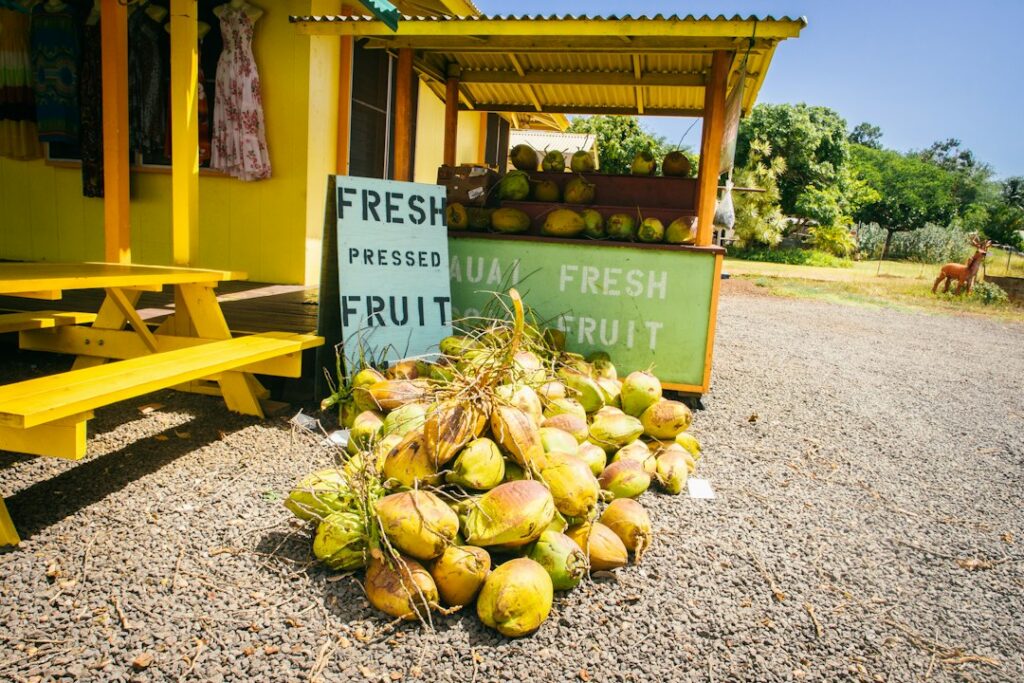
Non-awa beverages include kombucha, fresh coconut water hacked open on request, lilikoi lemonade, cold brew coffee from Kau and Puna growers, and cacao drinks. The market does not serve alcohol. Visitors planning to try awa should note that operating a vehicle afterward requires the same caution as any sedative — the drive back through unlit Highway 130 is not the place to test tolerance.
Crafts and body products
Craft stalls run 8 to 15 in number and lean toward locally made goods: handmade soaps and salves, tie-dyed clothing, jewelry using Puna-sourced volcanic glass and shells, wooden bowls, screen-printed T-shirts, small paintings, and healing arts services like on-site massage or reflexology. Prices span $5 for a bar of soap to $150 for larger craft pieces.
Live music
Music is programmed by the Keliihoomalu family and rotates among Hawaiian slack-key guitarists, reggae bands, ukulele players, and occasional visiting mainland acts. The stage runs a single set from about 6 p.m. to 8:30 p.m., with sound levels calibrated for a family audience — loud enough to draw a crowd, low enough to hold conversation at nearby food tables. For a broader survey of live music on the islands, see the roundup at Hawaii Music Festivals.
The cash-only reality and stall-by-stall payment mix
Most Puna vendors run cash-first operations. Card readers rely on cellular data, and Kalapana sits at the edge of coverage from every major carrier — Verizon and AT&T typically show one to two bars at the market, and speeds slow enough that a Square or Stripe transaction may time out on the first swipe.
Estimates from vendor surveys suggest 60 to 75 percent of stalls accept cash only, another 15 to 25 percent accept cash plus Venmo or Zelle (which require the buyer to have working cellular data), and only a small minority — usually 5 to 10 percent — accept credit or debit cards. The awa bar itself accepts cash and sometimes card, depending on connectivity that night.
How much cash to bring
A useful rule of thumb: budget roughly $25 to $45 per adult for a full-market visit including one meal, one drink, and small vendor tips. Families of four should plan on $80 to $160 in small bills — twenties, tens, fives, and a stack of ones. Vendors rarely have change for a $100 bill, and asking for change on a $50 during peak hour delays the line behind you.
| Party size | Food budget | Awa/drinks | Crafts/tips | Suggested cash |
|---|---|---|---|---|
| 1 adult | $15 | $8 | $10 | $35 |
| 2 adults | $32 | $16 | $15 | $65 |
| Family of 4 (2 kids) | $55 | $16 | $20 | $95 |
| Group of 6 adults | $96 | $48 | $30 | $175 |
| Craft-heavy shopper | $18 | $8 | $100 | $130 |
Where to get cash before arriving
Pahoa town has the last reliable ATMs before Kalapana. First Hawaiian Bank on Pahoa Village Road, Bank of Hawaii on Highway 130 near the Longs Drugs, and the ATM inside Malama Market (open until 9 p.m.) all dispense in $20 increments. From Volcano Village, the closest ATM is at the general store on Old Volcano Road, but its cash reserves are limited and it may be empty by Wednesday evening.
Driving directions from Pahoa (roughly 15 minutes)
Pahoa is the natural staging point for the Wednesday market. The drive covers roughly 12 miles down Highway 130 (Keaau-Pahoa Road, which becomes Kalapana Highway past mile marker 15) and takes about 15 to 20 minutes at posted speeds of 45 to 55 mph.
From central Pahoa, drivers head south on Highway 130 past the 2018 lava flow crossing at Leilani Estates, continue past the intersection with Pohoiki Road (which leads to Isaac Hale Beach Park), and follow the highway as it descends toward the coast. Highway 130 dead-ends at Uncle Robert’s parking area — there is no wrong turn to make on the final approach.
Households considering a base camp in Pahoa for a Wednesday market visit can compare nightly rates and availability at the Puna Pahoa farmstay cluster, which typically undercuts Volcano Village lodging by 20 to 40 percent on weeknights. For deeper context on the district’s post-eruption housing landscape, the Pahoa and Lower Puna relocation breakdown covers off-grid lot pricing and road conditions.
| Segment | Distance | Time | Notes |
|---|---|---|---|
| Pahoa center to Leilani Estates entry | 2.4 miles | 4 min | Posted 45 mph, straight road |
| Leilani to Pohoiki Road junction | 3.8 miles | 5 min | Watch for pedestrians near Kaimu |
| Pohoiki junction to lava crossing | 2.9 miles | 4 min | 2018 flow crossing paved 2019 |
| Lava crossing to Uncle Robert’s | 2.7 miles | 4 min | Downhill to sea, gravel lot on left |
| Total Pahoa to Kalapana | 11.8 miles | 17 min | Add 5-10 min for market traffic |
Driving directions from HVNP village (roughly 45 minutes)
From Volcano Village near the Hawaii Volcanoes National Park entrance, the drive to Uncle Robert’s covers about 33 miles and runs 45 to 55 minutes, depending on traffic through Keaau and daylight conditions. There is no through-park route to Kalapana — the old Chain of Craters road that once connected Kilauea to Kalapana was severed by lava flows in 1986 and 1990 and has never been reopened as a through road.
The practical route runs east on Highway 11 from Volcano Village to Keaau (about 22 miles, 30 minutes), then south on Highway 130 through Pahoa to Kalapana (another 20 miles, 25 minutes). Drivers who have spent the day at Chain of Craters Road HVNP viewpoints should factor in a fuel stop at Keaau, as pump availability drops after Pahoa.
Groups basing in Volcano Village vacation rentals near the HVNP entrance should note that the return drive puts them on Highway 130 during peak market-exit traffic (roughly 8:30 to 9:30 p.m.) and then on Highway 11 climbing back to 4,000 feet elevation in darkness. Fog on the Highway 11 stretch near Glenwood is common after 9 p.m.
| Segment | Distance | Time | Fuel/rest options |
|---|---|---|---|
| Volcano Village to Mountain View | 10.5 miles | 13 min | None; forest reserve |
| Mountain View to Keaau | 11.7 miles | 15 min | Keaau Shell station, 7-Eleven |
| Keaau to Pahoa | 10.2 miles | 14 min | Longs Drugs, Malama Market |
| Pahoa to Uncle Robert’s | 11.8 miles | 17 min | No fuel; last ATMs in Pahoa |
| Total one-way | 44.2 miles | 59 min | Budget 65-75 min in evening |
For visitors doing the reverse — Kalapana in the evening then Volcano Village overnight — the Chain of Craters roadway HVNP fuel plan covers pump locations and pricing patterns worth reviewing before departure.
Parking capacity and arrival timing
Uncle Robert’s parking is a large gravel-and-cinder lot that holds roughly 150 to 200 vehicles at peak capacity. On a typical Wednesday between May and September, the lot fills to 60 to 80 percent by 6:30 p.m. and reaches near-capacity by 7 p.m. during holiday weeks or when a well-known musical act is booked.
Arrival windows
Three usable arrival windows exist. Arriving at 5 to 5:45 p.m. lands during setup wind-down: the lot is 20 to 40 percent full, food lines are short, but not every vendor is open yet. Arriving 5:45 to 6:30 p.m. hits peak vendor availability with moderate crowds. Arriving after 7:30 p.m. means a fuller lot but shorter food lines as vendors sell out.
Overflow parking occasionally spills onto the shoulder of the highway approach, but the road narrows near the terminus and shoulder space is limited. Vehicles parking on the shoulder should pull fully off the pavement and leave lights on for the walk to the market — the road has no lighting and the drop-off from pavement to lava rubble can be sharp.
Parking fees and etiquette
Parking has historically been free, though the market operators sometimes request a $2 to $5 suggested donation during peak season to cover lot maintenance and portable restroom rentals. Cash tips at the entrance go directly to the family and lot attendants. Drivers should avoid blocking the vendor loading lanes at the back of the lot and keep aisles clear for emergency vehicle access.
Safety notes for the drive back through Highway 130 after dark
The safety pattern that catches most first-time visitors off guard is not the market itself — it is the drive back. Highway 130 from Kalapana north to Pahoa has no streetlights along its entire 12-mile stretch. Ambient light from residential subdivisions is minimal, and the road passes through several stretches of jungle canopy that block moonlight even on clear nights.
Common hazards after dark
- Pedestrians in dark clothing, often without reflective gear, near residential turn-offs
- Bicycles without lights or reflectors, especially between Kaimu and Pohoiki Road
- Feral pigs and small dogs crossing the road unpredictably
- Wet pavement from evening rain showers, common November through March
- Fog patches in the lava field crossing sections after cool evenings
- Debris including fallen palm fronds and small branches after windy days
- Oncoming high-beams from drivers unfamiliar with the road
- Occasional loose cattle near the Pahoa-adjacent pasture stretches
Recommended driving practices
Reduce speed to 40 to 45 mph rather than the posted 50 to 55 mph, especially in the first 5 miles north of Kalapana. Keep headlights on low beam when oncoming traffic is present — the two-lane road offers little shoulder to recover from a blinding pass. Rental cars from Hilo Airport occasionally lack functioning high beams; check both settings before leaving Pahoa.
Drivers who consumed awa at the market should wait 45 to 60 minutes before driving. Awa is legal and non-alcoholic, but its sedative effect on reaction time is real. A designated driver arrangement is the safer option for anyone planning to sample multiple shells. Coffee vendors at the market sell strong cold brew as an alertness aid for the return trip.
Cell coverage on the drive back
Cell coverage is spotty until drivers reach the outskirts of Pahoa. In the event of a breakdown, walking to the nearest lit house is safer than waiting in an unlit vehicle on a narrow road. AAA response times to lower Puna after 9 p.m. can exceed 90 minutes given the remote location.
What to bring and how to prep
The gear that makes a Wednesday market visit smoother is not complicated but it is easy to forget in the aloha-shirt-and-slippers packing mindset most visitors adopt on the Big Island.
Essential items
- Cash in small bills: minimum $40 per adult, more for groups
- A light jacket or fleece — evening temperatures drop to 65-72°F
- Insect repellent for mosquitos, especially near the coast
- Reusable water bottle (a fill station is available near the awa bar)
- Small flashlight or phone with charged battery for the parking lot
- Reusable food container or napkin stack for takeaway plates
- Cash for the parking donation ($2-$5)
- Full fuel tank — no gas stations between Pahoa and Kalapana
Weather considerations
Lower Puna sees roughly 130 to 150 inches of annual rainfall, distributed heavily across evening hours. December, January, and February bring the highest chance of a rain-shortened market night, though the covered structures at Uncle Robert’s mean the awa bar and music stage stay operational even in moderate downpours. Vendors sometimes tarp their stalls or close early during heavier weather.
Summer months (June through September) push evening temperatures to 75-82°F and can bring vog — volcanic smog carried on southerly Kona winds. The Hawaii Department of Health tracks air quality readings on the state air quality monitoring dashboard, a useful check before driving down for the evening.
How Wednesday market fits Puna’s broader weekly rhythm
Uncle Robert’s is one node in a Puna and Big Island market circuit that spreads vendors across the week. Understanding the rotation helps visitors sequence multiple market stops during a trip and helps relocating households build a weekly food-shopping cadence.
| Market | Day | Hours | Vendors | Focus |
|---|---|---|---|---|
| Maku’u Farmers Market | Sunday | 7 a.m.-2 p.m. | 100+ | Produce, prepared food, crafts |
| Pahoa Village Farmers Market | Sunday | 8 a.m.-2 p.m. | 25-40 | Local produce, plants |
| Kalapana Wednesday Market | Wednesday | 5-9 p.m. | 35-70 | Prepared food, awa, music |
| Hilo Farmers Market | Wed/Sat | 6 a.m.-3 p.m. | 200+ | Produce, seafood, souvenirs |
| Volcano Village Farmers Market | Sunday | 6:30-10 a.m. | 20-30 | Produce, baked goods |
The Uncle Robert’s evening slot uniquely fills a gap: it is the only weekly market on the east side that runs into the evening hours, making it accessible to households who work daytime jobs and to visitors returning from a full day at Hawaii Volcanoes National Park. Daytime markets like the Hilo Farmers Market Wednesday rotation capture the produce and grocery function; the Wednesday night market captures the community-gathering function.
Visitors coming from other islands who have experienced clusters like Paia’s food truck cluster near Baldwin Beach on Maui will recognize the format — an informal vendor gathering that functions as much as a neighborhood social hub as a commercial marketplace. What sets Kalapana apart is the ceremonial role of awa and the presence of live Hawaiian music as a fixed weekly programming element.
Awa cultural notes and consumption etiquette
Awa is not a tourist novelty — it is a plant with roughly 3,000 years of documented use across Polynesia, including in traditional Hawaiian ceremonies, hoʻoponopono (reconciliation) practices, and social gatherings. Uncle Robert’s operates as an active awa bar with a rotating selection of Hawaiian-grown roots, and consumption follows a loose but recognizable protocol.
Order and drinking sequence
- Approach the awa bar and ask what strains are available that night
- Order a “shell” — a coconut half-shell filled with prepared awa
- Pay cash before receiving the shell (typical price $5-$8)
- Raise the shell briefly in acknowledgment before drinking
- Drink the entire shell in one or two swallows — sipping is not the practice
- Return the empty shell to the bar staff
- Allow 15-20 minutes to feel effects before ordering additional shells
What awa feels like
The initial taste is bitter and earthy — most drinkers describe it as similar to unsweetened root beer or wet cardboard. Within 10 to 15 minutes, users report a mild numbing of the tongue and lips, followed by muscle relaxation and mild sedation. The effect is calming rather than intoxicating, and most drinkers remain fully alert mentally while feeling physically loosened.
Awa should not be combined with alcohol (which is not sold at Uncle Robert’s) or with prescription sedatives. Its legal status in the United States is unrestricted for consumption, but Hawaii state tax authorities do treat commercial awa sales as taxable transactions — see the Hawaii tax authority summary for general excise tax context that affects vendor pricing.
Getting there from other Big Island bases
Not every visitor stages from Pahoa or Volcano Village. The market draws consistently from Hilo, Kona-side day-trippers, and off-island travelers who fly in and rent cars at Hilo International Airport (ITO). Drive times vary substantially by origin.
| Origin | Distance | Drive time | Fuel stops |
|---|---|---|---|
| Hilo Airport (ITO) | 29 miles | 45 min | Keaau or Pahoa |
| Downtown Hilo | 28 miles | 45 min | Pahoa |
| Volcano Village | 44 miles | 60 min | Keaau, Pahoa |
| Kailua-Kona | 111 miles via Hwy 11 | 2 hr 45 min | Naalehu, Keaau |
| Waikoloa Resort area | 105 miles via Hwy 19/11 | 2 hr 30 min | Hilo, Pahoa |
| Waimea | 96 miles via Hwy 19 | 2 hr 20 min | Hilo, Pahoa |
Kona-side visitors should treat Uncle Robert’s as an overnight trip — the drive back to west-side lodging at 9 p.m. lands after midnight and crosses saddle-road grades that can be dangerous when fatigued. Booking one night in Pahoa, Hilo, or Volcano Village is the standard workaround. The Hawaii transportation department road conditions dashboard tracks closures and road advisories worth checking before long inter-district drives.
What the market says about lower Puna life
For households evaluating relocation to lower Puna, an evening at Uncle Robert’s offers a compressed introduction to the district’s social fabric. The vendor mix reflects the population — a blend of Native Hawaiian families with multi-generational ties to the coastline, back-to-the-land homesteaders who arrived between the 1970s and 1990s, more recent transplants drawn by cheap off-grid lots, and rotating visitors on the tourist circuit.
The Puna District has grown from roughly 31,000 residents in 2000 to over 51,000 by the most recent Census QuickFacts figures, making it the fastest-growing area on the Big Island. That growth has strained roads, schools, and emergency services, and the 2018 eruption destroyed roughly 700 structures in Leilani Estates and coastal subdivisions. Community events like the Wednesday market function as informal continuity — a place where old-timers and newcomers occupy the same lava-cinder lot.
What relocation-minded visitors should observe
- The mix of pidgin English and standard English in vendor conversations
- The prevalence of off-grid solar and rainwater catchment in vendor stories
- Local Civil Beat and Hawaii News Now coverage of Puna infrastructure debates
- The way vendors track lava flow status through informal channels rather than official releases
- Which produce items grow reliably in the district (papayas, avocados, cacao, coffee)
- The near-absence of chain retail beyond Pahoa’s Malama Market
These signals matter for anyone considering a purchase in Leilani Estates, Nanawale, Hawaiian Paradise Park, or the smaller Kalapana Gardens and Kalapana Sea View subdivisions. Off-grid infrastructure and lava zone designations shape insurance costs, mortgage availability, and resale value in ways that generic Hawaii research rarely captures.
Frequently asked questions
Do visitors need to be residents to attend Uncle Robert’s Wednesday market?
No, the Wednesday night market is fully open to the public — residents, mainland visitors, and international travelers all attend. There is no entry fee, no reservation system, and no dress code beyond the general expectation of respectful behavior. Families with children are common, and the market operates as a community gathering rather than a members-only event.
Is Uncle Robert’s open on days other than Wednesday?
Yes, the Awa Bar and restaurant portion of Uncle Robert’s operates seven days a week during daytime hours, typically 11 a.m. to 8 p.m. But the full vendor market with 35 to 70 stalls, live music, and craft tents is a Wednesday-only event. Other days offer awa service and a limited food menu without the market atmosphere.
Can visitors buy awa to take home from the market?
Some vendors sell packaged awa root, ground awa powder, or bottled preparations for take-home use. Prices range roughly $20 to $60 depending on strain and quantity. Legal shipping to the U.S. mainland is permitted, and awa root travels through USDA agricultural inspection like other plant products. International shipping restrictions vary by country.
Is the drive to Uncle Robert’s safe in a standard rental car?
Yes, Highway 130 is fully paved from Keaau to Kalapana, and standard economy rental cars handle the route without issue. Four-wheel drive is not needed. The primary concerns are darkness on the return drive and occasional wet pavement, not road surface quality. Rental car agreements typically permit travel to Kalapana without restriction.
Are pets allowed at the Wednesday market?
Leashed dogs are generally welcome in the outdoor vendor areas, though owners should keep pets away from food stalls and the music stage. The gravel-and-cinder ground surface can be rough on paws, and evening temperatures are usually pet-friendly. Service animals are allowed throughout. Aggressive or unleashed pets will be asked to leave by market staff.
What happens if it rains heavily on a Wednesday?
Light and moderate rain do not shut down the market — vendors tarp their stalls and the covered awa bar and music stage remain operational. Heavy sustained rain can reduce vendor turnout to 15 or 20 stalls and shorten operating hours. The market operators post updates on Uncle Robert’s social media pages, and locals often confirm status by phone before driving down.
Is there restroom access at the market?
Portable restrooms are placed near the parking lot entrance, typically 4 to 6 units depending on expected crowd size. They are cleaned before market opening but see heavy use throughout the evening. No indoor plumbing is available at the vendor area. Visitors with mobility concerns or medical needs should plan restroom stops in Pahoa before arrival.