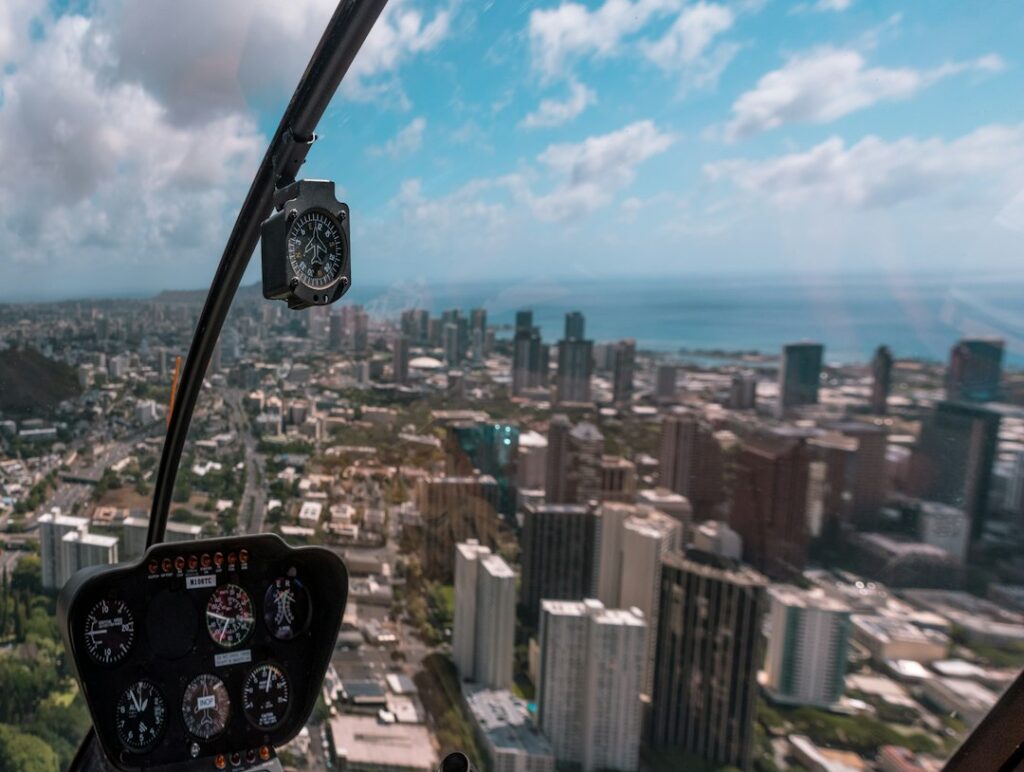
Between Downtown Honolulu and Ala Moana Boulevard, a former warehouse and industrial district has become the city’s fastest-changing overnight neighborhood. Kakaako and its Howard Hughes-planned Ward Village core now offer a walkable grid of boutique hotels, condo towers, coffee counters, and street murals that sit less than 2 miles from Waikiki Beach.
For mainland visitors weighing where to sleep on Oahu, the question has shifted. Waikiki’s beach-front strip still dominates hotel search results, but a boutique-and-high-rise circuit in the 96813 zip code offers cheaper valet rates, quieter mornings, and 12-minute walks to Ala Moana Center’s 350-plus stores. This article maps the tradeoff for households scouting a longer-term move as well as first-time overnights.
The neighborhood covers roughly 600 acres between Piikoi Street and Punchbowl Street, wedged between the H-1 freeway and Kewalo Basin harbor. Rebuilding began in earnest around 2014, and by 2026 more than a dozen residential towers have opened, alongside two boutique hotels, the Salt at Kakaako food hall, and the ongoing POW! WOW! Worldwide mural festival that repaints external walls each February.
Kakaako’s warehouse-to-neighborhood transformation
Kakaako spent most of the 20th century as Honolulu’s light-industrial spine — auto body shops, printers, marine repair yards, and the ice house that supplied the fishing fleet at Kewalo Basin. Master planner Howard Hughes Corporation acquired 60 acres of the Ward Estate in 2009 and has since delivered towers including Waiea, Anaha, Ae’o, Ke Kilohana, A’ali’i, Ko’ula, and Victoria Place, with more construction ongoing through 2027.
The rebuilding follows a Hawaii Community Development Authority (HCDA) master plan approved by the state legislature. Density targets sit around 15,000 residential units at completion, roughly triple the population Kakaako held in 2010. That density is why the neighborhood suddenly supports a foodhall, a Whole Foods, a grocery-anchored Ward Centre plaza, and small boutique lodging — the daily-use retail base finally exists.
Visitors sleeping in Kakaako in 2026 encounter a still-mixed streetscape. Auction warehouses on Kawaiaha’o Street sit two blocks from $2 million penthouses on Ala Moana Boulevard. Cargo movements from Honolulu Harbor still rumble down Ilalo Street before dawn. The unfinished feel is a feature for some travelers and a drawback for others, and it shapes whether a boutique or a full-service condo tower makes more sense.
The POW! WOW! Worldwide mural circuit
POW! WOW! Worldwide began as a Honolulu block party in 2010 and became the anchor arts event of the Kakaako calendar. Every February for one week, roughly 100 artists — local, mainland, and international — repaint warehouse walls, roll-up doors, and utility boxes across a 12-block core. The murals stay up until the following year, when many are painted over and replaced.
Because the walls rotate annually, no printed map stays current. The self-guided circuit still follows a reliable spine: start at the intersection of Cooke Street and Auahi Street, walk mauka (toward the mountains) on Cooke, turn left on Pohukaina Street, and continue to Coral Street. That loop passes 40+ pieces in under a mile, most on ground-floor walls at eye level.
Weekend crowds thin dramatically before 8 a.m., and morning light on the makai (ocean-side) walls between Cooke and Keawe Streets is the strongest for photography. Guided walking tours run Friday and Saturday mornings from partners like Hawaii Walking Tours, usually 90 minutes for around $35 per adult. Independent visitors can cover the same ground for free with a phone camera.
Where the density is highest
- Cooke Street between Pohukaina and Auahi — largest single-wall pieces.
- Lana Lane between Cooke and Kamake’e — smaller, more experimental work.
- Coral Street garage doors — rotating small-format artists.
- Ala Moana Boulevard-facing warehouses — largest audience but hardest photos.
- The Fresh Cafe alley off Queen Street — original site of the festival.
Salt at Kakaako and the foodhall complex
Salt at Kakaako opened in 2016 at 691 Auahi Street as a 71,000-square-foot mixed-use block anchored by chef-driven restaurants. The complex functions less like a mall foodcourt and more like a cluster of independent operators inside a shared warehouse envelope. Anchor tenants have rotated, but the through-line has been coffee, ramen, poke, cocktails, and locally-owned retail at higher price points than nearby Ala Moana Center.
Reservations are common at dinner but not required for most counters at lunch. Parking beneath the block runs $2 for the first 90 minutes with validation, versus street parking meters at $2 per hour with a 2-hour maximum. Visitors staying within Ward Village typically walk from any tower in under 8 minutes.
Recurring tenants worth mapping
- Arvo — coffee counter with breakfast toasts and Australian-style flat whites.
- Moku Kitchen — larger sit-down operator from Chef Peter Merriman.
- Highway Inn — 76-year-old plate-lunch spot with a modern satellite location.
- Bevy — cocktail bar with Filipino-inflected small plates most evenings.
- Aloha Beer — brewery-restaurant with outdoor seating on Coral Street.
Poke counters are limited inside Salt itself, but visitors chasing the format can walk 6 minutes to Off The Hook Poke Market on Ward Avenue. Deeper coverage of the island’s poke geography sits in a companion post on Waikiki poke shops beyond Ala Moana, which maps the takeaway counters most tourists miss.
Boutique hotel options inside the neighborhood
Kakaako is unusual for a Honolulu overnight district because it holds relatively few traditional hotels. The Modern Honolulu, on the Ala Moana Boulevard edge at 1775 Ala Moana, is the closest full-service boutique property with 353 rooms, a saltwater pool, and Sunrise Pool/Sunset Pool split-level design. Rack rates typically start around $329 in shoulder season and climb past $500 during summer peak.
Farther Diamond Head, boutique properties like The Laylow and Wayfinder Waikiki draw Kakaako-curious visitors who want smaller footprints than the 2,800-room Hilton Hawaiian Village. Both sit within a 12-minute Uber ride and a 25-minute walk. Rates run $250 to $380 in most months, and neither requires resort-fee bundles as steep as the beach-front giants.
The rest of the Kakaako inventory sits inside condominium buildings operated as vacation rentals under Honolulu’s Ordinance 22-7 short-term rental rules, which restrict most transient stays to 90 nights or longer. Visitors booking sub-30-night stays in Kakaako should confirm the unit is either a legal condo-hotel unit (not all towers qualify) or booked through a permitted operator. Enforcement has tightened since 2022.
High-rise condo tower stays: the tradeoff
Ward Village towers offer full kitchens, in-unit laundry, and ocean views from the 20th floor upward that no boutique hotel in the neighborhood can match. Nightly rates for a legal 30+ night stay in Ae’o or Anaha typically run $220 to $410 for a one-bedroom, dropping per-night as the stay lengthens. Weekly and monthly discounts of 15 to 30 percent are common in the shoulder months of April, May, and September.
The tradeoff is service. There is no lobby concierge, no housekeeping between stays, and no restaurant on-site. Package pickup happens at a front desk with variable hours, and building elevators can queue 4 to 6 minutes during rush hour. For a family relocating and using the stay as a scouting trip, the kitchen and washer-dryer usually outweigh the missing amenities.
| Format | Typical nightly rate | Best for | Weakness |
|---|---|---|---|
| The Modern Honolulu boutique | $329-$525 | 2-4 night couple stay | Resort fee ~$45/night |
| Ward Village condo (30+ nights) | $220-$410 | Relocation scouting | No concierge or housekeeping |
| Waikiki full-service resort | $310-$680 | Beach access priority | 1.5-mile walk to Kakaako |
| Ko Olina resort (west side) | $389-$720 | Multi-family kids trip | 45-minute drive to town |
Households weighing the west-side alternative can consult the fuller Waikiki versus Ko Olina lodging comparison for a broader Oahu framework. Kakaako sits geographically between the two, and its appeal turns on urban access rather than beach access.
Walking access to Ala Moana Center
The single strongest argument for a Kakaako base is that Ala Moana Center — the state’s largest shopping complex at 2.4 million square feet and 350+ retailers — sits within a 12-minute walk of most Ward Village towers. The walking path along Ala Moana Boulevard has continuous sidewalks, signalized crossings at Piikoi and Kamake’e Streets, and shaded stretches under the Neiman Marcus and Nordstrom facades.
Distance breakdowns from the neighborhood core:
- Ae’o (Whole Foods tower) to Ala Moana Center Ewa entrance — 0.5 miles, 11 minutes.
- Salt at Kakaako to Ala Moana Center — 0.7 miles, 15 minutes.
- The Modern Honolulu to Ala Moana Center — 0.3 miles, 7 minutes.
- Kewalo Basin harbor to Ala Moana Center — 0.9 miles, 19 minutes.
- Waikiki (Royal Hawaiian) to Ala Moana Center — 1.4 miles, 30 minutes.
The center’s food-court floor, Shirokiya Japan Village Walk successor tenants, and the ground-floor Foodland Farms grocery mean a Kakaako-based traveler can cover most daily errands on foot. The 8, 20, and 42 city buses also connect the neighborhood to the airport and Waikiki for $3.00 per single ride under the current TheBus fare structure.
For beach access, Ala Moana Beach Park sits directly makai of the shopping center. The 76-acre park has a protected shallow lagoon, restrooms every 300 yards, and free parking that fills by 10 a.m. on weekends. Walk time from most Ward Village towers is 15 to 20 minutes, roughly the same as Waikiki-based visitors need to reach the busier Kuhio Beach.
Kakaako versus Waikiki as an overnight base
Waikiki is denser, older, and closer to the water. Kakaako is quieter after 9 p.m., cheaper on parking, and closer to the local dining scene that most residents actually use. Households scouting a move often prefer Kakaako because it resembles the neighborhoods they might realistically live in — Salt Lake, Kaimuki, or Aiea condominiums — more than the destination-tourism strip a mile east.
| Metric | Kakaako / Ward Village | Waikiki |
|---|---|---|
| Boutique hotel count | ~2 | ~30 |
| Distance to beach | 0.6 miles to Ala Moana Beach | 0.1 miles to Kuhio Beach |
| Distance to Ala Moana Center | 0.5 miles | 1.4 miles |
| Typical resort fee | $0-$45/night | $45-$65/night |
| Overnight parking | $18-$35/night | $35-$60/night |
| Foot traffic after 10 p.m. | Low | High |
| Grocery within 5 minutes | Whole Foods, Foodland Farms | ABC Store convenience only |
The tradeoff is beach immediacy. Kuhio Beach in Waikiki is a 2-minute walk from most beachfront towers, while Ala Moana Beach Park requires a 15-minute walk or a 5-minute drive from Kakaako. For a family with young children who want a swim after each meal, Waikiki still wins. For a scouting couple who want restaurants, murals, and a Whole Foods on the way home, Kakaako wins.
Getting there and getting around
Kakaako sits about 8 miles east of Daniel K. Inouye International Airport (HNL). The taxi and rideshare fare typically runs $28 to $42 without traffic and 20 to 40 minutes depending on time of day. Airport Express shuttle service operates hourly for $22 per adult, with drop-offs at major Ala Moana and Waikiki hotels but limited direct Kakaako coverage.
Rental cars are useful for exploring Oahu’s North Shore or the windward coast, but not necessary for Kakaako-based visitors staying within town. Daily rental rates on Oahu averaged $58 in 2025 per state tourism authority data, with additional airport concession recovery fees adding 12 percent. Overnight garage parking at most Ward Village buildings runs $25 to $35 per stall.
The Skyline rail project opened Segment 1 in June 2023 and Segment 2 through Halawa/Aloha Stadium in late 2025, but does not yet reach the Kakaako area. Full extension to Civic Center is targeted for 2031 per the Honolulu Authority for Rapid Transportation. Until then, TheBus and rideshare remain the main options for connecting to the airport and outer neighborhoods.
A sample 3-night Kakaako overnight circuit
The tightest scouting itinerary uses one full day for the neighborhood core, one day for Waikiki and Diamond Head, and one for a windward-side loop. Distances stay short enough that a rental car is optional if the third day is dropped or replaced with a Kualoa area guided tour.
Day 1 — arrival, murals, foodhall
Land at HNL by 2 p.m., check in at either The Modern Honolulu or a Ward Village condo by 4 p.m., and walk the POW! WOW! spine on Cooke and Pohukaina before sunset (roughly 7:15 p.m. in June, 5:55 p.m. in December). Dinner at Salt at Kakaako. Total walking distance around 1.6 miles.
Day 2 — Ala Moana morning, Waikiki afternoon
Coffee at Arvo before 8 a.m., walk to Ala Moana Beach Park for a swim, then cross the boulevard to Ala Moana Center by 10 a.m. Lunch at Mahaloha Burger or Foodland Farms grab-and-go. Uber to Waikiki for the Diamond Head Crater hike (reservations required for out-of-state visitors, $5 per person, entry closes at 4 p.m.).
Day 3 — windward loop or Pearl Harbor
Option A: rent a car for a windward drive to Kualoa Ranch and Kaneohe Bay, returning through the Pali Highway. Option B: taxi to Pearl Harbor National Memorial (opens at 7 a.m., timed USS Arizona tickets are free but limited). Return to Kakaako by 3 p.m. for a final foodhall dinner and packing.
Visitors extending to a fourth or fifth night often add a windward day exploring the shoreline. The Mokoli’i kayak run from Kualoa and the Waikiki sunset catamaran comparison are two common half-day add-ons that pair well with a Kakaako base because the neighborhood offers a full kitchen for leftover-friendly late dinners.
Weather, safety, and neighborhood texture
Honolulu weather is stable enough that overnight decisions rarely hinge on forecasts. Average high temperatures range from 80°F in February to 89°F in September, with humidity between 63 and 76 percent. Trade winds average 10 to 15 mph from the northeast and keep the Kakaako grid cross-ventilated. Rainfall averages 17 inches per year in the immediate coastal zone, versus 60+ inches in the windward valleys.
The neighborhood is generally safe for pedestrians during daylight and early evening. Homelessness remains visible in pockets, especially along the makai edge near Kakaako Waterfront Park and around the Ilalo Street corridor. Honolulu Police Department District 1 patrols the area, and the safety profile is broadly comparable to a downtown arts district on the mainland rather than a resort strip. Standard urban precautions apply.
Kakaako Waterfront Park closes at night per City & County of Honolulu ordinance and reopens at 4 a.m. Kewalo Basin harbor remains open 24 hours but is primarily a working fishing and charter marina. For daytime park use, the 30-acre Ala Moana Beach Park sits directly east and is patrolled more actively. Details on parks, permits, and closures live at honolulu.gov.
Cost benchmarks for a 3-night Kakaako stay
The following cost model assumes two adults, one hotel room or one 1-bedroom condo, and one restaurant meal per day plus one foodhall meal and one grocery meal. Prices are late-2025 averages; the Bureau of Labor Statistics tracks Honolulu inflation quarterly via its Honolulu CPI release.
| Line item | Boutique hotel path | Condo tower path |
|---|---|---|
| Lodging (3 nights) | $1,050 | $780 |
| Resort fee / cleaning | $135 | $185 (one-time) |
| Parking (3 nights) | $105 | $90 |
| Groceries | $85 | $175 |
| Restaurant meals | $420 | $260 |
| Airport transfer round-trip | $70 | $70 |
| Estimated total | $1,865 | $1,560 |
Gasoline prices swing the rental-car scenario meaningfully. Hawaii averaged $4.68 per gallon regular in mid-2025 per the Energy Information Administration’s retail gas dashboard — roughly 40 percent higher than mainland averages. Adding a compact rental at $58 daily plus $35 in fuel raises the 3-night trip cost by $209 on either path.
How Kakaako fits a relocation scouting trip
For mainland households seriously considering a move to Oahu, a Kakaako overnight is more useful than a Waikiki one because the daily rhythm approximates urban local life. Grocery runs to Whole Foods, coffee at neighborhood counters, and a walk to Ala Moana Center for essentials all mirror what a resident’s Saturday might look like. Waikiki, by contrast, is a tourism monoculture that reveals little about residential Oahu.
Real estate showings inside Ward Village towers are usually available with a 24-hour notice through licensed brokers, and the neighborhood’s HOA fee structures — often $900 to $1,600 monthly for a 1-bedroom — become tangible when a visitor pays overnight strata-equivalent costs. State tax filings, including the general excise tax that shapes retail prices, are documented at the Hawaii Department of Taxation.
Utilities are another line item worth previewing during a stay. Hawaiian Electric residential rates ran 41.4 cents per kilowatt-hour in 2025 — the highest in the U.S. per the EIA Hawaii state profile. Condo dwellers often skip air conditioning entirely for 8 to 10 months per year, but summer AC bills in a top-floor unit can exceed $400 monthly. Visitors should note whether test-stay units use central AC or trade-wind ventilation.
Population and demographic context is available via the Census Bureau’s Hawaii QuickFacts. Statewide population sat around 1.44 million in 2024, with Honolulu County holding about 1 million residents. Kakaako itself contains an estimated 12,000 residents in 2026, projected to reach 30,000 at Ward Village build-out.
Households comparing Oahu with the neighbor islands during the same trip often add Maui overnights in the Haiku vacation-stay corridor or Kauai stops such as the Salt Pond area on the west shore. The neighbor islands offer lower housing density and slower internet than Kakaako’s fiber footprint, which is worth factoring into a work-from-home relocation shortlist.
Museums, cultural sites, and evening walks
Kakaako sits within a 10-minute walk of downtown Honolulu’s historic core, which shapes the neighborhood’s cultural offering. The Hawaii State Art Museum (HiSAM) at 250 South Hotel Street displays 360+ works by Hawaii artists and offers free admission. The Honolulu Museum of Art at 900 South Beretania Street holds one of the largest Asian art collections in the U.S. and charges $20 for adults.
Iolani Palace, the only official royal residence in the United States, sits 0.7 miles from central Kakaako at 364 South King Street. Docent-led tours run Monday through Saturday at 9:00, 10:30, and noon for $32.95 per adult. Visitors interested in similar royal-residence history on the Big Island can compare notes with the Hulihee Palace docent circuit in Kailua-Kona.
Evening walks along the Kewalo Basin harbor front connect Kakaako Waterfront Park to Point Panic, a bodysurfing-only break on the western breakwater. Sunset over the Ewa (western) horizon runs roughly 6:55 p.m. in June and 5:50 p.m. in December. The harbor is also the departure point for many of Honolulu’s sunset sails as an alternative to the busier Waikiki-based charters.
Shipping household goods for a Kakaako-based move
For scouting visitors who convert their Kakaako stay into a lease or purchase, the container-shipping timeline becomes relevant. Matson and Pasha Hawaii are the two dominant carriers between the West Coast and Honolulu. A 20-foot container from Oakland to Honolulu typically runs $6,800 to $9,200 with a 5 to 7 day sailing plus port handling.
Household schedules and terminal booking windows live at Matson’s shipping portal and Pasha Hawaii’s household goods page. Auto shipping runs $1,150 to $1,700 for a mid-size sedan Oakland to Honolulu, with pickup windows of 3 to 8 business days after arrival. Kakaako residents typically stage delivery to a temporary storage locker near Sand Island rather than curbside.
Furnished Ward Village rentals during the transitional 30 to 90 day period cost more than the container itself and often make a bridge-lease pencil out. This is a common enough pattern that condominium associations in the neighborhood have adjusted move-in policies to allow weekday morning elevator reservations from a single dedicated freight elevator per tower.
Frequently asked questions
Is Kakaako safer than Chinatown for an overnight stay?
Both neighborhoods share a similar urban Honolulu character with visible homelessness, but Kakaako’s newer condo blocks and continuous foot traffic near Ward Centre make its evening streets feel more predictable. Chinatown carries a stronger nightlife concentration and steeper contrast between blocks. Neither is dangerous by mainland urban standards, and standard precautions such as securing rental cars overnight apply equally in both districts.
Can visitors book Kakaako condos for under 30 nights?
Under Honolulu Ordinance 22-7, short-term rentals of fewer than 90 nights are restricted outside limited resort zones. A handful of Ward Village units hold legal transient accommodation status, but most condos advertised for 3 or 7 night stays are technically noncompliant. Enforcement has increased since 2022, and booking through the Modern Honolulu or a compliant brand is the cleaner path for short overnights.
How far is Kakaako from Waikiki on foot?
The walking distance from the eastern edge of Ward Village (near Ala Moana Center) to the western edge of Waikiki (Fort DeRussy Beach) runs about 0.9 miles, or 20 minutes at a steady pace along Ala Moana Boulevard. Continuing to the Royal Hawaiian core adds another 0.5 miles. Most visitors switch to a $12 to $18 rideshare rather than walking after dark.
Where do POW! WOW! artists actually paint each February?
The festival concentrates on the block bounded by Cooke Street, Auahi Street, Pohukaina Street, and Coral Street. Additional pieces appear along Ala Moana Boulevard-facing warehouses and in the Lana Lane alley. Painting typically happens from Valentine’s Day through the following weekend, and the murals remain visible until the following February’s rotation unless building owners commission earlier repaints.
Is Ala Moana Beach Park worth walking to from Kakaako?
Yes for calm-water swimming, less so for surf. The park’s 3,300-foot shoreline is protected by an offshore reef that keeps wave action minimal — good for children and lap swimmers, less appealing for anyone chasing rideable waves. Restrooms sit every 300 yards, and free parking fills by 10 a.m. on weekends. The 15-minute walk from central Ward Village is flat and shaded on the mauka sidewalk.
Does the Salt at Kakaako complex have on-site parking?
Salt operates a below-grade garage with 220 stalls, validated at $2 for the first 90 minutes with restaurant purchase. Beyond 90 minutes, standard hourly rates apply and can accumulate to $18 for a 4-hour dinner. Ward Village residents and hotel guests within 4 blocks typically skip the garage and walk. Street meters along Auahi and Cooke Streets max out at 2 hours during business hours.
How does Kakaako compare to Ko Olina for a first Oahu trip?
Kakaako offers urban density, museums, and walkable dining but no swim-ready beach on-site. Ko Olina, 22 miles west, offers manicured lagoons and full-service resorts but requires a car for any off-property meal. Families with young children lean Ko Olina; couples scouting a relocation lean Kakaako. The two are so different that many multi-week visitors split nights between them rather than choosing one.