Most mainland households moving to Hawaii budget for shipping, electricity and groceries. Fewer prepare for the first night a six-inch centipede crosses the bathroom tile at 2 a.m. Hawaii has no established land snakes, but the islands do host a short, specific list of arthropods that live indoors year-round in warm, humid houses.
The practical news is that the list is short and mostly harmless. Of the animals a renter or new homeowner will actually meet inside a Hawaii house, exactly one delivers a sting that reliably hurts enough to interrupt a night: the Vietnamese or Chinese centipede, Scolopendra subspinipes. Everything else is a nuisance, an ally, or a yard problem rather than a house problem.
What follows covers identification, seasonal timing, the fixes that actually keep animals out, what professional pest control runs on Oahu compared with the mainland, which symptoms warrant a clinic visit, and how little fire ant infestations get reported to the Hawaii Department of Agriculture.
What actually lives indoors in Hawaii
Nearly every household arthropod in Hawaii arrived by ship or plane. The islands’ isolation means the native insect fauna is dominated by specialists that ignore houses entirely; the animals in kitchens and bathrooms are almost all introduced species with broad tropical ranges.
That has one useful consequence. The indoor cast is largely the same on Oahu, Maui, Kauai and Hawaii Island, with elevation and rainfall mattering far more than which island a household picks. A Volcano house at 3,700 feet has a different pest profile than Kailua-Kona at sea level on the same island.
| Species | Typical size | Where encountered | Risk to people |
|---|---|---|---|
| Centipede (Scolopendra subspinipes) | 4–8 inches | Bathrooms, laundry, bedding, garage | Painful sting; rarely medical |
| American cockroach | 1.5–2 inches | Drains, yard, garages; flies indoors | Allergen; no bite |
| Surinam cockroach | 0.7–1 inch | Potted plant soil, mulch beds | None; plant pest |
| German cockroach | 0.5 inch | Kitchens, apartment blocks | Strong asthma allergen |
| Cane spider (Heteropoda venatoria) | 3–5 inch leg span | Walls, ceilings, showers | Essentially none |
| Little fire ant | 1/16 inch (1.5 mm) | Trees, yards, laundry, pets | Welts lasting days; pet blindness |
| House and day geckos | 3–6 inches | Windows, lanai, ceilings | Beneficial predator |
| Coqui frog | 1–2 inches | Hawaii Island and East Maui yards | Noise only, 80–90 dB |
Centipedes: the one that genuinely hurts
The centipede that matters is Scolopendra subspinipes, usually a deep reddish-brown or orange-brown with darker banding and a pair of bright forcipules at the head. Adults commonly run 4 to 6 inches; 8-inch specimens turn up often enough that longtime residents treat them as unremarkable rather than legendary.
A second, smaller species, Lethobius and related blue-grey centipedes at 1 to 2 inches, shows up under sinks and in damp corners. Those are not worth worrying about. The sting rarely penetrates skin meaningfully and feels closer to a bee sting’s first second than its full arc.
When centipedes come inside
Centipedes are moisture-regulated animals with poor water retention. They move indoors under two opposite conditions: heavy rain that floods their normal hiding places, and extended dry spells that push them toward the reliable humidity of bathrooms and laundry rooms.
On the windward sides of each island, the first pattern dominates. A week of November through March trade-driven rain regularly produces a spike in sightings, especially within 24 to 48 hours of a storm. Households tracking this against the Big Island’s month-by-month rainfall pattern tend to see the same correlation on their own property.
On leeward and Kona-side properties, the dry-season pattern is stronger. August and September, when leeward rainfall can drop under an inch for the month, drive centipedes toward shower drains, dog water bowls and irrigation drip lines near the foundation.
What the sting feels like and how long it lasts
The sting is mechanical as well as chemical. Two puncture marks about 3 to 10 millimeters apart are typical, with immediate burning pain that peaks in the first 30 to 60 minutes. Localized swelling, redness and occasional lymph node tenderness follow.
Most healthy adults report the worst of it resolving within 4 to 12 hours, with residual soreness and itching for 2 to 5 days. A large centipede on a thin-skinned area — ankle, wrist, inner arm — hurts substantially more than a glancing strike through a sock.
First aid that actually helps
Centipede venom contains heat-labile components, which is why hot water immersion is the standard field response. Water at 110–113°F (43–45°C) for 10 to 20 minutes reduces pain for many people. Test the temperature with an unaffected hand first; scalding an already swollen limb is a common self-inflicted injury.
- Wash the site with soap and water immediately.
- Immerse in hot water at 110–113°F for 10–20 minutes.
- Apply ice afterward in 15-minute intervals for swelling.
- Take an oral antihistamine and standard OTC pain relief.
- Keep the limb elevated; mark the redness border with a pen.
When a centipede sting needs a doctor
Routine stings do not require care. What warrants a clinic or emergency visit is a systemic reaction, a sting near the eye or inside the mouth, or infection developing over the following days. Hawaii’s Department of Health maintains general guidance for envenomation and vector-borne illness across the islands.
Marking the edge of the redness with a pen at the time of the sting makes the decision easier 12 hours later. Redness that has expanded well past that line, combined with warmth and increasing pain rather than decreasing pain, points to a secondary bacterial infection rather than venom.
Keeping them out of bedding
Centipedes climb poorly on smooth vertical surfaces but travel along anything textured. The recurring nighttime encounter — a sting in bed — almost always traces to bedding touching the floor, a bed frame pushed against a wall, or laundry piles serving as daytime shelter.
- Keep duvets, sheets and bed skirts off the floor entirely.
- Pull bed frames 4–6 inches away from walls.
- Store laundry in lidded hampers, not floor piles.
- Shake out shoes, towels and beach gear before use.
- Remove leaf litter and mulch within 18 inches of the foundation.
Cockroaches: three species, three different problems
Hawaii has several dozen cockroach species, but three account for nearly all indoor complaints. Treating them as one problem leads to the wrong control strategy, because two of the three do not actually want to live inside.
American cockroach
The large reddish-brown roach, 1.5 to 2 inches long, is Periplaneta americana. It breeds outdoors in sewers, green waste, palm crowns and storm drains, then flies or walks indoors, often through a bathroom vent or an open lanai door at dusk.
Because the population lives outside, indoor spraying accomplishes little. Effective control targets entry: drain covers, vent screens, door sweeps, and green waste storage away from the house. Cities publish collection schedules — on Oahu, through the City and County of Honolulu — and keeping green bins off the lanai matters more than any aerosol.
Surinam cockroach
Pycnoscelus surinamensis is the shiny, dark, roughly one-inch roach that appears when a potted plant is repotted or moved. The Hawaii population is parthenogenetic — effectively all female, reproducing without males — so a single introduced individual can found a colony in a pot.
It burrows in soil, feeds on roots, and rarely establishes indoors away from plants. The practical control is quarantine: new nursery plants sit outside for two weeks, and soil from the mainland should not enter the property at all. The same inspection habit protects against far worse hitchhikers.
German cockroach
The half-inch tan roach with two dark pronotal stripes is the one that genuinely infests. Blattella germanica completes a generation in roughly 60 days, lives entirely indoors, and spreads between units in multifamily buildings through shared walls and plumbing chases.
This is the species where professional treatment earns its cost. Gel baiting over 8 to 12 weeks outperforms spraying, and in an apartment building, treating one unit while neighbors do nothing produces a reinfestation within a quarter.
Cane spiders and the rest of the arachnids
The cane spider, Heteropoda venatoria, is a flat brown huntsman with a leg span reaching 3 to 5 inches. It has no web, moves in fast bursts, and appears on walls and shower ceilings. It also eats cockroaches and small centipedes, making it a net asset.
Cane spiders can bite if pinned against skin, and the result is a minor puncture with brief local pain — closer to a paper cut with a sting than an envenomation. There is no tissue necrosis, no systemic effect, and no medical follow-up required for a healthy adult.
Hawaii does have introduced brown widow and southern black widow spiders, typically in outdoor clutter, rock walls, meter boxes and under lanai furniture. They are uncommon indoors and not aggressive, but widow bites do warrant medical evaluation, particularly in children.
Geckos: the household ally worth keeping
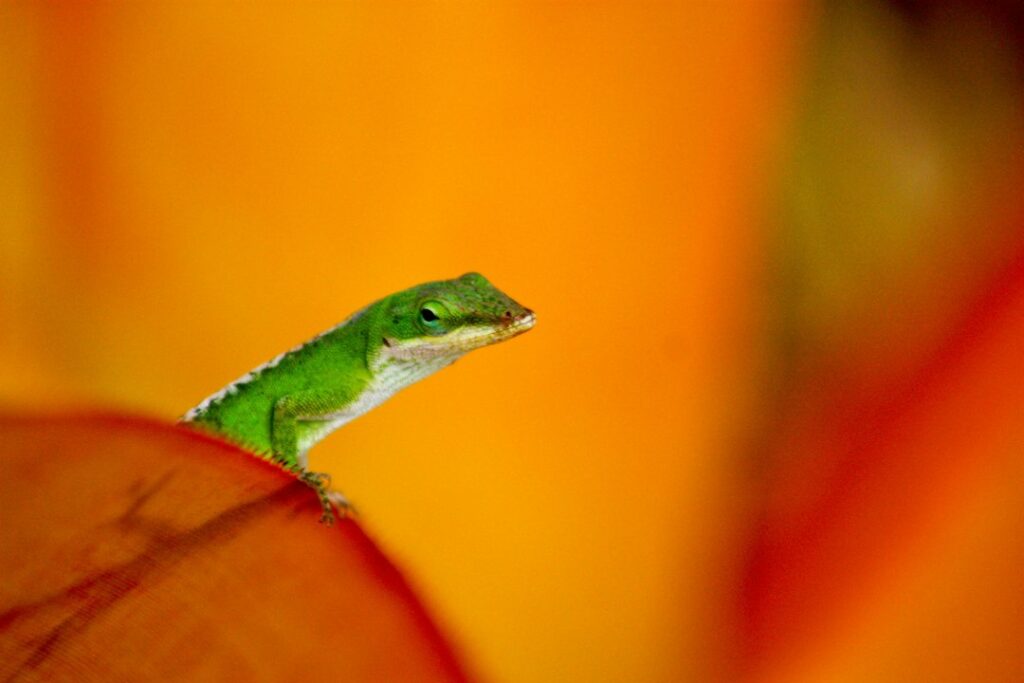
Four gecko species commonly occupy Hawaii houses. The common house gecko (Hemidactylus frenatus) is the nocturnal, pale-grey, chirping one on window screens. The gold dust day gecko (Phelsuma laticauda) is the bright green and yellow diurnal species on Oahu and Hawaii Island walls.
Mourning geckos and stump-toed geckos fill out the group. All four eat mosquitoes, ants, small roaches, moths and termite alates. A house with a healthy gecko population has measurably fewer insects, and residents who remove them usually notice the difference within a month.
The tradeoffs are real but small: droppings on windowsills, chirping at night, and occasional wandering behind appliances. Most households decide this is a fair exchange. Geckos are also part of the local vocabulary — everyday pidgin usage treats them as ordinary housemates rather than wildlife.
Little fire ants: the yard problem that becomes a house problem
Little fire ants (Wasmannia auropunctata) are about 1/16 inch long — roughly the thickness of a penny — pale orange, and slow-moving. They nest in trees and drop onto people below, which is why the first sign is often welts across the neck and shoulders after gardening.
The sting produces a burning welt that can itch for days, far out of proportion to the insect’s size. In pets, repeated stings to the eye cause corneal clouding and eventual blindness, a condition veterinarians on Hawaii Island see regularly.
Testing a yard
The standard survey uses chopsticks or popsicle sticks smeared with peanut butter, placed in shade, left 45 to 60 minutes, then bagged and frozen. Ten sticks across a typical residential lot gives a usable picture. Testing before signing a lease or closing on a property is standard practice on Hawaii Island.
Households working through the protocol should follow the full yard testing and quarantine sequence rather than a single spot check, since the ants are patchy and a negative result from one corner means little.
Reporting and treatment
Suspected little fire ants go to the Hawaii Department of Agriculture’s Plant Quarantine Branch, or to the statewide pest hotline at 643-PEST (643-7378). Reporting is free, specimen identification is free, and the report feeds distribution mapping that determines where control resources go.
Treatment is a multi-round process, not a single application. Ground and arboreal baiting typically runs on a 6-week cycle repeated four to six times across roughly 12 months, which is why the HDOA paste bait survey protocol emphasizes scheduling over product choice.
Coqui frogs: a Hawaii Island noise issue
Coqui frogs are not a bite risk and not an indoor pest. They are a sleep and property-value issue, concentrated on Hawaii Island — particularly Puna, Hilo and parts of Hamakua — with established populations in East Maui and scattered sites elsewhere.
A single male calls at 80 to 90 decibels measured at close range, comparable to a garbage disposal. Dense populations in lower Puna have been measured at densities exceeding 8,000 frogs per acre, producing a continuous chorus from roughly dusk until 3 or 4 a.m.
Anyone shortlisting neighborhoods should visit after dark before committing. Coverage in Honolulu Civil Beat and county resources at Hawaii County track control efforts, but a nighttime walk through the actual street answers the question faster. It is one of the clearest differences captured in a realistic Big Island cost and lifestyle picture.
Sealing the house: the fixes that work
Pest control in Hawaii is 80 percent exclusion and 20 percent chemistry. A house sealed against a 1/4-inch gap keeps out centipedes entirely; a house sealed to 1/16 inch keeps out most roaches. Older single-wall plantation construction makes the second target difficult and the first achievable.
| Fix | Material cost | Install time | What it stops |
|---|---|---|---|
| Aluminum door sweep, 36 in. | $14–$28 | 20 minutes | Centipedes, American roaches |
| Rescreen a window, 20×20 mesh | $12–$20 per window | 25 minutes | Small flies, ants, geckos |
| Silicone caulk, plumbing penetrations | $8 per tube | 45 minutes whole house | Roaches, ants, centipedes |
| Drain covers, 2 in. silicone | $10 for four | 5 minutes | American roaches via sewer |
| Dryer vent flap replacement | $16–$24 | 30 minutes | Roaches, geckos, mice |
| Weatherstrip lanai slider | $18–$35 | 40 minutes | Centipedes, ants |
| Dehumidifier, 30-pint | $180–$240 | Plug in | Reduces indoor attraction |
The dehumidifier line carries an operating cost worth checking. Hawaii’s residential electricity averages roughly 41 to 45 cents per kWh statewide according to EIA state data — a 30-pint unit running 8 hours daily at 300 watts adds about $30 a month. That is real money against a $1,200 household energy bill.
Gear that earns its place
- Aluminum door sweep with vinyl fin — $14–$28, the single highest-value purchase.
- 20×20 fiberglass screen roll, 48 in. × 25 ft — $38, rescreens six to eight windows.
- Screen spline roller and spline — $12 combined, reusable indefinitely.
- Digital instant-read thermometer — $12, for safe 110–113°F sting immersion.
- Picaridin 20% lotion, 3 oz — $9–$12, effective against mosquitoes, gentle on gear.
- Oral antihistamine and 1% hydrocortisone — $14 combined, keep both in a bathroom kit.
- Bright headlamp — $22, for nighttime yard and lanai checks.
- Lidded hamper and under-bed storage bins — $45, removes floor harborage.
What pest control costs on Oahu versus the mainland
Professional pest control in Hawaii costs more than the national average, but less than the gap in most other household categories. Labor and product availability drive the difference, not exotic treatments — the chemistry is the same fipronil, bifenthrin and indoxacarb used everywhere.
| Service | Oahu typical | Mainland average | Frequency |
|---|---|---|---|
| General quarterly plan | $135–$185 per visit | $100–$145 per visit | 4× per year |
| Monthly perimeter service | $65–$95 per month | $45–$70 per month | 12× per year |
| One-time interior treatment | $175–$300 | $150–$250 | As needed |
| German roach gel program | $320–$550 (3 visits) | $250–$400 (3 visits) | 8–12 weeks |
| Little fire ant treatment, 1/4 acre | $600–$1,400 per year | Not applicable | 4–6 rounds |
| Ground termite treatment | $1,800–$3,500 | $1,200–$2,500 | Once, then annual |
| Tent fumigation, 1,500 sq ft home | $3,500–$6,500 | $1,500–$3,000 | Every 10–15 years |
Termites deserve their own line in a Hawaii housing budget. Formosan subterranean termites are established statewide and swarm heavily in the evenings from roughly April through July, and tenting is a routine part of the maintenance cycle for older wood-frame homes.
Households comparing overall island costs should fold pest service into the monthly figure alongside electricity and food. The Honolulu Consumer Price Index tracks the broader pattern, and the same premium shows up in grocery pricing across the islands.
Neighbor island pricing runs slightly higher per visit because technicians cover more ground per route, though the difference is modest — typically $10 to $20 per service. Households weighing Oahu against the neighbor islands will find pest service is not the deciding factor.
Which bites and stings warrant a doctor
Most encounters resolve at home. The table below separates the cases that justify a clinic visit from the ones that do not, based on symptom pattern rather than species identification, since most people never see what stung them.
| Symptom pattern | Likely cause | Action | Timeframe |
|---|---|---|---|
| Two punctures, severe local pain | Centipede | Hot water, antihistamine | Resolves 4–12 hours |
| Scattered burning welts, neck and arms | Little fire ants | Topical steroid; test yard | Itch 3–7 days |
| Single puncture, mild ache | Cane spider | Wash, monitor | Resolves under 2 hours |
| Cramping abdomen, sweating, muscle pain | Widow spider | Emergency department | Go immediately |
| Hives, wheezing, throat tightness | Anaphylaxis, any species | Epinephrine, call 911 | Go immediately |
| Expanding redness after 24 hours | Secondary infection | Clinic, likely antibiotics | Within 24 hours |
| Sting to eye, mouth or throat | Any species | Emergency department | Go immediately |
Rural emergency access varies sharply by island. A Puna household may be 40 to 60 minutes from Hilo Medical Center, and parts of Hana sit over two hours from Maui Memorial. Knowing the drive time before an emergency is more useful than any first aid kit.
A seasonal pattern worth planning around
Pest pressure in Hawaii is not evenly distributed across the year. The pattern is driven by rainfall and temperature, and it differs between windward and leeward sides of each island more than between islands.
| Months | Dominant issue | Driver |
|---|---|---|
| November–March | Centipedes indoors, windward | Heavy rain flooding shelter |
| April–July | Formosan termite swarms | Evening swarming season |
| May–September | American roach flights | Warm nights, 78–86°F |
| August–September | Centipedes indoors, leeward | Dry spell, under 1 in. rain |
| Year-round | Little fire ants, coqui frogs | No meaningful seasonality |
| October–November | Ant trails into kitchens | First rains after dry season |
Screen repairs and door sweeps go in during October, ahead of the wet season. Termite inspections make sense in March, ahead of the swarm window. Little fire ant surveys can happen any month, though dry days give cleaner bait results than days with afternoon showers.
What renters should check before signing
Hawaii’s tight rental market discourages tenants from asking hard questions, but a 15-minute inspection prevents a year of problems. Inventory pressure has intensified since Oahu’s short-term rental rules shifted supply, which makes it tempting to skip due diligence entirely.
- Check door sweeps on every exterior door, including the garage.
- Look for screen tears and gaps at window frame corners.
- Run water in floor drains; confirm covers or traps exist.
- Ask who pays for pest service and at what frequency.
- Visit the property after dark, especially on Hawaii Island.
- Test the yard for little fire ants before move-in day.
- Ask when the building was last inspected for termites.
Landlords on all islands vary widely in whether pest service is included. On multifamily properties it usually is, because German roach control fails unless every unit participates. On single-family rentals it usually is not, and $65 to $95 a month belongs in the budget.
Anyone moving with plants, garden soil or outdoor gear should also review the agricultural inspection rules at HDOA’s Plant Quarantine Branch before packing. Container shipments through Matson are subject to inspection, and soil is broadly prohibited.
Frequently asked questions
Are centipedes in Hawaii dangerous?
Scolopendra subspinipes delivers a genuinely painful sting, and large specimens reach roughly 8 inches. The pain typically peaks within the first hour and fades over 4 to 12 hours. Serious complications are rare in healthy adults, but reactions vary, and small children, older adults and anyone with known venom allergies deserve closer monitoring.
Why do centipedes come inside after rain?
Centipedes lose water rapidly through their cuticle and depend on humid shelter. Heavy rain floods the leaf litter, rock walls and mulch beds where they normally hide, pushing them toward dry interior spaces. The reverse also happens: during August and September dry spells on leeward sides, they move indoors seeking bathroom moisture.
Does a centipede sting need a doctor?
Usually not. Home care means washing the site, immersing in 110–113°F water for 10 to 20 minutes, then icing and taking an antihistamine. Seek care for hives, wheezing, throat tightness, stings near the eye or mouth, or redness that expands past its original border after 24 hours.
Are cane spiders venomous to humans?
Cane spiders possess venom for subduing insect prey, but bites on people are rare and produce only brief local pain and a small puncture. There is no necrosis and no systemic reaction. They also hunt cockroaches and small centipedes, so most longtime residents relocate them outdoors rather than killing them.
Should geckos be removed from a Hawaii house?
Generally no. House geckos, gold dust day geckos, mourning geckos and stump-toed geckos all eat mosquitoes, ants, moths and small roaches. The cost is droppings on windowsills and nighttime chirping. Households that exclude geckos completely usually report noticeably more insects indoors within about a month.
How much does pest control cost on Oahu?
A general quarterly plan runs roughly $135 to $185 per visit on Oahu, against $100 to $145 on the mainland. Monthly perimeter service is about $65 to $95. Specialty work costs far more: tent fumigation on a 1,500-square-foot home ranges from $3,500 to $6,500.
How are little fire ants reported in Hawaii?
Collect suspected ants on peanut-butter-smeared sticks, freeze the sample, and contact the Hawaii Department of Agriculture Plant Quarantine Branch or the statewide pest hotline at 643-PEST. Identification is free. Reports feed the state distribution map, which determines where survey crews and bait resources are deployed each year.
Do coqui frogs live on Oahu?
Coqui populations are concentrated on Hawaii Island, especially Puna, Hilo and Hamakua, with established sites in East Maui. Oahu has scattered incursions that the state works to eradicate rather than a widespread chorus. Anyone shortlisting neighborhoods on Hawaii Island should walk the street after dark before committing.