A companion piece to the list of reasons you might not like living in Hawaii, this guide looks at the other side of the ledger: the reasons people are drawn to the islands in the first place.
Despite the well-documented challenges of living in Hawaii — the high cost of living, limited job opportunities, and more — there are many reasons people choose to move here, and why locals stay put or return after living elsewhere.
October 2026 update: Act 46, signed in June 2024, is phasing in the largest income tax reduction in Hawaii’s history. The standard deduction for a single filer rises to $5,000 for the 2026 tax year — up from $2,200 before the law — with further increases scheduled through the early 2030s. Social Security income and qualifying employer pensions remain fully exempt from Hawaii state income tax. For middle-income workers and retirees weighing a move, the tax burden is measurably lower in 2026 than it was five years ago.
What makes Hawaii the place to be?
Living in Hawaii means living in a tropical paradise, and — although it may sound odd — that isn’t for everyone. But for people who love the water, enjoy island life, and gravitate toward a laid-back environment, Hawaii is often a strong fit.
The beautiful year-round weather is a big part of what makes Hawaii an appealing place to live. The beach is rarely far away — even for those who live further inland — so it’s easy to head to the coast after work.
The sections below lay out the reasons most commonly cited by people who decide to make the move to Hawaii.
Good place to raise kids
Yes, many of the public schools in Hawaii leave something to be desired. And yes, a white kid attending a school with mostly non-white students is bound to face some racism and peer-testing. But for parents who can find the right school for their children, Hawaii can be an excellent place for kids to grow up.
The warm weather and numerous beach parks encourage kids to spend more time playing outside — swimming, biking, surfing, skateboarding, or just walking around with friends — instead of staying indoors and participating in unhealthy activities.
Neighbours tend to get to know each other in the smaller confines of Hawaii’s island towns and are more apt to question neighbourhood kids (or their parents) if they seem to be getting into trouble.
Exposure to Hawaii’s cultural diversity gives children invaluable life skills in appreciating and getting along with people who are different from themselves.
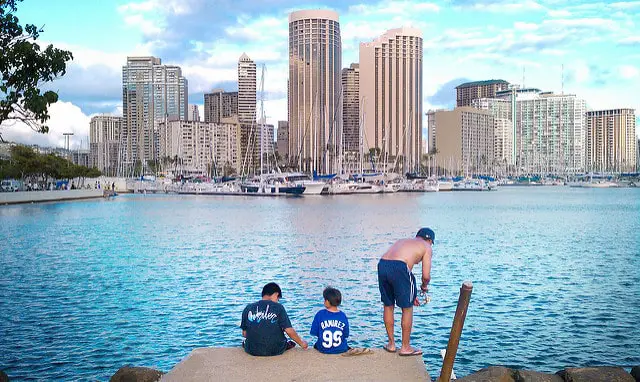
One of the many simple pleasures to be had in Hawaii: fishing with the kids. (Photo credit: Keoni 101)
Cheap entertainment
Many things in Hawaii are expensive: housing, food, gas, and so on. But there is one area of the budget where living on the islands can actually save money — entertainment.
There are so many outdoor activities here that are free or cheap, and the wonderful weather makes them all the more enjoyable: swimming or bodysurfing at a beach, picnicking or barbecuing at a park, hiking a trail, biking around town, sightseeing in a state or national park or botanical garden, attending a cultural festival, and lots more.
All beaches in Hawaii are public and free to enjoy, and on weekends it’s common to see extended families relaxing under a party tent at a beach park, having a barbecue potluck and “talking story.” It’s simple pleasures like these that Hawaii residents make the most of.
Residents can also take advantage of free activities offered to tourists — for example, there are free Hawaiian cultural classes in Waikiki, as well as live music, fireworks, and outdoor movies.
For things that do cost money, many places offer a kama’aina (resident) discount if you ask and show a Hawaii driver’s license or state ID card. The Waikiki Aquarium, for instance, gives residents a discount on general admission.
Good place to be a senior citizen
Hawaii’s population is aging quickly — state projections have long pointed toward roughly one in four residents being 60 or older, and that share has continued to climb. While this strains a state that already faces a shortage of nursing-home openings, seniors who are in relatively good health enjoy some nice perks.
Hawaii’s senior citizens benefit from a couple of long-standing state tax provisions: Social Security income and qualifying government and employer pensions are exempt from state income tax, and senior homeowners can qualify for reduced property taxes through county exemptions.
There are also programs that provide seniors with subsidized public transportation, housing, cleaning services, prepared meals, prescriptions, nursing care, and more.
The broader tax picture has improved too. Act 46 raises the standard deduction for a single filer to $5,000 for the 2026 tax year (up from $2,200), with increases continuing through the early 2030s. Combined with the long-standing Social Security and pension exemptions, this lowers effective state income tax for most retirees on fixed or moderate incomes.
These benefits — along with Hawaii’s year-round warm weather and traditional respect for kupuna (wise and beloved elders) — make the islands a good place to maintain an active life as a senior citizen.
Perfect weather year-round
Hawaii’s weather is one of its biggest draws. In Honolulu, temperatures hover around 80°F (about 27°C) most days, all year long. It does rain regularly, but showers often pass in just a few minutes before the sun returns.
Rainfall varies a great deal depending on where you live, but it rarely gets genuinely cold at low elevations — for many residents, it feels like summer all year round.
There is also far less seasonal variation in daylight than on the mainland, because Hawaii sits closer to the equator. People who moved from higher latitudes — where the winter commute happens in darkness at both ends of the day — often notice the difference right away.
In Hawaii, the sun rises only about an hour earlier and sets about an hour later in summer than in winter. It’s also why the state doesn’t observe Daylight Saving Time — no clocks to change back and forth.
A little friendlier & less hectic
Many new residents report that strangers seem more likely to smile back at them in passing. It’s easy to chalk that up to a “honeymoon” phase with a new home, where everything looks rose-colored.
But it’s a common enough observation that even visitors notice it, often asking whether people really do smile more at each other here and seem happier in general — which suggests it isn’t purely imagination.
Opinions vary, and residents in different parts of the state may disagree, but by many accounts people in Hawaii tend to come across as a little friendlier, kinder, more courteous, more patient, and less hurried.
That’s not to say the islands are free of bad apples — unnecessary horn-honking and the occasional case of road rage happen here just like anywhere else.
But stories of everyday kindness from strangers are just as common. There are still plenty of people here who practice aloha in their daily lives, and the good news is that it tends to be contagious.
Cultural diversity
Hawaii is one of the most culturally diverse states in the U.S., and has been for a long time. Besides the tourists who visit from all over the world, the immigrants currently moving to Hawaii come from a wide variety of countries, including the Philippines, China, Japan, South Korea, Vietnam, Thailand, Canada, Brazil, Mexico, Tonga, Samoa, Guam, and Micronesia.
And then there are kama’aina, the long-time residents whose ancestors came to Hawaii generations ago — an amalgam of Native Hawaiian, Chinese, Portuguese, Puerto Rican, Japanese, Okinawan, Korean, Filipino, and mainland American cultures.
Mixed-race people and couples, who might be considered oddities in other parts of the U.S. or world, are unremarkable here in Hawaii, where there’s been a long history of intermarriage.
Evidence of Hawaii’s cultural influences can be found in the foods eaten here, the holidays residents celebrate, the festivals that are always happening, the arts that are performed, the traditions that are upheld, and the languages that are spoken.
Not only is it often fun to experience these different cultural elements, but it’s also an education in human understanding.
Natural beauty
Even with the residential and commercial development happening throughout the state, it’s hard to deny that Hawaii still has some of the most stunningly beautiful landscapes and seascapes in the world.
Being surrounded by so much natural beauty — the lush, green mountains; the multi-hued ocean; the glorious sunrises and sunsets; the brilliant tropical flowers blooming everywhere — is widely reported to have a positive psychological effect.
Residents often describe a simple remedy for a stressful or low day: a walk outside, a swim in the ocean, or a scenic drive can bring an almost immediate sense of calm and well-being — an effect that research on access to nature and the ocean broadly supports.
Work-life balance
Hawaii residents are often described as tending to “work to live” rather than “live to work” — at least more so than their mainland counterparts. A common explanation is that Hawaii’s mild climate, beckoning beaches, and earlier work schedule are all conducive to having a life outside of work.
When the workday ends at 4pm, the sun doesn’t set until 6 or 7pm, the temperature is still around 80°F, and the nearest beach is an easy drive away, people are less likely to head straight home and switch on the evening news to hear about all the bad stuff happening in the world.
Instead, the after-work routine might mean swinging by the beach to catch a few waves, picking up the kids for the park, heading to canoe-paddling team practice, meeting friends at a local restaurant for pupus and drinks, or simply watching the sun set from the lanai at home.
Closer to other parts of the world
For anyone moving from the mainland U.S., relocating to Hawaii means being several thousand miles closer to Asia, New Zealand, Australia, Polynesia, and Micronesia.
That proximity can open up travel destinations that previously seemed too far or too expensive to consider.
And for people with relatives or business in the Asia-Pacific region that require frequent travel, living in Hawaii makes those trips noticeably easier and more convenient to take.
Honolulu’s Daniel K. Inouye International Airport offers nonstop service to major hubs across Asia and the Pacific — including Tokyo, Osaka, Seoul, Sydney, and Auckland — and the route map continues to evolve from year to year.
Unique job and educational opportunities
Hawaii’s tourism-based economy, island geography, and volcanic activity make for some unique job and educational opportunities that can’t be found just anywhere.
Those interested in marine biology or oceanography can find job and study opportunities through the University of Hawaii’s extensive programs in those fields.
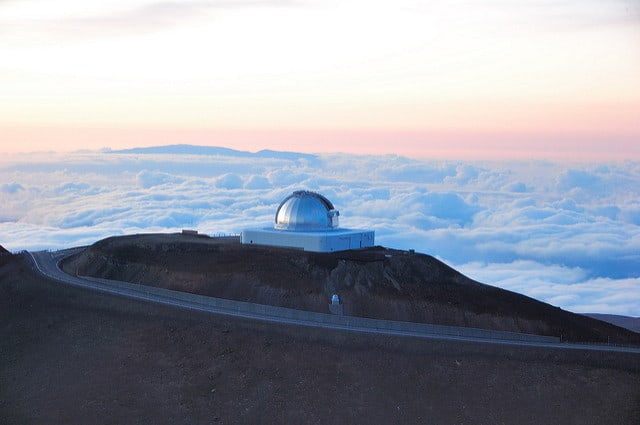
Kilauea on the Big Island is one of a handful of places in the world where volcanologists can study an active volcano closely. Also on the Big Island is Mauna Kea, home to some of the world’s most important observatories for studying optical, infrared, and submillimeter astronomy. And for anyone working in hospitality or tourism, few places offer as high a concentration of job opportunities as Hawaii.
Final thoughts
Hawaii is an amazing place, there’s no doubt about it. Whether it’s the people, the work-life balance, or simply the beachy vibe, it’s no surprise that so many people want to move to Hawaii.
Hopefully this rundown makes the appeal a little clearer — and helps anyone planning a move to Hawaii feel better prepared for the amazing journey that awaits.