The phrase “pahoa farmers market” almost always brings up the Wednesday night gathering at Uncle Robert’s Awa Bar in Kalapana, and that market deserves its reputation. But relocating households researching the Puna district discover quickly that the region’s produce economy runs a much wider weekly rotation. Sunday mornings anchor at Maku’u, Saturdays at the downtown Hilo Farmers Market, and smaller pop-ups fill the calendar around Pahoa village itself.
For a mainland reader planning a scouting trip or a first year on the Hilo side, mapping this cadence matters as much as knowing which islands to visit. A single Puna day trip can hit two markets, a lava-viewing pullout, and a fruit stand run by the same farmer who sold at Maku’u that morning. The catch: nearly every transaction is cash, and the rambutan, dragon fruit, and longan that draw visitors follow narrow seasonal windows.
This guide maps the four major Puna and Hilo-side markets by day, hour, vendor cluster, and produce specialty. It also walks through a realistic 12-hour loop from either Puna farmstay or HVNP village lodging, plus what has changed on the ground since the 2018 lava flow rerouted lower Puna access.
The Puna market week at a glance
Puna’s four largest weekly markets fall on four different days, which means a household basing on the Hilo side for a week can visit all of them without doubling up. The table below shows the anchor days, hours, and rough vendor counts as of the most recent season.
| Market | Day | Hours | Vendors | Anchor produce |
|---|---|---|---|---|
| Maku’u Farmers Market | Sunday | 7:00 AM – 2:00 PM | 90–120 | Rambutan, taro, kava |
| Uncle Robert’s Kalapana | Wednesday | 5:00 PM – 9:00 PM | 50–70 | Dragon fruit, prepared food |
| Hilo Farmers Market (big day) | Wednesday & Saturday | 6:00 AM – 3:00 PM | 200+ | Longan, papaya, flowers |
| Pahoa Village Sunday | Sunday | 8:00 AM – 2:00 PM | 20–35 | Greens, coffee, baked goods |
The Wednesday overlap between Hilo’s big day and Uncle Robert’s evening market is the classic pairing for a first-time visitor: shop the Hilo stalls in the morning, drive 30 miles south for the Kalapana music-and-food scene after sunset.
Why four markets, not one
Puna’s growers are small-plot farmers on lots between one and ten acres, most of them off-grid or partially so. Selling direct at multiple markets each week keeps a farm’s cash flow steady without committing to a single wholesale contract. A vendor who moves rambutan at Maku’u Sunday morning may drive the leftover flats to Pahoa’s afternoon market, then process the same fruit into freeze-dried snacks for Wednesday.
Uncle Robert’s Wednesday night market in Kalapana
Uncle Robert’s Awa Bar sits at the end of Highway 130 in Kalapana, where the road meets the 1990 lava flow that buried the old Kaimu black-sand beach. The Wednesday night market runs from roughly 5:00 PM to 9:00 PM year-round, with live Hawaiian music from about 6:00 PM and a food-truck cluster that pulls visitors from Hilo, Volcano, and even Kona day-trippers.
Produce is a smaller share here than at Maku’u — the tent count skews toward hot food, awa (kava) drinks, jewelry, and craft. But a handful of Puna farm stalls still bring the week’s dragon fruit haul, and the Kalapana location means the ride home wraps around the eastern rift zone with sunset light on the ocean cliffs.
For the granular vendor rotation, expected wait times, and cash-load recommendations, the deeper writeup on the Uncle Robert’s Puna Wednesday market covers what to bring and when to arrive.
Parking and traffic to Kalapana
The final 12 miles of Highway 130 narrow as they descend toward the coast, and the Wednesday inbound rush from about 4:30 PM to 6:00 PM turns the two-lane road into a slow convoy. Arriving at 5:00 PM sharp usually secures gravel parking within a 3-minute walk of the main tent. After 6:30 PM the overflow lot fills, and later arrivals park along the shoulder for a 10-to-15-minute walk in.
Music, awa, and what to expect after 7 PM
Hawaiian slack-key and reggae sets take the small covered stage from about 6:00 PM onward. Awa (kava) is served in coconut-shell cups at $5 to $8 each depending on preparation. The crowd density peaks around 7:30 PM, when the food-truck lines run 15 to 25 minutes deep. Visitors focused on produce should shop the tents in the first 45 minutes, then settle in for music.
Maku’u Farmers Market on Sunday morning
Maku’u is the largest weekly market in Puna proper. It sets up on Kea’au-Pahoa Road (Highway 130) between Kea’au and Pahoa, roughly 15 miles south of Hilo. Sunday hours run from 7:00 AM to 2:00 PM, with the strongest vendor turnout and freshest produce in the first two hours after opening.
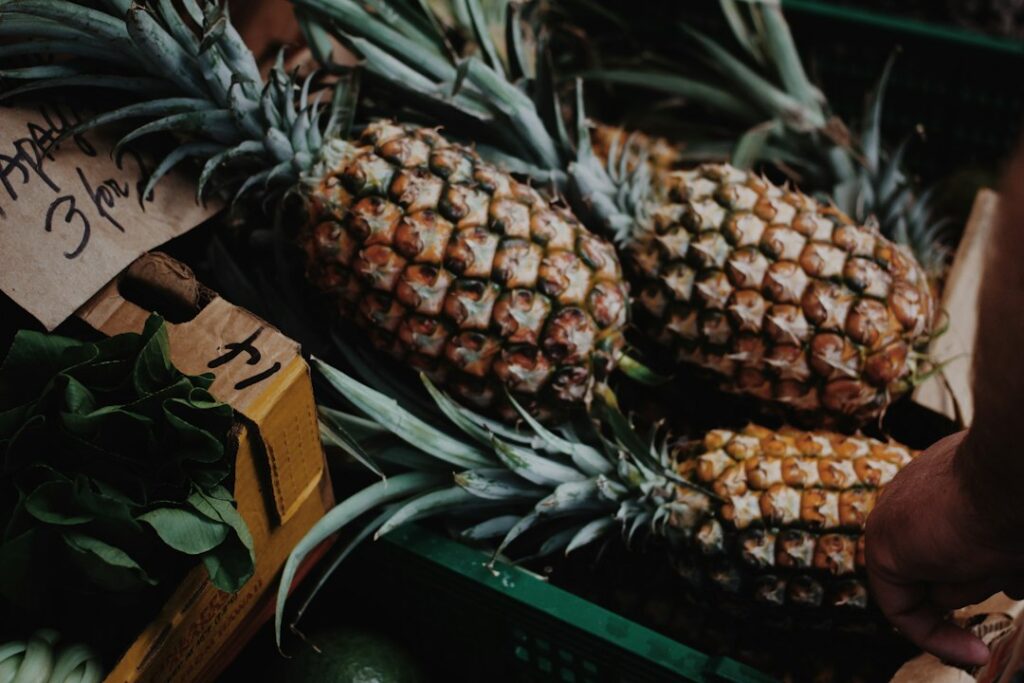
The vendor count typically lands between 90 and 120 stalls, spread across a shaded grassy field. Produce dominates the front rows: rambutan by the pound in season, dragon fruit stacked by color, longan clusters wrapped in newspaper, and taro roots sold both fresh and as prepared poi. Behind produce sits the food-truck row, and further back the flea-market-style stalls with tools, plants, and clothing.
What Maku’u sells that the others don’t
Maku’u’s scale gives it a produce depth that the other Puna markets cannot match. Buyers looking for rare stone-fruit varieties, unusual citrus, or specific ulu (breadfruit) cultivars have the best odds here. Nurseries selling starter plants for backyard fruit trees also cluster on Sundays — a relevant detail for readers exploring Pahoa and lower Puna relocation and planning their own tropical orchard.
Arrival timing at Maku’u
Sunday traffic on Highway 130 is light before 8:00 AM. Arriving at 7:15 AM catches the first vendor rush without the mid-morning crowd, and the temperature at that hour typically sits in the mid-70s °F even in August. By 11:00 AM the parking lot is full, direct sun raises the field temperature into the high 80s, and the best rambutan flats have usually sold through.
Hilo Farmers Market: Saturday as the full-scale day
The downtown Hilo Farmers Market at the corner of Mamo Street and Kamehameha Avenue runs seven days a week with a smaller weekday footprint and a “big market” cadence on Wednesday and Saturday. The Saturday version is the largest single farmers market on the Big Island’s east side, with more than 200 vendors when the weather cooperates.
Saturday hours run from about 6:00 AM to 3:00 PM. The 6:00-to-8:00 AM window is a working-farmer’s market: chefs, restaurants, and serious home cooks buying by the case. By 9:00 AM the visitor mix takes over, and the flower stalls, ready-to-eat food, and craft tents draw the heaviest foot traffic.
What Hilo Saturday does better than Puna markets
Hilo’s downtown location, covered stall rows, and paved parking make it the easiest market for older visitors, families with strollers, or anyone traveling with cash-heavy grocery loads. The produce selection is broader than any single Puna market, and vendor competition on core staples like papaya, banana, and orange keeps per-pound pricing 10 to 20 percent below the smaller markets.
Wednesday vs Saturday at Hilo
| Feature | Wednesday | Saturday |
|---|---|---|
| Vendor count | 140–170 | 200+ |
| Peak crowd hour | 10:00 AM | 9:00 AM |
| Parking availability | Moderate after 10:30 AM | Tight before 11:00 AM |
| Flower stall count | 8–12 | 15–20 |
| Prepared-food trucks | 10–14 | 18–24 |
Locals often say Wednesday is for shopping and Saturday is for the experience. Visitors basing in Hilo for a week can hit Saturday for volume and Wednesday for a calmer walk through the same downtown stall rows.
Pahoa village and smaller Sunday markets
Pahoa town itself hosts a smaller Sunday farmers gathering along Government Main Road on the north side of the historic village. Hours run roughly 8:00 AM to 2:00 PM. The stall count is modest — 20 to 35 vendors — and the mix leans toward Puna-grown greens, backyard eggs, home-baked goods, and 100% Puna coffee sold by the half-pound.
The village market pairs well with Maku’u earlier the same morning: shoppers hit Maku’u at 7:30 AM, drive 6 miles into Pahoa village by 10:30 AM, and finish with lunch on the wooden boardwalk of Pahoa’s raised-plank main street.
Kalapana Awa Bar Friday cadence
Uncle Robert’s also opens a smaller Friday night session in high-visitor months, though the schedule varies. Friday counts closer to 20 to 30 tents versus Wednesday’s 50 to 70, and live music is not guaranteed. Callers checking ahead are always safer than showing up on a Friday assuming full-scale operations. Vendor rosters shift weekly, so the safest confirmation is a Wednesday-night ask at a favorite stall.
Puna coffee at the village markets
Puna’s lower-elevation coffee has quietly become a serious specialty product. The Pahoa Sunday market usually hosts three to five roasters selling half-pound bags between $12 and $22. Beans harvested in the September-through-February season carry the strongest cup profile, and small-farm labels dominate — commercial-scale roasters stay closer to Kona.
Tropical fruit specialties and seasonal windows
Puna’s warm, wet lowlands grow tropical fruits that most of the mainland only sees imported and freeze-damaged. Three fruits define the visitor experience at these markets: rambutan, dragon fruit, and longan.
Rambutan
Rambutan is a lychee relative with a red, hairy shell and a sweet, grape-like interior. Puna is the primary U.S. commercial growing region. Peak season runs from August through November, with the heaviest flushes typically in September and October. Market prices in the 2025 season ran $8 to $12 per pound, with a 5-pound flat commonly selling for $35 to $45 at Maku’u.
Dragon fruit
Dragon fruit (pitaya) fruits from May through November with multiple flushes. Puna growers sell three main flesh colors: white, red-pink, and deep magenta. Per-pound pricing typically runs $5 to $8, and larger 1-to-1.5-pound single fruits often sell for $6 to $10 each. The deep magenta variety carries a small premium and sells out first on Sunday mornings.
Longan
Longan resembles a smaller, tan-shelled lychee with a similar juicy interior. Its season is short — roughly July through September — and yields vary year to year. Prices ran $6 to $10 per pound in the last season, with quart-container pricing around $12 to $15. Longan is less shelf-stable than rambutan, so morning-of purchases hold up best for a same-day drive back to Volcano or Kona.
Seasonal calendar for major Puna fruits
| Fruit | Peak months | Typical price/lb | Best market |
|---|---|---|---|
| Rambutan | Aug – Nov | $8 – $12 | Maku’u Sunday |
| Dragon fruit | May – Nov | $5 – $8 | Maku’u & Hilo Saturday |
| Longan | Jul – Sep | $6 – $10 | Maku’u Sunday |
| Mangosteen | Jun – Oct (limited) | $15 – $25 | Hilo Saturday |
| Lychee | Jun – Jul | $8 – $14 | Hilo Saturday |
| Papaya (Kapoho Solo) | Year-round | $2 – $4 | All markets |
Readers planning a scouting trip around fruit season should aim for a May visit for early dragon fruit and lingering lychee, or a late-September window for peak rambutan-and-longan overlap. Data on Big Island produce output is aggregated in the Hawaii Department of Agriculture statistics dashboards.
Cash-only norms and payment realities
Nearly every Puna market vendor prefers cash. Some accept Venmo or Zelle, and a few have introduced Square readers, but assuming card acceptance is a mistake. The nearest reliable ATM to Uncle Robert’s is in Pahoa town, roughly 20 minutes back up Highway 130, and the machine has been known to run dry on Wednesday evenings when several hundred visitors hit the same market.
How much cash to carry
A reasonable cash load for a two-person day of market shopping runs $150 to $250. Small bills matter: many vendors cannot break a $100 for a $6 purchase after 9:00 AM. Breakdown suggestions: eight $20s, ten $5s, twenty $1s, and $10 in loose change. A produce-heavy Sunday at Maku’u can easily absorb $80 before lunch even for a light-eating couple.
Recommended cash denominations
- Twenty $1 bills for single-fruit and small snack purchases
- Ten $5 bills for standard produce transactions under $10
- Eight $20 bills for larger flats and prepared-food family orders
- Avoid $50s and $100s — vendor change stocks run thin fast
Building a Puna day trip from Hilo lodging
A household basing in Hilo has the easiest logistics. The drive from downtown Hilo to Maku’u is roughly 15 miles and 25 minutes. Kalapana adds another 30 miles and 45 minutes from Maku’u. A full-day loop covers Hilo Farmers Market breakfast, Maku’u Sunday shopping, Pahoa village lunch, and — on Wednesday, not Sunday — the drive south to Uncle Robert’s for dinner and music.
Sample Sunday itinerary from Hilo
- 7:00 AM: Coffee at a Kamehameha Avenue café, then walk the Hilo Farmers Market
- 8:15 AM: Drive south on Highway 11, cut to Highway 130
- 8:45 AM: Arrive Maku’u for produce, fruit, and prepared-food breakfast
- 10:30 AM: Continue south into Pahoa village for the smaller market
- 12:30 PM: Lunch on the Pahoa boardwalk, then drive back to Hilo
Sample Wednesday itinerary from Hilo
- 7:30 AM: Hilo Farmers Market for the morning working-farmer window
- 10:00 AM: Coffee break and downtown walk in Hilo
- 3:00 PM: Drive south, stop at a Puna scenic pullout
- 4:45 PM: Arrive Kalapana ahead of the 5:00 PM Wednesday market open
- 8:30 PM: Drive back to Hilo, arriving before 10:00 PM
Building the loop from Volcano lodging
Volcano Village sits about 30 miles southwest of Pahoa on Highway 11. A Puna day trip from Volcano is longer but still very doable: 45 minutes down to Pahoa, another 25 minutes to Kalapana, and a full return via Hilo or a direct return via the same highway. Total daily driving lands around 90 to 110 miles depending on the loop chosen.
Volcano-based visitors also gain access to the winery on the way out. A stop at the Volcano Winery for tea and tropical grape flights pairs well with a mid-afternoon return before the Wednesday-night Kalapana drive.
Volcano-to-Puna driving distances
| Segment | Miles | Typical drive time |
|---|---|---|
| Volcano Village → Kea’au | 21 | 28 min |
| Kea’au → Maku’u Market | 7 | 12 min |
| Maku’u → Pahoa Village | 6 | 10 min |
| Pahoa → Uncle Robert’s Kalapana | 12 | 22 min |
| Uncle Robert’s → Hilo downtown | 30 | 50 min |
| Hilo → Volcano Village | 28 | 40 min |
Fuel and range planning
Gas stations are sparse below Pahoa. The last reliable station heading south sits in Pahoa town itself; from there to Kalapana and back, drivers should plan to leave with at least a half tank. Weekly Hawaii pump prices track on the EIA gasoline dashboard, and Big Island prices typically run 30 to 50 cents above the state average.
Weather, roads, and post-2018 access
Lower Puna’s climate is one of the wettest in the state. Pahoa averages about 130 inches of rain per year, and Kalapana often sees 100-plus inches at lower elevations. Market days rarely close for weather, but afternoon squalls in November through March can soak an unprepared visitor within minutes. A packable rain shell in the car is not optional.
2018 lava flow rerouting
The 2018 lower East Rift Zone eruption cut Highway 132 and buried a stretch of Highway 137, permanently rerouting access to the southeast coast. Uncle Robert’s in Kalapana remains open and is reached by Highway 130 from Pahoa; the drive is unaffected. Broader relocation context for the district is covered in the post-2018 Pahoa and lower Puna guide.
Eruption-preparedness overlay
Anyone spending significant time in Puna should know the district’s evacuation zoning. The county’s zone framework is summarized in the Mauna Loa evacuation zones guide, and Hawaii County Civil Defense updates are pushed via the county government site. Vendor communities have practiced re-routing before and will do so again if the East Rift Zone reactivates.
How Puna markets compare to other Hawaii options
Puna’s markets have a distinct character even against other Hawaii markets. Kona’s markets skew tourist and craft; Waimea leans toward high-elevation vegetables and beef; Oahu’s biggest markets prioritize prepared food. Puna sits at the intersection of working-farmer supply and end-of-the-road bohemian culture, which is why the same fruit costs more on Oahu than at Maku’u.
Statewide market context
Readers building a broader picture can cross-reference the statewide farmers markets guide for interisland comparison, and the best farmers markets on Oahu writeup for the Honolulu-side alternatives. Maui’s Paia food-truck cluster covered in the Paia food truck cluster piece occupies a different niche — prepared food rather than raw produce.
Cost-of-living connection
Puna market pricing reflects Big Island grocery inflation more broadly. The BLS Honolulu CPI release tracks statewide food inflation, though rural Big Island prices often move differently from Honolulu’s. Household electricity costs — which drive irrigation and cold-chain pricing on the farm side — are updated by the EIA Hawaii electricity dashboard.
Vendor etiquette and community norms
These markets sit at the heart of small Puna towns, and vendor relationships often stretch back generations. Visitors who treat the space like a tourist attraction get a colder reception than those who ask about a variety, buy a modest amount, and thank the farmer by name. A first-time buyer who returns three Sundays in a row will often be handed a sample bag “for the road.”
Practical do’s
- Bring your own bags, ideally sturdy canvas or insulated totes
- Ask before photographing a specific stall or vendor
- Try one new fruit each visit rather than bulk-buying the familiar
- Tip generously at food trucks — margins are thin
Practical don’ts
- Don’t haggle on produce priced under $10 per pound
- Don’t ask for card payments after the vendor says cash
- Don’t block a stall for 15 minutes without buying
- Don’t bring pets into the covered stall rows
Frequently asked questions
Is there a farmers market in Pahoa town itself, or only in Kalapana?
Pahoa hosts a smaller Sunday farmers market along Government Main Road, running roughly 8:00 AM to 2:00 PM with 20 to 35 vendors. It’s distinct from the larger Kalapana Wednesday night market at Uncle Robert’s Awa Bar, which sits 12 miles south of Pahoa town at the end of Highway 130. Both are worth visiting, but they operate on entirely different days and scales.
Do any Puna farmers markets accept credit cards?
A handful of vendors now carry Square readers, and some accept Venmo or Zelle, but the vast majority operate on cash. Visitors should carry $150 to $250 in small bills for a full day. The nearest ATM to Uncle Robert’s Kalapana is in Pahoa town, about 20 minutes north on Highway 130, and it can run out of cash during Wednesday night market peaks.
When is rambutan actually in season at Maku’u?
Rambutan season on the Big Island runs August through November, with peak volumes usually in September and October. Prices ran $8 to $12 per pound in the 2025 season, and 5-pound flats commonly sold for $35 to $45 at Maku’u Sunday morning. Arriving before 9:00 AM secures the best selection, since serious rambutan buyers clear the top flats within the first two hours.
Can a Volcano-based visitor realistically hit both Uncle Robert’s and Maku’u in one trip?
Not on the same day — Maku’u runs Sunday morning and Uncle Robert’s runs Wednesday evening. A Volcano stay of four nights or more comfortably covers both. Sunday requires a 45-minute drive to Maku’u; Wednesday adds another 25 minutes south to Kalapana. Total driving for the pair over a week runs about 180 miles, plus optional detours through Hilo Farmers Market on Saturday.
How does the Hilo Farmers Market Saturday session compare to Wednesday?
Saturday is the bigger day, with 200-plus vendors versus 140 to 170 on Wednesday. Saturday also brings more flower stalls (15 to 20 versus 8 to 12) and more prepared-food trucks (18 to 24 versus 10 to 14). Wednesday parking loosens after 10:30 AM; Saturday parking stays tight until nearly noon. Locals often shop Wednesday and bring visitors on Saturday.
Has the 2018 lava flow affected access to any of these markets?
No — the four markets covered here all remain fully accessible via Highway 130 and Kea’au-Pahoa Road. The 2018 lower East Rift Zone eruption buried sections of Highway 132 and Highway 137 southeast of Kalapana, but the market route from Hilo through Kea’au, Pahoa, and Kalapana was unaffected. Uncle Robert’s Awa Bar remained open throughout the eruption and continues its Wednesday night cadence.
Are these markets kid-friendly, or better for solo shoppers?
All four are family-friendly. Maku’u has grassy open space, Hilo Farmers Market has paved stalls and stroller access, and Uncle Robert’s Wednesday market includes live Hawaiian music that entertains children through the dinner hour. Pahoa village’s small Sunday market has the calmest pace. Stroller-heavy visitors should skip Uncle Robert’s after 7:00 PM, when crowd density peaks and the gravel lot gets uneven.