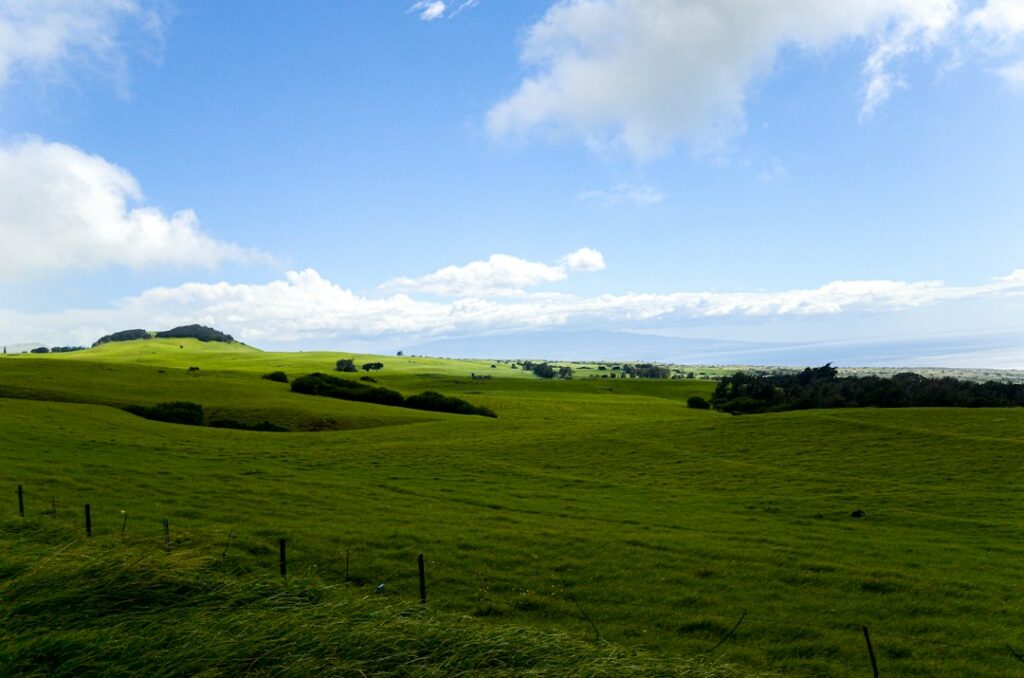
Hawaii’s Important Agricultural Lands (IAL) program locks working farmland into permanent agricultural use in exchange for tax credits and permitting priority. For mainland families researching a move — especially those eyeing acreage on Hawaii Island, Maui, or Kauai — the IAL layer sits on top of the existing State Land Use districts and can quietly rewrite what a rural parcel can ever become.
The program traces to a 1978 constitutional amendment that directed the state to conserve productive farmland, but it did not gain operational teeth until Act 183 (2005) and Act 233 (2008). Today the rules sit in HRS 205-41 through 205-52 and are enforced by the Land Use Commission, county councils, and the Department of Taxation.
This article walks through how a parcel becomes IAL, what the 50% state income tax credit actually pays for, which uses are barred once designation attaches, and why undoing an IAL classification is one of the hardest land use maneuvers in Hawaii law.
What Important Agricultural Lands designation actually means
IAL is not a State Land Use district. It is a separate overlay attached to parcels already sitting inside the Agricultural district. A parcel can be in the “A” district without ever becoming IAL; once it is designated IAL, however, the parcel gains a permanent agricultural-use covenant that runs with the land regardless of ownership changes.
The Legislature’s stated goal is to identify roughly 15% to 20% of the state’s agricultural base — the parcels with the best soils, water access, and infrastructure — and shield them from residential or commercial conversion. As of the most recent Department of Agriculture inventory, roughly 85,000 acres have been formally designated, well short of the long-term target.
Because the covenant survives sale and inheritance, IAL status is a title-level fact that shows up on the tax map key record. It belongs in every diligence checklist alongside easements, kuleana history, and county zoning. Buyers who miss it commit to a farming obligation they never intended to price into their purchase.
The statutory framework and eight designation standards
HRS 205-44 defines the standards a parcel must meet before it can be added to the IAL inventory. County agencies and the Land Use Commission evaluate a parcel against eight statutory criteria, and a parcel does not need to satisfy every criterion to qualify — it must simply score highly on a weighted assessment.
The eight standards drive both mapping exercises and individual petitions. County planning departments produce IAL maps that rank parcels against these factors:
- Land currently used for commercial agriculture
- Soils with high productivity ratings (Prime, Unique, or Other classes)
- Contiguous parcels large enough for viable operation
- Access to available surface or well water for irrigation
- Access to transportation infrastructure and processing facilities
- Past investment in agricultural improvements
- Sustained past use for commercial farming
- Consistency with the county general plan and long-range planning
The Department of Agriculture publishes maps that apply these criteria at the parcel level. Land Study Bureau soil ratings from the 1970s, plus USDA Prime and Unique classifications, still do most of the analytical work — a quirk of Hawaii planning practice that occasionally frustrates newer landowners with modern soil test data.
The two designation pathways
HRS 205-45 and 205-47 create two very different routes into IAL status. Which route a parcel travels shapes how much control the landowner retains, how quickly designation happens, and which incentives attach at the end of the process.
Landowner-initiated petition (HRS 205-45)
A landowner may voluntarily petition the Land Use Commission to designate all or part of their land as IAL. The petition triggers a public hearing, review by the county planning department, and a written LUC decision. Voluntary petitioners gain immediate access to the 50% state income tax credit under HRS 235-110.93 and to loan guarantees under the Agribusiness Development Corporation.
The tradeoff is permanence. Once the LUC issues a designation order, the parcel is bound by every IAL restriction until two-thirds of the LUC votes to remove it — a supermajority the Commission has almost never granted.
State-initiated county recommendation (HRS 205-47)
County councils, working from planning department recommendations, may forward maps of proposed IAL parcels to the LUC without landowner consent. The LUC still holds hearings and issues findings, but the landowner loses the voluntary petitioner incentives — no tax credit multiplier, no priority processing bonuses. Recommended parcels tend to be historically productive plantation lands, seed corn tracts on Molokai, and central-Oahu diversified agricultural lots.
State-initiated designations have moved slowly. Oahu, Kauai, Maui, and Hawaii County have all worked through recommendation cycles, but political friction around development corridors such as Ho’opili and Koa Ridge — extensively covered by Star-Advertiser reporting — has repeatedly stalled council votes.
| Feature | Landowner petition (HRS 205-45) | State-initiated (HRS 205-47) |
|---|---|---|
| Initiator | Fee-simple owner | County council recommendation |
| 50% state income tax credit | Yes, from Year 1 | Only if landowner accepts |
| Loan guarantee eligibility | Up to $1.5 million per project | Limited |
| Public hearing required | Yes | Yes |
| Removal supermajority | Two-thirds LUC vote | Two-thirds LUC vote |
| Typical timeline | 9 to 18 months | 3 to 7 years |
The 50% state income tax credit
The headline incentive is HRS 235-110.93, which lets a qualified IAL landowner claim a nonrefundable state income tax credit equal to 50% of qualified agricultural costs, capped at $625,000 per project in the aggregate over the credit’s life. The credit covers capital investments — new fencing, irrigation retrofits, packing sheds, feeder systems, water reservoirs — that keep the parcel actively producing.
A cap of $7.5 million per calendar year applies across all statewide claimants, and the Department of Taxation allocates on a first-come basis. Applicants file Form N-344, and unused credits carry forward until fully claimed. Coordination with the broader Hawaii state tax picture matters because the credit is nonrefundable.
Counties also apply a real property tax break: IAL parcels are taxed at the lowest agricultural rate within each county’s schedule, and Honolulu, Maui, and Kauai further reduce the assessment on IAL-classified land relative to the ordinary “A” rate. The effective savings often run 40% to 55% off the standard agricultural rate for the parcel.
| County | Standard ag rate ($/1,000) | IAL effective rate ($/1,000) | Annual saving on $500,000 assessed |
|---|---|---|---|
| Honolulu | $5.70 | $3.50 | $1,100 |
| Maui | $5.94 | $3.50 | $1,220 |
| Hawaii County | $9.35 | $5.05 | $2,150 |
| Kauai | $6.75 | $3.50 | $1,625 |
These figures reflect the 2024–2026 assessment cycles; each county sets its schedule annually through the council budget process, so Hawaii County and its peers publish updates every summer. Households comparing after-tax cost of ownership can layer these numbers against the broader Maui cost of living to see how much the IAL discount actually shifts a monthly budget.
What IAL designation blocks — subdivision and non-agricultural use
The restrictions in HRS 205-45 and 205-46 are the reason the tax credit exists. Once designated, a parcel operates under a set of hard prohibitions:
- Cannot be subdivided into lots smaller than 50 acres unless the county reduces the minimum for good cause
- Cannot be reclassified out of the Agricultural district without a two-thirds LUC supermajority vote
- Cannot host non-agricultural principal structures beyond the Section 7 farm dwelling allowance
- Cannot be used for permanent commercial or industrial operations unrelated to agriculture
- Cannot support new golf courses, resort uses, or heliports
- Cannot be sited for utility-scale solar or wind unless the state finds no comparable non-IAL alternative
The subdivision cap is the restriction that hits mainland buyers hardest. Non-IAL Agricultural district parcels commonly subdivide to 2, 5, or 10-acre minima depending on the county. IAL forces 50 acres unless a specific exemption survives council review, which effectively ends the strategy of buying acreage to split among heirs or sell down over time.
The interaction with the underlying State Land Use district framework matters here. IAL sits inside the “A” district as a covenant; escape requires two consecutive supermajority actions, one to lift IAL and one to redraw the district boundary.
Non-agricultural principal structures include vacation rentals not tied to a working farm, second homes for absentee owners, and any commercial venue disconnected from crop or livestock production. Enforcement runs through the county planning department, which can revoke building permits and file abatement actions when it finds an unpermitted use.
Section 7 farm dwelling allowance
The one significant exception to the “no residential uses” rule is what practitioners commonly call the Section 7 farm dwelling allowance. It permits one single-family dwelling per farm parcel above a threshold acreage — typically five acres — provided the dwelling houses a working farmer, family member, or paid farm worker whose principal occupation is the on-parcel agricultural operation.
Section 7 dwellings must meet a documented nexus test. The owner files an income-and-use declaration with the county, and periodic recertification is required. Counties commonly require that at least 50% of household income derive from the farm, or that the operation produces at least $35,000 in annual gross agricultural sales — thresholds set at the county level rather than in HRS 205 itself.
This nexus test is what turns a farm dwelling allowance into a real restriction. Vacationing owners who plant token orchards and stay in the home a few weeks per year fail the test on paper, even if the county never audits them. When an heir inherits and cannot meet the standard, the dwelling can revert to a code-compliance target within a few tax cycles.
Estate planning tools such as a transfer-on-death deed or a properly restated trust let the parcel pass to the family member most likely to farm it actively, preserving both the Section 7 dwelling and the tax advantages.
Farm dwelling versus ohana unit versus ADU
Hawaii’s county codes recognize several accessory unit categories that mainland buyers commonly confuse. A Section 7 farm dwelling is not an ohana, and it is not a permitted ADU under a residential subdivision. The table below shows why the distinctions matter.
| Structure type | Allowed on IAL? | Occupancy rule |
|---|---|---|
| Section 7 farm dwelling | Yes (with nexus) | Farmer or farm worker |
| Ohana unit | Usually no | Family member on residential lots |
| Permitted ADU (residential) | No | Any resident on urban district lots |
| Farm labor housing | Yes (barracks-style) | Paid farm workers only |
| Short-term vacation rental | Prohibited | Not applicable |
Reclassification friction — why exiting IAL is nearly impossible
HRS 205-52 sets the removal standard. A landowner petitioning to withdraw a parcel from IAL must show that the land no longer meets the standards in HRS 205-44 and that removal serves a public purpose. The LUC then requires a two-thirds vote — six of nine commissioners — to approve.
Between 2008 and the current inventory cycle, only a handful of removal petitions have been granted, most tied to public infrastructure takings such as highway alignments or utility corridors. Voluntary removals for private development purposes have been effectively unavailable throughout the program’s history.
This friction extends to Land Use Commission district reclassification petitions. Moving IAL from the Agricultural to the Urban district requires the same two-thirds vote plus a separate LUC boundary amendment — two supermajority votes and typically 24 to 36 months of hearings, environmental review, and county council concurrence.
The practical effect is that buyers should treat IAL designation as functionally permanent. Any pro forma that assumes future upzoning is unrealistic. The LUC has publicly stated that IAL parcels will be treated as the last candidates for urban expansion in every future round of district boundary review.
Additional incentives beyond the tax credit
Beyond the 50% credit and reduced property tax, HRS 205-46 lists secondary benefits designed to make active farming viable on designated land:
- Priority processing for state agricultural loan guarantees up to $1.5 million
- Preference for state agricultural water rate schedules
- Farm road maintenance grants administered by the Department of Agriculture
- Priority access to Agribusiness Development Corporation crop diversification programs
- Automatic eligibility for state agricultural park lease programs where available
- Preference in USDA Farm Service Agency programs coordinated at the state level
State agricultural water rates on Oahu run roughly $0.51 per thousand gallons versus $5.10 per thousand for standard Board of Water Supply rates — a tenfold reduction that alone can save a mid-sized farm $18,000 to $30,000 per year on irrigation, depending on crop type and rainfall pattern.
Farm road maintenance grants matter more than the dollar figure suggests. Many IAL parcels sit on private access roads that require regular grading, culvert clearing, and drainage repair — costs the state absorbs for designated parcels under joint memoranda between the City and County of Honolulu or Hawaii County and the state Department of Agriculture.
Timeline and cost of pursuing designation
Landowners filing voluntary petitions should budget for a 9- to 18-month timeline and $15,000 to $60,000 in professional services. The largest cost driver is the parcel-specific soil, water, and productivity study the LUC expects to see attached to the petition.
| Cost category | Typical range | Purpose |
|---|---|---|
| LUC filing fee | $500 to $2,500 | Statutory petition intake |
| Land use attorney | $8,000 to $25,000 | Petition drafting and hearing |
| Soil productivity study | $4,000 to $12,000 | HRS 205-44 documentation |
| Water availability report | $3,000 to $10,000 | Irrigation feasibility |
| Farm business plan | $2,500 to $8,000 | Credit qualification |
| Public notice and mailing | $500 to $1,500 | Chapter 91 hearing notice |
The 50% state income tax credit typically pays back these upfront costs within 3 to 5 tax years for a working farm making even modest capital investments. Passive owners or absentee landowners who cannot claim the credit see a much longer breakeven window — often past year 10 once the property tax discount alone is doing the work.
How IAL interacts with cost of living and estate planning
Because IAL parcels lock land into a low-appreciation trajectory, they alter the arithmetic of both retirement budgeting and estate planning. A designated parcel appreciates roughly in line with agricultural land indices rather than urban residential — perhaps 2% to 4% per year rather than the 6% to 8% Honolulu residential average of the last decade.
For families relying on land as a store of value, IAL designation is a policy-imposed cap on that value. On the other hand, the lower assessment and property tax reduce the annual carrying cost enough that some retirees explicitly choose IAL parcels to control monthly outflows in retirement.
Estate planning gets more constrained. IAL parcels cannot easily be divided among multiple heirs — the 50-acre subdivision minimum forces most families into either sole-successor structures, tenancy-in-common arrangements, or trust-held ownership that keeps the parcel intact across generations.
Small estates benefit from routing farm dwellings and equipment through the small-estate affidavit path where possible, while the underlying acreage passes through a properly structured trust — often one revised via Hawaii’s trust decanting statute to add explicit farm-management authority to the trustee.
Diligence checklist for buyers considering an IAL parcel
Buyers who plan to farm actively find that IAL parcels can produce strong risk-adjusted returns after credits. Buyers who see the land primarily as future development or a lifestyle home almost always regret the purchase within a few years. A structured diligence pass separates one group from the other.
- Pull the tax map key record and confirm current IAL designation status
- Verify the LUC decision order and any subsequent modifications
- Review the county real property tax assessment history for the reduced rate application
- Confirm any existing Section 7 farm dwelling has current recertification on file
- Order a soil productivity study to understand the parcel’s Class ratings
- Read the county planning department’s IAL enforcement history for the parcel
- Model the after-tax return including the 50% credit and the property tax reduction
- Confirm water source, allocation, and rate schedule for irrigation needs
Attorneys handling these transactions typically add a specific IAL rider to the purchase agreement that lists every restriction, every recertification requirement, and every pending removal or modification petition on file. Skipping the rider is the single most common source of post-closing regret documented in Civil Beat coverage of Neighbor Island rural land disputes.
Common misconceptions among mainland buyers
A recurring mistake among mainland buyers is treating “Agricultural district” and “IAL” as interchangeable labels. The Agricultural district is a State Land Use classification created in 1961 that covers roughly 1.9 million acres statewide. IAL is a subset — the parcels within that classification that received the additional overlay under Act 183.
A second misconception treats the 50% credit as automatic. It is a nonrefundable income tax credit; households with no Hawaii state income tax liability cannot claim it. Corporate farm entities and pass-through structures capture the credit far more efficiently than sole proprietors with modest Hawaii-source income.
A third misconception treats IAL status as tradeable. HRS 205-52 does allow limited compensating designations in narrow circumstances, but the LUC has not treated this as a real off-ramp. Owners should assume the covenant is permanent unless legal counsel specifically confirms otherwise for a documented public purpose.
Frequently asked questions
Does IAL designation affect residential mortgage financing?
Most conventional mortgage lenders treat IAL parcels as agricultural collateral requiring specialized farm credit products. Fannie Mae and Freddie Mac guidelines exclude working farms above 40 acres from standard residential financing. Buyers usually need to use Farm Credit Services of Hawaii or the state Agribusiness Development Corporation loan guarantee program for competitive rates on IAL parcels.
Can an IAL parcel host a short-term vacation rental?
No. Short-term rentals are non-agricultural uses that fail both the Section 7 farm dwelling nexus test and the general prohibition on commercial non-farm operations. County ordinances also independently ban new short-term rentals on Agricultural district land in most zones. Enforcement is aggressive because IAL status is often the county’s clearest hook for issuing a cease-and-desist order.
How long does a landowner-initiated designation take?
Voluntary petitions filed with the Land Use Commission generally close in 9 to 18 months from filing to decision order. The timeline depends on public hearing scheduling, county planning department review, and any objections filed during the notice period. Complex parcels with disputed soil ratings or unclear water rights can extend the process past 24 months.
Does IAL status transfer automatically upon inheritance?
Yes. IAL designation is a permanent overlay on the parcel that survives every ownership transfer including inheritance, gift, sale, and trust conveyance. Heirs assume every restriction and every recertification requirement — including the Section 7 farm dwelling nexus test — from the date of transfer. Executors should review recertification deadlines before closing an estate.
Can utility-scale solar be developed on IAL land?
Only when the developer proves no comparable non-IAL site exists within the same interconnection zone. HRS 205-4.5 was amended to allow certain agrivoltaic and rooftop solar on IAL parcels when the agricultural use continues underneath. Standalone utility-scale solar without co-located farming is functionally barred and has not been approved on an IAL parcel through the current cycle.
Are there tax benefits for buyers who inherit an IAL parcel?
Heirs inherit the 50% state income tax credit for future qualified agricultural investments and the reduced property tax rate. The federal step-up in basis rules still apply, so heirs receive fair market value basis at date of death. Hawaii does not impose a state estate tax on parcels below the statutory exemption, currently $5.49 million.
What happens if the working farm operation stops?
If active agricultural use ends, the county planning department may issue a compliance notice requiring a farm business plan and a return to production within a defined cure period, typically 12 to 24 months. Continued fallow status can trigger revocation of the property tax reduction and, in rare cases, LUC review — though the underlying IAL covenant itself does not lapse.