The brown tree snake (Boiga irregularis) is not established in Hawaii, and keeping it that way is one of the largest ongoing biosecurity operations in the Pacific. HDOA’s Plant Quarantine Branch coordinates cargo screening with the Department of Defense, USDA Wildlife Services, and the U.S. Fish and Wildlife Service.
The concentration of effort on inbound Guam cargo is deliberate. Between 1981 and 2024, at least eight brown tree snake interdictions have been documented in Hawaii, and every one traced back to Guam-origin shipping, military airlift, or transshipment through Guam’s ports.
This article explains how the inspection system actually works at Honolulu Harbor, Joint Base Pearl Harbor-Hickam, and Kahului. It covers snake-detector dog teams, mandatory holds on military cargo, why Guam transshipment triggers extra scrutiny for household goods, and how residents report a suspected sighting to the 643-PEST hotline.
Why the brown tree snake threatens Hawaii
The brown tree snake reached Guam as a stowaway on post-World War II military cargo, likely between 1949 and 1952. Within four decades, the nocturnal, mildly venomous snake had eliminated 10 of Guam’s 12 native forest bird species. Population densities peaked at up to 13,000 snakes per square mile in the 1980s, one of the highest densities recorded for any snake species.
Hawaii’s ecosystems present nearly identical conditions: no native land snakes, dense forests, ground-nesting seabirds, and endemic honeycreepers already stressed by avian malaria and habitat loss. A 2010 University of Hawaii Economic Research Organization analysis estimated establishment costs at $593 million to $2.14 billion annually in lost tourism, power outages, medical treatment, and control spending.
Power outages are a specific concern. On Guam, the snakes climb utility poles and short transformers, causing more than 1,600 power outages per year at peak infestation. Hawaiian Electric already contends with wildfire and hurricane risks; adding a climbing predator to that list would strain grid reliability across every island.
Species at immediate risk
- Palila, akiapolaau, and akohekohe — endemic honeycreepers already listed as endangered.
- Nene (Hawaiian goose), the state bird, which ground-nests on Kauai, Maui, and Hawaii Island.
- Wedge-tailed shearwater and Laysan albatross colonies at Kaena Point and Kilauea Point.
- Hawaiian hoary bat (opeapea), the only native land mammal.
- Green sea turtle hatchlings on windward-facing beaches during summer nesting.
The HDOA Plant Quarantine Branch mission
The Plant Quarantine Branch operates under Hawaii Revised Statutes Chapter 150A and enforces Hawaii Administrative Rules Title 4, Chapters 70 and 71. Its inspectors have peace-officer status for cargo enforcement and can hold, refuse, or destroy shipments that fail inspection. The branch runs stations at Honolulu Harbor, Kalaeloa Barbers Point Harbor, Kahului Harbor on Maui, Nawiliwili Harbor on Kauai, and Hilo and Kawaihae on Hawaii Island.
Funding comes from a mix of state general revenue and the Pest Inspection, Quarantine, and Eradication Fund, which draws a $1.00 per 1,000-pound assessment on inbound freight. The Legislature has periodically boosted the fund; the fiscal 2024 appropriation for biosecurity was roughly $6.3 million, according to Honolulu Civil Beat reporting on state budget hearings.
Personnel remain the binding constraint. The branch has struggled with vacancy rates above 20 percent for inspector positions, which slows cargo throughput and forces triage decisions about which containers get physical inspection versus paperwork review alone. A 2022 legislative audit found staffing shortfalls specifically limited snake-response capacity outside normal business hours.
Interagency partners
HDOA does not act alone on brown tree snake risk. USDA Wildlife Services runs the snake-detector dog program under a cooperative agreement, while the Department of Defense enforces cargo protocols at Andersen Air Force Base on Guam before flights reach Hickam. The U.S. Fish and Wildlife Service supports habitat-side surveillance around ports, and HDOT Harbors Division coordinates dock access for inspection teams.
Snake-detector dog teams at ports of entry
The snake-detector dog program is the most visible piece of the interdiction system. USDA Wildlife Services runs the primary kennel at Andersen Air Force Base on Guam, where roughly 8 to 12 Jack Russell terriers, beagles, and small mixed-breed dogs are certified to alert on live brown tree snake scent. Handlers rotate through 12-week training cycles, and each dog is recertified every 6 months.
On the Hawaii side, USDA maintains a smaller contingent of certified dogs that respond to specific alerts and conduct scheduled sweeps at Honolulu Harbor and the joint-use cargo apron at Joint Base Pearl Harbor-Hickam. When a Guam-origin container arrives, dogs work the exterior seams, ventilation vents, and undercarriage before the container is opened for physical inspection.
Detection performance varies with cargo type. Studies by the National Wildlife Research Center have reported detection rates above 70 percent on planted-snake trials in outdoor container yards, with rates dropping in high-heat conditions above 95°F when scent dispersal patterns change. Dogs work 20-to-30-minute shifts with mandatory water breaks, which is why teams typically deploy in pairs.
Where the dogs work
| Location | Cargo type | Approximate frequency |
|---|---|---|
| Andersen AFB, Guam (outbound) | Military airlift, DoD household goods | Every outbound flight to Hawaii |
| Apra Harbor, Guam (outbound) | Matson and DoD sea cargo | Every outbound vessel to Honolulu |
| Joint Base Pearl Harbor-Hickam | Inbound military airlift | All Guam-origin flights on arrival |
| Honolulu Harbor Piers 1-51 | Commercial containers from Guam | Targeted, plus random audits |
| Kahului Harbor, Maui | Interisland transshipment | As alerted by Honolulu screening |
Mandatory military cargo holds at Hickam
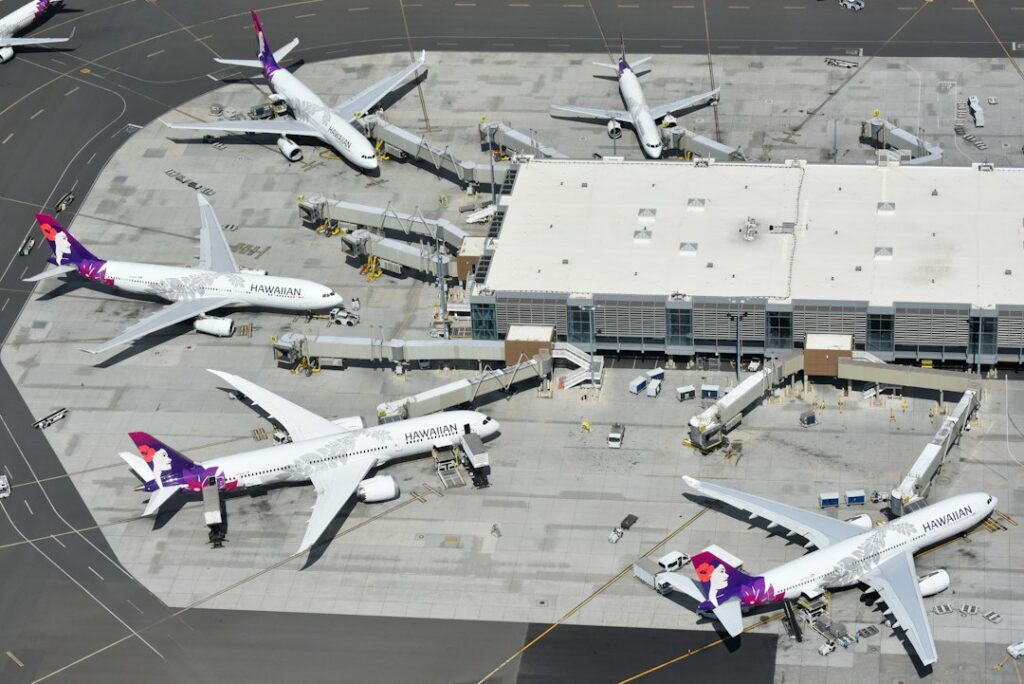
Joint Base Pearl Harbor-Hickam sees the highest volume of Guam-origin cargo in Hawaii because of Andersen Air Force Base’s role as a Pacific staging hub. C-17 Globemaster III and C-5 Galaxy flights routinely move pallets, vehicles, and household goods for permanent change of station moves. Every one of those flights is treated as a brown tree snake risk under Department of Defense Instruction 4715.20 and joint HDOA protocols.
The protocol chain begins on Guam. Before loading, cargo staged for Hawaii goes through a “snake sweep” in a sealed inspection facility where USDA teams have 30 to 90 minutes to visually inspect and dog-check pallets. Aircraft cargo holds are also inspected, and outer surfaces are sprayed with a fenthion-based residual barrier where allowed.
On arrival at Hickam, aircraft are held on a designated parking apron until HDOA and USDA teams complete a secondary inspection. Household goods bound for a PCS to Hawaii can add 4 to 24 hours of hold time depending on the container mix and whether a dog alert triggers a full offload. Families moving into AMR military housing often see the effect as a delayed delivery window.
Timeline for a PCS shipment routed through Guam
- Origin pickup and packing at the outbound duty station (typically 1–3 days).
- Consolidation at Andersen AFB freight terminal on Guam (2–7 days).
- Snake sweep and container sealing before loading (30–90 minutes per pallet).
- Flight or sea leg to Hawaii (6 hours by air, 5–7 days by sea).
- Hickam or Honolulu Harbor hold and secondary inspection (4–24 hours).
- Release to transportation office and delivery scheduling.
Why Guam transshipment adds inspection time for civilian shipments
Civilian household goods do not always route directly from a mainland origin. If a shipment passes through Guam’s Apra Harbor as a transshipment point — common for consolidated freight moving via Pacific carriers — it inherits Guam-origin risk classification even if the goods never physically originated there. That designation triggers additional screening on arrival at Honolulu Harbor.
Carriers like Matson and Pasha Hawaii disclose Guam-touchpoint status on their bills of lading, and HDOA cross-references those against arrival manifests. A container flagged as Guam-transshipped can spend an extra 12 to 48 hours at the container yard before release. This delay is separate from any agricultural inspection for soil, plant material, or produce.
Movers arranging their own containers should ask carriers explicitly whether a route touches Guam. A direct Long Beach-to-Honolulu sailing is faster and cheaper on inspection charges than one routed through Apra Harbor, even if the base freight rate looks similar. This detail is worth checking well before booking, especially for households timing arrival around planning a Hawaii move.
Approximate inspection fee ranges
| Shipment type | Standard inspection fee | Guam-origin surcharge |
|---|---|---|
| 20-foot container, household goods | $85 flat plus $0.005/lb | Additional $75 handling |
| 40-foot container, household goods | $135 flat plus $0.005/lb | Additional $125 handling |
| Pallet freight (LCL) | $45 per pallet | Additional $35 per pallet |
| Personal vehicle (POV) | $65 flat | Additional $25 for undercarriage sweep |
| Air cargo, over 500 lbs | $0.02/lb, $50 minimum | Additional $50 flat |
The 643-PEST hotline and reportable sightings
Hawaii’s Pest Hotline — dial 643-PEST from any island — is operated by HDOA and is the single reporting line for suspected brown tree snakes, coqui frogs, little fire ants, and other invasive species. Callers reach a trained dispatcher who takes location, description, and photo evidence when available. Response for a credible snake sighting is escalated to USDA Wildlife Services within 60 minutes.
Reports have historically peaked in summer months (June through September) when outdoor activity increases and warm nighttime temperatures make snakes more active if present. Anonymous reporting is accepted, and Hawaii offers a reward of up to $1,000 for verified brown tree snake reports leading to confirmed capture, funded through the Hawaii Invasive Species Council.
Residents should photograph any suspected snake at a safe distance, note the exact location and time, and call 643-PEST immediately. Do not attempt capture. Hawaii’s only native reptiles are marine turtles and skinks; any snake sighted on land is by definition non-native and reportable under state law. False reports are not penalized when made in good faith.
What counts as a reportable sighting
- Any snake seen on land anywhere in Hawaii, alive or dead.
- Suspicious shed skins, especially near cargo yards or freight terminals.
- Unfamiliar reptile eggs found in mulch, potted plants, or landscaping.
- Snakes offered for sale online or at swap meets (illegal in Hawaii).
- Freight or luggage from Guam with visible reptile activity.
Legal penalties for illegal snake possession
Hawaii’s snake laws are among the strictest in the United States. Under Hawaii Revised Statutes Section 150A-6.5, knowing possession, transport, or release of a snake is a class C felony. Penalties include fines up to $200,000 for corporations, $50,000 for individuals, and prison sentences up to three years. HDOA also runs an annual amnesty period each January when illegally held snakes can be surrendered without prosecution.
Amnesty surrenders have produced a running total of over 300 snakes and other prohibited reptiles turned in since 1990. Most are ball pythons, boa constrictors, and corn snakes brought as pets by mainland arrivals who did not check Hawaii’s law. Ball pythons are legal in every mainland state; possessing one in Honolulu is a felony.
For anyone moving with an exotic pet inventory, checking the HDOA prohibited species list before shipping is non-negotiable. The published list overlaps only partially with USDA restricted species and includes hedgehogs, gerbils, ferrets, and all snakes. Movers who realize mid-shipment that a pet is prohibited should call 643-PEST rather than trying to conceal or reroute.
Cost of establishment: what Hawaii is protecting against
Every dollar spent on inspection is small compared to the estimated cost of an established population. The University of Hawaii Economic Research Organization modeled a range of scenarios in a 2010 study updated in 2020. In the most probable establishment scenario — a breeding population confined to Oahu — annual costs reached $593 million. In the worst case, with spread to Maui and Hawaii Island, annual costs rose to $2.14 billion.
Those figures are dominated by three categories. Direct tourism loss — from perception effects and specific site closures — accounts for roughly 60 percent of the modeled total. Power outage repair and medical treatment for envenomation of infants and small children make up most of the balance, with permanent bird-species loss carrying a monetized but limited share.
The Census Bureau puts Hawaii’s population at about 1.44 million as of 2024, with 10 million annual visitors in a normal tourism year. Even a 5 percent visitor drop translates to more than 500,000 fewer arrivals and a multi-billion-dollar hit to state GDP. That math is why biosecurity ranks alongside hurricane preparedness in state emergency planning.
Comparison of biosecurity threats and mitigation spending
| Threat | Estimated annual damage if established | Current mitigation spend |
|---|---|---|
| Brown tree snake | $593 million – $2.14 billion | $3.5 million (federal + state) |
| Little fire ant | $194 million – $211 million | $4.2 million (state) |
| Coconut rhinoceros beetle | $169 million (coconut sector) | $8 million (USDA/HDOA) |
| Rapid ohia death | Ecosystem loss, unpriced | $3.1 million (DLNR) |
| Coqui frog | $7.6 million (Big Island) | $2 million (Maui/BIISC) |
What movers and PCS families should do
The practical impact on a household moving to Hawaii from Guam, Okinawa, or a mainland duty station routed through Guam is measured in hours and paperwork rather than dollars. Awareness of the extra inspection layer allows families to plan realistic delivery windows and avoid missing move-in dates for on-base or off-base housing.
Households moving pets need to remember that the FAVN rabies process and the brown tree snake inspection are separate systems. Dogs and cats route through the Airport Animal Quarantine Holding Facility near HNL, not through Plant Quarantine cargo docks. Reptile pets, however, fall under the snake enforcement chain and are almost always prohibited entirely.
For civilian movers, requesting a routing statement from the carrier before booking is worth the phone call. If the shipment will not physically touch Guam, the Guam-origin surcharge does not apply, and inspection turnaround is typically 24 hours faster. Detailed guidance on the full civilian relocation process is covered in the broader Hawaii pet-move guide.
Practical checklist before shipment
- Confirm carrier routing — direct to Honolulu vs. Guam transshipment.
- Photograph and inventory all outdoor equipment, garden pots, and mulch bags before loading.
- Clean and dry all camping gear, tents, and vehicle undercarriages.
- Remove any exotic reptile or amphibian from the household before packing.
- Store the 643-PEST number in your phone before departure.
- Save the HDOA declaration form for review at the port of arrival.
Interisland biosecurity and container transfers
The brown tree snake risk does not stop at Hawaii’s borders. Once cargo lands at Honolulu Harbor, portions of it move onward to Maui, Kauai, or Hawaii Island by barge. Any Guam-origin container that clears initial inspection still gets a tracking flag if it is going interisland. Neighbor-island ports run their own smaller inspection stations and coordinate with the central Plant Quarantine office at Sand Island.
Kahului Harbor on Maui handles roughly 300,000 tons of inbound cargo per year, of which a small fraction has Guam-transshipment history. Nawiliwili on Kauai and Hilo on Hawaii Island move smaller volumes but face longer inspector travel times for reactive dog deployments. A suspected sighting on a neighbor island can trigger an inspector flight from Honolulu with turnaround under 4 hours.
Interisland movers scheduling shipments during the summer inspection ramp-up should factor in an extra 12 to 24 hours for any container originally flagged as Guam-touched. This detail matters most for households timing a move around Hawaii’s September travel shoulder season or coordinating with school-year start dates.
Neighbor-island inspection stations
- Kahului Harbor, Maui — 6 inspector positions, 2 vacant as of mid-2024.
- Nawiliwili Harbor, Kauai — 3 inspector positions, staffed to full capacity.
- Hilo Harbor, Hawaii Island — 4 inspector positions, occasional overtime coverage.
- Kawaihae Harbor, Hawaii Island — 2 inspector positions, primarily agricultural.
- Kaunakakai Harbor, Molokai — no dedicated inspector; alerts routed from Maui.
Life in Hawaii after arrival
Once the inspection is cleared and the container is delivered, the biosecurity system becomes largely invisible to daily life. Residents rarely see HDOA inspectors unless they garden with imported soil, ship interisland freight, or move a pet. That invisibility is deliberate; the goal is to keep border risk at the border rather than embedding it in daily inconvenience.
Newcomers who spend time hiking Oahu’s Koolau Range, snorkeling at the best Oahu snorkeling spots, or exploring the rainforests across the islands may not realize that the absence of snakes in the leaf litter is itself a biosecurity outcome. Ground-nesting birds and native invertebrates persist in Hawaii because of that absence.
Residents who report suspicious sightings are treated as force multipliers by HDOA rather than nuisances. The 643-PEST line runs 24 hours a day, and dispatchers escalate credible calls even at 3 a.m. Every confirmed capture over the last four decades has come from either a scheduled inspection or a resident tip — never from a routine wildlife survey. That statistic frames why public reporting matters.
Historical interdictions and what they revealed
Hawaii’s earliest documented brown tree snake interdiction dates to 1981, when a live snake was found in the wheel well of a military aircraft at Hickam. The most recent verified live-snake capture on Hawaii soil occurred in 1998, though several dead specimens have been recovered from cargo holds since. Each interdiction triggered protocol reviews that tightened Guam-side outbound inspection.
A 2020 report by the U.S. Government Accountability Office credited the layered inspection system with preventing establishment despite an estimated 10,000 to 20,000 attempts by individual snakes to enter cargo streams annually on Guam. The report also flagged funding volatility as the single largest risk to continued success, echoing warnings from local outlets like the Honolulu Star-Advertiser.
The interdiction record shows a clear seasonal pattern: 60 percent of documented captures occurred between May and September, mirroring the peak snake activity season on Guam. HDOA schedules extra dog-team shifts and inspection ramps during those months, and the 643-PEST line sees a corresponding uptick in public calls.
Documented interdictions timeline
| Year | Location | Circumstance |
|---|---|---|
| 1981 | Hickam AFB | Live snake in C-141 wheel well |
| 1986 | Honolulu Harbor | Live snake in Guam-origin shipping container |
| 1991 | Schofield Barracks | Dead snake in relocated household goods |
| 1994 | Hickam AFB | Live snake in cargo pallet from Andersen AFB |
| 1998 | Honolulu Harbor | Live snake in vehicle shipment |
| 2011 | Hickam AFB | Dead snake found during routine dog sweep |
How brown tree snake inspection fits into Hawaii’s broader biosecurity picture
Snake inspection is one leg of a larger stool that also includes agricultural pest interdiction, aquatic invasive species screening, and wildlife disease monitoring. The state Department of Health coordinates on disease vectors like the little fire ant and mosquito-borne illness, while HDOA holds primary responsibility for plant and animal quarantine.
Fuel costs from the EIA gasoline data and electricity rates from the EIA Hawaii electricity profile feed into cost-of-establishment modeling: an outage-prone grid caused by snakes would compound Hawaii’s existing energy price disadvantage. Household electricity in Hawaii already averages 41.8 cents per kWh as of 2024, roughly 2.5 times the national average.
Local media coverage from Hawaii News Now periodically covers detection drills and public reporting campaigns. The City and County of Honolulu partners on port access, and Hawaii County supports outreach on the Big Island. This distributed governance keeps snake inspection visible even without a single headline agency.
Frequently asked questions
Has a brown tree snake ever established a breeding population in Hawaii?
No. As of 2026, no breeding population has been documented in Hawaii, and every recorded snake has been an interdicted specimen linked to Guam-origin cargo. The multi-agency inspection system, combined with the 643-PEST reporting hotline, has kept the risk at the port boundary despite decades of continuous exposure to Guam shipping traffic and military airlift.
How long does the HDOA hold typically take for household goods from Guam?
A Guam-origin container clears secondary inspection in 4 to 24 hours in normal conditions. If a snake-detector dog alerts on a specific pallet, full offload and re-inspection can extend the hold to 48 or even 72 hours. Military airlift shipments at Hickam sometimes clear faster because of dedicated apron space and pre-loaded manifests.
What happens if a Hawaii resident reports a snake through the 643-PEST hotline?
A trained HDOA dispatcher takes the report, requests photos and location details, and dispatches USDA Wildlife Services and HDOA responders within 60 minutes for credible reports. Callers can remain anonymous, and verified reports leading to confirmed capture qualify for a reward of up to $1,000 through the Hawaii Invasive Species Council.
Are all snakes illegal to own in Hawaii, or only venomous species?
All snakes are illegal in Hawaii, regardless of species or venom status. Even a legally purchased mainland ball python becomes contraband on arrival. Possession is a class C felony carrying fines up to $200,000 for corporations and $50,000 for individuals, plus prison sentences up to three years, though HDOA runs an annual January amnesty allowing surrender without prosecution.
Does the inspection system also cover pet dogs, cats, or livestock?
Dogs, cats, and livestock route through separate systems. Companion animals go through the Airport Animal Quarantine Holding Facility on Oahu under the FAVN rabies protocol, while livestock imports require veterinary certification. The brown tree snake inspection stream is specific to cargo, freight, and vehicle shipments, though inspectors can escalate any suspicious reptile encounter into the quarantine chain.
How can civilian movers avoid the Guam-origin surcharge on their shipment?
Request explicit routing information from the shipping carrier before booking. A direct sailing from Long Beach or Oakland to Honolulu Harbor avoids Guam transshipment entirely and typically arrives 5 to 7 days sooner. Carriers such as Matson and Pasha Hawaii disclose Guam touchpoints on the bill of lading, so households can confirm before signing the contract.
Why are Jack Russell terriers used as snake-detector dogs?
Jack Russells, beagles, and small mixed-breed dogs are used because their size lets them enter tight cargo spaces like C-17 pallet undercarriages and container ventilation ducts. Their high-drive temperament suits repetitive alert work in noisy, hot environments. USDA Wildlife Services certifies each dog every 6 months and rotates them off duty in ambient temperatures above 95°F to protect the animals.