Nico’s Pier 38 sits inside the working perimeter of Honolulu Harbor at 1129 North Nimitz Highway, roughly 200 yards from the United Fishing Agency auction floor where longline boats offload yellowfin tuna, bigeye, and other pelagic catch six mornings per week. The restaurant opened in 2004 under French-trained chef Nico Chaize and built its identity around one operational fact: the fish walks a shorter distance from boat to plate than at almost any other sit-down operation on Oahu.
For a rental-car loop through Honolulu, the address feels unusual — wedged between shipping berths and forklift traffic on the harbor side of Nimitz. That industrial grit is exactly what keeps prices lower than Ala Moana counterparts and keeps the ahi supply chain measured in hours rather than days.
This research piece walks through the auction relationship, the poke rotation, the furikake ahi signature order, indoor and lanai seating, service windows, parking friction, and how Nico’s fits alongside the wider Honolulu poke landscape a relocating household should sample.
The Pier 38 Location and Fish Auction Context
Pier 38 belongs to Honolulu Harbor’s commercial fishing complex, with berths for the longline fleet on one side of the parking lot and the auction shed on the other. The United Fishing Agency runs the only fresh tuna auction in Hawaii and one of only three fresh-tuna auctions nationwide. Boats begin unloading around 1:00 AM, wholesale buyers inspect frozen-tail core samples from 5:00 AM, and the auction bell rings at 5:30 AM sharp.
Nico’s kitchen sources through that same buying floor. Restaurant buyers walk over during the pre-open window, select fillets by grade, and carry them across the lot within an hour of purchase. The result is a menu where the ahi cube in a poke bowl at 11:00 AM may have been swimming 48 hours earlier — a supply chain that competitors elsewhere in Honolulu cannot easily match.
The auction handles over 25 species across the year including yellowfin, bigeye, albacore, mahi mahi, ono, opah, and monchong. Volume swings with weather and season, but daily landings often exceed 100,000 pounds across all buyers. Visitors curious about the operation can request the free auction viewing available roughly two mornings per week through Hawaii tourism materials.
Why the harbor edge matters for freshness
Most Honolulu poke counters buy through wholesalers who buy through the auction, adding 12 to 36 hours of handling before the fish reaches the retail cutting board. Nico’s collapses that chain to under two hours on delivery days. For customers focused on texture — the specific translucence and cool spring of just-broken ahi flesh — the difference is visible on the plate.
Sourcing Model: From Auction Floor to Plate
The restaurant operates two sides of the same building. The full-service kitchen serves cooked entrees and dine-in guests. The retail fish market at the front counter sells whole fillets, poke by the pound, and prepared items to walk-up traffic. Both draw from the same morning purchase.
Fish arriving at the back door is graded and portioned within the day. Yellowfin destined for poke is trimmed and cubed by hand, then seasoned in small batches through the service window rather than premixed hours in advance. Sashimi-grade cuts get held under specific temperature protocols documented in state Department of Health seafood handling guidance.
Yellowfin tuna prices at wholesale swing between roughly $5 and $18 per pound depending on grade, season, and weather. Higher-grade #1 sashimi cuts command the top of that range. Nico’s retail poke passes some of that variance to customers via the daily case pricing, but the cooked plate menu holds steadier prices through the week.
What species show up on any given day
The kitchen adjusts specials to what arrived that morning. Yellowfin ahi is the everyday backbone. Bigeye ahi appears when landings support it. Ono, monchong, opah, mahi mahi, and swordfish rotate through the sauté and grill specials. Seasonal reef fish like uku and opakapaka show on the cooked side when boats bring enough volume to plate consistently.
Grading tags and what they mean
Ahi at the auction is graded on flesh color, texture, and fat marbling. Grade #1 goes to premium sushi and sashimi buyers at $12 to $18 per pound. Grade #2 covers most restaurant applications at $6 to $10 per pound. Grade #3 handles processing and cooked preparations at $4 to $6. Nico’s uses primarily grades #1 and #2, weighted toward the higher grade for poke and sashimi service.
The Furikake Ahi: Signature Order Anatomy
The pan-seared furikake ahi is the plate most repeat customers order. A center-cut block of yellowfin is crusted in nori-heavy furikake seasoning, seared hard on all four faces to about 8 seconds per side, then sliced into medallions with a raw center and a thin cooked ring. The plate arrives with two scoops of white rice, mac salad or a mixed green side, and a ginger-soy dipping sauce.
Price at lunch runs roughly $18 to $22 depending on cut weight; the dinner version with expanded sides climbs closer to $28. The lunch portion is generally the better value for a solo diner, while dinner suits a slower table with a shared appetizer of ahi tartare or fried calamari.
Ordering notes: staff will ask about doneness. “Rare” delivers the correct textural contrast between crust and interior. “Medium rare” cooks past the intended threshold for this preparation. Requesting brown rice adds no upcharge on most visits. Poke bowl builds and ticket-based ordering on other islands, such as the Ishihara Waimea numbered-ticket queue on Kauai, follow different flows than Nico’s counter walk-up.
Signature order comparison table
| Order | Lunch price | Dinner price | Ounces of fish |
|---|---|---|---|
| Furikake pan-seared ahi | $18–22 | $26–30 | 6–8 oz |
| Ahi poke bowl (single) | $14–16 | Not offered | 5 oz |
| Ahi belly plate | $21 | $29 | 7 oz |
| Fried ahi collar | $16 | $22 | 10–12 oz bone-in |
| Local catch of the day | $24 | $34 | 6–8 oz |
The Poke Bowl Daily Rotation
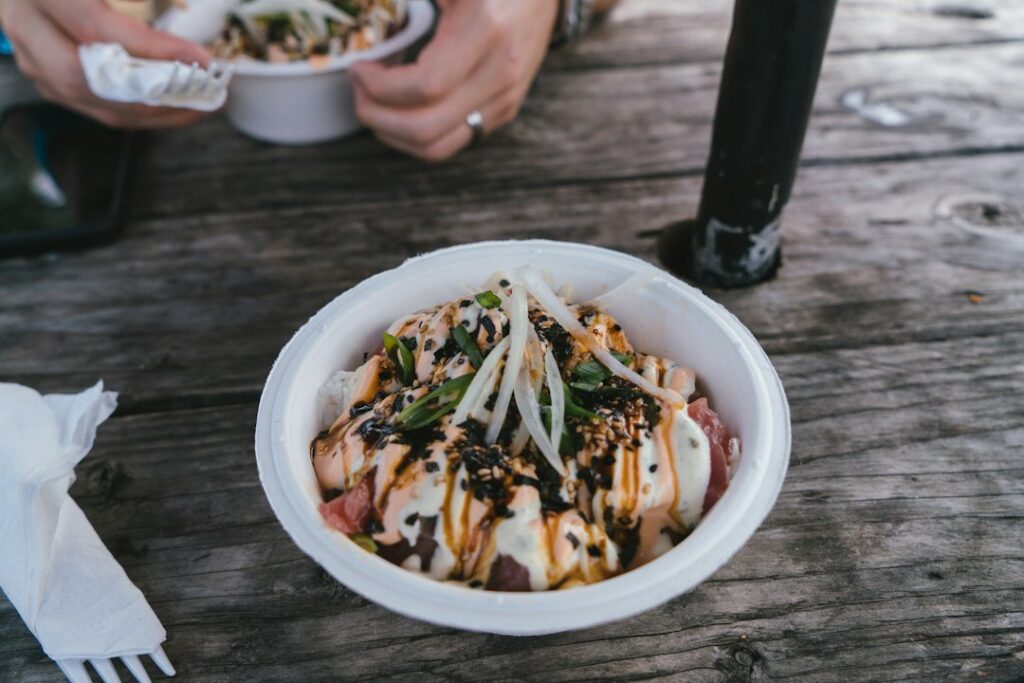
The retail fish market case at the front carries between 8 and 14 poke varieties on any given day. Traditional shoyu ahi is a permanent fixture. Limu (seaweed) ahi and Hawaiian salt ahi hold spots in the case most days. Beyond those, the rotation flexes with what came off the auction floor.
Rotating varieties commonly include:
- Spicy ahi with sriracha aioli and green onion
- Wasabi ahi with tobiko
- Furikake ahi in cubed cold form
- Miso salmon poke when salmon lands
- Tako (octopus) poke with sesame oil
- Ika (squid) poke with limu kohu
- Kimchi ahi with gochujang base
- Avocado ahi seasonal builds
Retail pricing runs approximately $16 to $22 per pound at the counter, tracking auction inputs. A bowl-format order pairs 5 ounces of poke with rice and one topping for roughly $14 to $16. Customers building a comparison across town should also study the wider ranking of Honolulu poke shops to calibrate expectations.
How the case reads at 11 AM vs 2 PM
Case selection peaks between 11:00 AM and 12:30 PM when the day’s cuts have all been set out. By 2:00 PM the popular shoyu and spicy varieties may have thinned; by 3:00 PM select varieties are re-stocked from the back while others sell out. Serious poke-first visits are best scheduled between 10:45 AM and 12:00 PM.
Menu Beyond the Signature Ahi
While ahi drives the reputation, the kitchen runs a wider menu built around the day’s auction purchases. Fried ahi collar is a common weekend feature — a bone-in cut oven-roasted or fried to crispy skin, priced around $16 to $22 depending on size. Ahi belly is the sashimi-forward alternative to the seared block: fattier, richer, and served with grated ginger and shoyu.
Cooked non-ahi plates typically include:
- Grilled ono with lemon caper butter around $22
- Blackened mahi mahi with mango salsa around $24
- Whole steamed opakapaka in season around $32
- Salt-crust monchong for two around $46
- Rotating catch-of-the-day preparations $22 to $34
Sides trend classic Hawaiian plate lunch: white rice, brown rice, mac salad, mixed greens with house dressing, and steamed vegetables. A children’s menu offers smaller portions of grilled fish or chicken tenders with rice for $8 to $12. Dessert is limited to house-made haupia and rotating seasonal fruit plates around $6 to $8.
Lunch Service vs Dinner Service Differences
Nico’s runs two distinct service modes with different pacing, menus, and price points. Lunch operates counter-style: order at the register, receive a numbered ticket, seat yourself, and food is delivered to the table. Dinner switches to full table service with a hostess stand, printed menus, and a wine list.
Lunch service runs 10:30 AM to 4:00 PM Monday through Saturday and typically 10:00 AM to 3:00 PM on Sundays. Dinner service runs approximately 4:30 PM to 9:00 PM Tuesday through Sunday, closed Monday nights. The fish market retail counter usually holds later than the kitchen — often to 9:30 or 10:00 PM.
| Attribute | Lunch service | Dinner service |
|---|---|---|
| Order method | Register, numbered ticket | Table service, printed menu |
| Typical entree price | $14–24 | $24–38 |
| Portion style | Plate-lunch with mac salad + rice | Composed plate, chef sides |
| Wait window | Register 5–15 min; food 8–20 min | Seating 0–25 min; food 20–35 min |
| Reservations | Not accepted | Accepted via phone or online |
| Live music | None | Selected evenings (7–9 PM) |
| Peak crowd | 11:45 AM – 1:15 PM | 6:30 PM – 8:00 PM |
Which service window fits which visit type
Lunch fits the tightest budget and the widest menu because the register menu shows all the plate-lunch options including poke bowls unavailable at dinner. Dinner suits a slower waterfront experience with cocktails and a longer wine pour, but poke bowls disappear from the standard menu after 4:00 PM. A visit coordinated with the sunset window between 6:15 and 7:30 PM uses the harbor light effectively.
Waterfront Outdoor Seating and Ambient Conditions
The dining room occupies a warehouse-style building with high ceilings, roll-up doors, and a covered outdoor lanai facing the harbor’s small-boat berths. The lanai holds roughly 30 tables under a shed roof with open sides, allowing trade winds to cross the seating area at 8 to 15 mph during typical afternoons.
Views from the lanai include working fishing boats, occasional container ship movements, and the Aloha Tower complex across the harbor. Sunsets appear between 5:45 PM in December and 7:15 PM in June, casting warm side light across the boat masts. Weekday afternoons see less pier traffic than weekend evenings; a weekday lunch on the lanai is often the calmest option.
Evening ambiance shifts with harbor traffic. Working fishing boats depart and return through the daylight hours, with the largest cluster of activity around 3:00 to 4:30 PM as returning boats offload. Container ship movements are announced via harbor radio audible faintly from the lanai. Occasional cruise ship departures from Aloha Tower create ship silhouettes crossing behind the boat masts.
Weather considerations
Honolulu average high temperatures run 80°F in January and 88°F in August. The lanai stays comfortable most days because the harbor breeze offsets radiant heat from the roof. Passing showers common between November and March may drift under the shed roof for 5 to 10 minutes at a time — the covered interior dining room remains available for reseating.
Air quality at the harbor tracks Honolulu’s typical readings, generally in the “Good” AQI band under 50 based on state monitoring data, though diesel exhaust from idling trucks occasionally intrudes on the north edge of the lot. Requesting a lanai table on the water side rather than the parking-lot side reduces that exposure.
Getting There: Rental Car Harbor Detour
Nico’s sits 4.8 miles from Waikiki, 6.2 miles from Daniel K. Inouye International Airport, and 1.7 miles from downtown Honolulu financial district. Drive times vary sharply with H-1 congestion — the same 5-mile trip from Waikiki takes 12 minutes at 10:30 AM and 35 minutes at 5:00 PM on weekdays per state transportation data.
| Origin | Distance | Off-peak time | Peak time |
|---|---|---|---|
| Waikiki (Kalakaua Ave) | 4.8 mi | 12 min | 35 min |
| Honolulu Airport (HNL) | 6.2 mi | 10 min | 25 min |
| Downtown Honolulu | 1.7 mi | 6 min | 15 min |
| Ko Olina resort | 22 mi | 28 min | 65 min |
| Kailua town | 13 mi | 22 min | 50 min |
| North Shore (Haleiwa) | 32 mi | 45 min | 80 min |
The most efficient routing from Waikiki takes Ala Moana Boulevard westbound to Nimitz Highway, then a right turn at the Pier 38 access road across from Sand Island Access Road. The turn is easy to miss the first time — GPS coordinates 21.3081, -157.8703 land in the correct parking lot.
Parking on the harbor lot
The restaurant shares a fenced parking lot with the fish market and adjacent maritime tenants. Approximately 120 free spaces sit within a 60-second walk. Peak lunch fills 80% of the lot between 11:45 AM and 12:45 PM. Rental SUVs and full-size vehicles fit comfortably; the lot surface is asphalt with painted stalls and no vertical clearance restrictions.
Pairing with other Honolulu stops
Nico’s works as a mid-loop pause on a rental-car day. A morning at Diamond Head plus lunch at Nico’s plus an afternoon at Bishop Museum forms a coherent 8-hour circuit. Visitors comparing plate-lunch counter culture across the island often add a Rainbow Drive-In stop on Kapahulu Avenue and evaluate the harbor-fresh vs diner-classic contrast directly.
Pricing, Payment, and Ordering Logistics
Register pricing places Nico’s in the mid-tier for Honolulu waterfront dining. Lunch plates run $14 to $24, poke bowls $14 to $16, side salads $5 to $8, and beverages $3 to $8. Local beer draft pours are $6 to $8; wine by the glass $9 to $14 at dinner. Cash, all major credit cards, and Apple Pay are accepted.
Honolulu general excise tax adds 4.712% to the tab per state department of taxation schedules, and voluntary gratuity is expected in the dinner service model but optional at the lunch counter. A two-person lunch with a shared appetizer and two entrees typically settles at $52 to $68 pre-tip. Two-person dinner with a shared appetizer, two entrees, and two drinks runs $95 to $135 pre-tip.
Ordering from the fish market retail case works differently: point to the variety in the case, name the weight in pounds or ounces, and the counter staff scoops into a plastic container and prices at the scale. Whole fillets are cut to spec on a large butcher block behind the counter, wrapped in butcher paper, and priced by pound.
Bringing poke home for a rental condo
For a household staying in a Waikiki condo, buying a pound of poke to eat later can be more economical than a sit-down bowl. One pound feeds 3 to 4 people as a shared serving and costs $16 to $22. Insulated coolers are available for purchase at $8 to $12 if the drive back to the accommodation exceeds 30 minutes.
Where Nico’s Fits in the Honolulu Poke Landscape
Nico’s is one node in a much wider Honolulu poke ecosystem that includes supermarket counters, dedicated poke bars, and neighborhood fish markets. Its distinguishing advantages are the auction-adjacent sourcing, the cooked-plate menu that supermarket counters cannot match, and the waterfront seating that most competitors lack.
Trade-offs relative to the alternatives:
- Supermarket counters (Foodland, Times) price lower but rotate slower
- Ono Seafood on Kapahulu is smaller with faster line movement
- Ala Moana food court poke serves tourists at a premium
- Off-strip Waikiki counters trade convenience for slightly older fish
- Neighborhood fish markets match freshness but lack seating
A household building a comparative research trip should sample at least three poke concepts across two days: a supermarket case, a dedicated counter such as those mapped in the Waikiki off-strip poke rundown, and the auction-adjacent Nico’s model. Palate calibration across those three benchmarks reveals what “fresh” and “well-seasoned” actually mean in practice.
Cost-of-living context for relocation research
Honolulu food-away-from-home CPI has climbed sharply per federal Bureau of Labor Statistics reporting. A relocating household’s dining budget benefits from calibrating expectations against auction-adjacent options like Nico’s rather than resort menus. A weekly $60 poke run at Nico’s supplies proteins for 12 to 16 meals across four adults — often cheaper than three restaurant sit-downs.
Cross-Island Poke Context for Relocation Research
For households evaluating multiple islands, poke traditions vary meaningfully. Kauai leans toward smaller family markets. Maui carries more resort-driven pricing. Hawaii Island stretches between Hilo family markets and Kona resort counters. Each island’s approach reveals something about the local seafood economy and grocery cost structure that a relocation budget must accommodate.
Comparison across islands
| Island | Signature counter type | Typical bowl price | Peak wait |
|---|---|---|---|
| Oahu (Nico’s Pier 38) | Auction-adjacent restaurant | $14–16 | 15 min |
| Kauai (Ishihara Waimea) | Deli-style ticket system | $12–15 | 25 min |
| Maui (Paia food trucks) | Food-truck cluster | $14–18 | 20 min |
| Hawaii Island (Hilo markets) | Family fish market | $10–14 | 10 min |
The Kauai model, documented in the Ishihara Waimea deli ticketing writeup, uses a numbered queue that plays out differently than Nico’s walk-up register. Maui’s cluster of truck-based lunch stops, covered in the Paia food truck cadence piece, sacrifices seating for menu breadth. Hilo family markets tie into the Hilo Wednesday market vendor rundown and emphasize wholesale-style pricing.
Broader Oahu plate-lunch context
Alongside Nico’s, Oahu plate-lunch culture spans diner counters, drive-ins, and specialty operations. A relocation household exploring Honolulu should compare Nico’s harbor experience against the plate combos at Rainbow Drive-In and the Cafe 100 loco moco tradition documented from Hilo. Each represents a different relationship between restaurant, supplier, and price point.
Practical Trip Notes for First-Time Visitors
Newcomers to the harbor benefit from a few operational notes. Photography inside the working areas of the pier is generally fine at the restaurant’s parking lot but restricted on the active auction floor without prior arrangement through the harbor authority at city and county resources. Children are welcome at both lunch and dinner. Late-night lot use after 10:00 PM is not recommended.
Accessibility notes: the restaurant is single-story with ramp access at both main entrances. Wheelchair-height tables are available on the lanai and interior. Restrooms meet ADA standards. The parking lot has clearly marked accessible stalls within 30 feet of the main entrance.
Best day-of-week strategy
Tuesday through Thursday lunches see the shortest lines and best variety in the retail case. Monday closes the auction (no fresh delivery), so Monday lunch relies on Saturday’s residual inventory. Friday and Saturday lunches are the busiest of the week. Sunday brunch is a quieter option many locals underrate; the retail case is well-stocked into midafternoon.
Local news context
Coverage of Hawaii’s longline fleet, auction economics, and seafood regulation appears regularly in Honolulu Star-Advertiser business reporting and Civil Beat investigative pieces. A relocating household serious about the industry should follow both outlets for context on the auction system that ultimately determines Nico’s daily menu.
Frequently asked questions
Does Nico’s Pier 38 take reservations for lunch?
Lunch service does not accept reservations; the counter-order format uses a register and numbered ticket system that keeps flow moving. Dinner service does accept reservations by phone or through the restaurant’s online booking widget. For weekday lunch arrivals between 11:15 AM and 12:00 PM, walk-in waits typically stay under 15 minutes even on busy days.
Can visitors watch the fish auction next door?
Public auction viewing is available on Saturdays roughly every other week through a scheduled tour program, which requires advance signup and a 5:30 AM arrival at the auction shed. Casual walk-in access to the auction floor is not permitted for insurance and food-safety reasons. Restaurant staff can direct interested guests to the current tour signup URL if asked at the counter.
What is the best time to arrive for the widest poke selection?
Retail case selection peaks between 10:45 AM and 12:15 PM after all the day’s cuts have been prepared and set out. By 2:00 PM the shoyu ahi and spicy ahi varieties often thin, and by 3:30 PM some varieties sell out entirely with limited restocking. Serious poke-first visits should target the 11:00 AM window on Tuesday through Thursday for maximum variety.
How does Nico’s Pier 38 pricing compare to other Honolulu poke counters?
Retail poke ranges $16 to $22 per pound at Nico’s, which sits below tourist-focused Ala Moana counters at $22 to $28 per pound and above neighborhood fish markets like Ono Seafood at $14 to $18 per pound. The tradeoff is that Nico’s offers dine-in waterfront seating that neighborhood markets do not, plus a broader cooked-plate menu unavailable at retail-only competitors.
Is Nico’s Pier 38 worth the detour for a first-time Honolulu visitor?
For a visitor with three days on Oahu, a lunch stop at Nico’s fits neatly into any day that already routes through downtown, Sand Island, or the airport corridor. The detour adds perhaps 20 to 40 minutes total including parking and ordering. The combination of auction-adjacent sourcing and waterfront seating exists nowhere else in Honolulu at this price point.
What should visitors order for their first meal at Nico’s?
The furikake pan-seared ahi at rare doneness is the operational signature and best represents the restaurant’s identity. A first-visit strategy that samples both cooked and raw preparations pairs the furikake ahi with a small shoyu ahi poke bowl split at the table. Add a shared side of fried calamari or ahi belly for a well-rounded introduction to the menu.
Does Nico’s Pier 38 have vegetarian options?
Vegetarian choices exist but the menu is fish-forward. Options include mixed green salad with house dressing, taro rolls, mac salad, edamame, and rice bowls with tofu when available. Vegan diners should call ahead to confirm current dairy-free options because side rotations shift weekly. The restaurant does not maintain a dedicated vegetarian section, and cross-contact with fish preparation surfaces is likely.