Kauai is the oldest of the four main Hawaiian islands and the most geographically isolated. With around 73,000 residents spread across 552 square miles, it is a small-economy island where tourism, government, and a handful of large agricultural landholders set the terms for most employment. The trade-off for living here is well-established: extraordinary natural scenery and a genuinely slower pace of life, paid for with housing costs that rank among the highest in the country, a single commercial airport, and limited access to specialist healthcare and professional services.
This breakdown covers what a household relocating to Kauai should expect in 2026: housing costs by town, the rental market, the job market, schools, healthcare, and the seasonal and geographic factors that shape daily life depending on which side of the island you settle on.
Kauai at a glance
| Indicator | Figure | Source / notes |
|---|---|---|
| County population | ~73,600 | U.S. Census Bureau, 2022 ACS 5-year estimates |
| County seat | Lihue | Airport (LIH) is also here |
| Median household income | ~$77,000 | U.S. Census Bureau, 2022 ACS 5-year estimates |
| Median home sale price | ~$980,000 | Kauai Board of Realtors, 2024 annual median; varies widely by area |
| Typical 1BR long-term rent | $2,100–$2,800/mo | Advertised listings, mid-2024; market is very tight |
| Typical 2BR long-term rent | $2,700–$3,800/mo | Advertised listings, mid-2024 |
| Property tax rate (homeowner) | $2.59 per $1,000 | Kauai County, FY2025-2026, owner-occupied homestead class; effective rate ~0.23% |
| State income tax | 1.4%–11% | Hawaii statewide, 12 brackets; see full breakdown |
| Unemployment rate | ~3.5% | Hawaii DLIR, 2024 |
| Public schools | 17 | Hawaii DOE, Kauai school complex area (3 high schools) |
| Main hospital | Wilcox Medical Center, Lihue | KVMH system; also Kauai Veterans Memorial Hospital, Waimea |
Where to live on Kauai: town by town
Kauai’s single highway wraps about three-quarters of the coastline, ending at Haena in the north and at Polihale in the northwest. The road does not complete a circuit, which means Lihue (the center) is effectively the hub. Where a household chooses to live affects commute time, rainfall exposure, school access, cost, and how quickly a road closure on the single highway becomes a problem. The four main zones — south shore, east side, north shore, west side — behave quite differently.
Lihue
The county seat and commercial core. Lihue holds the airport (LIH), the county offices, Wilcox Medical Center, Costco, and most of the big-box retail. It is the most practical location for families who need regular access to services, and it is close enough to both the south and east side that a 30-minute drive covers most needs. Rainfall averages around 43 inches annually — moderately wet but manageable. Long-term rental supply is thin across the island but slightly less constrained here than in resort areas.
Kapaa and Wailua (East Side / Coconut Coast)
The largest town cluster on the island. Kapaa and the adjoining Wailua area form the highest-population zone, with a mix of local businesses, restaurants, and residential neighborhoods that sit closer to the community than the resort belt. Rainfall is similar to Lihue (~43–50 inches), and the east side gets consistent trade wind activity. Commute to Lihue runs 10–20 minutes. Families looking for a local-feeling neighborhood with reasonable access to services typically find the east side the most practical balance of price, services, and commute.
Koloa and Poipu (South Shore)
The sunniest and driest part of Kauai, with annual rainfall around 30–35 inches in Poipu and somewhat more inland at Koloa. The south shore has the highest concentration of resorts, vacation rentals, and luxury condo developments, which compresses the long-term rental market severely — much of the housing stock here is tied to short-term visitor use. Buyers looking for a primary residence find competition from investor demand. The commute to Lihue runs around 30 minutes via Kaumualii Highway.
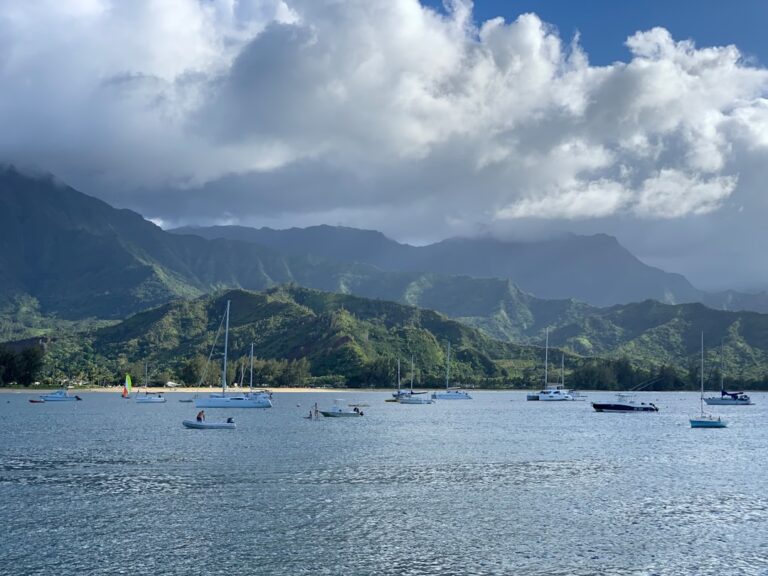
Princeville and Hanalei (North Shore)
The most scenic and the most rain-exposed zone. Princeville, a gated master-planned community, receives roughly 85 inches of rainfall annually; Hanalei, 5 miles further along the road, receives even more. The north shore road (Kuhio Highway beyond Kilauea) regularly closes after heavy rain events, creating real access risk for residents who commute to Lihue — the drive in good conditions takes 50–65 minutes and can extend to several hours after storms or become impassable. Princeville’s HOA-heavy structure imposes ongoing fees on top of already high property prices. For buyers without a commute requirement, the scenery is unmatched in Hawaii; for those who commute to Lihue regularly, the road risk is a material factor.
Hanapepe and Eleele (West Side, near Poipu corridor)
Hanapepe is one of the least expensive areas on Kauai in relative terms, a small historic town on the west side known for its Friday night art walk. Eleele sits on the water nearby. Both are 20–30 minutes from Lihue and have limited services locally. Families trading cost for commute sometimes settle here, though the savings in purchase price or rent are meaningful but not dramatic relative to the east side.
Waimea and Kekaha (Far West)
The westernmost communities on the highway. Waimea anchors the approach to Waimea Canyon State Park and sits near the Pacific Missile Range Facility (PMRF) at Barking Sands, a federal military installation that is one of the island’s larger employers. Kekaha is a small town with some of the most affordable housing on Kauai, though services are minimal and the commute to Lihue runs 40–55 minutes. The far west receives the least rainfall of any area on the island.
Kalaheo (Upcountry, South-Central)
Perched at roughly 800–1,400 feet on the ridge between Poipu and the Hanapepe valley, Kalaheo is a small, established town with a local character. Elevation keeps temperatures a few degrees cooler than the coast and brings occasional morning cloud. The commute to Lihue runs around 30 minutes. Land here has agricultural designations in some parcels. A detailed breakdown of Kalaheo’s specifics — CPR zoning, water supply, school access — is in the Kalaheo relocation guide.
Housing costs
Buying
Kauai has one of the highest median home prices in the country. The island-wide median sale price for single-family homes in 2024 was approximately $980,000 according to the Kauai Board of Realtors, though that figure masks wide variation: entry-level properties in west-side neighborhoods can start below $600,000, while north shore and Poipu-area homes commonly trade above $1.5M and beachfront properties regularly exceed $3M.
The primary drivers of high prices are land scarcity (a substantial share of Kauai’s land is in conservation, agriculture, or military use), continuing demand from mainland buyers and investors, and the persistent inflow of short-term rental investment that pulls properties out of the owner-occupied market. Kauai’s property tax rates are relatively low — $2.59 per $1,000 of assessed value for the homestead class (owner-occupied primary residences), with an effective rate around 0.23% of assessed value — which partly offsets monthly carrying costs.
Buyers pursuing a homestead exemption must occupy the property as a primary residence and apply with the Kauai County Real Property Assessment Division. The homestead classification reduces the tax rate from the non-owner-occupied residential rate to the homestead rate; the savings on a $900,000 property are approximately $2,000–$3,000 annually depending on the applicable rates for that fiscal year.
Renting
The long-term rental market on Kauai is tight. The short-term vacation rental industry has historically captured a significant share of the island’s housing stock, limiting supply for year-round residents. In mid-2024, a 1-bedroom unit in livable condition was typically listed at $2,100–$2,800 per month; 2-bedroom units ran $2,700–$3,800. Units advertised below those ranges are usually older, further from services, or restricted in some way. Furnished units suitable for an initial relocation period command a further premium.
State and county regulations on vacation rentals have tightened since 2022. Maui’s experience with vacation-rental restrictions (Bill 9) has parallels across the state, and Kauai has also moved to restrict new short-term rentals in residential zones. The effect on long-term supply is ongoing and should improve incrementally, but the market as of 2026 remains supply-constrained.
Cost of living
Kauai’s cost of living follows the island pattern: everything that arrives by container ship costs more than on the mainland, and most things do arrive by container ship. Groceries run 30–50% higher than the U.S. mainland average, with produce and perishables at the top of that range. Fuel sits consistently above mainland averages. Utilities — electricity in particular — are priced higher than all but a few mainland states because of Hawaii’s dependence on petroleum for power generation. A household relocating from the mainland should add roughly 30–40% to their current budget for food, fuel, and utilities before accounting for the housing differential.
The island’s utility cost breakdown by island covers electricity, water, and internet in detail. Kauai’s electricity is provided by KIUC (Kauai Island Utility Cooperative), a consumer-owned utility that has invested heavily in solar-plus-storage, giving the island one of the highest renewable energy percentages of any U.S. utility. The investment has moderated but not eliminated the premium over mainland rates.
Jobs and economy
Kauai’s economy is heavily weighted toward tourism. Hotels, resorts, and the businesses that serve them collectively represent the largest employment sector. The island hosts several major resort properties — including Grand Hyatt Kauai, Marriott’s Waiohai Beach Club, and Westin Princeville — that are among the island’s largest private employers. State and county government is the next significant sector. The Pacific Missile Range Facility (PMRF) at Barking Sands employs a smaller but stable federal and contractor workforce.
Outside of hospitality and government, the professional services sector is thin. Healthcare has grown as the island’s population has aged, but specialists are limited — Wilcox Medical Center in Lihue is the primary hospital, and complex medical cases are often referred to Oahu. Technology and financial services roles are concentrated in Honolulu; remote workers who can work independently of location can effectively import Oahu or mainland salaries while living on Kauai, and this cohort has grown since 2020.
Households looking for work before relocating should review the state’s pre-move job search guide. Competition for non-hospitality professional roles is significant given the appeal of island living, and salaries for equivalent positions on Kauai typically run below Honolulu and well below San Francisco or Seattle comparables. The salary calculator is a useful starting point for comparing take-home against actual island costs.
Schools
Kauai has 17 public schools within the Hawaii Department of Education’s Kauai complex area, including three public high schools: Kauai High School in Lihue, Kapaa High School on the east side, and Waimea High School on the west side. There is also the Kauai New Century Public Charter School. The DOE administers enrollment statewide and assigns students based on residence zone.
Private school options on the island are limited relative to Oahu. The island’s main private institutions include Island School (college-preparatory, Lihue), Kauai Christian Academy, and a small number of faith-based elementary programs. A more comprehensive look at private options across Hawaii, including tuition ranges and grade coverage, is in the private schools guide. Families with specific educational requirements should evaluate options carefully before committing to a particular area of the island, as school zones and private school availability create real geographic constraints.
Healthcare
Kauai’s healthcare infrastructure is limited by its size. Wilcox Medical Center in Lihue is the island’s main acute-care facility, operated by Kauai Veterans Memorial Health System. It covers general surgery, emergency care, maternity, and a range of outpatient services, but complex or subspecialty care — cardiac surgery, neurology, oncology — is typically referred to Honolulu. Residents with chronic conditions requiring specialist follow-up should factor the cost and logistics of inter-island travel into their planning; a routine specialist visit can require a same-day round trip to Oahu.
Hawaii’s Prepaid Health Care Act requires employers to provide health insurance to employees working 20 or more hours per week, which means most full-time residents who are employed have employer-sponsored coverage. The dominant insurers are HMSA (Hawaii Medical Service Association, the Blue Cross Blue Shield affiliate) and Kaiser Hawaii. Self-employed residents and those without employer coverage buy through the individual market.
Climate and weather by area
Kauai’s topography concentrates rainfall sharply. Mount Waialeale, near the island’s center, is among the wettest spots on Earth, recording 350–450 inches of rain annually on average. Trade winds carry moisture from the northeast and dump it on the windward (north and east) sides; the leeward (south and west) sides sit in a rain shadow. The practical range across inhabited areas runs from about 30 inches annually in Poipu to more than 85 inches in Princeville.
| Area | Approx. annual rainfall | Notes |
|---|---|---|
| Poipu / south shore | 30–35 in | Driest and most consistently sunny |
| Lihue | ~43 in | Trade winds moderate heat |
| Kapaa / east side | ~45–55 in | Afternoon showers common |
| Kilauea / north shore approach | ~65 in | Wetter as you move north |
| Princeville / Hanalei | 85–100 in | Significant road closure risk Nov–March |
| Waimea / west side | ~20–25 in | Driest area overall |
Road closures on the north shore highway are a practical risk that residents underestimate before experiencing them. Heavy rain events can wash out sections of Kuhio Highway north of Hanalei, stranding north shore residents for hours or, in severe cases, days. The Kauai month-by-month guide covers rainfall and road conditions in detail for visitors; the pattern is the same for residents, but the stakes are higher when it is your daily commute.
Pros and cons for relocating households
Reasons people move to Kauai
- Natural environment: Na Pali Coast, Waimea Canyon, Hanalei Bay, and the island’s preserved interior are consistently cited by residents as the primary reason they chose Kauai over other islands.
- Community scale: At 73,000 residents, Kauai has a distinctly small-town feel relative to Oahu. Services and social networks build relatively quickly.
- Slower pace: The island has no interstate-style highways, limited 24-hour commercial activity, and a culture that resists the development pressure common to Maui and Oahu.
- Climate (south and west): The south shore’s 30 inches of annual rain and consistent sunshine make it one of the drier resort climates in Hawaii.
- Lower property tax: The homestead rate of $2.59 per $1,000 — one of the lowest rates in the state — reduces carrying costs for owner-occupants relative to what the high home prices might suggest.
Challenges to factor in
- Housing cost and supply: Median home prices above $900,000 and a compressed long-term rental market make entry more expensive than any other U.S. location except perhaps San Francisco Bay Area coastal towns.
- Limited job market: Outside tourism and government, professional opportunities are thin. Remote-work income helps significantly but is not universal.
- Geographic isolation: Kauai has one commercial airport with capacity constraints, no interstate ferry service, and a single highway loop that does not complete the circuit. Any disruption — weather, infrastructure, aircraft availability — affects all movement off and around the island.
- Healthcare access: Subspecialty care requires travel to Oahu. For households with chronic or complex health needs, this is a real operational burden.
- Road reliability on north shore: Households choosing Princeville or Hanalei for the scenery must accept meaningful commute uncertainty in winter months.
- Cost of goods: 30–50% food premium, high fuel prices, and shipping surcharges on anything large affect day-to-day budgets more than the housing number alone suggests.
Planning your move to Kauai
Most households moving to Kauai arrive without a permanent home secured in advance — long-term rental availability is too limited to reliably pre-book from the mainland, and buyers typically need to be on-island for the negotiation process. A common approach is to secure a furnished short-term rental or extended-stay option for 4–8 weeks while navigating the long-term market locally. The total cost of moving to Hawaii covers what to budget for the shipping, flights, and first-month cash requirements in detail.
If you are in the early stages of planning, a quick comparison of what shipping your household goods and vehicle will cost — broken down by route and move size — can be a useful anchor for the larger financial planning.