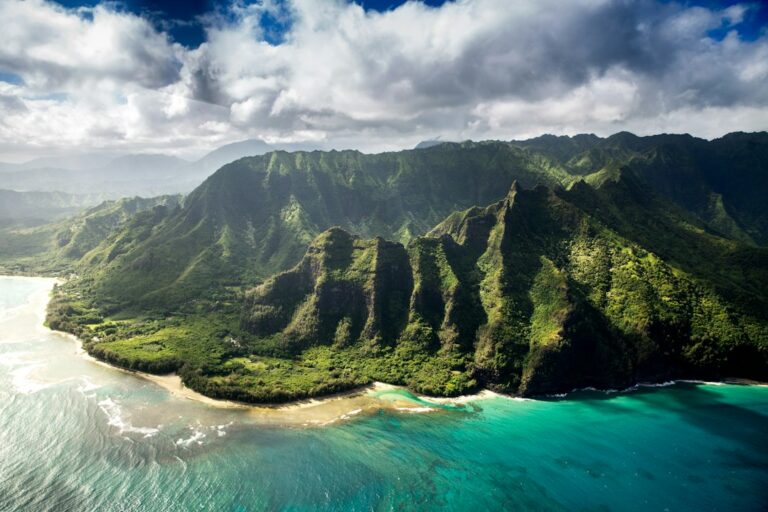
The Kalaupapa Peninsula juts from the north shore of Molokai like a green afterthought, cut off from the rest of the island by a wall of sea cliffs that rise 1,600 feet in less than a mile. For nearly fifty years, the Molokai Mule Ride shuttled visitors down 26 switchbacks to the settlement floor, giving the pali trail its cultural signature.
That commercial mule operation has been suspended since a February 2018 landslide, and the reopening picture remains unsettled through mid-2026.
This piece walks through the current access framework for the peninsula: the National Park Service permit system, the Damien Tours ground-transport requirement once visitors arrive, the resident-only sections that remain off-limits without an escort, and the hike-in path that substitutes when mules are grounded. It also covers Molokai lodging realities in Kaunakakai, since same-day round-trip travel from Oahu or Maui rarely leaves enough daylight for the descent and the full four-hour ground tour.
Kalaupapa is a place with a heavy history. From 1866 to 1969 the peninsula served as a forced-isolation settlement for people diagnosed with Hansen’s disease, and a small number of former patients still call it home under a lifetime residency agreement. That history shapes every access rule visitors encounter, and treating it as a checklist activity misses the point.
The pali trail: 3 miles, 26 switchbacks, 1,600 feet
The trail cut into the Kalaupapa pali is the only land route between “topside” Molokai and the peninsula floor. It descends roughly 1,664 feet in about 2.9 miles, giving it an average grade near 11 percent, though several switchback segments run steeper. Trail width varies from three to four feet across, with sections narrowing where basalt outcrops force a tighter line. The pali itself is among the tallest sea cliffs on Earth by continuous vertical rise.
The 26 numbered switchbacks are stenciled onto pali rock faces as visitors descend, with switchback 1 sitting near the trailhead at Pala’au State Park and switchback 26 opening onto the beach flats above the settlement road. Mule teams historically clocked the descent at roughly 90 minutes, with hikers typically completing it in 60 to 90 minutes at a working pace. The return climb takes longer and is where fatigue and heat exposure catch most visitors.
How the grade compares to other Hawaii cliff routes
Molokai’s pali trail is longer and more sustained than most Hawaii cliff descents visitors encounter as tourists. The Waipio Valley road on the Hamakua Coast drops about 900 feet in 0.6 miles at a 25 percent grade, but it is a paved road for vehicles rather than a foot trail. The Kalaupapa pali is nearly triple the length with a gentler average slope, but it is exposed cliff terrain the whole way.
| Route | Distance | Vertical drop | Average grade | Surface |
|---|---|---|---|---|
| Kalaupapa pali trail | 2.9 miles | 1,664 feet | ~11% | Dirt/rock switchbacks |
| Waipio Valley road | 0.6 miles | ~900 feet | ~25% | Paved |
| Queens Bath descent, Kauai | 0.3 miles | ~150 feet | ~9% | Lava rock/mud |
| Puu Poa cliff trail, Kauai | 0.4 miles | ~200 feet | ~9% | Rope-assisted dirt |
| Haleakala summit road | 36 miles | 10,023 feet | ~5% | Paved |
What changed after February 2018
On February 21, 2018, a landslide above switchback 4 sent debris across the pali trail and damaged sections that the commercial mule operator had used daily. The Molokai Mule Ride, which had run in some form since the 1970s, stopped commercial operations that week. The National Park Service also closed the trail to hikers while engineers assessed the debris field and the stability of the slope above.
The hiking trail reopened in phases starting in 2019, but the commercial mule operation has not returned to its pre-2018 daily cadence. Coverage in the Honolulu Star-Advertiser and Honolulu Civil Beat has tracked the periodic negotiations between the operator, the NPS, and the state Department of Health, which retains jurisdiction over the resident settlement. Travelers researching the trip in 2026 should treat mule availability as unresolved and plan around hike-in access instead.
Why the operator status matters
Even during the mule era, the commercial ride was the only way for most visitors under age 60 to access the peninsula without hiking. The mule operator held one of the few tour concessions permitted by the NPS and provided the required Damien Tours handoff at the bottom. Without that concession running, every non-resident visitor arrives either on foot down the pali trail or by small aircraft into Kalaupapa Airport (LUP).
The permit and access system through the NPS
Kalaupapa National Historical Park was authorized by Congress in 1980 and covers roughly 10,779 acres on the peninsula and surrounding lands. Unlike most units in the National Park system, Kalaupapa is not a walk-in park. Every non-resident visitor over age 16 needs advance authorization to enter, and no visitors under 16 are allowed on the peninsula at all under long-standing Department of Health rules.
Authorization comes through one of three paths: a permit sponsored by an active Kalaupapa resident, an authorized tour company (Damien Tours), or an NPS-approved research or work purpose. Casual “just look around” visits are not part of the system. The Hawaii Department of Health retains regulatory jurisdiction over the settlement because former patients still live there under a residency guarantee from the 1969 legal reforms.
Resident-only zones and photography rules
Several parts of the peninsula are strictly resident-only. The occupied residential row along Damien Road, the small store, the community’s private homes, and the interior of Bishop Home for Girls are off-limits to visitors even with a Damien Tours pass. Photography of residents, their homes, and their vehicles is prohibited. The NPS enforces these rules with real trespass consequences, and repeat violators lose future access permits.
Fee structure and reservation lead time
Damien Tours has typically charged $60 to $70 per person for the ground portion of the day, cash preferred and payable at the bottom of the trail. That fee is separate from any transportation cost, whether hiking, formerly the mule ride, or the small commercial flight from Molokai Airport. Reservations should be locked in at least four weeks ahead in peak months of June, July, and August, when tour capacity fills fastest.
Damien Tours: the ground component
Once visitors reach the peninsula floor, whether by foot or by air, they must join the Damien Tours ground portion. This is not marketing preference; it is the mechanism by which the NPS and the Department of Health limit unescorted movement through an active residential community. The tour is operated by long-time Kalaupapa resident families and typically runs four hours, covering the settlement, the historic sites, and the beach at Papaloa.
The tour vehicle is usually a repurposed school bus, and the guide is often a person with deep family ties to the settlement. Stops include St. Philomena Church, where Father Damien served and is memorialized; Siloama Church, founded in 1866 as the community’s first Protestant congregation; the Kalaupapa Airport building; the crater lookout at Kauhako; and the settlement store. Lunch is not provided, so visitors pack their own food and water for the day.
The 4-hour tour itinerary in practice
Damien Tours generally kicks off around 10:30 a.m., after the small commuter aircraft has landed and the hikers have made the descent. The bus departs the airfield/trail-terminus staging area, works through the historic core over roughly two hours, breaks for the packed lunch near the shoreline, and completes the loop by 2:00 p.m. That timing leaves hikers a hard window: complete the 1,600-foot climb back up before daylight and heat degrade the trail.
| Time | Activity | Notes |
|---|---|---|
| 6:30 a.m. | Trailhead check-in at Pala’au | Parking at end of Highway 470 |
| 7:00 a.m. | Begin descent | 60–90 minutes at working pace |
| 8:30 a.m. | Arrive settlement flats | Meet tour bus |
| 10:30 a.m. | Damien Tours begins | After flight arrivals |
| 2:00 p.m. | Tour ends | Begin return hike |
| 4:30 p.m. | Reach topside | Climb usually 90–150 minutes |
Kauhako Crater and the peninsula’s geology
The Kalaupapa Peninsula is a low, flat lobe of land created by a later volcanic eruption after the main Molokai shield had collapsed. Kauhako Crater sits near the peninsula’s center, roughly 405 feet above sea level, and holds a small lake in its deep interior. Tour guides typically stop at the crater lookout to explain how the peninsula’s formation left it geographically isolated even from the rest of Molokai — a fact that made it useful as an isolation site.
The hike-in alternative when mules are down
With the mule concession suspended, the hike-in route is the only ground option in 2026. Hikers must still hold a Damien Tours reservation for the day they intend to descend; the NPS does not permit visitors to arrive at the peninsula with no scheduled escort. Hikers check in at the topside trailhead near mile marker 4 on Highway 470, then descend on their own timing to meet the tour bus at the base by 10:00 a.m.
The trail surface is packed dirt and volcanic rock, with roots and loose stone in the mid-elevation switchbacks. Trail runners with aggressive tread outperform smooth hiking boots in the descending switchbacks, but a stiffer boot helps most people on the climb back up. Rain in the winter months of November through March turns the mid-trail into a slick sheet, and the NPS periodically closes it when the surface becomes unsafe.
Fitness realities of the climb back up
The descent is manageable for most people who exercise regularly. The climb out is a different matter. A 1,600-foot ascent over 2.9 miles at midday, with limited shade and typical trailside temperatures of 78 to 85 °F, taxes cardiovascular systems that are not primed for it. Hikers should treat this like a training day, not a stroll. The Haleakala downhill bike tour fitness discussion covers a comparable altitude-plus-effort profile from a different angle.
The Kalaupapa Airport option
Visitors who cannot hike can reach the peninsula on Makani Kai Air or Mokulele Airlines, which have historically operated single-engine commuter service into Kalaupapa Airport (LUP). Flights depart from Honolulu (HNL) or Molokai Airport (MKK). Round-trip fares typically run $225 to $325 per person from Honolulu and $110 to $160 from topside Molokai. Airline schedules shift; travelers should confirm 2026 service directly and match it to the Damien Tours booking window.
The history that shapes visitor rules
Understanding the rules requires understanding what Kalaupapa was. In 1866 the Hawaiian Kingdom, under pressure from a Hansen’s disease epidemic that had swept the islands, established a forced-isolation settlement on the peninsula. Over the next 103 years, roughly 8,000 people were exiled there, most of them Native Hawaiian, most of them separated from families for life. The peninsula is functionally a graveyard as much as a community.
Father Damien de Veuster, a Belgian Catholic priest, arrived on May 10, 1873, and spent the rest of his life in the settlement, dying of Hansen’s disease himself on April 15, 1889. Mother Marianne Cope arrived in 1888 and served until her death in 1918. Both were canonized as Catholic saints — Damien in 2009, Marianne in 2012 — and much of the visitor day pays attention to their work and burial sites at St. Philomena.
The forced isolation policy formally ended in 1969, and remaining residents were given the right to stay for life. As of the mid-2020s only a small number of former patients still live at Kalaupapa year-round, most in their 80s and 90s. The NPS took over site management in 1980, but the Department of Health retains authority over the residential settlement itself, which is why the tour-only rules for visitors have not loosened.
Getting to Molokai and lodging in Kaunakakai
Molokai has one commercial airport, Molokai Airport (MKK), which sits about seven miles west of Kaunakakai. Hawaiian Airlines and Mokulele Airlines operate regular service from Honolulu, with typical flight times of 25 to 30 minutes and round-trip fares in the $170 to $270 range depending on season. There is also a small-craft dock, but there is no interisland passenger ferry to Molokai in 2026; the Molokai-Maui ferry ceased operations in 2016.
Kaunakakai, the island’s main town with a population near 3,500 per Census QuickFacts, sits on the south shore and is where most travelers base themselves. It is roughly 17 miles from Kaunakakai to the Pala’au State Park trailhead — a 30- to 35-minute drive along Highway 470. That drive time matters, because a same-day round-trip visit from Maui or Oahu leaves almost no margin, and the Damien Tours 10:00 a.m. rendezvous requires arriving on Molokai the day before.
Lodging inventory on Molokai
Molokai’s lodging inventory is modest and skewed toward vacation rentals and one full-service hotel. Hotel Molokai in Kaunakakai is the primary hotel option, with roughly 50 rooms and nightly rates typically ranging $195 to $325. Condo units at Wavecrest on the east end and Ke Nani Kai on the west end round out the options. Vacation rental listings supply the rest, though the county has tightened short-term rental enforcement since 2023.
Molokai’s tourism footprint is intentionally small — the island has resisted resort development for decades and lacks the concentrated lodging of Waikiki or Ko Olina on Oahu. Travelers should book at least six weeks ahead for a Kalaupapa trip. Molokai also lacks the buffet of dining options; most restaurants close by 8:30 p.m. and Kaunakakai’s grocery footprint is one supermarket plus a bakery famous for hot bread pulled from the oven after 8 p.m.
| Property | Location | Type | Nightly rate (typical) | Distance to trailhead |
|---|---|---|---|---|
| Hotel Molokai | Kaunakakai | Full-service hotel | $195–$325 | 17 miles / 30 min |
| Wavecrest Resort | East end (Kilohana) | Condo | $135–$220 | 28 miles / 50 min |
| Ke Nani Kai | West end (Maunaloa) | Condo | $165–$275 | 22 miles / 40 min |
| Paniolo Hale | West end | Condo | $155–$260 | 22 miles / 40 min |
| Vacation rentals | Island-wide | Home/cottage | $120–$400 | Varies |
Planning the day: fitness, weather, logistics
The Kalaupapa day is not a casual outing. It combines a demanding physical descent, a four-hour bus tour with historical weight, a demanding climb back out, and strict adherence to a schedule that is set by the tour and by the ferry-style rhythm of the small commuter aircraft. Building the day around the tour rendezvous — 10:00 a.m. at the base — is the only workable planning move.
Weather windows and closure patterns
The pali trail closes during heavy rain, and the peninsula generally sees rain on 90 to 130 days per year, concentrated between November and March. Trade winds from the northeast average 12 to 18 mph and can gust much higher through the winter, kicking up on the exposed switchbacks. Summer months of May through September are drier and offer more predictable trail windows, though heat indices at midday climb into the low 90s.
What to pack
- 2.5 to 3 liters of water per person for the round trip
- Packed lunch and salty snacks; no food available on the peninsula
- Sunscreen, hat, and long sleeves for exposed switchback sections
- Hiking poles for the ascent, especially on wet days
- Cash for the Damien Tours fee — no card processing at the base
- Photo ID for NPS entry verification and airline check-in
- Rain shell for winter descents when squalls appear quickly
Access method comparison: mule, hike, fly
Because the mule option is currently unavailable, most visitors will choose between hiking down and flying in. Each mode reaches the same Damien Tours pickup and covers the same on-peninsula itinerary, but they differ sharply in cost, fitness demand, time, and reservation friction.
| Access mode | Time down | Time up | Cost per person | Fitness required | 2026 status |
|---|---|---|---|---|---|
| Commercial mule ride | ~90 min | ~90 min | Historically ~$210 | Low (riding only) | Suspended |
| Hike down/up | 60–90 min | 90–150 min | $0 transport + $70 tour | High | Available |
| Fly from Honolulu | ~45 min flight | ~45 min flight | $225–$325 + $70 tour | Low | Available |
| Fly from Molokai (MKK) | ~10 min flight | ~10 min flight | $110–$160 + $70 tour | Low | Available |
How Kalaupapa fits with other Molokai and Hawaii trips
Molokai is a distinct island culturally, and a Kalaupapa day is often paired with other island touchpoints across a two- or three-night stay. The Papohaku Beach on the west end, at three miles of continuous white sand, is one of the largest sand strands in Hawaii. Halawa Valley on the east end and the coffee farms on the central plateau round out a typical Molokai itinerary that gives Kalaupapa its full weight.
Compared to other cliff-adjacent Hawaii activities, Kalaupapa sits in its own category because of the historical and residential dimensions. The Puu Poa cliff descent on Kauai and the Queens Bath route in Princeville are far shorter and lack the escorted structure. Even the Papakolea green sand beach hike-in on Hawaii Island — a comparable “hike or tour” access debate — has no equivalent permit and residency framework.
Where the mule ride might return
Reopening the commercial mule ride requires two things the parties have not fully aligned on: NPS certification of the trail’s structural safety and a Department of Health sign-off on the visitor concession model. Media coverage through 2024 and 2025 suggested that discussions continued but that no fixed reopening date had been set. Travelers planning trips for 2026 should not book any lodging or airfare on the assumption that mule operations will resume.
Conduct expectations on the peninsula
The residency situation makes Kalaupapa fundamentally different from a typical park visit. Visitors are guests in an active community whose members did not choose exile and lived through decades of forced separation. The Department of Health and NPS conduct rules are absolute: no photography of residents or their homes, no entering marked-off private lots, no leaving the tour group without the guide’s approval, and no attempting to purchase items from residents.
Cultural conduct also matters. Visitors remove hats and speak quietly at St. Philomena and at the two cemeteries adjacent to it, which hold roughly 8,000 graves from the isolation period. Note-taking and quiet photography of buildings and landscapes is welcome; loud group behavior is not. Guides may ask groups to pause for a moment of silence at burial sites, and visitors are expected to comply without complaint or performative grief.
Souvenir and food purchases
- The community bookstore at the visitor center sells small books and postcards
- All proceeds support settlement operations and NPS programming
- No street vendors or informal souvenir stands operate on the peninsula
- Any exchange with a resident should be routed through the tour guide
- Federal law prohibits collection of shells, rocks, or plants from park land
Emergency planning and communications on the peninsula
Cell service on the Kalaupapa Peninsula is limited and unreliable. AT&T and Verizon may register some signal in the settlement core but drop out entirely along the trail. Visitors should carry a whistle, a headlamp with fresh batteries, and a small first aid kit with electrolyte tablets. In-park emergency response is coordinated through the NPS ranger station, and any serious injury on the trail typically requires helicopter evacuation staged from either Molokai Airport or Honolulu.
The nearest hospital-grade emergency room is at Molokai General Hospital in Kaunakakai, roughly 17 miles from the topside trailhead. That means an injury at the base of the pali trail can involve a two- to three-hour response window even before the helicopter is airborne. Hikers with pre-existing medical conditions should discuss the trip with their physician and carry any daily medication in a labeled container in a waterproof bag.
Frequently asked questions
Is the Kalaupapa mule ride operating in 2026?
No commercial mule ride is running as of mid-2026. The Molokai Mule Ride has been suspended since a February 2018 landslide, and the National Park Service has not certified a return to service. Travelers should treat the hike-in route or the small commercial flight into Kalaupapa Airport as the only current ways to reach the peninsula for a tour.
Can visitors under 16 go to Kalaupapa?
No. Visitors under age 16 are prohibited from entering Kalaupapa National Historical Park under long-standing Department of Health rules that predate NPS management. The rule stems from the isolation-era history of the settlement and has not been changed. Families planning a Molokai trip with children should plan alternate activities such as the Pala’au State Park lookout, which offers a topside view of the peninsula.
How much does the Kalaupapa tour cost in 2026?
The Damien Tours ground portion has historically run $60 to $70 per person, cash preferred, paid at the base of the trail. Hikers pay only the tour fee. Fly-in visitors add round-trip commuter airfare, typically $225 to $325 from Honolulu or $110 to $160 from Molokai Airport. Rates should be confirmed at the time of booking since they shift year to year.
How long is the pali trail down to Kalaupapa?
The pali trail runs 2.9 miles from the Pala’au State Park trailhead to the peninsula flats, descending roughly 1,664 feet through 26 numbered switchbacks. Descent time averages 60 to 90 minutes for fit hikers. The return climb takes 90 to 150 minutes and is where visitors should budget their hardest effort of the day. Trail closes during heavy rain and periodic NPS maintenance windows.
Can visitors walk around Kalaupapa on their own?
No. Unaccompanied movement through the settlement is prohibited for non-residents. Every non-resident visitor must be part of a Damien Tours group or hold a resident-sponsored permit with a designated escort. This applies to hikers and fly-in visitors equally, and it is a Department of Health rule tied to the residency guarantee for former patients. The rule is enforced and violations result in permit revocation.
What is the best time of year to hike the Kalaupapa trail?
May through September offers the most reliable weather windows, with lower rainfall and firmer trail conditions. June, July, and August also see the highest tour demand, so book Damien Tours at least four to six weeks ahead. November through March brings heavier rain, occasional trail closures, and slick switchback surfaces. April and October are shoulder months with moderate conditions and easier last-minute booking.
Do visitors need special travel insurance for the Kalaupapa hike?
Standard travel insurance does not always cover backcountry rescue on federal park land. Visitors planning the hike should confirm that their policy covers medical evacuation from a remote setting, since a helicopter extraction from the pali trail can cost $15,000 to $40,000. Older hikers or anyone with cardiac concerns should consider dedicated adventure travel insurance and consult a physician before committing to the ascent.