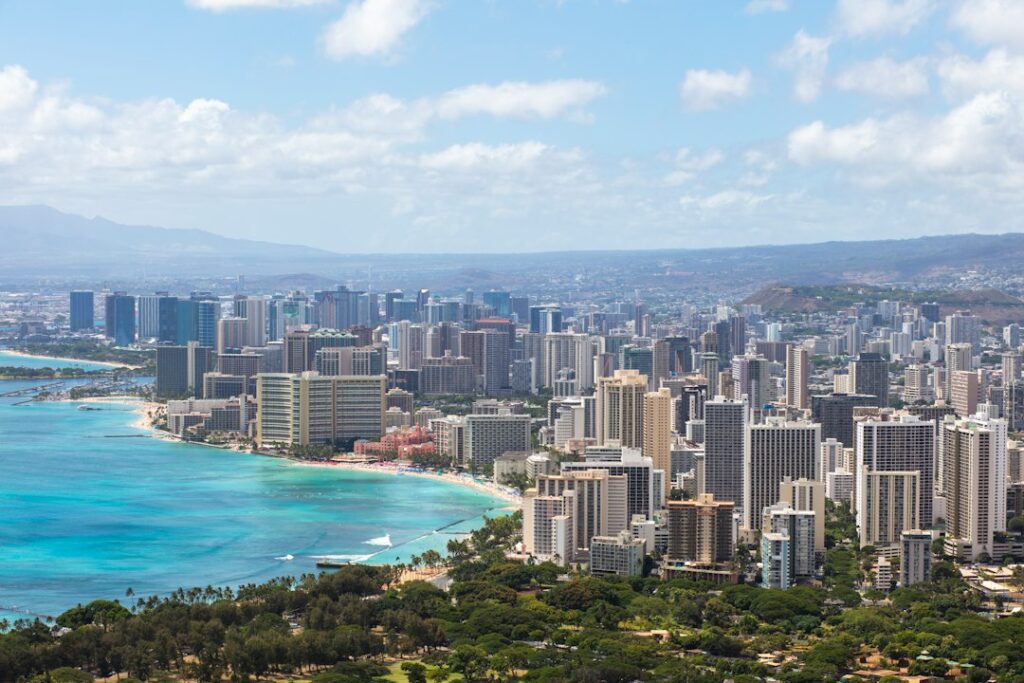
Finding a job in Hawaii is the part of the move that surprises most mainland transplants. The islands look like a frontier of opportunity from the outside — beaches, growing tourism, a tight labor market — but the local economy is small, concentrated in a handful of industries, and pays wages that have not kept pace with one of the highest costs of living in the United States.
According to the U.S. Census Bureau’s QuickFacts for Hawaii, the state has roughly 1.44 million residents and a civilian labor force under 700,000 — smaller than Sacramento County. That tiny pool funnels nearly every white-collar job into Honolulu, leaves blue-collar workers competing for shifts in tourism, and rewards anyone who arrives with a remote employer already attached to their paycheck.
This article walks through what relocating households actually face: which industries hire, what they pay, how long the search typically takes, and why portable income from a mainland employer remains the single most reliable financial strategy for a move to Hawaii in 2026.
The Hawaii labor market in plain numbers
Hawaii’s economy runs on four pillars: visitors, healthcare, defense spending, and government payrolls. The state’s Department of Business, Economic Development and Tourism reports total nonfarm employment hovering near 660,000 jobs across the islands, with Oahu accounting for roughly 70 percent of them. Maui, the Big Island, and Kauai split the remainder, and unemployment in 2025 ranged between 2.9 percent and 3.4 percent depending on the month.
That low unemployment figure is misleading. It masks chronic underemployment, a large share of part-time hospitality work, and an out-migration trend where working-age residents leave for Las Vegas, Texas, and Washington state. The labor market is tight at the bottom — restaurants and resorts post help-wanted signs year-round — and competitive at the top, where corporate roles cluster around Bishop Street in downtown Honolulu and turnover is low.
For a transplant, the practical implication is straightforward: the job a household needs in order to afford Hawaii rent is harder to find than the gig that pays $18 an hour. A Bureau of Labor Statistics consumer price index release for Honolulu consistently shows local prices running 25 to 35 percent above the U.S. average, which means $25 an hour does not buy what it buys in Atlanta.
| Sector | Share of jobs | Median hourly wage | Hiring posture |
|---|---|---|---|
| Leisure and hospitality | 17% | $22.40 | Always hiring |
| Healthcare and social assistance | 14% | $32.10 | Acute shortages |
| Government (federal/state/county) | 20% | $34.50 | Slow, credential-gated |
| Retail trade | 10% | $19.80 | Always hiring |
| Construction | 6% | $38.20 | Union-controlled |
| Professional and business services | 13% | $33.70 | Oahu-only, competitive |
Dominant industries: who actually employs people
Four industries do most of the hiring across the islands. Understanding what each one rewards — and what it pays after Hawaii taxes — helps a relocating household decide whether to job-hunt locally or arrive with a remote contract already in hand.
Tourism and hospitality
Tourism is the most visible employer in Hawaii and the one most likely to take a transplant without local references. Hotels, resorts, restaurants, tour operators, and rental-car agencies fill the bulk of openings on Indeed and Hawaii’s WorkForce job board. Wages range from $18 to $26 per hour for front-of-house roles, with tipped servers in Waikiki and Wailea earning more on busy weeks and significantly less in slow months like September.
The catch is volatility. Visitor counts swing with airline capacity, mainland recessions, and events such as the August 2023 Lahaina fire, which gutted Maui’s hospitality payroll for over a year. Hawaii News Now and the Honolulu Star-Advertiser regularly cover layoffs and reopenings, and union contracts at the major hotel groups dictate seniority rules that protect long-tenured staff first.
Healthcare
Healthcare is the strongest sector for transplants who arrive with credentials. The state Department of Health and the major hospital systems — Queen’s Health, Hawaii Pacific Health, Kaiser Permanente, and Adventist Health Castle — face persistent shortages of registered nurses, physical therapists, radiology techs, primary-care physicians, and behavioral-health specialists. Sign-on bonuses of $10,000 to $25,000 are common for nurses willing to commit two years, and rural hospitals on the Big Island offer relocation packages.
Licensure is the bottleneck. Hawaii is not part of the Nurse Licensure Compact, so RNs from compact states must apply for a single-state Hawaii license, which the Board of Nursing typically processes in 6 to 10 weeks. Physicians face a similar timeline through the Hawaii Medical Board, and dentists, pharmacists, and therapists all require Hawaii-specific credentialing before they can earn a paycheck.
Military and federal government
The Department of Defense is the second-largest employer in the state after the state government itself. Pearl Harbor, Hickam, Schofield Barracks, Kaneohe Bay, and Pacific Missile Range Facility on Kauai together support tens of thousands of uniformed personnel, civilian DoD workers, and contractors. USAJOBS postings for GS-9 through GS-13 roles appear weekly, and security-cleared candidates from the mainland have a structural advantage over locals without clearances.
For households arriving with active-duty orders, the military experience of living in Hawaii shapes everything from housing-allowance math to commissary access. Civilian spouses often plug into base contractor jobs through firms like Leidos, Booz Allen, and SAIC, which post openings tied to specific contracts and require clearances that take 6 to 18 months to process from scratch.
State, county, and education
The State of Hawaii and the four county governments together employ over 80,000 people. The Hawaii Department of Education is the only statewide school district in the country, which centralizes hiring for roughly 13,000 teachers and 22,000 total staff. Public-school teachers earn between $50,000 and $80,000 depending on tenure and credentials, with shortage-area bonuses for special education, science, and Hawaiian-language instruction.
State and county jobs are credential-gated and slow to fill. Applications run through the state’s GovernmentJobs.com portal, written exams are common for clerical and law-enforcement roles, and interviews can take 60 to 120 days from application to offer. The Hawaii Department of Transportation, public utilities, and county housing authorities each maintain their own hiring queues with similar timelines.
Wages versus the cost of living gap
The arithmetic of working in Hawaii is brutal for most service-sector wages. The median household income in the state is roughly $98,000 per year, but the median single-family home price on Oahu sits above $1.1 million and the median rent for a two-bedroom apartment in Honolulu runs $2,800 to $3,400. A household earning the statewide median spends nearly 40 percent of gross income on housing alone.
State income tax compounds the squeeze. Hawaii’s top marginal rate is 11 percent — the second-highest in the country — and the General Excise Tax of 4.5 percent on Oahu applies to nearly every transaction, including rent in many leases. The Hawaii Department of Taxation publishes the brackets, which kick in at relatively low income thresholds compared with most mainland states.
For a clearer side-by-side, the site’s analysis of Hawaii versus Nevada and Hawaii versus North Carolina shows that a $75,000 salary buys closer to $45,000 of mainland purchasing power once housing, electricity, gasoline, and groceries are normalized.
| Role | Hawaii median wage | U.S. median wage | Premium needed* |
|---|---|---|---|
| Registered nurse | $118,000 | $86,000 | +37% |
| Software developer | $104,000 | $132,000 | −21% |
| Elementary teacher | $66,500 | $63,700 | +4% |
| Hotel front-desk agent | $45,000 | $33,400 | +35% |
| Construction laborer | $58,200 | $43,800 | +33% |
| Police officer | $82,000 | $70,000 | +17% |
*The premium reflects roughly what Hawaii wages must exceed mainland wages by to break even on cost of living. Software pay is the obvious outlier: Hawaii-based tech jobs typically pay less than equivalent mainland roles, which is why remote work has become the dominant strategy for engineers and product workers relocating to the islands.
Compare quotes for shipping to Hawaiʻi.
Ocean freight to the islands is priced by the cubic foot and varies wildly by route. Tell us about your move and we’ll come back with the shipping options and quotes that apply to yours. Free, and no obligation.
Flat-rate mail, consolidators or a shared container: what each costs and how long it takes.
Read the shipping guide →Port-to-port prices, sailing schedules and what to do before drop-off.
Compare car shipping →Most people book a few weeks of furnished stay before signing a lease. Compare apartments and longer-stay hotels.
Compare longer stays →Why remote-portable income is the safest path
The single clearest pattern in the relocation data of the last five years is that mainlanders who arrive in Hawaii with a remote W-2 or 1099 contract attached to their bank account thrive financially. Those who arrive hoping to find work locally often drain savings inside 12 months. Hawaii’s wage scale was not built for newcomers paying 2026 housing prices.
A software engineer earning $165,000 from a Seattle employer, taxed in Hawaii, nets roughly $108,000 after federal, state, FICA, and GET withholding. That income covers a $3,200 rent, a $900 monthly grocery budget, and the elevated Hawaii electricity costs that the Energy Information Administration tracks at roughly 41 cents per kilowatt-hour residential — about three times the U.S. average. A locally hired engineer at $115,000 would struggle with the same lifestyle.
The same math works for marketing managers, accountants, consultants, customer-success leads, attorneys with multi-state bar admission, and remote-friendly federal employees. Several large companies — Salesforce, Atlassian, GitLab, and Automattic among them — keep employees on payroll in Hawaii because those workers were already remote-eligible. The relocating household’s job is to lock the remote arrangement in writing before signing a lease.
What employers will say no to
Not every mainland employer agrees to a Hawaii-based remote worker. Common reasons include payroll registration costs in Hawaii, the state’s 11 percent income-tax withholding burden, the five- or six-hour time-zone gap from the East Coast, and federal contracting rules that restrict where covered work can be performed. Asking before moving — in writing, via HR, not in a hallway conversation — prevents the worst surprises later.
The realistic job-search timeline without an offer
Households that arrive without a remote contract and intend to job-hunt locally should plan for a longer runway than any mainland city would require. The combination of credentialing delays, slow hiring committees, and a small candidate pool means even strong applicants often spend three to six months between landing and a steady paycheck.
The table below reflects what relocating professionals have reported on Reddit’s r/Hawaii, in Civil Beat reporting, and through LinkedIn data — informal but consistent. It is a planning baseline, not a guarantee.
| Job category | To first interview | To written offer | Savings runway |
|---|---|---|---|
| Hospitality, retail, service | 1–2 weeks | 3–5 weeks | 2 months |
| Licensed healthcare (RN, PT, RT) | 2–4 weeks | 8–14 weeks | 4 months |
| Public-school teacher | 4–8 weeks | 10–16 weeks | 5 months |
| State or county government | 6–12 weeks | 16–28 weeks | 7 months |
| Federal civilian (GS roles) | 8–14 weeks | 20–36 weeks | 9 months |
| Corporate, Bishop Street | 3–6 weeks | 10–20 weeks | 6 months |
| Construction, union trades | 2–6 weeks | 4–10 weeks | 3 months |
Households should also assume one-time setup costs — first/last/security on a rental, vehicle shipping through Matson or Pasha Hawaii, and out-of-pocket healthcare while waiting for employer benefits — that can easily reach $12,000 to $18,000 before a single Hawaii paycheck clears.
Island-by-island differences in the job market
Hawaii is not one labor market. Oahu, Maui, the Big Island, and Kauai each have distinct economies, hiring rhythms, and salary norms. A nurse on Oahu and a nurse on Molokai do not work in the same world.
Oahu
Oahu carries roughly 70 percent of state employment and almost all of the corporate jobs. Honolulu hosts the headquarters of Bank of Hawaii, First Hawaiian Bank, Hawaiian Electric, Alexander & Baldwin, Outrigger, and the Queen’s Health System. If a relocating household needs a salaried, non-tourism job, Oahu is the realistic answer — but it also has the highest housing costs, with median Honolulu rents about 30 percent above the other islands.
Maui
Maui’s economy is still rebuilding after the August 2023 Lahaina fire. Tourism employment has recovered slowly, construction labor for the Lahaina rebuild is in heavy demand, and healthcare openings at Maui Memorial Medical Center have grown. The site’s cost-of-living analysis for Maui tracks the post-fire wage and rent shifts in detail and is essential reading before targeting a Maui-specific job search.
Big Island
The Big Island offers two distinct micro-economies. The Kona–Kohala coast runs on luxury resorts, real-estate services, and remote workers. Hilo runs on government, the University of Hawaii at Hilo, healthcare, and the agricultural sector. Wages are lower than Oahu but housing is more attainable; the site’s Big Island cost-of-living guide maps the trade-off carefully and is worth reading before targeting either side of the island.
Kauai
Kauai has the smallest job market of the four major islands, with roughly 33,000 jobs and an economy concentrated in resorts, agriculture, the Pacific Missile Range Facility, and county government. Healthcare positions at Wilcox Medical Center are hard to fill, and tourism wages run slightly below Oahu’s. The Kauai cost-of-living guide and the Kapaa-specific breakdown show why remote-portable income is even more important here than on Oahu.
What works on a Hawaii resume — and what does not
Hiring managers in Hawaii are wary of mainland applicants for one reason: turnover. Roughly one in three transplants leaves the islands within five years, and employers have learned to filter for stickiness. A resume that signals long-term commitment, local connections, or cultural awareness lands more interviews than one that emphasizes mainland credentials alone.
Strong signals include a confirmed Hawaii address (not a mainland one), a local cell-phone area code (808), references to family or partners with Hawaii ties, mentions of relevant volunteer work, and a cover letter that names the specific island rather than “Hawaii” generically. Weak signals include “open to relocation,” LinkedIn profiles still listing a mainland city, and salary expectations pegged to Bay Area or Manhattan norms.
The cultural-fit question is real and unforgiving. The site’s piece on making friends and fitting in after moving to Hawaii explains how local-culture awareness translates directly into interview outcomes — a candidate who shows respect for the way work gets done in the islands will outcompete a stronger résumé that reads tone-deaf.
Things to fix before applying
- Change the LinkedIn location to the target island before submitting applications.
- Get an 808 phone number through Google Voice or a Hawaii SIM card.
- List Hawaii-based references if any exist, including non-professional ones.
- Drop any “looking for adventure” language from cover letters.
- Localize the resume — name the specific neighborhood or town.
- Quote modest salary ranges in initial conversations, not aggressive ones.
- Replace the mainland mailing address with a Hawaii P.O. box if needed.
Licenses, credentials, and the “local preference” question
Hawaii regulates more professions than most mainland states, and reciprocity is uneven. Nurses, physicians, attorneys, real-estate agents, contractors, social workers, cosmetologists, and several teaching credentials all require Hawaii-specific licensing or endorsement. The Department of Commerce and Consumer Affairs runs the Professional and Vocational Licensing division that processes most of these applications.
Processing times have lengthened since 2023. Nursing licensure averages 6 to 10 weeks, bar admission for attorneys can run six to nine months including the Hawaii bar exam, and real-estate agents must complete 60 hours of pre-licensing education and pass both national and state exams. Households should budget the credentialing gap into their savings runway, not their first month’s expenses.
Local preference is unofficial but visible. Many small businesses, county jobs, and union trades prioritize residents with established Hawaii history, sometimes through explicit kamaaina pricing on training or apprenticeship slots. This is not illegal discrimination — it is community preference — and a transplant should expect to build trust over a year or two before that preference begins to shift.
Side hustles, gig work, and stitching income together
A significant share of relocating households end up running multiple income streams in the first year. Common combinations include a full-time hospitality job plus weekend Airbnb cleaning, a remote part-time mainland contract plus freelance photography, or a nursing day job plus per-diem shifts at a second hospital. The General Excise Tax applies to nearly every gig dollar earned and must be filed even on small amounts.
Driving for Uber and Lyft works on Oahu and parts of Maui, less well on the neighbor islands. Instacart and DoorDash deliveries pay moderately in Honolulu and Kihei, poorly elsewhere. Vacation-rental cleaning is the highest-paying gig category but is increasingly regulated; Honolulu and Maui counties have both tightened short-term rental rules in 2024 and 2025, which has cut cleaner demand in restricted zones.
Common scams and red flags transplants should know
Hawaii’s tight labor market attracts the usual remote-job and recruiting scams, plus a few that are specific to the islands. Any job requiring an upfront payment for training, equipment, certification, or a background check is fraudulent. Any rental tied to a job offer — “we have housing for our new hires” — should be verified through the employer’s official HR department before any wire transfer or signed lease.
Suspicious listings cluster on Craigslist, Facebook Marketplace, and unmoderated job boards. Civil Beat and the City and County of Honolulu consumer-protection pages publish periodic scam alerts. Legitimate Hawaii employers do not interview exclusively over text message, do not pay via Zelle or Cash App, and do not ask new hires to mail check deposits to third parties as part of “training.”
Putting it together: a 12-month financial plan
A workable approach for most relocating households is to lock in remote-portable income before the move, treat any local job as a bonus rather than a base case, and maintain a savings cushion that survives at least six months of Hawaii-priced expenses. The site’s retiree budget guide works equally well as a working-age baseline because the underlying cost structure is identical regardless of life stage.
Households should also model gasoline at $4.80 to $5.40 per gallon — the EIA gasoline tracker publishes weekly state-level averages — and assume electricity bills of $250 to $450 for a typical two-bedroom apartment. These recurring costs eat margin that mainland budgets never anticipated.
The households that succeed financially in Hawaii usually share three traits: portable income, a low housing footprint relative to the local market, and a willingness to drive an older paid-off vehicle rather than ship a new car. The site’s guide on shipping a car between Matson and Pasha covers the trade-offs of the latter decision.
Frequently asked questions
What jobs are easiest to get in Hawaii without local experience?
Hospitality, retail, food service, and entry-level healthcare support roles hire transplants quickly because turnover is high. Hotels and restaurants in Waikiki, Wailea, and the Kona–Kohala coast post openings constantly. Wages run $18 to $24 per hour, which is sufficient for a single person sharing housing but rarely enough to support a family on a single income alone.
Can someone realistically find a job before moving to Hawaii?
It is possible but uncommon. Remote interviews are normal for healthcare, military civilian, and corporate roles, but most employers require an in-person final round and a confirmed Hawaii address before signing. The practical approach is to schedule a one-week scouting trip after a verbal offer, then move once paperwork and housing are locked.
Which industries pay enough to actually afford Hawaii?
Registered nursing, advanced healthcare, federal GS-12 and above, union construction trades, airline pilots, and senior corporate roles at the Bishop Street banks consistently clear the $90,000 to $130,000 range that makes Oahu rent and groceries workable. Most service-sector roles do not, which is why dual-income or remote-portable strategies dominate among financially stable transplants.
Is remote work from Hawaii really tax-friendly?
No. Hawaii taxes worldwide income for residents at rates up to 11 percent, and the General Excise Tax applies to many freelance arrangements at 4 to 4.5 percent. Remote work is financially attractive in Hawaii not because of tax benefits but because mainland salary scales typically exceed local pay for the same role by a meaningful margin.
How long should savings last before a Hawaii paycheck arrives?
Plan for six months of full living expenses, plus $12,000 to $18,000 in one-time relocation costs. Healthcare and government roles can take four to nine months from arrival to first paycheck once credentialing, background checks, and onboarding finish. Hospitality and retail jobs pay sooner but rarely cover the full cost of a Hawaii household alone.
Do military spouses have an easier time finding work in Hawaii?
Yes and no. Defense contractors hire cleared spouses quickly through firms like Leidos, SAIC, and Booz Allen, often within four to ten weeks of arrival. Spouses without clearances face the same competitive market as any other transplant. Base employment offices and the Military Spouse Employment Partnership help bridge the gap, especially for nursing and teaching roles.
Should a family move to Hawaii without any job lined up?
Most financial advisors and long-term residents would say no. Without remote-portable income or a confirmed offer, a family-sized household will burn through $80,000 to $120,000 in the first 12 months while job-hunting. Single adults with flexible expectations sometimes pull it off; families with school-age children and a mortgage rarely do without significant savings or external support.